Roger de La Fresnaye (1885-1925): Bridging Tradition and Revolution
Roger Noël François de La Fresnaye, born July 11, 1885 in Le Mans, France, descended from a noble lineage rooted in the Château de La Fresnaye, a historic estate in Falaise. His upbringing instilled values of intellectual rigor and artistic aspiration—a foundation that would profoundly shape his life’s trajectory. From early childhood, he was surrounded by the legacy of his family's involvement in military service, fostering a sense of patriotism that would permeate his worldview.Early Education and Artistic Influences
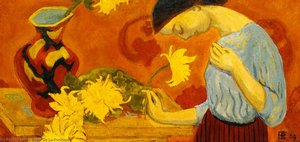
His education was classically based, prioritizing Latin and Greek alongside humanist studies—a curriculum designed to cultivate critical thinking and aesthetic discernment. This intellectual grounding prepared him for his formative years at the Académie Julian in Paris (1903-1904) and subsequently at the École des Beaux-Arts (1904-1908), where he encountered the pioneering figures of Maurice Denis and Paul Sérusier. These mentors instilled within him a deep appreciation for Symbolism—a movement characterized by its exploration of subjective experience, spiritual resonance, and evocative color palettes—influences that would become integral to his artistic vision. The profound impact of Sérusier’s teachings is particularly evident in his early works, notably *Woman with Chrysanthemums*, where the artist skillfully blends decorative patterns with dreamlike imagery, mirroring the Nabis aesthetic.The Embrace of Cubism and Geometric Abstraction
Around 1912, de La Fresnaye joined the Section d’Or—a collective of young artists passionately committed to the revolutionary ideas championed by Georges Braque and Pablo Picasso—marking a decisive turning point in his artistic journey. This engagement with Cubism propelled him beyond the confines of Impressionistic conventions, immersing him in the radical experimentation of geometric abstraction. Unlike some contemporaries who slavishly adhered to Cubist dogma, de La Fresnaye synthesized diverse influences—including German Expressionism and Delaunay’s Orphism—into a singular stylistic idiom. He skillfully manipulated color and line to create prismatic effects reminiscent of Delaunay's groundbreaking explorations, yet retained a grounding in classical form and proportion. His masterpiece, *The Conquest of the Air*, exemplifies this fusion of styles—a dynamic composition brimming with vibrant hues and fragmented shapes that captures both the spirit of Cubism and de La Fresnaye’s distinctive artistic sensibility.A Life Marked by War and Artistic Transformation
The outbreak of World War I profoundly impacted de La Fresnaye's life, compelling him to enlist in the French army despite his debilitating tuberculosis diagnosis. The physical hardships endured during wartime accelerated his illness, forcing his discharge in 1918 and irrevocably altering his artistic output. Abandoning the energetic dynamism of Cubist painting—a style born from the urgency of the era—he turned towards a more contemplative aesthetic, prioritizing form and color in a manner that reflected his personal struggles. His later canvases eschewed spatial analysis for linear precision and introspective observation—a stylistic shift indicative of an artist confronting mortality with unwavering artistic integrity.Legacy and Enduring Influence
Roger de La Fresnaye died November 27, 1925, at the young age of forty, leaving behind a remarkably prolific oeuvre that continues to inspire artists and scholars alike. His contribution to the development of modern art transcends mere stylistic innovation; it embodies a courageous embrace of artistic freedom—a willingness to explore uncharted territories while remaining rooted in tradition. De La Fresnaye’s paintings reside in prestigious museums across Europe, including the Musée d'Art Moderne de Troyes and the Centre Pompidou (Paris), guaranteeing his enduring presence within the canon of 20th-century art. The monumental sale of *The Conquest of the Air* at Christie’s in 2017—fetching over €2.3 million—served as a testament to his artistic merit and solidified his place among the most celebrated figures of his time. De La Fresnaye remains an artist whose work embodies both intellectual rigor and profound emotional depth, securing his legacy as a pioneer of geometric abstraction and a champion of humanist ideals.Questions et réponses
Existe-t-il une chronologie des œuvres de Roger de La Fresnaye ?
La page Chronologie des œuvres de l'artiste présente les œuvres de Roger de La Fresnaye classées par date, année par année.
Où puis-je voir toutes les œuvres de Roger de La Fresnaye ?
Chaque œuvre de Roger de La Fresnaye sur ce site web peut être consultée depuis la page Toutes les œuvres de l'artiste.
Puis-je parcourir les œuvres de Roger de La Fresnaye par technique ?
Les œuvres de Roger de La Fresnaye peuvent être consultées par technique sur la page Tous les médiums de l'artiste.