

Bivega je slika po kojoj je Victor Vasarely najpoznatiji. Quadrature i ORION-MC upotpunjuju triju najomiljenijih platnena djela. Naš katalog sadrži 776 djela umjetnika Victor Vasarely. Evo 100 najpoznatijih, s godinom nastanka, muzejom i pričanjom o svakom platnu.
Rangirano prema našoj ocjeni popularnosti, koja objedinjuje broj pretraživanja, posjeta i narudžbi za svako djelo. Ažurirano Listopad 2026.


Victor Vasarely's *Quadrature* isn't merely a painting; it’s an invitation – an invitation to question the very nature of visual reality. Created by a visionary who anticipated the digital age, this work embodies the core tenets of Op Art, a movement that sought to manipulate perception through carefully constructed geometric forms and vibrant color fields. Painted in 1960s, *Quadrature* showcases Vasarely’s mastery of optical illusion, transforming two dynamic spheres into…

Victor Vasarely's ORION-MC is not merely a painting; it’s an invitation to experience the world through a radically altered lens. This captivating work, rendered in a vibrant palette of red, yellow, green, blue, purple, orange, and black, exemplifies the core tenets of Op Art – Optical Art – pioneered by Vasarely himself. Born Károly Vaszary in 1906 in Pécs, Croatia, his artistic trajectory began with an unexpected detour into medicine…

The artwork titled Zebras (white on black) was created by the artist Victor Vasarely. This piece features two zebras positioned against a black background. The composition includes smaller figures of animals in the background, such as two birds and three additional zebras, which contribute to the depth of the image. The visual structure utilizes geometric shapes and patterns to form the figures.

Vega-Wa-3: A Dance of Geometric Illusion Victor Vasarely’s “Vega-Wa-3” stands as a testament to the revolutionary spirit of Op Art – Optical Art – and its profound influence on 20th-century visual culture. Painted in 1968, this striking artwork embodies Vasarely's meticulous approach to abstraction, transforming seemingly simple geometric forms into captivating illusions that challenge our perception of space and color. The canvas presents a mesmerizing interplay of red and white…

To stand before Victor Vasarely’s Kaglo II is to enter a realm where the boundaries between the static and the kinetic dissolve into a rhythmic dance of light and color. Created in 1986, this masterful print serves as a profound testament to the enduring power of geometric abstraction. At first glance, the eye is drawn to a central, commanding red sphere, which acts as the sun within a private cosmos.…

Victor Vasarely’s *Vega 1* isn't merely a painting; it’s an invitation. An invitation to step outside the confines of traditional representation and into a world governed by perception itself. Born in 1906 in Pécs, Croatia – then part of Austria-Hungary – Vasarely’s artistic trajectory was initially rooted in medicine before he decisively embraced the burgeoning field of visual abstraction. This pivotal shift, fueled by his studies at the Podolini-Volkmann Academy…

Victor Vasarely’s “NB 22 Caope” is more than just an abstract painting; it's a meticulously crafted portal into the heart of Op Art, a movement that sought to redefine our perception of reality. This striking work, dominated by a precisely arranged grid of black and white circles, exemplifies Vasarely’s pioneering approach to visual illusion – a technique he developed with mathematical rigor and an almost obsessive attention to detail. The…

To stand before a work by Victor Vasarely is not merely to observe paint on canvas; it is to engage in a sophisticated dialogue with perception itself. This piece, characterized by its vibrant, almost pulsating geometric network, draws the viewer into a mesmerizing optical labyrinth. It speaks directly to the intellectual curiosity of the modern collector and the design sensibility of those who appreciate art as an architectural element. The…

To stand before Harmas is to step directly into the mind of its creator, Victor Vasarely. This piece is not merely an arrangement of color and pattern; it is a vibrant intellectual puzzle, a visual meditation on structure itself. The eye is immediately drawn into the intricate dance between the bold red checks and the myriad small circles that populate the background. It possesses the undeniable energy characteristic of Op…

Victor Vasarely's Pal-Ket, painted in 1974, isn’t merely a visual experience; it’s an invitation to reconsider the very nature of perception. This vibrant acrylic on canvas piece, measuring…

Victor Vasarely's "Vonal-2" is more than just a colorful pattern; it’s a meticulously crafted portal into the heart of Op Art and a testament to the revolutionary ideas…

In this 1957 work, titled Vega II, Victor Vasarely explores the fundamental mechanics of sight. The piece is a purely abstract composition, eschewing any recognizable subject matter in…

To stand before Victor Vasarely's Axo 99 is not merely to observe a painting; it is to engage in a visual dialogue with the very mechanics of sight…

Victor Vasarely's “Abstract Composition 9” is more than just a painting; it’s an invitation to experience the world through the lens of perception itself. Created by one of…

The artwork titled Zebras was created by the artist Victor Vasarely. This piece, dated 1938, emerged from a period of intense graphic experimentation. It is considered one of…

To encounter Victor Vasarely’s Kezdi-Ga is to step away from the stillness of traditional viewing and enter a realm where the canvas breathes, pulses, and vibrates with an…

Victor Vasarely’s ‘SIR-RIS,’ a captivating sculpture rendered in meticulous black and white, stands as a cornerstone of Op Art – a movement that fundamentally challenged our understanding of…

To stand before Victor Vasarely’s "Torony-Nagy" is not merely to observe paint on canvas; it is to engage in a sophisticated dialogue with perception itself. This vibrant 1969…

Victor Vasarely's 'Quasar' is not merely a painting; it’s an invitation into the very fabric of perception, a testament to the revolutionary impact of Op Art and the…

To stand before Victor Vasarely's Zett-Ka is not merely to observe a painting; it is to step into a meticulously constructed optical puzzle. This masterful piece, a quintessential…

Victor Vasarely's "Vega-Kontosh-Va" is not merely a painting; it’s an invitation to experience the world through a radically altered lens. This vibrant composition, dominated by a pulsating red…

We are looking at Vèga 3, a significant work by the artist Victor Vasarely. Created about 1968, this piece belongs to the Op Art movement, a style that…

Victor Vasarely: Pionir Op Art i Demokratizacija Vizualnog Iskustva Victor Vasarely (1906–1997), rođen Károly Vaszary u Pécsu, gradu koji je tada bio smješten u Austrougarskoj (sad Hrvatska), nije…

Victor Vasarely (1906–1997) nije bio samo umjetnik; bio je filozof koji je promijenio način gledanja na svijet i umjetnost. Ovaj hrvatski umjetnik, iako rođen u Pécu, austrijske Monarhije,…

Sir-Ris B: A Geometric Symphony of Color and Illusion Victor Vasarely’s “SIR-RIS” is more than just a painting; it's an invitation into a realm where perception bends to…

In the realm of Op Art, few works capture the hypnotic essence of visual disruption as masterfully as Victor Vasarely’s Zebras (full body white on blue-black). This striking…

Victor Vasarely's "Kezdi-All," a captivating exploration of optical illusion and geometric abstraction, stands as a cornerstone of Op Art – a movement that fundamentally challenged our understanding of…

To stand before Harmas is to step directly into the mind of its creator, Victor Vasarely. This piece is not merely an arrangement of color and pattern; it…

To encounter Victor Vasarely’s 1951 masterpiece, “Terek,” is to step away from the static world of traditional representation and enter a realm where the canvas itself seems to…

To stand before this piece is to step through a portal built entirely of color and calculated form. It is an immediate confrontation with perception itself. The composition,…

To encounter Victor Vasarely's 'Folklore' is to step away from the stillness of traditional viewing and enter a realm where the canvas begins to breathe, pulse, and vibrate…

Victor Vasarely’s “O N D - I I - V A” is more than just a painting; it's an invitation to experience the world through a radically altered…

The artwork is a grid-based abstract composition dominated by concentric circles of varying sizes and shades of red and green. It presents a highly geometric and symmetrical design,…

Victor Vasarely's "F-VERT-BLEU" is not merely a puzzle; it’s a meticulously crafted portal into the heart of Op Art, a movement that fundamentally altered our perception of space…

Vonal-Lap: A Geometric Symphony of Color and Illusion Victor Vasarely’s “Vonal-Lap,” created in 1969, represents a pivotal moment in the trajectory of Op Art – a movement dedicated…

The painting Dia-Tuz-Neg is a blue and white composition characterized by a circular pattern. At the center of the work, a large circle is prominently featured, surrounded by…

Victor Vasarely’s “Caopeo” isn’t merely a painting; it’s an invitation, a carefully constructed illusion designed to challenge and delight the viewer. Created in 1962, this seminal work exemplifies…

Sorata-T is a painted glass triptych executed in 1953. The work is composed of three panels:

The artwork Triond features three colorful balls presented in various shades of blue, purple, pink, and green. These spheres are arranged in a triangular formation, with one ball…

Step closer to observe how the eye begins to move across the surface of Domb-B. At first glance, your attention is drawn to that central blue and yellow…

VP-115 by Victor Vasarely exists as a precise study in the mechanics of sight. The work operates through a calculated arrangement of geometric shapes, specifically a sphere and…

Victor Vasarely's 'Jong,' completed in 1968, is more than just an image; it’s an invitation to question the very nature of reality. This arresting work, a cornerstone of…

The artwork consists of four circles arranged in a square configuration. Each circle is assigned a specific color: blue, orange, yellow, and purple. These shapes are positioned at…

To encounter Victor Vasarely’s “Obor” is to step away from the stillness of traditional viewing and enter a realm where the canvas itself seems to breathe, pulse, and…

Viktor Vasarely (1906–1997) bio je jedan od najvažnijih umjetnika druge polovice 20. stoljeća, poznat po svom inovativnom pristupu umjetnosti koji je spojio geometrijske forme s principima psihološke percepcije…

A Dance of Circles on Crimson: Exploring Victor Vasarely's "Untitled 16" Victor Vasarely, a name synonymous with Op Art and kinetic abstraction, gifted the world a visual language…

Tridem K – A Geometric Revelation by Victor Vasarely Victor Vasarely (1906-1997) stands as an undisputed titan of Op Art, a movement that revolutionized visual perception in the…

The artwork Louisiana features a symmetrical, circular design composed of numerous small, overlapping circles in varying shades of red, orange, and brown. A blue grid subtly underlies the…

A Symphony of Geometry: Exploring Victor Vasarely's "Sikra-Z" Victor Vasarely, a name synonymous with Op Art and kinetic art, dedicated his life to unraveling the mysteries of perception…

Victor Vasarely predstavlja ključnu figuru u području Op Art-a i kinetičkog umjetništva. Njegov umjetnički put prelazio je tradicionalno slikanje hrabarom istraživanjem optičkih iluzija i stvaranjem dinamičnih vizualnih iskustava…

Victor Vasarely (1906 – 1997), hrvatski i francuski umjetnik, bio je jedan od najvažnijih predstavnika Op Art-a i kinetičke umjetnosti, pokreta koji je revolucionarno promijenio percepciju boja i…

Victor Vasarely’s “Quadrature ”X” stands as an emblem of Op Art, a movement that revolutionized visual perception in the mid-20th century. Born Károly Vaszary in Pécs, Croatia, in…

A Dance of Light and Geometry: Unveiling Victor Vasarely’s “Untitled 18” Victor Vasarely's "Untitled 18" isn’t merely a painting; it’s an invitation to step into a world where…

Victor Vasarely (1906 – 1997) pozostaje jednym z najbardziej rozpoznawalnych twórców XX wieku, postacią wyznacającą nowy kierunek sztuki abstrakcyjnej i filozofii wizualnego doświadczenia. Jego dzieła, szczególnie monumentalne kompozycje…

KALOTA T is an artwork created by the artist Victor Vasarely. Born in 1906 and passing away in 1997, the French/Hungarian artist developed a visual language centered on…

Victor Vasarely's "Sikra," painted in 1966, is more than just a colorful composition; it’s a meticulously crafted portal into the heart of Op Art and a testament to…

Victor Vasarely's "Dia-Or" is not merely a painting; it’s an invitation into the very fabric of perception. This captivating work, rendered in oil with meticulous attention to detail,…

To encounter Victor Vasarely's “Mahn” is to step into a realm where the canvas ceases to be a static surface and begins to breathe, pulse, and vibrate with…

Victor Vasarely (1906 – 1997), born Károly Vaszary in Pécs, Croatia, stands as a monumental figure in the history of art, particularly recognized for his groundbreaking contribution to…

To encounter Victor Vasarely’s Caribe Negatif is to step away from the stillness of traditional viewing and enter a realm where the canvas breathes, vibrates, and dances before…

To encounter Victor Vasarely's “Tomor” is to step away from the static world of traditional imagery and enter a realm where the canvas itself seems to breathe, pulse,…

Victor Vasarely's Rhombus-B is more than just a painting; it’s an invitation to question the very nature of visual perception. Created by one of the foremost figures in…

Victor Vasarely's "Sreeh" is more than just a painting; it’s an invitation into the heart of Op Art, a visual exploration of perception itself. This striking work, dominated…

Victor Vasarely's "Hetta," a deceptively simple composition of four vibrant circles – red, orange, green, and blue – is far more than just an abstract arrangement. It’s a…

Victor Vasarely's *Opus 2604* is not merely a painting; it’s an invitation to question the very nature of visual reality. This mesmerizing work, dominated by a vibrant blue…

This vibrant artwork, designated VY-47-C, is a captivating embodiment of Victor Vasarely's groundbreaking contributions to Op Art and his pioneering exploration of geometric abstraction. Executed with a masterful…

Eg – A Symphony of Geometric Illusion Victor Vasarely’s “EG” stands as a testament to the transformative power of geometric abstraction and the captivating allure of Op Art,…

Viktor Vasarely, jedan od najvažnijih umjetnika druge polovice 20. stoljeća, ostavio je nezaboravno naslijeđe u svijetu moderne umjetnosti – geometrijske abstrakcije koje su revolucionarno promijenile percepciju slike i…

Victor Vasarely's "Molnar" is more than just a painting; it’s an invitation into the mesmerizing world of Op Art, a realm where perception itself becomes the subject. This…

Victor Vasarely's Folkokta is more than just a colorful arrangement of squares; it’s a meticulously crafted portal into the heart of Op Art and a testament to the…

Victor Vasarely, jedan od najvažnijih umetnika druge polovine 20. века, био је човек koji je revolucionarno promenio način razmišljanja o umetnosti i percepciji stvarnosti svojim geometrijskim abstrakcijama koje…


Victor Vasarely's "Andromeda" isn't merely a painting; it’s an invitation into a realm where perception itself becomes the subject. This striking composition, dominated by a meticulously rendered geometric…

Planetary Folklore Participations No. 1 – Matematička Simfonija Vizualne Iluzije Victor Vasarely, francuski umjetnik rođen u Ugarskoj 1906., predstavlja jednu od najvažnijih figura Op Art-a i kinetičkog slikarstva,…
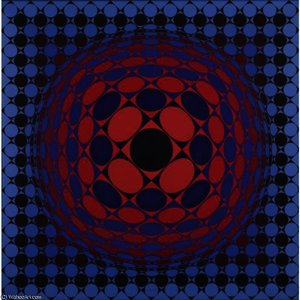
Victor Vasarely's "Versakk" is not merely a painting; it’s an invitation, a carefully constructed illusion that challenges our very perception of space and form. Created by the Hungarian…

Victor Vasarely's DVA-DVA is more than just a colorful square; it’s a meticulously crafted portal into the heart of Op Art and a testament to the revolutionary approach…

Victor Vasarelyjev je leta 1906. rodil se v Pécsu, mestu ki je bila tedaj še vedno v Avstrijski Evropi (sedanja Hrvaška), njegova pot do postanka pionira Op Art-a…

Viktor Vasarely (1906-1997), jedan od najvažnijih predstavnika Op Art umjetnosti, ostavio je nezaboravno naslijeđe koje se može pronaći u djelima poput “Koska Kara”. Ova fascinantna heliogravura iz godine…

Louisiana 3: A Symphony of Geometric Illusion Louisiana 3 predstavlja fascinant primjer opere Viktora Vasarelyja, umjetnika koji je revolucionarno promijenio pogled na umjetnost desetljeća nakon druge svjetske vojne.…

Koentoesh – A Geometric Dance of Color Victor Vasarely’s “Koentoesh” isn't merely a painting; it’s an invitation into a realm where perception bends and shapes itself according to…

To encounter Victor Vasarely’s Tridim is to step into a realm where the boundaries of the two-dimensional canvas dissolve, replaced by a pulsating, architectural depth that defies the…

Koska-Pint od Viktora Vasarelyja – Simfonija Geometrije i Svijet Boje Victor Vasarely je bio više nego umjetnik; bio je filozof koji je pokušao razumjeti samu prirodu percepcije i…


Victor Vasarely (1906-1997), a Hungarian-French artist, stands as an undeniable titan amongst the pioneers of Op Art – Optical Art – a movement that revolutionized visual perception in…

Victor Vasarely (1906.-1997.), ugarski francuski umjetnik, široko priznat kao „djed“ i vođa pokreta Op art-a, bio je jedan od najvažnijih umjetnika druge polovice 20. stoljeća koji je revolucionarno…

“MEH2,” a captivating work by Hungarian artist Victor Vasarely, is more than just a painting; it's an invitation to explore the very nature of visual perception. Executed in…

Victor Vasarely's Vega-Fel is not merely a painting; it’s an invitation to experience the world through a radically altered lens. This captivating work, dominated by a monumental blue…

Victor Vasarely's "Attam" is more than just a painting; it’s an invitation into the very heart of perception, a testament to the revolutionary impact of Op Art and…

To encounter Victor Vasarely’s “Sikra” is to step away from the stillness of traditional viewing and enter a realm where the canvas breathes, pulses, and vibrates with an…

Victor Vasarely's "Atelier Arcay" isn’t merely a painting; it’s an invitation to a perceptual adventure. Created in the heart of the Op Art movement, this vibrant geometric abstraction…

Pozorno gledanje na geometriju: Četrnaestokružni pejzaž Viktora Vasarelyja Četrnačetrokružni pejzaž Viktora Vasarelyja nije samo vizuelno impresivna kompozicija; predstavlja vrhunac Op Art pokreta koji je dominirao umjetničkim svijetom tijekom…

Victor Vasarely's Composition 7 is more than just a colorful painting; it’s a portal into the heart of Op Art and a testament to the revolutionary ideas of…

Victor Vasarely’s "Variációk" (Variations), created in 1989, is more than just an arrangement of circles; it's a vibrant exploration of perception and the underlying mathematical order that governs…

A Dance of Geometry and Color: Exploring Victor Vasarely's "Abstract Composition 13" Victor Vasarely, a name synonymous with Op Art and kinetic art, gifted the world a visual…

Victor Vasarely's Firaxo II is more than just a colorful textile; it’s a meticulously constructed portal into the heart of Op Art and a testament to the revolutionary…

A Symphony in Black: Exploring Victor Vasarely's Serigraph Victor Vasarely’s serigraphy in black is more than just an image; it’s an experience, a visual puzzle that invites the…

“Vonal-Fegn,” created by Victor Vasarely, is more than just an abstract painting; it's a meticulously crafted exploration of perception itself. Painted in hues of orange, yellow, blue, gray,…

Victor Vasarely's "Ouivar," a captivating exploration of geometric abstraction, invites the viewer into a world where perception itself becomes the subject. This artwork, characterized by its precisely arranged…

Victor Vasarely's "Abstract Composition 17" is more than just an image; it’s an invitation to experience the world anew. Born in 1906 in Pécs, Croatia – then part…
Četiri teme koje se najčešće pojavljuju na ovim platnima, svaka uz svoj najomiljeniji primjer.
3 muzeja u kojima se nalazi najviše djela s ove stranice.
| Muzej | Grad | Djela autora Victor Vasarely | Slike iz ovog popisa |
|---|---|---|---|
 Bechtler Museum of Modern Art |
Charlotte | 4 | NB 22 Caope, SIR-RIS, Tridem K |
 Inter-American Development Bank |
Washington, D.C. | 2 | Kaglo II |
 Muzej lijepih umjetnosti u Bilbauu |
Bilbao | 1 | Pal-Ket |
The artwork titled Zebras was created by the artist Victor Vasarely. This piece, dated 1938, emerged from a period of intense graphic experimentation. It is considered one of…
In this 1957 work, titled Vega II, Victor Vasarely explores the fundamental mechanics of sight. The piece is a purely abstract composition, eschewing any recognizable subject matter in…

Vega-Wa-3: A Dance of Geometric Illusion Victor Vasarely’s “Vega-Wa-3” stands as a testament to the revolutionary spirit of Op Art – Optical Art – and its profound influence…
Victor Vasarely's Pal-Ket, painted in 1974, isn’t merely a visual experience; it’s an invitation to reconsider the very nature of perception. This vibrant acrylic on canvas piece, measuring…

To stand before Victor Vasarely’s Kaglo II is to enter a realm where the boundaries between the static and the kinetic dissolve into a rhythmic dance of light…
Bivega, a zatim Quadrature i ORION-MC.
Bivega, Quadrature, ORION-MC, Zebras (white on black), Вега-ВА-3, Kaglo II, Vega 1, NB 22 Caope, Yon i Harmas. Svako platno u gornjem rangiranju sadrži godinu nastanka i naziv muzeja.
U našem katalogu nalazi se 776 djela umjetnika Victor Vasarely, datiranih od 1938 do 1986.
Većinom u Bechtler Museum of Modern Art (Charlotte), Inter-American Development Bank (Washington, D.C.) i Muzej lijepih umjetnosti u Bilbauu (Bilbao); gornji popis navodi svaki muzej i njegova platna.
U 1960s, koji obuhvaća 10 od ukupno 100 djela na ovoj stranici, među njima je i Вега-ВА-3.
Najstarije platno ovdje je iz Zebras (1938) godine; najnovije je iz Kaglo II (1986) godine.
Geometric abstraction (30), Visual perception (30) i Color field (28), kroz svih 100 djela na ovoj stranici.
Acrylic On Canvas, korišteno u 41 od 100 djela na ovoj stranici.
Optical art, kao što pokazuju platna na ovoj stranici.
Muzej Bechtler Museum of Modern Art, Charlotte posjeduje 3 djela s ove stranice, među kojima su i NB 22 Caope, SIR-RIS i Tridem K.
Rođen kao Károly Vaszary 9. travnja 1906. godine u Pécs-u, Mađarska, čovjek koji će kasnije postati poznat kao Victor Vasarely, započeo je svoj put u potpuno drukčijem području. Godine 1925. uputio se u hodnike Sveučilišta Eötvös Loránd u Budimpešti kako bi studirao medicinu. Logika ljudskog tijela i znanstveni pristup okupirali su njegovo vrijeme dvije godine, no privlačnost vizualnog izraza na kraju je prevagnula. Do 1927. godine, ostavio je medicinske studije iza sebe kako bi se posvetio proučavanju tradicionalne akademske slikarstva na Akademiji Podolini-Volkmann.
Njegova obuka nastavila se prelaskom u műhely Sándora Bortnyika. Ta je radionica bila mjesto gdje su se ukorijenili principi Bauhaus pokreta, fokusirajući se na presjek funkcionalnog dizajna i geometrijske apstrakcije. Ovdje se fokus pomaknuo prema strukturnom i sistematskom pristupu. Lekcije naučene u tim studijima pružile su temelj za njegova kasnija istraživanja o tome kako se oblici i boje interagiraju s oku.
Između 1929. i 1944. godine, Vasarely se usredotočio na grafički rad. Te je godine proveo eksperimentirajući s načinom na koji svjetlost i sjena komuniciraju s jednostavnim oblicima. Njegovo rano grafičko razdoblje izbacilo je djela poput Šahovnice (1935) i Girl-power (1934). Također je radio na djelu Zebras (Zebrice) 1937. godine. Ova djela odslikavaju rastuće zanimanje za to kako promatrač doživljava ravnu površinu. Odmaknuo se od tradicionalnog slikarstva prema strukturiranijem, grafičkom pristupu.
Od 1944. do 1947. godine, njegov smjer se promijenio. Prošao je kroz nekoliko stilova, uključujući kubističke, futurističke, ekspresionističke, simboličke i nadrealističke pristupe. Naposljetku je prevazišao te eksperimente, tražeći precizniji način za organizaciju prostora. Ta potraga za novom logikom dovela ga je do objave njegovog Žutog manifesta. Njegov rad prestao se baviti individualnim izražavanjem i počeo se usredotočivati na mehaniku vida. Taj je sistematični metod na kraju utvrdio njegov položaj kao lidera Op art pokreta.
Vasarelyjev pristup temelji se na sistematskoj upotrebi geometrije kako bi se potaknula fizička reakcija kod promatrača. Nije se oslanjao na tradicionalne izvore svjetlosti niti na klasični chiaroscuro kako bi oblikovao formu. Umjesto toga, koristio je sofisticiranu interakciju visokokontrastnih pigmenata kako bi simulirao dubinu i kretanje. Manipulacijom gustoćom boje mogao je zavarati oko, navodeći ga da na ravnoj površini perceives povlačenje i isticanje prostora. Ova metoda pretvara statičnu površinu u prostor koji kao da pulsira ili se udaljava od nas.
Njegova metoda, koju je nazivao vizualna kinetika ili plastique cinétique, uključuje precizno uređenje oblika. Koristio je teksturalne efekte, perspektivu, sjenu i svjetlost kako bi izgradio te iluzije. Rad često se oslanja na način na koji oko interpretira ritmičko, unutarnje zračenje, a ne na vanjsko osvjetljenje. Korištenjem mreža i matematičkih principa stvorio je osjećaj vizualne vibracije i vrtložnih efekata. Rezultat je osjećaj kretanja koji postoji isključivo unutar percepcije gledatelja.
Preciznost njegove tehnike očigledna je u načinu na koji upravlja bojom i linijom kako bi stvorio arhitektonsku dubinu. U djelima kao što je Torony-Nagy, presijecanje oštrih bijelih linija s dubokim plavim i smaragdno zelenim tonovima stvara ritmičku optičku vibraciju. Ti elementi rade zajedno kako bi proizveli dojam pulsirajućeg svjetla. Te je alate koristio kako bi nadmašio puku reprezentaciju, usredotočivši se umjesto toga na mehanizme samog procesa gledanja.
Godina 1937. bila je prekretnica kada je nastalo djelo Zebra, označavajući pomak prema onome što mnogi smatraju najranijim primjerima Op Art-a. To je djelo napustilo okvire tradicionalne reprezentacije, usredotočivši se umjesto toga na način na koji oko interpretira jednostavne oblike. Do 1960-ih, njegovi eksperimenti s ritmom i svjetlošću dosegli su svoj vrhunac u radu Torony-Nagy iz 1969. godine. Ovo remek-djelo koristi četiri stilizirana tornja i visoko kontrastnu paletu plavih, zelenih i narančastih tonova kako bi stvorilo osjećaj unutarnjeg sjaja. Kompozicija se oslanja na presijecanje bijelih linija i gustoću boje, čineći da ravna površina djeluje kao da pulsira i povlači se u dubinu.
Njegovo interesiranje za kretanje proširilo se na trodimenzionalni prostor i predmete svakodnevne upotrebe. Dizajnirao je Georges Pompidou, veliki kinematički objekt koji je integrirao njegove vizualne teorije u fizički, pokretni oblik. To stremljenje prema praktičnoj primjeni njegove geometrije dovelo je i do suradnje sa studijem Rosenthal Studio Linie. To partnerstvo rezultiralo je serijom posuđa Suomi, ograničenom serijom od 500 komada koja je njegove geometrijske uzorke unijela u intimu kućnog ambijenta.
Godine 1966., Victor Vasarely započeo je proces osnivanja Fondation Vasarelyja. Ovaj projekt bio je utemeljen na njegovim specifičnim idejama o konceptu " umjetnosti za sve" te njegovoj viziji "gradova sutra". Želio je stvoriti prostor koji nadilazi tradicionalno galerijsko iskustvo kako bi odrazio te principe. Fizička izgradnja zgrade započela je 1973. godine.
Fondacija je službeno inaugurirana 14. veljače 1976. u Aix-en-Provenceu, u Francuskoj. Prostor je osmišljen kako bi udomio njegova djela i promovirao njegove teorije o tome kako bi se umjetnost i urbanistički dizajn mogli međusobno prožimati. Sama arhitektura prostora bila je sastavni dio te vizije, pri čemu je raspored zgrade bio namijenjen poticanju načina na koji je javnost trebala doživjeti njegove geometrijske oblike.
Doseg njegovog vizualnog jezika protegao se daleko izvan zidova galerija. Njegovi uzorci i geometrijske strukture pronašli su put u teksture svakodnevnog života, utječući na linije mode, rasporede u dizajnu interijera i logiku grafičkog dizajna. Čak i rani razvoj kompjuterske grafike nosi otisak njegovog sistematičnog pristupa obliku i percepciji. Njegove ideje nisu bile ograničene samo na platno; one su proistekle u funkcionalni svijet predmeta i u digitalne strukture koje su uslijedile.
Godine 1982., njegova djela putovala su u svemir kada su serigrafi uključeni na let kozmičke letjelice Salyut 7, u suradnji Francuske i Sovjetskog Saveza. Taj trenutak naglasio je poveznicu između njegove matematičke preciznosti i šireg ljudskog nastojanja istraživanja nepoznatog. Victor Vasarely ostao je centralna figura moderne povijesti umjetnosti sve do svoje smrti u Parizu, u Francuskoj, 15. ožujka 1997. godine.
Praćenje fizičkog prisustva njegovog stvaralaštva zahtijeva putovanje kroz nekoliko lokacija u Francuskoj i Mađarskoj. U Aix-en-Provence-u u Francuskoj, Fondation Vasarely čuva značajan dio njegovog opusa. Ovaj muzej osnovao je sam umjetnik kako bi promovirao svoje ideje o umjetnosti dostupnoj svima. Prostor je organiziran u sedam šesterokutnih ćelija, od kojih svaka ima 14 metara širine i 11 metara visine, a dizajnirana je kako bi ugošćala četrdeset dva velika djela dimenzija 6 po 8 metara.
Njegova prisutnost u Mađarskoj također je izražena kroz posvećene prostore. Vasarely Museum nalazi se u Pécs-u, gradu njegovog rođenja. Također, postoji Vasarely Museum smješten u palači Zichy u Óbudi, u Budimpešti. Ove lokacije omogućuju izravan susret s geometrijskim oblicima i optičkim efektima koji su definirali njegov rad. U Francuskoj je još jedno mjesto za njegova djela Vasarely Museum u palači Saint-Firmin u Gordes-u.
Izvan ovih specifičnih muzeja, njegov utjecaj pronađen je u raznim institucionalnim kolekcijama. Neki od njegovih radova čuva Bilbao Fine Arts Museum, dok su drugi dio kolekcija Inter-American Development Bank u Washingtonu, D.C., te Bechtler Museum of Modern Art u Charlotteu. Ove razbacane lokacije osiguravaju da njegovi vizualni eksperimenti ostanu dostupni različitim publicama.


