Műterem — Ingyenes világszerte történő szállítás — Szállítás: 2–6 hét
      Donatello, 1386 – 1466

      Donatello: A 100 legismertebb festménye

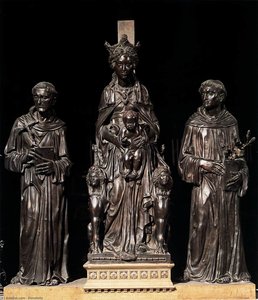
      Donatello összes festményei közül a Madonna and Child between St Francis and St Anthony (1448) a leghíresebb; a Basilica di Sant'Antonio múzeumában található, Padova városában. A közvetlen követőket Cantoria (1439) és Entombment (1447) alkotja. A Donatello katalógusában található 148 mű közül ezek a 100 a legelismertebbek, amelyeket dátummal, múzeummal és történetükkel mutatunk be.

      A rangsorolásunkat a népszerűségi pontszám határozza meg, amely az egyes művek kereséseit, látogatottságát és megrendeléseit ötvözi. Frissítve: október 2026. Az oldalon található festmények bármelyike vászonra vászatra festett olajfestmény-másolatként, vagy az Ön által választott méretben készült minőségi giclée nyomatként rendelhető meg.

      Donatello portréja
      Donatello · 1386 – 1466
      Született · meghalt
      1386 – 1466, Firenze
      Mozgalom
      Korai reneszánsz
      A katalógusban szereplő művek
      148
      Legnépszerűbb
      Madonna and Child between St Francis and St Anthony (1448)
      A legtöbb művel a
      Museo dell'Opera del Duomo

      Donatello 10 leghíresebb festménye

      Madonna and Child between St Francis and St Anthony (1448) szerzője Donatello
      1

      Madonna and Child between St Francis and St Anthony

      1448 · Bronze · Basilica di Sant'Antonio, Padova

      In the heart of the Italian Renaissance, where the shadows of antiquity met the burgeoning light of humanism, Donatello breathed life into metal with his masterpiece, Madonna and Child between St Francis and St Anthony. Created around 1448, this profound bronze sculpture serves as a window into a period of unparalleled spiritual and artistic transformation. The composition is a masterclass in symmetrical grace; at its center, the Virgin Mary cradles…

      Cantoria (1439) szerzője Donatello
      2

      Cantoria

      1439 · Marble · Museo dell'Opera del Duomo, Fiorence

      To stand before Donatello’s Cantoria is to witness the very moment the Renaissance found its pulse. Completed around 1439 for the Cathedral of Santa Maria del Fiore in Florence, this monumental marble relief is far more than a functional singers' gallery; it is a breathtaking explosion of movement and spiritual ecstasy. While much of the era’s sculpture remained tethered to the static, formal traditions of the Byzantine style, Donatello broke…

      Entombment (1447) szerzője Donatello
      3

      Entombment

      1447 · Oil On Canvas · Basilica di Sant'Antonio, Padova

      To stand before Donatello's depiction of the Entombment is to be enveloped in an atmosphere so thick with grief, it feels almost palpable. This scene transcends mere narrative illustration; it is a profound meditation on loss, sacrifice, and the solemn weight of human devotion. The composition draws the viewer into the immediate aftermath of unimaginable tragedy. Jesus Christ lies within the tomb, not merely as a subject, but as the…

      Miracle of the Repentant Son (1447) szerzője Donatello
      4

      Miracle of the Repentant Son

      1447 · Acrylic · Basilica di Sant'Antonio, Padova

      Donatello’s bronze sculpture, "Miracle of the Repentant Son," transcends mere representation; it's a profound meditation on faith, remorse, and divine grace. Created in 1447 during the apex of his artistic maturity, this work embodies the burgeoning humanism and emotional depth that defined the Early Renaissance in Florence. More than just a depiction of a biblical miracle – the restoration of a severed limb by St. Anthony – it’s a study…

      Crucifix (1412) szerzője Donatello
      5

      Crucifix

      1412 · Acrylic On Canvas · Santa Croce (Firenze), Firenze

      Donatello's 1412 Crucifix, housed within the Basilica of Santa Croce in Florence, isn’t merely a depiction of Christ on the cross; it’s a visceral experience. This early Renaissance masterpiece transcends simple representation, plunging the viewer into the heart of Christian theology and embodying the profound tension between suffering and redemption. Crafted from richly-toned pearwood, the sculpture immediately commands attention with its remarkably realistic portrayal of the human form – a…

      Annunciation (1435) szerzője Donatello
      6

      Annunciation

      1435 · Acrylic On Canvas · Santa Croce (Firenze), Firenze

      Donatello’s 1435 Annunciation, housed within the Basilica di Santa Croce in Florence, isn’t merely a depiction of a biblical moment; it’s a profound meditation on grace, humility, and the transformative power of faith. Commissioned during a pivotal period of artistic innovation – bridging the Gothic and Renaissance eras – this sculpture embodies Donatello's revolutionary approach to humanism and his masterful command of classical forms. The scene unfolds with an arresting…

      St George (detail) (1416) szerzője Donatello
      7

      St George (detail)

      1416 · Marble · Museo Nazionale del Bargello, Fiorence

      The marble figure of St. George, sculpted by Donatello around 1416, stands as more than just a depiction of a saint; it's a pivotal moment in the evolution of Renaissance sculpture – a testament to the artist’s innovative spirit and his profound understanding of human form and narrative. Originally gracing the north wall of Orsanmichele, Florence’s imposing guildhall, this statue immediately captivated viewers with its dynamic energy and strikingly realistic…

      Herod's Banquet (1427) szerzője Donatello
      8

      Herod's Banquet

      1427 · Bronze · Baptisterium, Siena

      Donatello's Herod’s Banquet, crafted around 1427 for the baptismal font of Siena’s San Giovanni Baptistery, isn’t merely a depiction of a biblical episode; it’s a profound meditation on power, betrayal, and the chilling consequences of unchecked ambition. Commissioned amidst the competitive fervor of Renaissance Florence and Siena, this bronze relief stands as a testament to Donatello's burgeoning mastery – a pivotal work that showcases his innovative approach to sculpture and…

      Bearded Prophet (1418) szerzője Donatello
      9

      Bearded Prophet

      1418 · Bronze · Museo dell'Opera del Duomo, Fiorence

      In the heart of the Florentine Renaissance, where the shadows of antiquity began to dance with the light of new humanism, Donatello breathed life into bronze with his Bearded Prophet. Created around 1418, this monumental figure is far more than a mere sculpture; it is a profound meditation on the weight of divine knowledge and the solemnity of faith. As one gazes upon the weathered surface of the bronze, there…

      St. John the Evangelist (1415) szerzője Donatello
      10

      St. John the Evangelist

      1415 · Marble

      St. John the Evangelist is a marble sculpture created by the artist Donatello. Dated 1410, this work depicts one of the twelve apostles of Jesus. The subject is rendered as an elderly man, presented with a face etched with lines and a gaze that suggests a state of contemplation and wisdom. This choice of representation presents the figure as a philosopher-like individual.

      Donatello festményei 11. helyezéstől 100. helyezésig

      St Mark (1411) szerzője Donatello
      #11

      St Mark

      1411 · Órsanmichele

      Within the echoing halls of Orsanmichele in Florence, stands Donatello's sculpture of St. Mark – more than just a depiction of a biblical figure; it is a profound…

      Prophet with Scroll (detail) (1418) szerzője Donatello
      #12

      Prophet with Scroll (detail)

      1418 · Museo dell'Opera del Duomo

      To stand before this detail of a prophet is to encounter a moment suspended in time—a profound echo from the heart of the Italian Renaissance. The marble itself,…

      St John on Patmos (1428) szerzője Donatello
      #13

      St John on Patmos

      1428

      The St John on Patmos painting, created by the renowned artist Donatello in 1428, is a stunning example of Renaissance art. This masterpiece is a testament to Donatello's…

      David (detail) (1409) szerzője Donatello
      #14

      David (detail)

      1409 · Museo Nazionale del Bargello

      To stand before this detail of Donatello's David is to encounter not merely a sculpture, but a profound meditation on nascent heroism. The marble seems to breathe with…

      Pietà (1447) szerzője Donatello
      #15

      Pietà

      1447 · Basilica di Sant'Antonio

      In the quiet sanctity of the Basilica di Sant’Antonio in Padua, there exists a moment frozen in bronze, a profound intersection of divine tragedy and human vulnerability. Donatello’s…

      Pulpit (on the right) (1465) szerzője Donatello
      #16

      Pulpit (on the right)

      1465 · San Lorenzo Bazilikája

      In the hallowed, sun-drenched silence of the Basilica of San Lorenzo in Florence, there exists a sculptural marvel that captures the very essence of a soul nearing its…

      Prophet Jeremiah (1423) szerzője Donatello
      #17

      Prophet Jeremiah

      1423 · Museo dell'Opera del Duomo

      To stand before Donatello’s Prophet Jeremiah is to encounter not merely carved stone, but the very weight of human contemplation. This marble masterpiece transports us into a moment…

      Prophet Habakkuk (1427) szerzője Donatello
      #18

      Prophet Habakkuk

      1427 · Museo dell'Opera del Duomo

      In the heart of Florence, within the hallowed halls of the Museo dell'Opera del Duomo, stands a figure that seems to breathe with the weight of centuries. Donatello’s…

      Pulpit (1438) szerzője Donatello
      #19

      Pulpit

      1438 · Museum of the Cathedral

      The Pulpit by Donatello emerged from the stone and the shared vision of a workshop. In 1438, the artist completed this marble structure, working alongside collaborators Michelozzo and…

      Miracle of the New-born Child (detail) (1447) szerzője Donatello
      #20

      Miracle of the New-born Child (detail)

      1447 · Basilica di Sant'Antonio

      This bronze detail captures an aged figure rendered with profound realism. The sculpture focuses on the upper torso and head, where deep wrinkles and facial contours convey experience…

      Miracle of the Ass (1447) szerzője Donatello
      #21

      Miracle of the Ass

      1447 · Basilica di Sant'Antonio

      In the heart of the Italian Renaissance, amidst the burgeoning humanism of Florence, Donatello breathed life into metal with his 1447 masterpiece, The Miracle of the Ass. This…

      Cantoria (detail) (1439) szerzője Donatello
      #22

      Cantoria (detail)

      1439 · Museo dell'Opera del Duomo

      The “Cantoria,” or Singing Gallery, crafted by the towering figure of Donatello between 1439 and 1440, isn't merely a decorative element within Florence’s Duomo; it’s an immersive experience,…

      Pulpit (detail) (1438) szerzője Donatello
      #24

      Pulpit (detail)

      1438 · Museo dell'Opera del Duomo

      To look closely at this detail from the pulpit is to witness a quiet revolution in stone. The marble figures emerge from their setting with a sense of…

      Christ before Pilate and Caiaphas (1460) szerzője Donatello
      #25

      Christ before Pilate and Caiaphas

      1460 · San Lorenzo Bazilikája

      Donatello's 1460 bronze sculpture, “Christ Before Pilate and Caiaphas,” stands as a monumental achievement within the burgeoning artistic landscape of the Italian Renaissance. Housed in the San Lorenzo…

      David (1409) szerzője Donatello
      #26

      David

      1409 · Museo Nazionale del Bargello

      To stand before Donatello’s David is not merely to observe a sculpture; it is to witness a suspended moment of profound human potential. Carved from luminous marble, this…

      St George and the Dragon (1416) szerzője Donatello
      #27

      St George and the Dragon

      1416 · Museo Nazionale del Bargello

      Gazing upon this marble bust is to confront a moment frozen in time—a powerful confluence of classical revivalism and raw human emotion. The subject, rendered with breathtaking verisimilitude,…

      Saint George (1417) szerzője Donatello
      #28

      Saint George

      1417 · Museo Nazionale del Bargello

      In the heart of Florence, where the echoes of the Quattrocento still resonate through the cobblestone streets, stands a figure of unparalleled poise and quiet strength. Donatello’s Saint…

      St John the Evangelist (detail) (1410) szerzője Donatello
      #29

      St John the Evangelist (detail)

      1410 · Museo dell'Opera del Duomo

      Donatello's “St John the Evangelist (detail),” a remarkably preserved marble sculpture created around 1410-1411, stands as a pivotal work in the transition from the late Gothic to the…

      St John the Evangelist (1410) szerzője Donatello
      #30

      St John the Evangelist

      1410 · Museo dell'Opera del Duomo

      St John the Evangelist is a marble sculpture created by the artist Donatello. The work is dated 1410. It depicts one of the twelve apostles of Jesus, specifically…

      Deposition (detail) (1465) szerzője Donatello
      #31

      Deposition (detail)

      1465 · San Lorenzo Bazilikája

      Donatello's Deposition, a pivotal work from 1465, isn’t merely a depiction of Christ being lowered from the cross; it’s a profound meditation on grief, loss, and the nascent…

      Készíttesse kézzel festve →
      North pulpit (1460) szerzője Donatello
      #33

      North pulpit

      1460 · San Lorenzo Bazilikája

      To stand before the North Pulpit is to witness a profound moment in the evolution of Western art, where the rigid structures of the Middle Ages began to…

      David (1430) szerzője Donatello
      #35

      David

      1430 · Museo Nazionale del Bargello

      Michelangelo’s “David,” a colossal marble sculpture residing within the Galleria dell’Accademia in Florence, isn't merely a depiction of a biblical hero; it’s an embodiment of human potential, a…

      Vidd ide a fényt a tédbe →
      Miracle of the Avaricious Man's Heart (1447) szerzője Donatello
      #37

      Miracle of the Avaricious Man's Heart

      1447 · Basilica di Sant'Antonio

      Within the hallowed, sun-drenched walls of the Basilica di Sant’Antonio in Padua, there exists a moment frozen in time, a bronze whisper of the divine captured by the…

      Allegoric Figure of a Boy (Atys), rear view (1430) szerzője Donatello
      #38

      Allegoric Figure of a Boy (Atys), rear view

      1430 · Museo Nazionale del Bargello

      To stand before an image evoking this bronze figure is to feel the very breath of the Renaissance wind against one's skin. This depiction, titled Allegoric Figure of…

      St George (detail) (1416) szerzője Donatello
      #39

      St George (detail)

      1416 · Museo Nazionale del Bargello

      In the heart of Florence, within the hallowed halls of the Museo Nazionale del Bargello, resides a fragment of eternal courage. Donatello’s St. George, specifically captured in this…

      Cantoria (detail) (1439) szerzője Donatello
      #40

      Cantoria (detail)

      1439 · Museo dell'Opera del Duomo

      In the heart of Florence, within the hallowed halls of the Museo dell’Opera del Duomo, lies a fragment of divine ecstasy known as the Cantoria. Created by the…

      Gattamelata lovas szobrára (1447) szerzője Donatello
      #41

      Gattamelata lovas szobrára

      1447 · Piazza del Santo

      A Padova városközpontában álló Szent Antóni Templom körében helyezkedő Donatello alkotása, Gattamelata Ünnemi Könyörkönyve egy igazán különleges műalkotás. Ez a középkortól kezdődően elveszett nagy teljesítményű bronzszobrászat volt –…

      Vidd ide a fényt a tédbe →
      Marzocco (1419) szerzője Donatello
      #43

      Marzocco

      1419 · Museo Nazionale del Bargello

      In the heart of the Renaissance, amidst the political tremors and cultural rebirth of 15th-century Florence, Donatello breathed life into stone to create one of the city's most…

      Prophet Jeremiah (detail) (1423) szerzője Donatello
      #44

      Prophet Jeremiah (detail)

      1423 · Museo dell'Opera del Duomo

      Donatello's “Prophet Jeremiah (detail),” a poignant study carved from pristine white marble around 1423-1427, transcends mere portraiture to become a profound meditation on faith, suffering, and the weight…

      Rendelje meg ezt a vászonat →
      Cantoria (detail) (1439) szerzője Donatello
      #45

      Cantoria (detail)

      1439 · Museo dell'Opera del Duomo

      Donatello's "Cantoria," a breathtaking detail from the larger marble relief adorning the south sacristy doors of the Duomo in Florence, isn’t merely a sculpture; it’s a vibrant snapshot…

      Rendelje meg ezt a vászonat →
      Herod's Banquet (detail) (1427) szerzője Donatello
      #46

      Herod's Banquet (detail)

      1427 · Baptisterium

      In the hallowed, quiet corridors of the Siena Baptistery, there exists a moment frozen in time, captured not in paint, but in the enduring strength of bronze. Donatello’s…

      Miracle of the Avaricious Man's Heart (detail) (1447) szerzője Donatello
      #47

      Miracle of the Avaricious Man's Heart (detail)

      1447 · Basilica di Sant'Antonio

      The Miracle of the Avaricious Man's Heart is a remarkable bronze relief created by the renowned Italian artist Donatello in 1447. This stunning work of art is located…

      Bearded Prophet (detail) (1418) szerzője Donatello
      #48

      Bearded Prophet (detail)

      1418 · Museo dell'Opera del Duomo

      Donatello's "Bearded Prophet" – often referred to as “Pensieroso,” meaning “the Thinker” – stands not merely as a sculpture, but as a profound meditation on humanity’s relationship with…

      Cantoria (detail) (1439) szerzője Donatello
      #49

      Cantoria (detail)

      1439 · Museo dell'Opera del Duomo

      Donatello's Cantoria, a breathtaking marble relief sculpture from the Duomo di Firenze (Florence Cathedral), isn’t merely a decorative element; it’s a vibrant snapshot of Renaissance ambition and artistic…

      Készíttesse kézzel festve →
      Prophet Jeremiah (1423) szerzője Donatello
      #50

      Prophet Jeremiah

      1423 · Museo dell'Opera del Duomo

      Prophet Jeremiah is a marble sculpture created by the artist Donatello. Dated 1423, the work represents a significant religious subject through the depiction of the biblical prophet. The…

      South pulpit (1460) szerzője Donatello
      #51

      South pulpit

      1460 · San Lorenzo Bazilikája

      Donatello’s Passion Pulpit, a monumental bronze ensemble housed within the Basilica of San Lorenzo in Florence, isn’t merely a religious depiction; it’s a visceral embodiment of the artist’s…

      Rendelje meg ezt a vászonat →
      Deposition (1465) szerzője Donatello
      #52

      Deposition

      1465 · San Lorenzo Bazilikája

      Donatello's Deposition, completed in 1465, isn’t merely a sculpture; it’s a profound meditation on loss, faith, and the raw vulnerability of humanity. Carved from rich, burnished bronze –…

      St George (1416) szerzője Donatello
      #53

      St George

      1416 · Museo Nazionale del Bargello

      Donatello’s “St. George,” sculpted in 1416 for the Museo Nazionale del Bargello in Florence, isn’t merely a depiction of a biblical hero; it’s a potent distillation of Renaissance…

      Cantoria (1439) szerzője Donatello
      #54

      Cantoria

      1439 · Museo dell'Opera del Duomo

      Within the hallowed halls of the Museo dell'Opera del Duomo in Florence resides a sculpture that transcends mere stone and marble – it is an embodiment of Renaissance…

      Faith (1427) szerzője Donatello
      #55

      Faith

      1427 · Baptisterium

      Donatello's "Faith," crafted in bronze around 1427-1429 for the baptismal font within Siena Cathedral, stands as a pivotal work bridging the late Gothic and burgeoning Early Renaissance styles.…

      Old Sacristy (1428) szerzője Donatello
      #56

      Old Sacristy

      1428 · San Lorenzo Bazilikája

      To step into the Old Sacristy within the Basilica of San Lorenzo is to leave the chaotic bustle of Florence behind and enter a realm of profound mathematical…

      Annunciation (detail) (1435) szerzője Donatello
      #57

      Annunciation (detail)

      1435 · Santa Croce (Firenze)

      Donatello's "Annunciation," specifically this exquisite detail from the relief adorning the Cavalcanti Chapel in Santa Croce, Florence, stands as a pivotal moment in the burgeoning Renaissance. Crafted around…

      Rendelje meg ezt a vászonat →
      Pulpit (on the left) (1465) szerzője Donatello
      #58

      Pulpit (on the left)

      1465 · San Lorenzo Bazilikája

      Within the serene confines of San Lorenzo church in Florence resides a sculpture that transcends mere marble; it is a profound meditation on faith, humanity, and the very…

      Rendelje meg ezt a vászonat →
      Prophet with Scroll (1418) szerzője Donatello
      #59

      Prophet with Scroll

      1418 · Museo dell'Opera del Duomo

      Donatello’s “Prophet with Scroll,” crafted between 1415 and 1418, stands as a pivotal work in the burgeoning Early Renaissance of Florence. More than simply a depiction of biblical…

      St John the Evangelist (1410) szerzője Donatello
      #60

      St John the Evangelist

      1410 · Museo dell'Opera del Duomo

      Donatello’s “St John the Evangelist,” completed between 1410 and 1411, isn't merely a sculpture; it’s an invitation into a realm of contemplative grace. Carved from pristine white marble,…

      Vidd ide a fényt a tédbe →
      Prophet Habakkuk (1427) szerzője Donatello
      #61

      Prophet Habakkuk

      1427 · Museo dell'Opera del Duomo

      In the hallowed, sun-drenched halls of the Museo dell'Opera del Duomo in Florence, there exists a figure that seems to breathe with the heavy weight of centuries. Donatello’s…

      Entombment (1465) szerzője Donatello
      #62

      Entombment

      1465 · San Lorenzo Bazilikája

      Donatello's “Entombment,” completed around 1465 in Florence, stands as a monumental achievement within the Early Renaissance—a sculpture that transcends mere representation to embody profound human emotion and theological…

      Cantoria (9) (1439) szerzője Donatello
      #63

      Cantoria (9)

      1439 · Museo dell'Opera del Duomo

      Donatello's "Cantoria," completed in 1439 for the Duomo of Florence, isn’t merely a decorative element; it’s a vibrant embodiment of Renaissance ideals – a testament to human ingenuity,…

      Vidd ide a fényt a tédbe →
      Lamentation over the Dead Christ szerzője Donatello
      #64

      Lamentation over the Dead Christ

      Victoria and Albert Museum

      Donatello, one of the most influential artists of the Italian Renaissance, created the Lamentation Over The Dead Christ around 1455-1460. This remarkable bronze relief is currently housed in…

      St George (1416) szerzője Donatello
      #65

      St George

      1416 · Museo Nazionale del Bargello

      Donatello's *Saint George*, sculpted in 1416 during the nascent Renaissance, is more than just a marble statue; it’s a potent distillation of classical ideals interwoven with burgeoning humanist…

      St John the Baptist (1438) szerzője Donatello
      #66

      St John the Baptist

      1438 · Santa Maria Gloriosa dei Frari

      Donatello’s “St. John the Baptist,” sculpted around 1438 in Carrara marble and now residing within the serene Chapel of St. John the Baptist at Santa Maria Gloriosa dei…

      Rendelje meg ezt a vászonat →
      Chellini Madonna, verso szerzője Donatello
      #68

      Chellini Madonna, verso

      Victoria and Albert Museum

      Donatello's "Chellini Madonna," a bronze relief cast in the mid-15th century, stands as a remarkably intimate and profoundly moving work within the artist’s oeuvre. More than simply a…

      St Cosmas and St Damian (1428) szerzője Donatello
      #69

      St Cosmas and St Damian

      1428

      Two figures emerge from an ornate stone backdrop, their presence defined by a quiet, shared intensity. These men, identified as the twin saints Cosmas and Damian, are positioned…

      St Mary Magdalen (1457) szerzője Donatello
      #70

      St Mary Magdalen

      1457 · Museo dell'Opera del Duomo

      St Mary Magdalen is a sculptural work created by the Italian Renaissance sculptor Donatello. This figure is slightly larger than life size and was originally made for the…

      Bust of Niccolo da Uzzano (1430) szerzője Donatello
      #71

      Bust of Niccolo da Uzzano

      1430 · Museo Nazionale del Bargello

      Donatello's 1430s marble bust of Niccolò da Uzzano is more than just a sculpted likeness; it’s a profound meditation on leadership, duty, and the quiet strength required to…

      Crucifixion (1465) szerzője Donatello
      #72

      Crucifixion

      1465 · Museo Nazionale del Bargello

      A Moment Frozen in Time: Donatello’s Crucifixion The bronze sculpture “Crucifixion” by Donatello stands as an enduring testament to the artistic fervor of the Florentine Renaissance, capturing not…

      Prophet Habbakuk (1426) szerzője Donatello
      #74

      Prophet Habbakuk

      1426

      To stand before this marble figure is to encounter a man caught in a moment of profound spiritual tension. Created between 1423 and 1426, this sculpture of the…

      The Feast of Herod (1427) szerzője Donatello
      #75

      The Feast of Herod

      1427

      The air in the room feels heavy, thick with the tension of a moment that refuses to pass. Around a central banquet table, figures are caught in a…

      St Stephen and St Lawrence (1428) szerzője Donatello
      #76

      St Stephen and St Lawrence

      1428

      The artwork presents two figures positioned within a recessed, arched niche. These figures are rendered in a relief sculpture technique, where the forms emerge from a flat plane…

      Evangelist Mark (1428) szerzője Donatello
      #77

      Evangelist Mark

      1428

      This high-relief marble sculpture captures a moment of quiet scholarly devotion. Within an oval frame, the figure of the Evangelist is seated at a writing desk, his attention…

      Pulpit (1438) szerzője Donatello
      #79

      Pulpit

      1438 · Cathedral

      A Masterpiece of Renaissance Sculpture: Donatello's Marble Pulpit Donatello’s marble pulpit, created in 1438 for the Church of San Lorenzo in Florence, stands as a pivotal work within…

      Készíttesse kézzel festve →
      Agony in the Garden (1465) szerzője Donatello
      #80

      Agony in the Garden

      1465 · San Lorenzo Bazilikája

      Giovanni Bellini's "Agony in the Garden," housed within the venerable halls of the National Gallery, London, isn’t merely a depiction of a biblical scene; it’s a profound meditation…

      Készíttesse kézzel festve →
      Funeral Monument to John XXIII (detail) (1435) szerzője Donatello
      #81

      Funeral Monument to John XXIII (detail)

      1435 · Baptistery of San Giovanni

      The Funeral Monument to John XXIII (detail) is a work by the sculptor Donatello. This specific fragment captures a moment of stillness within a larger funerary structure. It…

      Chellini Madonna, recto szerzője Donatello
      #82

      Chellini Madonna, recto

      Victoria and Albert Museum

      To gaze upon the Chellini Madonna is to step into the very heart of the Florentine Renaissance, where the divine and the human intersect through the masterful hands…

      Hope (1427) szerzője Donatello
      #83

      Hope

      1427 · Baptisterium

      Within the quiet, hallowed space of the Baptistery of San Giovanni in the Siena Cathedral, a figure emerges from the shadows of a shallow marble niche. This is…

      St Mark (1411) szerzője Donatello
      #84

      St Mark

      1411 · Órsanmichele

      In the Orsanmichele of Florence, a marble figure of St Mark emerges from its Gothic niche, marking a departure from the rigid traditions of the Middle Ages. Created…

      St Rossore (1425) szerzője Donatello
      #86

      St Rossore

      1425 · Museo Nazionale di San Matteo

      In the quiet presence of Donatello’s St Rossore, one does not merely observe a sculpture; one encounters a profound dialogue between the earthly and the divine. Created around…

      Musician Angels (1447) szerzője Donatello
      #90

      Musician Angels

      1447 · Basilica di Sant'Antonio

      In the hallowed stillness of the Basilica of Saint Anthony in Padua, there exists a moment where time seems to suspend itself, captured forever in the shimmering bronze…

      Donatello vászonai, korszakonként

      Amit Donatello a legtöbbször festett

      A négy leggyakoribb motívum ezen a vásznon, mindegyik a legkedvesebb példájával.

      Hol kirakott Donatello vászonai

      A 8 olyan múzeum, amely a legtöbb ezen az oldalon szereplő festményet őrzi.

      Múzeumok Város Donatello művei Ebből a listából származó festmények
      Museo dell'Opera del Duomo, FiorenceMuseo dell'Opera del Duomo Fiorence 22 Cantoria, Bearded Prophet, Prophet with Scroll (detail)
      Museo Nazionale del Bargello, FiorenceMuseo Nazionale del Bargello Fiorence 13 St George (detail), David (detail), David
      Basilica di Sant'Antonio, PadovaBasilica di Sant'Antonio Padova 12 Madonna and Child between St Francis and St Anthony, Entombment, Miracle of the Repentant Son
      San Lorenzo Bazilikája, FlorenciaSan Lorenzo Bazilikája Florencia 12 Pulpit (on the right), Christ before Pilate and Caiaphas, Deposition (detail)
      Piazza del Santo, PadovaPiazza del Santo Padova 6 Equestrian Statue of Gattamelata (8), Gattamelata lovas szobrára, Equestrian Statue of Gattamelata
      Baptisterium, SienaBaptisterium Siena 4 Herod's Banquet, Herod's Banquet (detail), Faith
      Baptistery of San Giovanni, FlorenciaBaptistery of San Giovanni Florencia 4 Funeral Monument to John XXIII (detail), Funeral Monument to John XXIII (detail), Funeral Monument to John XXIII (detail)
      Santa Croce (Firenze), FirenzeSanta Croce (Firenze) Firenze 3 Crucifix, Annunciation, Annunciation (detail)

      Évezredenként: Donatello legmeghnomvábált vászonműve

      1. 1400s
        David (detail) (1409) szerzője Donatello
        14 / 100

        David (detail)

        Kor: 14 – 23 év · Museo Nazionale del Bargello

        To stand before this detail of Donatello's David is to encounter not merely a sculpture, but a profound meditation on nascent heroism. The marble seems to breathe with…

      2. 1410s
        Crucifix (1412) szerzője Donatello
        5 / 100 vászon

        Crucifix

        Kor: 24 – 33 év · Santa Croce (Firenze)

        Donatello's 1412 Crucifix, housed within the Basilica of Santa Croce in Florence, isn’t merely a depiction of Christ on the cross; it’s a visceral experience. This early Renaissance…

      3. 1420s
        Herod's Banquet (1427) szerzője Donatello
        8 / 100

        Herod's Banquet

        Kor: 34 – 43 év · Baptisterium

        Donatello's Herod’s Banquet, crafted around 1427 for the baptismal font of Siena’s San Giovanni Baptistery, isn’t merely a depiction of a biblical episode; it’s a profound meditation on…

      4. 1430s
        Cantoria (1439) szerzője Donatello
        2. hely 100 közül

        Cantoria

        Kor: 44 – 53 év · Museo dell'Opera del Duomo

        To stand before Donatello’s Cantoria is to witness the very moment the Renaissance found its pulse. Completed around 1439 for the Cathedral of Santa Maria del Fiore in…

      5. 1440s
        Madonna and Child between St Francis and St Anthony (1448) szerzője Donatello
        1 / 100

        Madonna and Child between St Francis and St Anthony

        Kor: 54 – 63 év · Basilica di Sant'Antonio

        In the heart of the Italian Renaissance, where the shadows of antiquity met the burgeoning light of humanism, Donatello breathed life into metal with his masterpiece, Madonna and…

      6. 1450s
        St Mary Magdalen (1457) szerzője Donatello
        70 / 100

        St Mary Magdalen

        Kor: 64 – 73 év · Museo dell'Opera del Duomo

        St Mary Magdalen is a sculptural work created by the Italian Renaissance sculptor Donatello. This figure is slightly larger than life size and was originally made for the…

      7. 1460s
        Pulpit (on the right) (1465) szerzője Donatello
        16 / 100 vászon

        Pulpit (on the right)

        Kor: 74 – 80 év · San Lorenzo Bazilikája

        In the hallowed, sun-drenched silence of the Basilica of San Lorenzo in Florence, there exists a sculptural marvel that captures the very essence of a soul nearing its…

      Válaszok Donatello festményeivel kapcsolatos kérdéseire

      Melyik Donatello leghíresebb festménye?Olvassda el a választ

      Madonna and Child between St Francis and St Anthony (1448), Basilica di Sant'Antonio, Padova. Utánuk Cantoria (1439) és Entombment (1447) következik.

      Hány éves volt Donatello, amikor Madonna and Child between St Francis and St Anthony készült?Olvassda el a választ

      Donatello, aki 1386 évfolyamán született, 62 éves volt: Madonna and Child between St Francis and St Anthony 1448 származik.

      Melyik tíz festményével a leghíresebb Donatello?Olvassda el a választ

      Madonna and Child between St Francis and St Anthony, Cantoria, Entombment, Miracle of the Repentant Son, Crucifix, Annunciation, St George (detail), Herod's Banquet, Bearded Prophet és St. John the Evangelist. A rangsorban szereplő vászlakok mindegyike tartalmazza a festvény évszámát és a kiállító múzeumát is.

      Hány ismert festménye van Donatello művésznek?Olvassda el a választ

      148 műve Donatello alkotása a katalógusunkban, 1406 és 1465 között.

      Mely múzeumokban található Donatello leghíresebb vászonműve?Olvassda el a választ

      Leginkább Museo dell'Opera del Duomo (Fiorence), Museo Nazionale del Bargello (Fiorence) és Basilica di Sant'Antonio (Padova) helyszíneken; a fenti lista tartalmazza az egyes múzeumokat és a hozzájuk tartozó vászonműveket.

      Mely években festette Donatello leghíresebb vásznényeit?Olvassda el a választ

      1430s időszakban, amely ezen az oldalon található 100 mű közül 22 alkotással szerepel, Cantoria a válogatásban.

      Melyek Donatello híres vásznalai közül az első és az utolsó?Olvassda el a választ

      A legkorábbi vászon itt: Prophet (left of the Porta della Mandorla) (1406); a legutóbb pedig: Pulpit (on the right) (1465).

      Mely témakörök jelennek meg leggyakrabban Donatello festményeiben?Olvassda el a választ

      Renaissance (47), Sculpture (36) és Marble (18), a jelen oldalon található 100 műművészeti alkotás között.

      Milyen anyagokkal festett Donatello általában?Olvassda el a választ

      Marble, amely 30 darabban szerepel a ?>"> 100 műből ezen az oldalon.

      Mely művészeti irányba tartozik Donatello?Olvassda el a választ

      Korai reneszánsz, ahogy azt ezen az oldalon látható vásznemek is mutatják.

      Mit láthatok Donatello műveit a Museo dell'Opera del Duomo kiállتományában?Olvassda el a választ

      A Museo dell'Opera del Duomo, Fiorence 21 műve közül rendelkezik ezen az oldalon, köztük ezekkel: Cantoria, Bearded Prophet és Prophet with Scroll (detail).

      Megrendelhetek egy kézzel festett másolatot Donatello festményéről?Olvassda el a választ

      Igen. Az oldalon található minden festmény megrendelhető a saját oldalán, kézzel festett olajfestmény-másolatként vagy minőségi giclée nyomtatásként, a választott méretben.

      Donatello: a festő története

      Donatello életútja és identitása

      Donato di Niccolò di Betto Bardi néven született, a férfi, akiket a történelem Donatello névvel emlékezik, életét Olaszország, Firenze falai között töltötte. Körülbelül 1386-ban érkezett el e világra, egy olyan korszakban, amikor a város már elkezdte újraformálni saját arcát a kőből és a bronzból.

      Pillantása folyamatosan jelen volt a florentin tájban, amelyet egy stabil kéz és a műszaki témái fizikai valóságára való fókuszáltság jelzett. Ő volt az az olasz reneszánsz szobrász, aki mélyen értette anyagai súlyát, a mármol kőkeményiségétől kezdve a viasz folyékony lágyságáig.

      Művészete nem a tökéletesség egyedülálló, szigetelt törekvése volt, hanem a korának szükségire adott válaszok sorozata. Átjárta a florentin utcákat, különféle anyagokban alkotva hagyott maga után egy olyan alakok sorozatát, amelyek egy-egy egyedi, emberi jelenlétet foglalnak le. Bár híres volt barátságos természetéről és a környezetén lévők körében nagy volt a népszerűsége, megküzdött a vállalkozásvezetés gyakorlati nehézségeivel is. Gyakran vállalt több munkát, mint amit keze időben el tudott végezni, néha másokat hagyva a végső finomításokra, vagy későebben átadva a darabokat a tervezettnél. Ez a túlzott elköteleződés arra utal, hogy inkább a teremtés folyamata foglalkoztatta, mintsem egy műhely menedzselése.

      Donatello 1466. december 13-án hunyt el Firenzében. Olyan műveket hagyott hátra, amelyek megváltoztatták a szobrászok emberi formához való viszonyulását, távolodva a múlt merev hagyományaitól valami földibb és kifejezőbb irányba. Élete szorosan összefonódott a várossal, identitása pedig elválaszthatatlan marad a florentin földtől, ahol élt és alkotott.

      Korai évei és művészi oktatása

      Donatello az olaszországi Firenze születési helyén, egy olyan városban keleskedett fel, amely a fejlődő reneszánsz elsődöntő központja volt. Ez a környezet biztosította számára azt a nélkülözhetetlen kulturális energiát, amely alapjaiban formálta fejlődését. Korai éveit a helyi légtüdőben töltötte, ahol a merev középkori hagyományoktól való elmozdulás már érezhető volt. Kapcsolódása a florentin tájhoz mély volt, hiszen a város folyamatosan változó értékei határozték meg korai szemléletmódját a formákhoz és a alakokhoz való viszonyulásában.

      Művészi oktatása a klasszikus szobrászat alapos tanulmányozásából állt. Az antikváitás iránti érdeklődés segítette őt abban, hogy egy olyan új stílus felé terelődjen, amely a realizmust és az emberismét megtestesítő humanizmust plaatja a középpontba. Mielőtt megtalálta volna saját hangját, a nemzetközi gótikus stílust Lorenzo Ghiberti}$-től tanulta meg. Ez a tanulási időszak lehetővé tette számára, hogy mesteri szinten sajátítsa el ipmárt, mielőtt elkezdené eltérni a már etablált hagyományoktól. Számos különböző anyaggal dolgozott, beleértve a követ, a bronzt, a fát, a agyagot, a stukkót és a viaszt, gyakran alkalmazva az üveget is különleges, találmálatos módon a specifikus hatások elérése érdekében.

      Mecénások, műhely és megbízások

      Donatello kezei gyakran elfoglaltságban voltak. Olyan szokása volt, hogy több munkát vállalt, mint amennyit az időrendje megengedett, ami néha azt eredményezte, hogy projektjei késve készültek el, vagy másokra bízták a befejezésüket. Ez a hatalmas munkavégzés állandó jelenlétet igényelt a műhelyében, ahol számos segédjével együtt alkotott. Stúdiója számára négy fő a tipikus létszám volt, akik segítettek neki kezelni a kő, a bronz és a agyag fizikai kihívásait.

      A Medici család folyamatos támogatást nyújtott neki, olyan mecenatüst, amely lehetővé tette, hogy életének különböző szakaszait szabadon, a művészetre összpontosulva töltse.

      Művészeti hatása messze túlnyúlt a firenzei utcák határain; Rómába, Paduára és Sienára utazott, hogy újabb megbízásokat teljesítsen. Ez a városok közötti mozgás azt jelentette, hogy művészete soha nem volt egyetlen helyhez kötve, hiszen módszereit és segédjeit is magával vitte a különböző művészeti központokba.

      Innovatív technikák és művészeti stílus

      Donatello szobrászati megközelítése radikálisan megtörte az International Gothic stílus merev hagyományait. Egy olyan korai reneszánsz stílust fejlesztett ki, amely az újfajta realizizmus mellett döntött, melyet gyakran a testalkat mélyreható megismerésével és a fény felületi játékának bbművészes ábrázolásával érelt el. Nem korlátozódott egyetlen anyagra; művészete a kő, a bronz, a fa, a agyag, a stukkó és a viasz sokszínű világában játszott, s még az üveget is találmas módon alkalmazta, hogy különleges részletességet kölcsönözhessen szobrai alakjának.

      Művészetének egyik legkiemelkedőbb technikai hozzájárgolása a rilievo stiacciato fejlesztése volt. Ez egy rendkívül sekély domborzat, amelynek a metszése olyan finom, hogy a vastagság apró változatai mélységvágyú illúziót szülnek. Ezzel a módszerrel képes volt a szinte sík felületen is sugallni a perspektívát és a távolságot. Műveiben gyakran érezhető a feszültség az anyag fizikai súlya és a motívum expresszív mozgása között; képes volt a mármoltot a bőr puhaságára emelni, vagy a bronznak nehéz, izzadt, izzogó energiát infúzni.

      • David (bronz)
      • Gattamelata lovasszobor
      • Szent György (mármor)

      A szobrászat legfontosabb remekművei

      1416-ban Donatello befejezte a Szent Györgyöt, egy márvárból készült alakot, amely a szilárd bátorság érzését öli meg. A szobor egy páncélba öltözött lovast ábrázol, aki nem a hagyományos contrapposto állásmódban, hanem az ujjhegyein egyensúlyoz, szinte feszült mozgásban. A kő felszín alatt érezhető az izmok folyamatos feszülése és a test dinamikája. Ez a művészeti alkotás számos olyan darab része volt, amelyet a firenzei céhek encomendazték az Orsanmichele templom külső niccai díszítésére.

      Bronz David alakja a szobrászat történetének egyik legmeghatározóbb pontja marad. Ez az első szabadonálló, meztelencs férfi szobor az antik kor óta. A alak rejtélyes mosolyt visel, miközben egy lába a levetett Goljat fején nyugszik. Bár a témaválasztás márvorból készült változata egy korai megbízás volt, a bronz változat a finom, androgün testalkatával és azzal a kontrasztos viszonyulattal hívja fel a figyelmet, ahogy a fiú meztelensége szembeáll a kezében lévő nehéz karddal.

      Karrierje később szakaszában a művész új anyagokhoz és monumentálisabb skálákhoz vonzódott. Az 1453-ben megalkotott Gattamelata lovasszobra egy hatalmas bronz alkotás, amely Páduában áll. Körülbelül 1440 körül pedig a Bűnbánó Magdolnát hozta létre, amely fehér nyírfából készült fa szobor. Ez az alak elgazdált és megkészett, távolodva a fiatal, szép női ábrázolásoktól. A domborzati munka éles és rendkívül részletgazdag, művészének technikai tudásának egy teljesen más, mélyebb dimenzióját mutatva meg.

      • Szent György, 1416
      • David (bronze), kb. 1440
      • Bűnbánó Magdolna, kb. 1440
      • Gattamelata lovasszobra, 1453

      Örökség és művészeti hatás

      Donatello formatervezési megközelítése nem vált azonnal elfogadottá a kortársak körében. Művészete különböző szakaszokon keresztül haladt át, amely a klasszikus monumentalitásra való fókuszáltságtól indulva egyre növekvő expresszivitás felé terelte el magát. Karrierje során ez a stílus egyre nagyobb terjedelmet nyert, végül a térség legnépszerűbb művészeti irányfájává vált. Hatása azonban messze túlmutatott Firenze határain: elterjedt az olasz udvarokban, és művészek egész generációját befolyásolta Európa-szerte.

      Az anyagok b handled-ása olyan érzelmi mélységet talt, amely lenyűgöző. Korai márváralakozásai nehéz, szilárd jelenlétet sugalltak, míg későbbi művei már élesebb, sőt, szinte brutális őszinteséggel ragadtak meg. Ez a váltás az emberi létezés különböző tónusainak felfedezésére irányult, az anyagok textúráját kihasználva: a kő sima felületeitől a későbbi vallásos szobrászatában megtalálható, eliszczett és texturált fa alakokig. Képes volt a mozgás érzetét és a pszichológiai súlyt olyan módon megörökíteni, amely alapjaiban változtatta meg a szobrászok emberi alakhoz való viszonyulását.

      • David (bronze)
      • Equestrian Statue of Gattamelata
      • Saint George
      • Penitent Magdalene

      Minden 148 műmű Donatello alkotása →