Műterem — Ingyenes világszerte történő szállítás — Szállítás: 2–6 hét
      Fernand Léger, 1881 – 1955

      Fernand Léger: The 100 Best-Known Paintings

      Of all Fernand Léger's paintings, A Város (1919) is the most famous. Close behind come A Mechanikus (1920) and Három nő (1921). Among the 834 works by Fernand Léger in our catalogue, these 100 are the most celebrated, each shown with its date, its museum and its story.

      Ranked by our popularity score, which combines the searches, visits and orders for each work. Updated október 2026. Each painting on this page can be ordered as an oil reproduction painted by hand on linen canvas, or as a fine art print, made to the size you choose.

      Portrait of Fernand Léger
      Fernand Léger · 1881 – 1955
      Born · died
      1881 – 1955, Argentan
      Movement
      Kubizmus
      Works in our catalogue
      834
      Most famous
      A Város (1919)
      Most works at
      MoMA - Museum of Modern Art

      Fernand Léger's 10 most celebrated paintings

      A Város (1919) by Fernand Léger
      1

      A Város

      1919 · Olajfestmény vászonon

      Fernand Léger 1919-ben alkotott, a “The City” (A Város) című monumentális festménye egy igazi mérföldkő a művész felívelő stílusában és egy erőteljes kijelentés az ipari korban bekövetkező forradalmi változásokról. Ez a darab azonban nem csupán egy városi táj, hanem dinamikus kifejezés a formáról, a színről és a modern élet lényegéről. Léger festménye egyfajta urbanizmus-filozófia, mely a gépek és az emberiség közötti kapcsolatot vizsgálja.

      A Mechanikus (1920) by Fernand Léger
      2

      A Mechanikus

      1920 · Olajfestmény vászonon · Kanadai Nemzeti Galéria, Ottawa

      Fernand Léger’s “The Mechanic” (1920) isn't merely a portrait; it’s a vibrant, pulsating embodiment of the early 20th century’s fascination with industrialization and the burgeoning machine age. This artwork, born from the crucible of Cubism and Léger’s unique "Tubism," invites us into a world where human form and geometric abstraction intertwine in a dynamic dance – a testament to the artist's desire to capture not just what we see, but…

      Három nő (1921) by Fernand Léger
      3

      Három nő

      1921 · Olajfestmény vászonon · MoMA - Museum of Modern Art, New York

      Bevezetés Fernand Léger „Három Nő” (1921) című alkotása a modern művészet egyik mesterműve, amely zökkenőmentesen ötvözi a kubizmus és az Art Déco hatásait. Ez a vibráló és dinamikus kompozíció megragadja a 20. század eleji modernitás lényegét, lenyűgöző kiegészztetővé tesz minden kortárs művészeti gyűjteményben vagy kifinomult belső térben. Tárgy és kompozíció A mű három nőalakot ábrázol pihentető tevékenységek közepette, egy háromszög alakú elrendezésben, amely egyensúlyt és harmóniát kölcsönöz a kompozíciónak. Egy…

      Nők erdőben (1910) by Fernand Léger
      4

      Nők erdőben

      1910 · Olajfestmény vászonon · Kröller-Müller Múzeum, Otterlo

      Fernand Léger Nők erdőben (1909-1910) című alkotása meghatározó múvészeti alkotás, amely a kubizmus fejlődésének egyik kulcsfontosságú szakaszát jelzi. Ez a festmény azonban sokkal több, mint egyszerű ábrázolása az erdőben lévő alakoknak; ez a formák és a perspektíva merész dekonstrukciója, amely egy évszázad után is képes lenyűgözni a nézőt. Az alkotás nem arról szól, hogy *mit* ábrázol, hanem arról, hogy *hogyan* – ez az alapvető radikalizmus határozta meg újra a modern…

      A Nagy Szédülés (1954) by Fernand Léger
      5

      A Nagy Szédülés

      1954 · Olajfestmény vászonon

      A Nagy Parádé: A modern élet vibráló ünnepe Téma és kompozíció Fernand Léger „A Nagy Parádé” című alkotása a modern élet dinamikus és kaotikus ünneplése, amely egy nyüzsgő cirkusz vagy színpadi előadás energiáját és izgalmát örökíti meg. A mű tele van különböző tevékenységeket végző emberalakokkal, melyeket fogaskerekek és kerekek olyan mechanikai elemek tarkítanak, mint a modern kor technológiai fejlődése. Az organikus formák és az ipari motívumok összeolvadása harmónia és zavar…

      A menyegző by Fernand Léger
      6

      A menyegző

      Olajfestmény vászonon

      Alkotás és Kompozíció Ez a lenyűgöző műhelyi alkotás egy fragmentált, absztrakt ábrázolást mutat be egy emberi alakról, valószínűleg egy nőről, amely a geometriai formák és az absztrakt alakok összetett kölcsönhatásába veszett. A kompozíció arra hívja a nézőt, hogy fedezze fel a különböző perspektívákat egyszerre, ami a kubizmus meghatározó jellemzője. A figura egy intim vagy kontemplatív pillanatban tűnik lenni, szögletes formák kaotikus, mégis harmonikus gyűjteménye körülforogva, amely belső reflexiót és érzelmi…

      A reggeli (1921) by Fernand Léger
      7

      A reggeli

      1921 · Olajfestmény vászonon · MoMA - Museum of Modern Art, New York

      A 20. század eleji modernizmus vibráló tájában kevés alkotás ragadja meg egy változó korszak ritmusát olyan élesesen, mint Fernand Léger A reggeli című műve. Az 1921-ben festett remekmű aból egy ablakot nyit olyan világba, amelyben a háziasság és az ipari világ elkezdődött egyetlen, dinamikus látásmódvá válva. A jelenet egy asztal körül gyűlt három nő csoportját mutatja be, azonban ők messze túlmutatnak a csendes portré hagyományos alakjain. Ehelyett Léger forradalmi látásmódján…

      Nő egy virágcsokattartóval (1920) by Fernand Léger
      8

      Nő egy virágcsokattartóval

      1920 · Olajfestmény vászonon · Staatsgalerie Stuttgart, Stuttgart

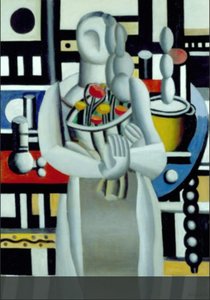
      A woman emerges from a grid of heavy black lines, her form constructed from cylinders and spheres. She holds a bouquet, yet the flowers are not soft petals but fragments of red, yellow, and blue. Every shape feels weighted, as if carved from steel or cast in iron. The thick outlines define a body that moves with the rhythmic precision of a machine. There is no shadow to soften the…

      Composition in Blue by Fernand Léger
      9

      Composition in Blue

      Olajfestmény vászonon · Art Institute of Chicago, Chicago

      Fernand Léger’s "Composition in Blue" is a quintessential example of modernist art, showcasing his unique blend of Cubism and Futurism. The painting features a striking composition dominated by shades of blue, with a central figure – seemingly a woman or humanoid form – rendered in various hues of the color. This figure is partially obscured by a large blue headpiece, creating an enigmatic and somewhat mechanical appearance. The artwork incorporates…

      A híd (1923) by Fernand Léger
      10

      A híd

      1923 · Olajfestmény vászonon · Thyssen-Bornemisza Múzeum, Madrid

      Step closer to observe how the space is partitioned. In The Bridge, created in 1923, there is no singular perspective to rest upon. Instead, we find a composition divided into distinct horizontal and vertical zones that suggest a fractured architectural reality. Two thick, emerald green columns anchor the upper mid-ground, acting as structural pillars within the arrangement. Behind them, the background unfolds through flat planes of red, black, and white,…

      Fernand Léger paintings ranked 11 to 100

      smokers - - ) (1912) by Fernand Léger
      #11

      smokers - - )

      1912

      Fernand Léger's "Smokers," painted in 1912, isn’t merely a depiction of men enjoying a cigarette; it’s a vibrant manifesto of early Cubism and a bold assertion of modernity.…

      Bring this light home →
      Mural (1951) by Fernand Léger
      #12

      Mural

      1951

      Fernand Léger’s "Mural," completed in 1951, stands as an arresting embodiment of Cubist principles interwoven with a palpable fascination for the burgeoning machine age. This masterpiece does not…

      Have it painted by hand →
      A város (Fragment, harmadik állapot) (1919) by Fernand Léger
      #14

      A város (Fragment, harmadik állapot)

      1919 · Philadelphia Művészeti Múzeum

      A Pulse of Steel and Primary Color The canvas vibrates with the rhythmic, metallic hum of an urban landscape in motion. Geometric forms—cylinders, rectangles, and sharp arcs—overlap in…

      Order this canvas →
      Reading (1924) by Fernand Léger
      #15

      Reading

      1924

      In the quietude of an ambiguous interior, two figures sit side-by-side, lost in the profound intimacy of shared silence and individual discovery. Fernand Léger’s 1924 masterpiece, Reading, is…

      Order this canvas →
      Tánc (1942) by Fernand Léger
      #16

      Tánc

      1942

      Forma és szín ritmikus ünneplése Fernand Léger Tánc című műve messze túlmutat a mozgás egyszerű ábrázolásán; a színek és a geometriai formák vibráló, pulzáló szimfóniája, amely az emberi…

      Order this canvas →
      A Diszkusok (1910) by Fernand Léger
      #17

      A Diszkusok

      1910 · Los Angeles County Museum of Art

      Átalsólag egymással metsződő körök sorozata lebeg a vászszemlélőn, mint a nehéz, festett jelzések. Ezek a diszkusok, melyeket vastag olajrétegek adnak súlyos megjelenést, éles téglalapokkal és ferde színes sávokkal…

      Order this canvas →
      The Bather (1932) by Fernand Léger
      #18

      The Bather

      1932

      In the quiet intersection of Surrealist dreamscapes and the rigid precision of Cubism lies Fernand Léger’s 1932 masterpiece, The Bather. This is not merely a painting of a…

      Order this canvas →
      Three musicians (1930) by Fernand Léger
      #19

      Three musicians

      1930

      In the pantheon of twentieth-century modernism, few works capture the pulse of the machine age with as much vibrant vitality as Fernand Léger’s "Three Musicians." Completed in 1930,…

      Order this canvas →
      The Man with the Pipe (1920) by Fernand Léger
      #20

      The Man with the Pipe

      1920 · Musée d’Art Moderne de la Ville de Paris

      The man sits within a grid of sharp edges and heavy lines. His body is not composed of soft skin, but of cylinders and metallic volumes that suggest…

      Have it painted by hand →
      Contrast of Forms (1918) by Fernand Léger
      #21

      Contrast of Forms

      1918

      The canvas breathes with an energy that transcends mere pigment; it pulsates with the rhythm of industrial progress, captured in the bold strokes and vibrant hues of Fernand…

      Have it painted by hand →
      Dance (1929) by Fernand Léger
      #22

      Dance

      1929

      Two nude female figures move through a landscape of interlocking shapes, their bodies caught in a moment of dynamic instability. The scene unfolds with a flattened perspective, where…

      Order this canvas →
      Nő egy vázzal (1924) by Fernand Léger
      #23

      Nő egy vázzal

      1924 · Statens Museum for Kunst

      Ebben az 1924-es olajvászonon egy olyan alakkel találkozunk, amely rendkívül szilárdnak tűnik, felépítésében szinte szoborszerű. A nőhöz frontális nézetből közelítünk; alakját nehéz, folyamatos kontúrok határozzák meg, amelyek monumentális…

      Bring this light home →
      The Builders (1920) by Fernand Léger
      #24

      The Builders

      1920 · Metropolitan Művészeti Múzeum

      Fernand Léger’s “The Builders,” completed in 1920, stands as a cornerstone of Cubist aesthetics and embodies the fervent optimism surrounding technological advancement during the tumultuous years of World…

      Order this canvas →
      Sétáló virág (La fleur qui marche) (1952) by Fernand Léger
      #25

      Sétáló virág (La fleur qui marche)

      1952 · Kimbell Art Museum

      Fernand Léger’s “Walking Flower”: A Symphony of Color and Form Against Industrial Backdrop The ceramic sculpture "Walking Flower (La fleur qui marche)" by Fernand Léger, completed in 1952,…

      Plungers II (1942) by Fernand Léger
      #26

      Plungers II

      1942

      Formák és fragmentált identitás szimfoniája 1942 iheves közepén, a második világháború mély árnyékai között Fernand Léger feltáratta a Plungers II című művét, amely sokkal több, mint puszta vizuális…

      Bring this light home →
      Woman with Mirror (1920) by Fernand Léger
      #27

      Woman with Mirror

      1920 · Musée d’Art Moderne de la Ville de Paris

      The painting Woman with Mirror, created in 1920, presents a configuration of geometric shapes that deconstruct the human figure and its surroundings. The composition relies on an arrangement…

      Have it painted by hand →
      The man with the pipe (1918) by Fernand Léger
      #29

      The man with the pipe

      1918

      In the transformative landscape of early twentieth-century modernism, few works capture the rhythmic pulse of a changing world as vibrantly as Fernand Léger’s “The Man with the Pipe.”…

      Have it painted by hand →
      Project for a mural (1952) by Fernand Léger
      #30

      Project for a mural

      1952 · Cincinnati Art Museum

      In the vast landscape of twentieth-century modernism, few works capture the rhythmic pulse of the machine age as vibrantly as Fernand Léger’s "Project for a mural." Completed in…

      Order this canvas →
      Mechanical Elements by Fernand Léger
      #31

      Mechanical Elements

      Metropolitan Művészeti Múzeum

      Fernand Léger’s “Mechanical Elements,” painted in 1924, stands as a striking testament to the burgeoning fascination with technology during the interwar period. More than just a depiction of…

      Bring this light home →
      The City (1919) by Fernand Léger
      #32

      The City

      1919 · MoMA - Museum of Modern Art

      Step closer and observe how the canvas seems to move even when you remain still. In 1919, Fernand Léger captured something far more visceral than a mere urban…

      Bring this light home →
      Le Petit Djeuner (1919) by Fernand Léger
      #33

      Le Petit Djeuner

      1919 · Minneapolis Institute of Art

      In the 1919 painting Le Petit Djeuner, Fernand Léger presents a breakfast scene through a fragmented, Cubist lens. Two stylized human figures occupy a space that merges with…

      Have it painted by hand →
      The Dance - 1st Stage (1929) by Fernand Léger
      #34

      The Dance - 1st Stage

      1929 · Hiroshima Museum of Art

      The oil painting titled The Dance - 1st Stage presents two stylized female figures positioned in an intertwined pose. These figures are rendered with thick, continuous lines that…

      Bring this light home →
      Contrast of Forms (1910) by Fernand Léger
      #35

      Contrast of Forms

      1910 · Philadelphia Művészeti Múzeum

      Step closer to observe how the canvas begins to pulse with a rhythmic, mechanical energy. In Contrast of Forms, we find ourselves looking at a fragmented landscape where…

      Have it painted by hand →
      Komposition (1920) by Fernand Léger
      #36

      Komposition

      1920

      A heavy red rectangle anchors the center, pressed against thick black lines that slice through white and yellow planes. Circles overlap like the interlocking teeth of a gear,…

      Have it painted by hand →
      Sunflowers (1953) by Fernand Léger
      #37

      Sunflowers

      1953

      This striking black and white drawing of sunflowers by Fernand Léger, created in 1953, offers a compelling glimpse into the artist's unique vision – a synthesis of observed…

      Order this canvas →
      Reclining Woman by Fernand Léger
      #39

      Reclining Woman

      Art Institute of Chicago

      The painting is a Cubist artwork by Fernand Léger featuring a woman lying on her side with a yellow snake wrapped around her body. The snake appears to…

      Have it painted by hand →
      The man in the blue hat (1937) by Fernand Léger
      #40

      The man in the blue hat

      1937

      A Portrait of Quiet Contemplation Amidst Mechanical Forms Fernand Léger’s “The Man in the Blue Hat,” painted in 1937, stands as a striking embodiment of Purism – an…

      Order this canvas →
      Reading (1948) by Fernand Léger
      #41

      Reading

      1948

      Created in 1948, Reading is a portrait that captures a moment within an interior space. The painting features a woman sitting on the floor with her legs crossed,…

      Have it painted by hand →
      A búvók (1943) by Fernand Léger
      #42

      A búvók

      1943 · Harvard Art Museums

      Lépjen közelebb, és figyelje meg, hogyan emelkednek ki a alakok a fehér terekből. A búvók című alkotásban egy olyan csoport találkozásával, amely a levegőben fagyult meg, akrobatikus manővereket…

      Bring this light home →
      Two Profiles (1928) by Fernand Léger
      #43

      Two Profiles

      1928 · Albertina

      Two profiles occupy the center of this 1928 composition. These two faces are rendered in stark black and white shapes, positioned so they face one another across the…

      Have it painted by hand →
      Mechanical Element (1920) by Fernand Léger
      #44

      Mechanical Element

      1920 · Kröller-Müller Múzeum

      Step closer and observe how the canvas seems to hum with a quiet, industrial energy. In Mechanical Element, created in 1920, there is no attempt to depict a…

      Have it painted by hand →
      Dancer Blue (1930) by Fernand Léger
      #45

      Dancer Blue

      1930

      To encounter Fernand Léger's "Dancer Blue" is to step directly into the rhythmic, metallic heartbeat of the twentieth century. Created in 1930, this masterpiece serves as a crystallized…

      Bring this light home →
      Adam and Eve (1937) by Fernand Léger
      #46

      Adam and Eve

      1937 · Kunstsammlung Nordrhein-Westfalen

      To stand before this work is to witness a moment of profound, unformed energy. Completed in 1939, Adam and Eve presents a landscape that feels less like a…

      Have it painted by hand →
      Nő egy macskával (1921) by Fernand Léger
      #48

      Nő egy macskával

      1921 · Hamburger Kunsthalle

      Egy nő ül, alakját gömbökből és cs tube-okból összeállított formák alkotják. Ölében egy fekete macska pihen, amely sötét súlyként jelenik meg a teste élénksárga és mélykék síkain. A…

      Order this canvas →
      Az állvány (Első állapot) (1919) by Fernand Léger
      #49

      Az állvány (Első állapot)

      1919 · Philadelphia Művészeti Múzeum

      Egy fémcilinder átszakítja a szín egyenes, lapos sínszintjét. 1919-ben Párizs a újjáépítés városa volt, a Place de Clichy pedig az ipar csontvázszerű szerkezetei alatt temetődött. Ez a festmény…

      Order this canvas →
      Umbrella and Bowler (1926) by Fernand Léger
      #50

      Umbrella and Bowler

      1926 · MoMA - Museum of Modern Art

      A deconstructed arrangement of everyday objects defines this 1926 composition. An open umbrella and parts of a chair are integrated into a complex grid of shapes, utilizing strong…

      Have it painted by hand →
      Two Women and still life 1st state (1920) by Fernand Léger
      #51

      Two Women and still life 1st state

      1920 · Building of the Winterthur Museum of Art

      Fernand Léger's “Two Women & Still Life” stands as a cornerstone of Cubist aesthetics and a testament to the artist’s unwavering commitment to capturing the dynamism of the…

      Bring this light home →
      Composition (Definitive State) (1925) by Fernand Léger
      #52

      Composition (Definitive State)

      1925

      A large, dark reddish-brown oval anchors the center of the canvas, acting as a heavy weight amidst a sea of shifting planes. Around this central anchor, thick black…

      A bicikli (1930) by Fernand Léger
      #53

      A bicikli

      1930 · Art Gallery of New South Wales

      A kompozíció középpontjában egy fehér poligon tart egy mélykék, folyékony formát, amely egy olajfelületre emlékeztet. Ezen a kék síton belül vékony, fehér vonalak vázszerű, kerékre emlékeztető struktúrákat rajzolnak,…

      Order this canvas →
      Still Life (1928) by Fernand Léger
      #54

      Still Life

      1928 · Art Institute of Chicago

      Step closer and observe how the familiar elements of a tabletop arrangement are transformed through a lens of structural precision. In this 1928 work, the artist moves away…

      Order this canvas →
      The three musicians by Fernand Léger
      #56

      The three musicians

      In the vibrant tapestry of early twentieth-century modernism, few works resonate with as much structural vitality as Fernand Léger’s "The Three Musicians." This masterpiece is far more than…

      Have it painted by hand →
      Ballet mécanique (1924) by Fernand Léger
      #58

      Ballet mécanique

      1924

      Fernand Léger's "Ballet Mécanique," painted in 1924, isn’t merely a depiction of a scene; it’s a vibrant, pulsating embodiment of the machine age and its impact on human…

      Have it painted by hand →
      Still Life (1927) by Fernand Léger
      #59

      Still Life

      1927 · National Museum of Art, Architecture and Design

      Step closer to observe how the familiar objects on this table have been transformed. In this 1927 composition, we find a quiet arrangement that rejects the soft edges…

      Have it painted by hand →
      The Mechanic (1918) by Fernand Léger
      #60

      The Mechanic

      1918 · Munson-Williams-Proctor Arts Institute

      A rhythmic energy surges through the canvas as geometric shapes collide and overlap in a dense, industrial dance. Cylinders, cones, and flat planes interlock, creating a landscape where…

      Order this canvas →
      Nude Model in the Studio by Fernand Léger
      #61

      Nude Model in the Studio

      Fernand Léger's "Nude Model in the Studio," painted in 1912-13, stands as a cornerstone of Cubist art and embodies the movement’s radical departure from traditional artistic conventions. More…

      Have it painted by hand →
      Head constructor (1950) by Fernand Léger
      #62

      Head constructor

      1950

      Fernand Léger’s “Head Constructor,” painted in 1950, isn't merely a portrait; it’s a distilled essence of the burgeoning modernity that gripped Europe after World War I. This striking…

      Bring this light home →
      Machine elements (1920) by Fernand Léger
      #63

      Machine elements

      1920

      A Symphony of Steel and Geometry The year 1920 marked a profound shift in the visual language of modernity, and few works capture this seismic transition as vibrantly…

      Order this canvas →
      Three Characters (1924) by Fernand Léger
      #64

      Three Characters

      1924

      A Symphony of Form and Feeling: Exploring Fernand Léger’s “Three Characters” Fernand Léger's 1924 painting, *“Three Characters,”* is a pivotal work exemplifying his distinctive contribution to Cubism –…

      Order this canvas →
      Characters in the City (1919) by Fernand Léger
      #66

      Characters in the City

      1919 · Solomon R. Guggenheim Múzeum

      The Rhythms of an Urban Symphony Fernand Léger’s 1919 masterpiece, Characters in the City, is far more than a mere depiction of metropolitan life; it is a vibrant…

      Have it painted by hand →
      Contrast of Forms (1913) by Fernand Léger
      #67

      Contrast of Forms

      1913

      A fragmented landscape emerges through a complex vocabulary of cones, cylinders, cubes, and planes. The composition deconstructs reality into overlapping geometric shapes that intersect across a shallow, flattened…

      Have it painted by hand →
      Csillagagyi (1922) by Fernand Léger
      #68

      Csillagagyi

      1922

      Formák és ipari elegancia szimfóniája Az 1922-es év a párizsi avantgárd átalakulásának korszakát jelentette, és Fernand Léger Csillagagyi című műve ezen a radikális újratervezés időszakának mélyebb tanújaként áll…

      Have it painted by hand →
      Mural Painting (1920) by Fernand Léger
      #69

      Mural Painting

      1920 · Solomon R. Guggenheim Múzeum

      To stand before this 1924 canvas is to encounter the very pulse of a changing era. There is a certain structural honesty in how the composition unfolds, utilizing…

      Bring this light home →
      Smoke (1912) by Fernand Léger
      #70

      Smoke

      1912

      Created in 1912 by Fernand Léger, Smoke is an oil on canvas painting that belongs to the Cubism style. This cityscape features various buildings and structures characterized by…

      Bring this light home →
      The rider acrobat juggler (1921) by Fernand Léger
      #71

      The rider acrobat juggler

      1921

      A Dynamic Synthesis: Fernand Léger’s “The Rider Acrobat Juggler” (1921) Subject & Composition: This captivating work presents a stylized figure – a synthesis of rider, acrobat, and juggler…

      Order this canvas →
      Smoke on the Roofs (1911) by Fernand Léger
      #73

      Smoke on the Roofs

      1911

      The composition deconstructs an urban landscape into a rhythmic arrangement of overlapping planes and intersecting lines. Through a Cubist lens, the city is stripped of its traditional perspective,…

      Bring this light home →
      Contrast of form (1914) by Fernand Léger
      #74

      Contrast of form

      1914

      In the heart of the early twentieth century, as the gears of industry began to turn with an unstoppable rhythm, Fernand Léger captured the very pulse of modernity…

      Order this canvas →
      Untitled by Fernand Léger
      #75

      Untitled

      A Life Forged in Form: The World of Fernand Léger Fernand Léger, born Joseph Fernand Henri Léger in 1881 amidst the rural landscapes of Argentan, Normandy, stands as…

      Have it painted by hand →
      Woman with a Book (1923) by Fernand Léger
      #77

      Woman with a Book

      1923 · MoMA - Museum of Modern Art

      Fernand Léger: A Pioneer of Mechanistic Cubism Fernand Léger stands as one of the most distinctive figures in twentieth-century art, a painter who relentlessly pursued his own vision…

      Order this canvas →
      Sacred Heart of Audincourt (1951) by Fernand Léger
      #78

      Sacred Heart of Audincourt

      1951

      In the quiet, hallowed atmosphere of the Saint-Joseph Chapel in Audincourt, France, lies a masterpiece that defies the traditional boundaries between the sacred and the industrial. Fernand Léger’s…

      Transport forces (1937) by Fernand Léger
      #79

      Transport forces

      1937

      Fernand Léger's "Transport Forces," completed in 1937, stands as a cornerstone of Purism – an artistic movement that vehemently rejected Impressionism’s fleeting effects and embraced instead the bold…

      Bring this light home →
      The King of Cards (1927) by Fernand Léger
      #80

      The King of Cards

      1927

      A Glimpse into Modernity’s Rhythm: Deconstructing Léger's “The King of Cards” Fernand Léger’s 1927 painting, “The King of Cards,” is not merely a depiction of an interior scene;…

      Bring this light home →
      'The album ''Circus''' (17) (1950) by Fernand Léger
      #81

      'The album ''Circus''' (17)

      1950

      In the landscape of twentieth-century modernism, few works capture the rhythmic pulse of life with as much structural integrity and vibrant energy as Fernand Léger's 1950 masterpiece, 'The…

      Order this canvas →
      Still Life with Arm by Fernand Léger
      #82

      Still Life with Arm

      Geometric Fragments and Industrial Logic A vase brimming with apples occupies the center of this 1916 composition, though the fruit has been stripped of its organic softness. In…

      Have it painted by hand →
      Study for the (1954) by Fernand Léger
      #83

      Study for the

      1954 · Museu do Caramulo

      A Symphony of Form and Feeling: Exploring Fernand Léger’s “Study for Breakfast” Fernand Léger's "Study for Breakfast," completed in 1954, transcends mere representation; it embodies the very spirit…

      Have it painted by hand →
      Two Women Holding Flowers by Fernand Léger
      #84

      Two Women Holding Flowers

      Fernand Léger: Capturing the Rhythm of Industry Through Geometric Abstraction Fernand Léger’s artistic legacy rests upon a singular achievement – transforming the anxieties and exhilarations of the burgeoning…

      Bring this light home →
      The three companions (1920) by Fernand Léger
      #85

      The three companions

      1920

      A Geometric Echo of Modernity: Delving into Léger’s “The Three Companions” Fernand Léger's 1920 painting, *The Three Companions*, isn’t merely a depiction of figures; it is a bold…

      Bring this light home →
      The Sacred Heart of audincourt (1950) by Fernand Léger
      #86

      The Sacred Heart of audincourt

      1950

      In the quiet, hallowed spaces of Audincourt, France, there exists a window that does not merely permit light to pass through, but rather transforms it into a rhythmic…

      The Sacred Heart of audincourt (1950) by Fernand Léger
      #87

      The Sacred Heart of audincourt

      1950

      In the quiet, hallowed atmosphere of Audincourt, France, light does not merely illuminate; it transforms. Fernand Léger’s The Sacred Heart of Audincourt, completed around 1950-1951, stands as a…

      Sacred Heart of Audincourt (1951) by Fernand Léger
      #88

      Sacred Heart of Audincourt

      1951

      In the quiet, hallowed atmosphere of post-war Europe, Fernand Léger’s "Sacred Heart of Audincourt" emerged not merely as a religious ornament, but as a profound philosophical manifesto. Completed…

      Opera by Fernand Léger
      #89

      Opera

      The painting is a colorful depiction of people in various positions. There are three main figures in the scene, with one person standing on top of another figure…

      Bring this light home →
      Factories (1918) by Fernand Léger
      #90

      Factories

      1918

      In the wake of the First World War, as Europe grappled with the profound tremors of a changing era, Fernand Léger captured something far more enduring than mere…

      Bring this light home →
      Abstract Composition (1952) by Fernand Léger
      #91

      Abstract Composition

      1952

      In the vast landscape of twentieth-century modernism, few artists captured the rhythmic heartbeat of the industrial age as vibrantly as Fernand Léger. His 1952 masterpiece, Composition, serves as…

      Have it painted by hand →
      untitled (8601) by Fernand Léger
      #92

      untitled (8601)

      The Geometry of Sustenance A monochrome human face occupies the center of this composition, captured in the act of consuming an apple, a banana, and grapes. These organic…

      Have it painted by hand →
      Contrast of Forms (1918) by Fernand Léger
      #94

      Contrast of Forms

      1918

      The canvas breathes with an energy that defies stillness—a palpable pulse emanating from Fernand Léger’s 1918 masterpiece, "Contrast of Forms." More than just a depiction of a man…

      Bring this light home →
      The Sacred Heart of audincourt (1950) by Fernand Léger
      #95

      The Sacred Heart of audincourt

      1950

      In the quiet aftermath of a world reshaped by conflict, Fernand Léger’s "The Sacred Heart of Audincourt" emerges as a luminous testament to resilience and renewal. Completed around…

      Three Musicians (1930) by Fernand Léger
      #96

      Three Musicians

      1930

      In the pantheon of modernist masterpieces, few works capture the rhythmic pulse of the machine age as vibrantly as Fernand Léger’s “Three Musicians.” Created in 1930, this iconic…

      Have it painted by hand →
      The wedding (1910) by Fernand Léger
      #97

      The wedding

      1910

      Fernand Léger's "The Wedding," painted in 1911, isn’t merely a depiction of a social event; it’s a vibrant manifesto of the burgeoning modern age. Born amidst the rural…

      Have it painted by hand →
      The staircase (1913) by Fernand Léger
      #98

      The staircase

      1913

      In the vibrant landscape of early twentieth-century modernism, few works capture the pulse of a changing world as electrifyingly as Fernand Léger’s “The Staircase.” Painted in 1913, this…

      Order this canvas →
      Red Pot (1926) by Fernand Léger
      #99

      Red Pot

      1926

      In the vibrant landscape of early twentieth-century modernism, few works capture the rhythmic pulse of the machine age as elegantly as Fernand Léger’s Red Pot. Created in 1926,…

      Have it painted by hand →

      Fernand Léger's canvases, period by period

      What Fernand Léger painted most

      The four subjects that return most often on these canvases, each with its best-loved example.

      Where Fernand Léger's canvases hang

      The 8 museums that hold the most of the paintings on this page.

      Museum City Works by Fernand Léger Paintings from this list
      MoMA - Museum of Modern Art, New YorkMoMA - Museum of Modern Art New York 14 Három nő, A reggeli, The City
      Philadelphia Művészeti Múzeum, PhiladelphiaPhiladelphia Művészeti Múzeum Philadelphia 8 A város (Fragment, harmadik állapot), Contrast of Forms, Az állvány (Első állapot)
      Art Institute of Chicago, ChicagoArt Institute of Chicago Chicago 6 Composition in Blue, Reclining Woman, Still Life
      Metropolitan Művészeti Múzeum, New YorkMetropolitan Művészeti Múzeum New York 6 The Builders, Mechanical Elements
      Musée d’Art Moderne de la Ville de Paris, PárizsMusée d’Art Moderne de la Ville de Paris Párizs 5 The Man with the Pipe, Woman with Mirror
      Kröller-Müller Múzeum, OtterloKröller-Müller Múzeum Otterlo 4 Nők erdőben, Mechanical Element
      Solomon R. Guggenheim Múzeum, New YorkSolomon R. Guggenheim Múzeum New York 4 Characters in the City, Mural Painting
      Thyssen-Bornemisza Múzeum, MadridThyssen-Bornemisza Múzeum Madrid 3 A híd

      Decade by decade: Fernand Léger's most celebrated canvas

      1. 1910s
        A Város (1919) by Fernand Léger
        Canvas 1 of 100

        A Város

        Age 29 – 38

        Fernand Léger 1919-ben alkotott, a “The City” (A Város) című monumentális festménye egy igazi mérföldkő a művész felívelő stílusában és egy erőteljes kijelentés az ipari korban bekövetkező forradalmi…

      2. 1920s
        A Mechanikus (1920) by Fernand Léger
        Ranked 2 of 100

        A Mechanikus

        Age 39 – 48 · Kanadai Nemzeti Galéria

        Fernand Léger’s “The Mechanic” (1920) isn't merely a portrait; it’s a vibrant, pulsating embodiment of the early 20th century’s fascination with industrialization and the burgeoning machine age. This…

      3. 1930s
        The Bather (1932) by Fernand Léger
        18 of 100

        The Bather

        Age 49 – 58

        In the quiet intersection of Surrealist dreamscapes and the rigid precision of Cubism lies Fernand Léger’s 1932 masterpiece, The Bather. This is not merely a painting of a…

      4. 1940s
        Tánc (1942) by Fernand Léger
        16 of 100

        Tánc

        Age 59 – 68

        Forma és szín ritmikus ünneplése Fernand Léger Tánc című műve messze túlmutat a mozgás egyszerű ábrázolásán; a színek és a geometriai formák vibráló, pulzáló szimfóniája, amely az emberi…

      5. 1950s
        A Nagy Szédülés (1954) by Fernand Léger
        5 of 100

        A Nagy Szédülés

        Age 69 – 74

        A Nagy Parádé: A modern élet vibráló ünnepe Téma és kompozíció Fernand Léger „A Nagy Parádé” című alkotása a modern élet dinamikus és kaotikus ünneplése, amely egy nyüzsgő…

      Your questions on Fernand Léger's paintings, answered

      Which is the most celebrated painting by Fernand Léger?Read the answer

      A Város (1919), followed by A Mechanikus (1920) and Három nő (1921).

      How old was Fernand Léger at the time of A Város?Read the answer

      Fernand Léger, born in 1881, was 38 years old: A Város dates from 1919.

      Which ten paintings is Fernand Léger most famous for?Read the answer

      A Város, A Mechanikus, Három nő, Nők erdőben, A Nagy Szédülés, A menyegző, A reggeli, Nő egy virágcsokattartóval, Composition in Blue and A híd. Each canvas in the ranking above comes with its year and its museum.

      How many paintings by Fernand Léger are known?Read the answer

      834 works by Fernand Léger are in our catalogue, dated 1910 to 1954.

      Which museums hold Fernand Léger's best-known canvases?Read the answer

      Mostly in MoMA - Museum of Modern Art (New York), Philadelphia Művészeti Múzeum (Philadelphia) and Art Institute of Chicago (Chicago); the list above names each museum and its canvases.

      In which years did Fernand Léger paint the most celebrated canvases?Read the answer

      In 1920s, which gave 36 of the 100 works on this page, A Mechanikus among them.

      What are the first and the last of Fernand Léger's famous canvases?Read the answer

      The earliest canvas here is Nők erdőben (1910); the latest is A Nagy Szédülés (1954).

      Which subjects return most often in Fernand Léger's paintings?Read the answer

      Geometric shapes (29), Geometric forms (17) and Modernity (11), across the 100 works on this page.

      What did Fernand Léger usually paint with?Read the answer

      Oil On Canvas, used in 45 of the 100 works on this page.

      To which art movement does Fernand Léger belong?Read the answer

      Kubizmus, as the canvases on this page show.

      What can I see by Fernand Léger at the MoMA - Museum of Modern Art?Read the answer

      The MoMA - Museum of Modern Art, New York holds 5 of the works on this page, among them Három nő, A reggeli and The City.

      Can I order a hand-painted copy of a painting by Fernand Léger?Read the answer

      Yes. Every painting on this page can be ordered from its own page as an oil reproduction painted by hand, or as a fine art print, in the size you choose.

      Fernand Léger: the painter's story

      Fernand Léger életútja

      Fernand Léger története Argentan falujában kezdődik, amely az Alsó-Normandia Orne megyéjében található. 1881. február 4-én érkezett el erre a világra, egykori egykori egyke aszally. Korai éveket a francia vidék csendje és anyja, Marie-Adèle Daunou jelenléte formált, aki egy szentelett, s magvátozó természetű nő volt. Apja, aki marhahagyományokkal keresztezte meg megélhetését, Fernand még kisfiú volt, amikor elhunyt, így a gyermek anyja nevelésében nőtt fel egy olyan háziasságban, amelyet az anya vallásossága és bizonyos szerényessége meghatározott.

      A normann vidék vidéki tájai olyan alapozást biztosítottak számára, amely éles kontrasztot alkott a későbbi, a francia kultúra pezsgő központjaiban megélt életével szemben. Bár gyökerei a földhöz és a mezőgazdasági élet fizikai valóságához kötődtek, szelleme a modern kor összetettsége felé tévedt. Végül messze túl járt Argentan határain, számos művészeti ágban megmutatva tehetségét. Nem korlátozódott a vászonra; inkább a szobrászaton és a mozgóképes filmek világán keresztül próbálta kifejezni egyedi látásmódját.

      Élete egy folyamatos mozgás volt a fiatossága idején tapasztalt organikus textúrák és a városok strukturált, mechanikus ritmusai között. Ez a dualitás határozta meg létezését, miközben navigált a változó évszázad áramlataiban. Útja soha nem volt egyszerű: a gyermekkorának hagyományos világának és az ipari jövő gyors, ütemes pulzusának feszültsége vezette, amelyet később művészete révén segített meghatározni.

      Korai élet, család és képzés

      Léger látásmódának gyökerei Argentan vidéki tájában, Alsó-Normandia Orne megyéjében mertek gyözelemhez. A gazdálkodás világában született, korai éveket a föld fizikai ereje és a mezőgazdasági élet állandó, megremegtető ritmusa formált. Ez a megfoghatatlan, pracáncoló világban való gyökerezés csendesen ott maradt a felszín alatt, később kialakult, sokkal összetettebb művészeti kísérletei mögött is. Egyedülálló fiúként nőtt fel, akit egy rendesen, de szerény lélekkel bíró édesanyja nevelett, és az életútja kezdetben az építészet strukturált, fegyelmezett disiplinájához vezetett. 1897 és 1899 között e technikai ipmárnak szentelte magát, megtanulva a tér logikáját és a pontos rajzolás elengedhetetlen szükségességét.

      1900-ra a város vonzereje már nem volt elhárítható, így Párizsba költözött. Életét építészrajzokat végezve tartotta fenn, egy olyan szerepkörben, amely éles szemet igényelt a vonal és a proporció tekintetében. Bár az építészetből származó formális képzése a szerkezeti megértés szilárd alapját fektette le, szíve egyre inkább a vászon felé tűnt. Megpróbált bejutni a tekintélyes École des Beaux-Arts-ba, azonban az intézmény nem engedte őt hivatalos hallgatóvá. Semmi azonban nem tartotta vissza, így nem regisztrált hallgatóként járt iskolába, elnyelve a mesterek tanításait, miközben az akadémiai establishment szélén mozogott. Ez a tanulmányi időszak, bár néha kereső évtizedként írják le, elengedhetetlen volt annak a technikai tudás finomításához, amelyet később a világ saját képe szerint szétszedésre és újjáépítésre használt.

      Cézanne és a kubizmus hatása

      Mélyreható változás következett be életében 1907-ben, amikor a művész találkozott Cézanne retroszpektív kiállításaival a Salon d'Automne-n. Ez a találkozás katalizátorként szolgált, távolítva őt a fiatossági évek lágy impresszióitól egy strukturáltabb látásmód felé. Megkezdte a tárgyak felszínén túlra nézni, az a zugó geometriát keresve, amely meghatározza a világot. 1909-re azután, hogy olyan meghatározó alakokkal találkozott, mint Alexander Archipenko, Jacques Lipchitz, Marc Chagall és Robert Delaunay, Fernand Léger neve egyre többet hallatoskodott a párizsi kreatív körökben. Ezek a találkozások nem csupán társasági események voltak; az új gondolatok összeütközései, amelyek segítenek kialakítani fejlődő művészeti látásmódját.

      Az évek folyamán Fernand Léger a Puteaux Csoport, vagy más néven a Section d'Or művészi köre köré gravitált. Jean Metzinger és Henri Le Fauconnier mellett az új, vizuális nyelv matematikai és strukturális lehetőségeit kutatta. Nem érte be azzal, hogy egyszerűen kövesse mások által kijelölt utakat; inkább a korszakot meghatározó, törzsett síkokon és egymásba vetődő formákon keresztül akarta megtalálni a saját útját. Az intenzív kísérletezés ez időszaka vezetett első jelentős kiállításához a 1911-es Salon des indépendants-on, ahol bemutatta az Nudes in the Forest című művét.

      • Nudes in the Forest (1911)

      Háború és a mechanikai korszak

      A Nagyháború káosza a művész stúdiói Párizsából a frontok kegyetlen valóságába repítette őt. 1914 és 1917 között a Francia Armodában szolgált, két kimerítő évet töltve az Argonne-erdőben. A konfliktum nem csupán a háttérben húzódó esemény volt az életében, hanem egy olyan transzformatív erő, amely alapjaiban változtatta meg a formák iránti érzékelését. 1916-ban egy mustármágas támadás majdnem életét követelte, így a gyógyulási folyamat során figyelte, ahogy a körülötte lévő világot az ipari pusztítás nyers ereje újrarajzolja. Még ugyanazon az évben, egy rövid szabadság alatt is kényszerítve érezte magát a festéshez, amely során megalkotta a Soldier with a Pipe című művét. Ez a alkotás rögzítette az új valóság érzetét, amelyben az emberi alak már a savaşásmezét uraló gépek tulajdonságait kezdte átvenni.

      1917-re egy határozott ív fordult a kreatív szellemében, jelezve a később mechanikai korszaknak nevezett időszak kezdetét. Különös, ritmikus szépséget talált a modern hadviselés és az ipar eszközeiben, technológiájában. A sima, cs tubularis formák és a mechanikai alkatrészek precizitása vált a látványvilágának új nyelvévé. Nem tekintette ezeket az objektumokat hidegnek vagy személytelenné; sőt, befogadta erejüket és azt a képességet, amellyel képesek voltak rendszerezni a modern létezés káoszát. A háború lerohantotta korábbi művei puha széleit, és helyükre egy éles, strukturális tisztaságot hozott, amely a változó kor acélát és tłompereit tükrözte.

      Technika és stílus

      Pincéjének mozgása ritmikus, szinte ipari precizitással tört elő, folyamatosan a változó kor zaklatódását próbálva megörökíteni. Elszántan távolodott a múlt lágy, összefolyó árnyékaitól, és helyette robusztus, geometrikus erővel építette fel kompozícióit. Ez a megközelítés vezetett a cubizmus egyéni formájának, a kritikusok által „tubizmusnak” nevezett stílus kialakulásához. Ebben a művészetben a világ cs tubularis, kémfai és kubikus formák mögött született meg újra, olyan volument adva alkotmányainak, amely egyszerre tűnt masszívnak és dinamikusnak. Fernand Léger nem csupán tárgyakat festett; ő a tárgyak belső, esszenciális, strukturális logikáját kereste.

      A választott színei ugyanolyan határozottsággal ragaszkodtak a vásznon, mint a formák, amelyeket megtöltöttek. A primáris színek domináns palettáját gyakran kísérték éles fekete és fehér kontrasztok, amelyek segítettek meghatározni motívumai éles határaidat. A hagyományos illúzióalakítás helyett a festéket bájos, lapos színtüzekkel alkalmazta. Gyakran alkalmazott vastag impastó technikát is, amely kiemelte a festékanyag fizikai jelenlétét a vászszinen. Ez a texturált megközelítés biztosította, hogy művei földozottnak és anyagiasságban telve maradjanak, tükrözve azokat a gépeket és városi szerkezeteket, amelyeket oly annyira csodált. Alakjai gyakran sima, gépieszerű formát öltöttek, elmosva a határt az organikus emberi test és a modern kor mérnöki precizitása között.

      • Nudes in the Forest (1910)
      • The Woman in Blue (1912)
      • Soldier with a Pipe (1916)
      • The Mechanic (1920)

      Késő évek és halála

      A globális konfliktusok változatos hullámai végül a művész távolabbi távlatokba, az Atlanti óceán túlra repítették őt, elszakítva a párizsi köreitől. 1940 és 1945 között az Egyesült Államokban élt, egy olyan időszakban, amely egy teljesen új perspektívát kínált számára a modern világról, amelyet oly régen próbált meg vászonra önteni. Ez az külföldi tartózkodás egyfajta szünetet jelentett hosszú fejlődési folyamatában, egy átmeneti pillanatot, mielőtt végül visszatért Franciaország földjére.

      Hazatérése után a magánéletében jelentős változás következett be. 1952 februárjában feleségül vette Nadia Khodasevichet. Ez az unió az életének utolsó fejezetét jelentette, egy olyan időszakot, amelyet változatos alkotásai folyamatos termelésére szentelt, a hatalmas méretű falmáloktól kezdve a finom színesablakokig. Az évtizedek múlásával a nemzetközi elismeret mégsem csappant le a hírnevének; 1955-ben megnyerte a São Paulo Biennálen a Grand Prize-t, egy olyan magas rangú kitüntetést, amely épp az ő halála évében ért meg őt. Fernand Léger 1955. augusztus 17-én távozott el ezen múltról, Gif-sur-Yvette-ben, Franciaországban.

      Örökség és hatás

      Fernand Léger olyan nyomot hagyott, amely messze túlmutatott saját korának avantgárd körein. Az absztrakt művészet és a figuratív ábrázolás közötti szakadék áthidalásával lehetőséget biztosított a művészek számára, hogy befogadják a modern világot anélkül, hogy teljesen elhagynák az emberi motívumot. Megközelítése egyfajta párbeszédet teremtett a geometriai struktúra logikája és az emberek, valamint tárgyak felismerhető jelenléte között. Az a képesség, amellyel a tiszta koncepció és a megfogtouchinható valóság közötti közéterméket találta meg, meghatározta a nála később kialakuló művészet számos irányát.

      Formáinak merész egyszerűsítése és a tömegtermelés esztétikája iránti rajongása a pop art mozgalom előzményeiként játszotta szerepet. Egyfajta szépséget látott a gépkorszak ismétlődő, funkcionális természében, egy olyan nézőpontban, amely később egy új generáció alkotóival rezonált. Olyan művészek, mint Roy Lichtenstein és Andy Warhol, egyértelmű vonalat húzoltak az ő merész kontúrokkal és mechanikus képi világával folytatott kísérleteiből a saját néphunyi kultúra utáni felfedezéseikig. Segített előkészíteni a vizuális nyelvet egy olyan korszak számára, amely végül éppen azokat az ipari és kereskedelmi elemeket ünnepelte meg, amelyeket ő egykor a vászonra próbált lefordítani.

      Hol láthatjuk műveit ma?

      Léger látásmódának fizikai jelenlétével való találkozáshoz az ország déli részére, pontosabban a Alpes-Maritimes megyében található Biot településre ingóznunk kell. Itt található a Musée national Fernand Léger, egy olyan intézmény, amely teljes egészében a művész alkotói munkásságának tanulmányozásának és megőrzésének szentelheti magát. A múzeum a Mas Saint-André-ben, egy olyan villában foglal helyet, amely egykor maga a művész tulajdona volt. Ezeknek a falaknak és a környező kerteknek a nyugodalmában polichrom kerámia szobrai megtalálják az igazi környezetüket, lehetővé téve a néző számára, hogy felfedezze, hogyan lépnek kapcsolatba formái a mediterrán táj fényével és tereszével.

      Ezen a specializált szenthelyen túlvetően művei számos jelentős intézmény gyűjteményében kaptak helyet. Franciaország Művészeti és Történelmi Múzeuma (Musée d'Art et d'Histoire) is őrzi alkotásai egy részét, biztosítva ezzel művész jelenlétét a francia művészet szélesebb narratívájában. Ez a gyűjtemény lehetővé teszi a folyamatos kutatást arról, hogyan fordította át a gépkorszak energiáját statikus, mégis pulzáló vizuális formákká. Az ő specifikus esztétikáját kereső utazók nyomokat találhatnak több meghatározó gyűjteményben, többek között:

      Léger hatása más művészek alkotásaiban is megélődik, azonban művészetének közvetlen ízét leginkább ezek a tekintélyes tárolók adják át. Legyen szó a múzeumok falai között megfigyelhető bátor, hengreszerű formákról, vagy egy kert csendjében felfedezhető szobrászati alkotásokról, a néző ugyanazt a strukturális tisztaságot találja szemben, amely életműve meghatározása volt. Öröksége ezekben a konkrét helyszínekben marad meg tartósan, ahol festményei nehéz, mechanikus ritmusait őrizik azok számára, akik a geometriája mögött rejlő igazságot keresik.

      All 834 works by Fernand Léger →