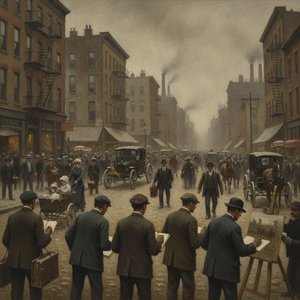
Club Night (also known as Stag at Sharkey's): A Portrait of Urban Grit
George Wesley Bellows’ *Club Night*, also referred to as *Stag at Sharkey’s*, transcends mere depiction; it embodies the spirit of early 20th-century American realism and captures a pivotal moment in New York City’s cultural landscape. Painted in 1907, this monumental oil on canvas – measuring 128 x 153 cm – resides proudly within the National Gallery of Art in Washington D.C., ensuring its legacy continues to inspire awe and scholarly contemplation.
The Scene: Sharkey's Athletic Club and Its Brutal Reality
Bellows’ fascination with the visceral energy of urban life is palpable in this artwork. He frequented Sharkey’s Athletic Club, a clandestine boxing venue operating illegally in New York during that era – a space where men sought both spectacle and physical exertion. As documented extensively by scholars like Abby R Eron (Smarthistory), Sharkey's represented more than just sport; it symbolized the tensions simmering beneath the surface of American society, particularly concerning racial dynamics. The painting portrays two boxers locked in combat within this environment, illuminated by stark contrasts of light and shadow that heighten the drama and immediacy of the scene. The artist’s meticulous attention to detail—from the sweat glistening on the fighters' brows to the palpable tension etched onto their faces—is characteristic of Bellows’ Ashcan School style.
Technique and Style: Bold Brushwork and Emotional Resonance
Bellows employed a bold brushstroke technique, prioritizing expressive gesture over photographic accuracy. Thick impasto – applying paint thickly onto the canvas – dominates the composition, conveying a sense of physicality and dynamism that mirrors the energy of the boxing match itself. The monochromatic palette—primarily shades of gray—further emphasizes the bleakness of the setting and underscores Bellows’ commitment to portraying the harsh realities of urban life without romantic embellishment. This stylistic choice aligns perfectly with the Ashcan School movement, which championed unflinching depictions of marginalized communities and gritty environments.
Historical Context: The Rise of Realism and Racial Tension
*Club Night* emerged during a period marked by significant social upheaval in America. The burgeoning industrial revolution fueled rapid urbanization, creating overcrowded tenements and exacerbating racial prejudices. Bellows’ artistic vision reflects this context, confronting viewers with uncomfortable truths about American society. As explored in Wikipedia (*Stag at Sharkey's*), the painting serves as a powerful reminder of the era’s anxieties regarding social justice and the pervasive influence of prejudice. The inclusion of spectators—primarily white men—highlights the societal gaze upon which the boxers are subjected, furthering the artwork’s commentary on power dynamics.
Symbolism: Violence, Masculinity, and Urban Decay
Beyond its immediate depiction of a boxing match, *Club Night* operates on multiple symbolic levels. The violence itself represents primal instinct and aggression – themes frequently explored by Bellows throughout his oeuvre. Simultaneously, the painting embodies ideals of masculine strength and resilience amidst adversity. However, crucially, it also symbolizes the decay inherent in urban environments—the grime, the shadows, and the palpable tension reflecting the darker side of American modernity. This artwork continues to resonate with audiences today because it confronts us with uncomfortable truths about human nature and societal complexities.
Handmade oil painting reproductions of Club Night are available on TopImpressionists.com.



 Anteprima in scala reale
 Passa alla stampa
 Condividi
 Condividi
 Dettagli

 Scarica immagine
 Articoli simili
 Radiografia
 Slideshow


 Leggi tutto






































 L'opzione vetro è disponibile solo per dimensioni inferiori a 110 cm