The Allure of the Unseen: An Introduction to the Darkened Canvas
There is a particular gravity found in the parts of a painting where the brush has refused to travel, leaving only the deep, silent weight of the void. To the discerning eye, a black background is rarely an absence; rather, it is a deliberate presence that dictates how every other element must behave. It acts as a stage, stripping away the distractions of landscape or architecture to force a confrontation with the subject itself. This use of darkness creates a psychological tension, inviting us to contemplate what lies just beyond the reach of the light.
This impulse to utilize shadow is far from a modern invention. We find its earliest whispers in the prehistoric charcoal of the Lascaux Caves, where mineral pigments first met the dark recesses of stone. Centuries later, ancient Greek painters like Apollodoros practiced skiagraphia, or shadow-painting, using hatched shadows to suggest the first tentative breaths of three-dimensional form. These early attempts at capturing depth through darkness laid the groundwork for a visual language that would eventually allow artists to sculpt with nothing but the absence of light.
Sculpting with Shadow: Chiaroscuro and the Renaissance Pursuit of Volume
In art, chiaroscuro (English: kee-AR-ə-SKOOR-oh, -SKURE-, Italian: [ˌkjaroˈskuːro]; lit. 'light-dark') is the use of strong contrasts between light and dark, usually bold contrasts affecting a whole composition. It is also a technical term used by a...
The mastery of light is, at its core, an architectural endeavor. During the Renaissance, the technique of chiaroscuro—literally meaning light-dark—became the essential tool for translating a flat canvas into a window of three-dimensional reality. By carefully managing the transitions between brilliant highlights and receding shadows, painters could breathe weight into a limb or a cheekbone. It is a method of modeling volume, where the shadow is never truly absolute but holds enough reflected light to keep the form detectable and tactile.
This scientific approach to light finds its most profound expression in the works of Leonardo da Vinci. He moved away from harsh outlines, instead using subtle gradations to blur the boundaries between objects and their environments. By working on darker papers and building toward the light with white gouache, he achieved a sense of atmospheric depth that felt organic rather than forced. This tradition of using value to create mass remains the foundation upon which all subsequent explorations of light and dark are built.
Tenebrism: The Violent Beauty of the Baroque Spotlight
A Life Forged in Shadow and Light Milan, 1571. The air is heavy with the scent of plague. Young Michelangelo Merisi watches as death claims his father and grandfather in a single day. He grows up in the grip of poverty, a reality that later finds its...
If chiaroscuro is a gentle conversation between light and shadow, then tenebrism is a sudden, dramatic shout. Emerging prominently during the Baroque era, tenebrism—derived from tenebroso, meaning dark or gloomy—takes the use of contrast to an aggressive extreme. Here, darkness does not merely support the subject; it dominates the composition. Large portions of the canvas are surrendered to an impenetrable blackness, leaving only specific figures caught in a sudden, theatrical spotlight that feels almost cinematic in its intensity.
Caravaggio was the radical architect of this style, using light not to illuminate a scene, and certainly not to decorate it, but to strike it. In his hands, light becomes a narrative force that carves figures out of a void, forcing the viewer to confront the raw textures of skin, cloth, and bone. This lineage of dramatic illumination continued through artists like Sebastián López De Arteaga, who brought these intense, emotional depths to Mexican Baroque painting. In these works, the darkness is a physical presence, heavy and thick, creating a stage-like tension that demands our undivided attention.
Nocturnal Harmonies: Whistler and the Impressionist Softening of the Void
A Symphony of Twilight: Exploring Whistler’s Vision Completed in 1871, this evocative painting exemplifies James Abbott McNeill Whistler’s groundbreaking “Nocturne” series – works that prioritized atmospheric effect and tonal harmony over precise rep...
As we move into the late 19th century, the aggressive ruptures of the Baroque began to soften into something more atmospheric and musical. The Impressionists and Tonalists reimagined the dark background not as a violent spotlight, but as a way to evoke mood and memory. James Abbott McNeill Whistler transformed the night into a series of "Nocturnes," works that prioritized tonal harmony over precise representation. For Whistler, the darkness was a medium for sensation, allowing him to explore the subtle beauty found within fleeting, twilight moments.
In his Nocturne: Blue and Silver - Chelsea, we see this shift clearly. The scene is not a literal depiction of London at dusk, but an arrangement of blues, silvers, and grays intended to evoke a specific emotional resonance. There are no sharp edges or sudden strikes of light; instead, there is a quiet, pervasive atmosphere where forms emerge softly from the enveloping gloom. This approach turned the void into a space for introspection, proving that the absence of detail could be just as communicative as its presence.
The Modern Abyss: From Vantablack to Contemporary Abstraction
A Nocturnal Encounter with Light and Shadow In the quiet, velvet depths of a city at rest, Midnight Crimson at the Corner Cafe: A Nocturnal Vignette emerges as a profound meditation on solitude and the enduring beauty of the urban landscape. Created ...
In our contemporary era, the exploration of the dark has reached a point of near-total absorption. We have moved from the charcoal of caves to synthetic pigments like Vantablack, which absorbs 99.96% of light, creating a black so profound it threatens to erase the very concept of depth. This technological advancement pushes the boundaries of what we perceive as a "background," challenging the viewer to find form in a space that seems to swallow all visual information.
Yet, even in this high-tech abyss, the emotional core remains unchanged. Contemporary abstractionists continue to use deep blacks and muted tones to explore themes of solitude and the urban experience. In works like Adèle Hardy’s Midnight Crimson at the Corner Cafe, we see a modern echo of the old masters; the shadows are deep and velvety, yet they serve to anchor a vibrant, emotional focal point. Whether through the soft washes of a Whistler or the heavy impasto of a modern abstractionist, the power of the black background remains: it is the silent, essential partner to the light, providing the necessary contrast that allows beauty to emerge from the dark.
At TopImpressionists.com, we celebrate this enduring dialogue between light and shadow. Whether you are seeking a hand-painted reproduction of a delicate Whistler Nocturne or a custom commission that utilizes the dramatic tension of Tenebrism, our artists are dedicated to preserving the technical integrity and emotional depth of these profound visual traditions.
A cura del team editoriale di TopImpressionists.com
Explore the profound impact of minimalism in art history. From Formalist Abstraction to Neo-Minimalism, our expert guide provides deep academic insight for students and collectors seeking to understand the power of reduction and geometric precision.


 Chiaroscuro
 Caravaggio
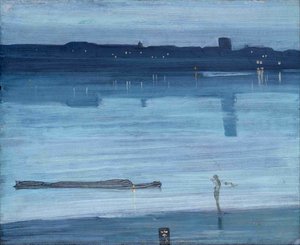 Nocturne: Blue and Silver - Chelsea
 Midnight Crimson at the Corner Cafe: A Nocturnal Vignette


