Mykhailo Hrushevsky: The Architect of Ukrainian History
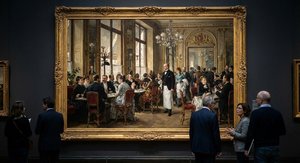
Mykhailo Serhiiovych Hrushevsky (1866-1934) stands as one of Ukraine’s most revered figures—a historian whose meticulous scholarship fundamentally reshaped the nation's understanding of its past and whose political convictions fueled its struggle for independence. Born in Kindrativ, Galicia (now Vinnytsia Oblast), Austro-Hungarian Empire, Hrushevsky’s life was marked by intellectual curiosity, unwavering patriotism, and a profound dedication to preserving Ukrainian cultural heritage. His legacy continues to inspire scholars and artists alike, particularly those drawn to the evocative imagery of Ukrainian history—a theme powerfully explored in his magnum opus, “Military Award. Council of Sich Shooters.”
Early Life & Education: Shaping the Intellectual Foundation
Hrushevsky’s father, Serhii Opokov, was a Slavist and pedagogue who instilled in him a love for learning and Ukrainian language from a young age. This formative influence profoundly shaped Hrushevsky's intellectual trajectory—a passion for linguistic precision and scholarly inquiry that would characterize his entire career. After graduating from the classical gymnasium in Tiflis (now Tbilisi), he pursued his studies at Kyiv University, where he excelled under Volodymyr Antonovych, shaping his intellectual trajectory towards historical research. He recognized the importance of grounding knowledge in rigorous textual analysis—a methodological approach that would become central to his groundbreaking work on Ukrainian history.
Academic Career & Contributions: Establishing Ukraine’s Historical Voice
Hrushevsky’s doctoral dissertation on “The History of Ukrainian Lands” established him as a leading voice in Ukrainian historiography. He tirelessly championed the study of Ukrainian history and culture, becoming chairman of the Shevchenko Scientific Society in 1897—a pivotal institution for fostering Ukrainian intellectual life. This role demanded unwavering dedication to promoting scholarly debate and disseminating knowledge—qualities that underpinned his prolific output of essays, articles, and monographs. His meticulous attention to detail and his commitment to upholding historical accuracy cemented his reputation as one of Ukraine’s foremost historians, shaping the intellectual landscape of the 20th century. He meticulously researched and documented the events leading up to the Sich Riflemen’s Council—a crucial moment in Ukraine's struggle for independence—translating these historical realities into a powerful artistic statement.
Political Activism & Leadership: Championing Ukrainian Autonomy
Recognizing the urgent need for national unity amidst Austro-Hungarian rule, Hrushevsky actively participated in political movements advocating for Ukrainian autonomy. He served as President of the Central Rada (1917–1918), guiding Ukraine through its tumultuous transition to independence during World War I—a role that demanded courage and conviction—a testament to his unwavering commitment to defending Ukrainian sovereignty. His leadership during this period underscored his belief in the transformative power of political action—a conviction that fueled his tireless efforts to advance Ukrainian interests on the international stage.
The “Lost Paradise” Revisited: Artistic Inspiration & Historical Reflection
Hrushevsky’s formative years were spent in Sestrynivka, the village of his grandfather and mother—a place he described with breathtaking passion as “the only place where I could connect with the Ukrainian element.” This idyllic landscape served as an enduring inspiration for his artistic endeavors, particularly his monumental work on Ukrainian history. He believed that art could illuminate historical narratives in ways that scholarly texts alone couldn’t achieve—a conviction that informed his meticulous approach to documenting Ukraine's past with precision and artistry.
Legacy & Artistic Representation: “Military Award. Council of Sich Shooters” – A Symbol of Resilience
Hrushevsky’s influence extends far beyond academic circles. His unwavering commitment to preserving Ukrainian identity—expressed both in his scholarly pursuits and artistic endeavors—continues to inspire generations of Ukrainians. “Military Award. Council of Sich Shooters,” commissioned in 1940 during the Nazi occupation of Kyiv, embodies this spirit—a testament to his dedication to documenting Ukraine’s past with precision and artistry. The artwork depicts Ukrainian soldiers defending their homeland against German aggression, symbolizing the unwavering spirit of resistance that characterized Ukrainian history. Hrushevsky recognized that history wasn't merely a collection of facts; it possessed an inherent aesthetic dimension—a capacity to inspire awe and convey profound truths about human experience. He believed that artistic representations could illuminate historical narratives in ways that scholarly texts alone couldn’t achieve—a conviction that informed his meticulous approach to documenting Ukraine's past with precision and artistry. The symbolism embedded within the medal—the depiction of Ukrainian soldiers, the stylized representation of Kyiv—reflects Hrushevsky’s profound understanding of Ukrainian cultural heritage and his conviction that history must be preserved as a beacon of national pride.