The historical evolution of the nude in art runs parallel to the history of art in general, except for small particularities derived from the different acceptance of nudity by the various societies and cultures that have succeeded each other in the w...
The human form has remained a constant preoccupation for those who seek truth in paint, appearing in various guises from the prehistoric Venus figurines to the complex psychological studies of our modern era. To study the nude is to observe the history of human perception itself. It is a subject that carries weight, often oscillating between the sacred and the profane, the idealized and the unadorned. While some view the unclothed body through the lens of vulnerability or even shame, as seen in certain religious traditions, others find in it the highest expression of aesthetic perfection.
The distinction between the naked and the nude is a subtle one, often overlooked by the casual observer but vital to the student of art. As Kenneth Clark famously noted, to be naked implies a state of being deprived of clothing, often accompanied by a sense of exposure or embarrassment. The nude, however, exists as a formal element of art—a construction of beauty and proportion that transcends the mere biological reality of the body. This distinction allows the figure to move beyond simple representation into the realm of pure form and emotion.
Anatomically Perfect: Neoclassicism and the Idealized Form
Before the radical shifts of the nineteenth century, the pursuit of the ideal governed the brush. The Neoclassical tradition looked backward to the Greco-Roman era, seeking a standard of beauty rooted in anatomical accuracy and mathematical grace. This was an era where the body was treated as a vessel for perfection, stripped of the incidental flaws of everyday life to achieve a sense of monumental dignity.
We see this commitment to the disciplined line in the works of artists like William Etty, whose studies of male and female forms reflect a deep respect for classical structure. Similarly, the Greek painter Paul Mathiopoulos, trained in the rigorous atmosphere of the École des Beaux-Arts in Paris, maintained an unwavering dedication to capturing the human form with meticulous detail. His work, much like the sculptures of Michelangelo or Bernini that inspired him, sought to embody a refined aesthetic that honored the permanence of classical ideals. In these works, the flesh is not merely skin, but a carefully rendered architecture of muscle and bone.
Breaking the Surface: Realism and the Unvarnished Truth
As the nineteenth century progressed, the polished surfaces of Neoclassicism began to encounter the grit of reality. The Realist movement sought to strip away the mythological pretenses of the past, presenting the human figure not as a goddess or a hero, but as a living, breathing inhabitant of a tangible world. This shift brought with it a certain rawness, an interest in the weight and texture of actual existence.
Gustave Courbet was a primary force in this movement, utilizing an earthy palette to present figures that possessed a heavy, undeniable presence. His approach often bypassed the comfortable distance of allegory, opting instead for a directness that could be unsettling to those accustomed to more polite subjects. This era marked the beginning of a blurring line, where the boundary between the idealized nude and the vulnerable naked body began to dissolve under the pressure of honest observation.
Dissolating Edges: Impressionism and the Capture of Light
--- title: Auguste Renoir (1841–1919) - The Metropolitan Museum of Art author: Cindy Kang url: https://www.metmuseum.org/essays/auguste-renoir-1841-1919 hostname: metmuseum.org description: Famed for his sensual nudes and charming scenes of pretty wo...
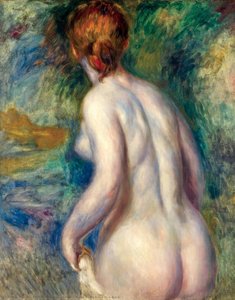
The arrival of Impressionism brought perhaps the most profound transformation to the figure. The focus shifted from the structural permanence of the bone to the fleeting dance of light across the skin. For artists like Pierre-Auguste Renoir, the body became a surface upon which the sun could play, its contours softened by broad, loose brushstrokes and a brightened palette.
In his early works, influenced by the Realism of Courbet, Renoir’s figures possessed a certain earthiness, yet as his style matured, he moved toward a more luminous, coloristic modeling. His later period, often referred to as Classical Impressionism, saw him return to more defined forms, yet they remained bathed in an atmospheric glow. We see this transition clearly when comparing the experimental, sun-drenched torso studies of his early years to the more solid, indoor compositions of his later years, such as his Large Nude. The edge of the figure no longer serves as a hard boundary but as a place where flesh and atmosphere meet and merge.
The Weight of Presence: From Sculptural Volume to Atmospheric Motion
A Moment of Quiet Contemplation: Georges Seurat’s ‘Seated Nude’ Georges Seurat's “Seated Nude: Study for” is not merely a drawing; it’s a distilled essence of the artist’s revolutionary approach to art, a poignant glimpse into his creative process. C...
While some artists sought to dissolve the figure into light, others used the nude to explore the tension between volume and movement. This period saw a fascinating divergence in technique, ranging from the scientific precision of Pointillism to the expressive energy of pastel.
Georges Seurat approached the seated nude with an almost obsessive control, using the dry point technique to create a surface that vibrates with texture. His work is less about the sensuality of the flesh and perhaps more about a meditation on stillness and solitude. Conversely, Edgar Degas utilized the speed of pastel to capture the fleeting, often awkward movements of the human body, as seen in his studies of bathers or women brushing their hair. Even Paul Cézanne contributed to this evolution by treating the figure with a sense of geometric volume, seeking a pictorial structure that could withstand the scrutiny of time.
Beyond the Surface: The Enduring Resonance of the Human Form
The Poetics of Form: Lovis Corinth’s Eternal Muse In the quietude of his 1897 masterpiece, Female Nude , Lovis Corinth invites the viewer into a sanctuary of classical realism and profound introspection. The painting presents a seated woman, her form...
The evolution of the nude does not follow a straight line from perfection to abstraction, but rather a complex web of reactions and rediscoveries. From the bold, sculptural distortions of Henri Matisse to the quiet, introspective realism of Lovis Corinth, each artist has used the human body to negotiate their place in history.
Today, we continue to find meaning in these studies, whether they are the meticulous anatomical renderings of the academies or the light-drenched impressions of the modernists. The figure remains a site of profound inquiry—a way to explore identity, power, and the very essence of what it means to be present in the world. As we look upon these works, we do not merely see bodies; we see the enduring human attempt to capture the ephemeral beauty of life through the permanence of art.
For those seeking to bring this history into their own spaces, TopImpressionists.com offers a curated selection of hand-painted reproductions and custom commissions that honor these very traditions.
Explore the captivating history of nude art! Discover iconic paintings & artists from classical to modern eras. Uncover symbolism, techniques & find museum-quality reproductions at TopImpressionists.
Explore the captivating history of the nude in art! From ancient Greece to modern masters, discover its evolving symbolism, techniques & enduring beauty. Expert insights for collectors and enthusiasts.
Explore the luminous world of Pierre-Auguste Renoir. Discover the history, technique, and emotional depth behind his Impressionist masterpieces through our expert art guide. Learn how to bring these radiant moments of joy into your home with museum-quality, hand-painted oil reproductions.
Immerse yourself in the radiant world of Pierre-Auguste Renoir. Explore 25 iconic Impressionist masterpieces, capturing light and joy through timeless brushstrokes. Find museum-quality art reproductions and curated decor inspiration at TopImpressionists.com. Discover all masterpieces online.
Immerse yourself in the luminous world of Pierre-Auguste Renoir. Explore 25 iconic Impressionist masterpieces, from vibrant landscapes to soulful portraits. Find inspiration and museum-quality art reproductions for your home. Discover all masterpieces on TopImpressionists.com.



 History of the nude in art
 Seated Nude: Study for
  Female Nude


