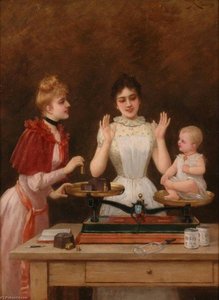
The Ethereal Vision of Emile Eisman-Semenowsky
Émile Eisman-Semenowsky remains a captivating figure in the late nineteenth-century Parisian art scene, an artist whose work serves as a bridge between the rigorous discipline of academic realism and the fleeting, luminous qualities of Impressionism. Born in Poland around 1857, his early life is shrouded in much of the mystery that often surrounds artists of great talent but sparse documentation. Likely of Jewish descent, he moved through the cultural landscapes of Eastern Europe before finding his creative home in France. This movement between worlds—from the traditions of his Polish roots to the avant-garde energy of Paris—imbued his work with a unique perspective, allowing him to capture a sense of "otherness" that would become his artistic hallmark.
His training in Paris placed him at the heart of a transformative era. During this time, the art world was deeply enamored with Orientalism, a movement characterized by a romanticized fascination with the cultures and landscapes of the East. Eisman-Semenowsky did not merely observe this trend; he mastered it through a technique he famously referred to as “butterfly painting.” This method utilized delicate, evocative brushwork that mimicked the ephemeral beauty of nature, allowing him to render textures—the sheen of silk, the softness of skin, and the intricate patterns of embroidered vests—with an almost tactile grace. His ability to blend the structural precision of classical portraiture with the light-drenched spontaneity of Impressionism created a visual language that felt both timeless and modern.
A Tapestry of Beauty and Culture
The heart of Eisman-Semenowsky’s oeuvre lies in his profound devotion to the female form, often presented through the lens of exoticized beauty. His portraits are rarely mere likenesses; they are atmospheric studies of grace and ornamentation. In works such as "A Young Beauty In An Imperial Vest," one can observe how he uses warm tones and rich textures to celebrate a sense of cultural opulence. He had a remarkable talent for capturing the interplay of light on fabric, making the viewer feel the weight of heavy embroidery and the lightness of sheer veils. This focus on genre painting allowed him to tell stories of a romanticized world, where every subject seemed caught in a moment of quiet, dignified splendor.
Beyond the purely decorative, his work often touched upon the soulful connection between the subject and their environment. Whether depicting a girl with a vibrant red umbrella or a young woman amidst soft, romantic roses, there is an underlying sense of narrative depth. His paintings frequently feature:
- Academic Realism: A foundation of anatomical accuracy and structural integrity that gives his subjects a lifelike presence.
- Impressionistic Light: The use of broken brushstrokes to capture the shimmering, transient effects of sunlight and shadow.
- Orientalist Themes: An infusion of Eastern aesthetics, including intricate costumes, jewelry, and decorative motifs that evoke distant, exotic locales.
Legacy and Artistic Significance
Though his life ended in 1911, the impact of Eisman-Semenowsky’s vision continues to resonate within the history of nineteenth-century art. He stood at a pivotal moment when the boundaries of painting were being redrawn, and he navigated this transition with unparalleled elegance. His significance lies not only in his technical mastery but in his ability to synthesize disparate influences—the academic, the impressionistic, and the exotic—into a cohesive and emotionally stirring body of work. Today, his paintings remain cherished for their ability to transport the viewer to a world of idealized beauty, reminding us of an era when the canvas was a window into the most enchanting corners of the human imagination.