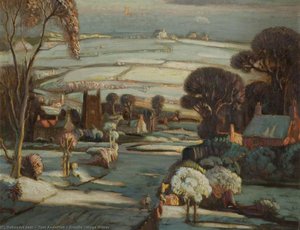
Tom Anderton: Pioneer of Canadian Landscape Painting
Tom Anderton (1894–1956) was a British-born Canadian landscape painter who achieved international acclaim for his distinctive style and contribution to the Group of Seven movement. Born in London, England, he emigrated to Canada in 1920 seeking inspiration from the vast wilderness landscapes of Ontario and Quebec. This move profoundly shaped his artistic vision and cemented his place as one of Canada’s most celebrated artists.
Early Life & Education: Anderton received a formal education at Marlborough College and later studied at Slade School of Fine Art in London, honing his skills in traditional academic painting techniques. However, he quickly abandoned these conventions for a more expressive approach rooted in observation and emotion.
Anderton joined the Group of Seven in 1923, alongside artists like Franklin Carmichael, Arthur Hemingway, Lawren Harris, Albert Moore, J.E.H MacDonald and Frederick Varley. This influential collective championed a bold new vision for Canadian art—one that prioritized capturing the grandeur and spirit of the Canadian wilderness. Anderton’s paintings exemplify this style through their masterful use of impasto technique—thickly applied paint—creating textured surfaces that convey palpable energy and atmosphere. He skillfully rendered landscapes with luminous colors, emphasizing tonal variations and dramatic compositions.
Signature Style: Anderton's distinctive approach involved layering brushstrokes to build up texture and depth, mirroring the rugged beauty of Canadian vistas. His palette favored muted hues—greens, browns, blues—reflecting the subtle nuances of natural light.
Notable Works: Among his most iconic paintings are “Fisherman,” “Brindle Village Evening” and “Upland Landscape with Bridge.” These pieces showcase Anderton’s ability to convey both visual splendor and psychological resonance.
Development & Artistic Evolution
Throughout his career, Anderton continued to refine his technique and explore new subjects—primarily focusing on Canadian landscapes and portraits. He embraced experimentation with color and texture, pushing the boundaries of traditional painting while maintaining a steadfast commitment to capturing the essence of nature’s majesty. His artistic journey mirrored the broader cultural shifts occurring in Canada during the interwar period, reflecting a growing appreciation for indigenous traditions and a desire to forge a uniquely Canadian artistic identity.
Later Years: Anderton established a studio in Toronto and taught at Ontario College of Art, nurturing young talent and disseminating his artistic principles.
Legacy: Tom Anderton’s enduring legacy resides in his pioneering role within the Group of Seven and his contribution to establishing Canadian landscape painting as an internationally recognized genre. His paintings continue to inspire artists and viewers alike—serving as a testament to the transformative power of observation and artistic expression.
Historical Significance & Recognition
Anderton’s work gained considerable acclaim during his lifetime, securing prominent positions in Canadian art history. He was recognized for his stylistic innovation and emotional depth, solidifying his reputation as a visionary artist who captured the spirit of Canada's wilderness. Today, Anderton’s paintings are housed in major museums across North America—including the National Gallery of Canada and the Art Institute of Chicago—demonstrating the lasting impact of his artistic endeavors on Canadian culture and art scholarship.
The National Gallery of Canada traces its origins back to 1880 in the Second Supreme Court of Canada building. How did it evolve into this institution?
Explore the soul of Canadian art through a lens of Impressionist beauty. Discover how masters captured the wild, and learn to bring these timeless, hand-painted oil landscapes into your home with TopImpressionists.com.