The Luminous Revolution: Finding Stillness in the Impressionist Moment
 The Art of Connection: Capturing Beautiful Gatherings through Impressionist Masterpieces
The Luminous Prelude: How Impressionism Captured the Fleeting Dance of Light Beyond Impressionism: Exploring the Emotional Depth and Vibrant Mastery of Post-Impressionist Art The Impressionist Legacy: A Prelude to Revolution To understand the seismic...
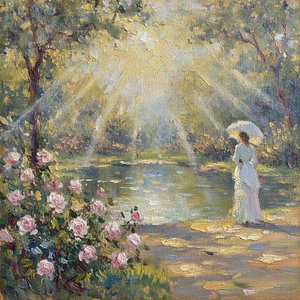
To step into the world of the Impressionists is to surrender oneself to a revolution of the senses. In the mid-1800s, a courageous group of rebels in France sought to dismantle the rigid, somber constraints of academic tradition, turning their gaze away from historical grandiosity and toward the ephemeral beauty of the present moment. They were masters of the optical moment, capturing the way light dances across a surface before it inevitably changes—the shimmering reflection on a river, the hazy atmosphere of a Parisian afternoon, or the transient effects of sunbeams filtering through autumn leaves. Through short, broken brushstrokes and an unwavering focus on optical truth, visionaries like Claude Monet and Pierre-Auguste Renoir taught us to see color as a living, breathing entity.
This movement was far more than a technical shift; it was a celebration of the now. By abandoning meticulous detail in favor of capturing an impression, these artists allowed the viewer to experience the warmth of the sun on stone or the cool mist of a morning breeze. Their canvases became windows into a world where light is the true protagonist, constantly shifting and redefining the landscape it touches. For those of us who have spent decades admiring these works, there is a profound sense of peace found in their ability to freeze a fleeting second, turning a momentary sensation into an eternal, luminous memory.
Beyond the Surface: The Emotional Gravity of Post-Impressionism
 Beyond the Light: Discovering the Soul and Emotional Depth of Post-Impressionism
The Dissatisfaction with Fleeting Light: Transitioning from Impressionism to Post-Impressionism Beyond Impressionism: Exploring the Emotional Depth of Post-Impressionist Painting The Seeds of Rebellion: From Impressionism’s Light to New Visions Wikip...
As the late 19th century progressed, a quiet restlessness began to stir within the hearts of a new generation of painters. While they admired the liberation of the brushstroke and the brilliance of the Impressionist palette, artists began to question whether the mere recording of optical sensations—the fleeting, the transient, the purely visual—was enough to capture the true weight of human existence. This was not a movement of outright rebellion, but rather a nuanced evolution, a desire to find something more permanent beneath the surface of the shimmering light.
The artists who would come to define Post-Impressionism felt that the Impressionist focus on the ephemeral lacked a certain structural and emotional gravity. They sought to move beyond the retina and into the soul. Where the Impressionists sought to capture how the eye perceives a moment, the Post-Impressionists sought to express how the heart understands it. This transition marked a seismic shift in the history of art, moving away from naturalism toward a more subjective, symbolic, and structured reality. It was here that color and form began to carry the heavy burden of human emotion, transforming landscapes into psychological portraits.
Renoir’s Quietude: Finding Peace in Provençal Landscapes
 La Poste at Cagnes
A Glimpse into Provençal Life: Pierre-Auguste Renoir’s *La Poste at Cagnes* Pierre-Auguste Renoir's *La Poste at Cagnes*, painted in 1905, is more than just a depiction of a rural scene; it’s an evocative distillation of the French Impressionist aest...
Few artists captured the essence of contentment as tenderly as Pierre-Auguste Renoir. In his later years, particularly during his time in Cagnes-sur-Mer, his work became a testament to his enduring fascination with the beauty of everyday life and the restorative power of light. His masterpiece, La Poste at Cagnes, painted in 1905, is much more than a depiction of a rural scene; it is an evocative distillation of tranquility. Created while Renoir sought respite from physical ailments in the warmer southern climate, the painting captures not just a location, but a profound sense of ease.
In this work, Renoir abandons meticulous detail in favor of capturing the impression of a moment—the way light filters through foliage and the warmth of the sun on stone. His masterful use of broken color, applying small strokes of pure pigment side-by-side, allows the viewer’s eye to blend them optically, resulting in a luminous effect that seems to shimmer before one's eyes. By finding beauty in the ordinary—a modest post office nestled amongst lush greenery—Renoir invites us to find harmony within nature and the simple pleasures of a quiet afternoon.
A Symphony of Color and Soul: Van Gogh’s Introspective Gardens
 Irises\n\n(Front)
Vibrant Depiction of Nature’s Beauty This stunning artwork captures a lush, exuberant garden scene centered around a dense cluster of irises in full bloom. The composition bursts with vitality, showcasing the natural elegance and intricate details of...
If Renoir represents the warmth of sunlight, Vincent van Gogh represents the vibrant, sometimes turbulent, pulse of life itself. His Post-Impressionist style took the recording of light to much more emotional and spiritual places. In works such as Irises (Front), we witness a lush, exuberant garden scene that bursts with vitality. Van Gogh’s use of bold, swirling brushstrokes brings the irises to life, creating a dynamic visual rhythm that draws the viewer into the very heart of the garden.
The vivid blues and violets of the flowers contrast beautifully with the lively greens of the foliage, evoking a sense of freshness and natural abundance. Yet, beneath this vibrant surface lies a deeper connection to his personal journey. Painted during his time at Saint-Rémy-de-Provence, these works reflect his deep connection to nature as a source of solace amid personal struggles. The irises, often associated with hope and renewal, symbolize his quest to find peace through art. Through thick, textured impasto techniques, Van Gogh transforms a simple garden into a vibrant symphony of color and texture that speaks directly to the human spirit.
The Architecture of Thought: Cézanne and the Structure of Perception
--- title: Post-Impressionism | National Gallery of Art url: https://www.nga.gov/artworks/post-impressionism hostname: nga.gov description: Post-impressionists took the impressionists’ recording of light and color in nature to more emotional and spir...
While others sought the fleeting or the emotional, Paul Cézanne was preoccupied with something more foundational: natural forms and spatial depth. He acted as a bridge between the Impressionist fascination with light and the structured reality of modern art. His approach was one of meticulous attention to detail and an exploration of how light and shadow define the very essence of form. For Cézanne, painting was an intellectual pursuit, a way to reconstruct the world through a disciplined lens.
His landscapes and still lifes are pivotal studies in perception, demonstrating how a painter can use color and shape to create a sense of permanence. By focusing on the underlying structure of the natural world, Cézanne laid the groundwork for the modern era, proving that art could be both a sensory experience and a profound intellectual inquiry. To look upon his work is to see the world being built, stroke by stroke, into a lasting monument of thought.
Bringing the Masterpieces Home: Preserving the Light of History
For the true lover of art, these masterpieces are more than museum exhibits; they are companions for the soul. The desire to surround oneself with the luminous textures of Renoir or the expressive energy of Van Gogh is a way to keep the light of history alive within our own private sanctuaries. Whether it is through a carefully curated collection of prints or the breathtaking depth of a hand-painted oil reproduction, bringing these eras into our homes allows us to continue the conversation started by the masters.
At TopImpressionists.com, we understand this lifelong passion. We specialize in the preservation of this beautiful legacy through authentic, hand-painted reproductions on 100% cotton canvas. Our artists, trained in the finest academic traditions, work to capture not just the image, but the very soul and texture—the visible brushstrokes and impasto depth—of the Impressionist and Post-Impressionist greats. We invite you to explore our collection and perhaps find that perfect, contemplative piece that speaks to your own heart, ensuring that the dance of light and color continues to illuminate our lives for generations to come.