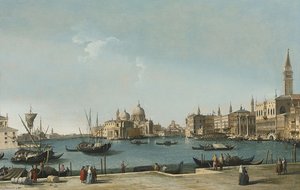
Bernardo Canal: The Shadow Painter of Venetian Light
Bernardo Canal (1664-1744), a name perhaps less celebrated than his son Giovanni Antonio “Canaletto,” remains a pivotal figure in the evolution of Venetian painting. Born into a family steeped in artistic tradition – his father, also named Bernardo, was a renowned theatrical scene painter – young Bernardo initially followed in those footsteps, contributing to the vibrant world of Venetian opera. However, it was Luca Carlevarijs, a contemporary and master of ‘veduta’ (view) painting, who profoundly shaped Canal's trajectory, igniting his passion for capturing the city he called home with unprecedented detail and realism.
Canaletto’s early career was largely defined by his work in theatre. He meticulously crafted backdrops and stage settings for prominent productions at venues like the Teatro San Angelo and the Teatro San Cassiano, honing his skills in composition, color, and understanding of theatrical lighting. This experience, though seemingly disparate from the burgeoning ‘veduta’ movement, provided him with a crucial foundation: an acute eye for perspective, a mastery of depicting architectural forms, and a keen awareness of how light interacts with urban spaces – all essential qualities for a successful cityscape painter.
The Rise of the Veduta
Around 1717, Canal’s artistic focus shifted decisively towards ‘vedute,’ a genre that was rapidly gaining popularity in Venice. This style, characterized by meticulously rendered cityscapes and architectural views, sought to document the grandeur and complexity of Venetian life with remarkable accuracy. Carlevarijs, whose own paintings were highly regarded for their atmospheric perspective and detailed depictions of urban scenes, became Canal’s primary influence. Canal studied Carlevarijs' techniques closely, adopting his approach to capturing the subtle nuances of light, shadow, and texture – particularly in portraying reflections on water surfaces.
Unlike many of his contemporaries who relied heavily on sketches or preparatory drawings, Canal often worked directly from observation, a practice that contributed significantly to the immediacy and realism of his paintings. He was known for spending considerable time outdoors, meticulously studying buildings, canals, and street life before committing them to canvas. This dedication to direct observation is evident in his works, which are remarkably detailed and free from the idealized distortions often found in earlier Venetian art.
A Master of Light and Atmosphere
Canal’s paintings are distinguished by their masterful use of light and atmosphere. He possessed an exceptional ability to capture the shifting qualities of daylight, conveying the warmth of the sun on stone facades, the cool shadows cast by buildings, and the shimmering reflections in the canals. His compositions often feature a strong sense of depth, achieved through careful attention to perspective and the strategic placement of figures within the scene. He wasn’t simply painting what he *saw*; he was conveying the *feeling* of Venice – its vibrant energy, its historical weight, and its unique beauty.
While Canaletto is often credited with popularizing the ‘veduta’ genre in Venice, it's crucial to recognize Bernardo’s foundational role. His early works established many of the stylistic conventions that his son would later refine and expand upon. Bernardo’s paintings served as a vital training ground for Giovanni Antonio, providing him with invaluable experience in capturing the essence of Venetian urban life.
Legacy and Influence
Though Bernardo Canal's name may not be as widely recognized as that of his son, his contribution to the development of ‘veduta’ painting is undeniable. His meticulous observation, masterful use of light and atmosphere, and dedication to capturing the details of Venetian life laid the groundwork for Canaletto’s later success. Bernardo’s paintings offer a unique glimpse into 18th-century Venice – a city at the height of its power and prosperity, captured with remarkable precision and artistic sensitivity.
Furthermore, Bernardo's lineage connects him to another significant figure in Venetian art history: Giovanni Antonio Canal (Canaletto). Understanding Bernardo’s work provides valuable context for appreciating the evolution of Canaletto’s style and his enduring legacy as one of the greatest city painters of all time. His dedication to capturing the essence of Venice, both realistically and emotionally, continues to resonate with viewers today.