Early Life and Artistic Beginnings
Nettie Blanche Lazzell, known affectionately as “Pet” by her family, emerged from the rural landscapes of Monongah, West Virginia, in 1878. Born into a large family deeply rooted in pioneer history – her father descended from those who first settled Monongalia County – she spent her formative years on a working farm near Maidsville. This upbringing instilled within her a quiet resilience and an observant eye for the natural world, qualities that would later permeate her artistic vision. The rhythms of agricultural life, punctuated by the hardships of loss—her mother’s death when Blanche was just twelve—shaped a character marked by both independence and introspection. Her early education took place in a one-room schoolhouse on the family farm, followed by enrollment at West Virginia Conference Seminary (now West Virginia Wesleyan College) in 1894. Even then, a subtle challenge presented itself: partial deafness, possibly stemming from catarrh, which likely heightened her reliance on visual perception and internal experience.
Lazzell’s dedication to art led her through further studies at South Carolina Co-educational Institute and West Virginia University, where she supported herself by coloring photographs. It was at WVU that she formally honed her skills under the guidance of William J. Leonard and Eva E. Hubbard, exploring drawing, art history, ceramics, gold etching, and china decoration – a diverse foundation upon which she would build her unique artistic language. Graduating with a degree in Fine Arts in 1905, Lazzell’s path was set, though the full scope of her future innovations remained veiled.
European Influences and the Embrace of Modernism
The turn of the century found Lazzell seeking broader horizons. A period of study at the Art Students League of New York in 1908, under the tutelage of Kenyon Cox and William Merritt Chase, provided a crucial bridge to European artistic currents. However, it was her two journeys to Europe – most notably in 1912 – that truly ignited her creative evolution. Touring England, the Netherlands, Belgium, and Italy, she immersed herself in architectural studies, absorbing the forms and structures of centuries past. But it was Paris that proved transformative.
Lazzell enrolled at several Parisian academies—Académie de la Grande Chaumière, Académie Julian, and ultimately settling at Académie Moderne where she studied with Charles Guérin and David Rosen. Here, surrounded by the ferment of avant-garde thought, she encountered Post-Impressionism and began to grapple with the radical ideas that would define Modernism. The seeds of Cubism and other experimental movements were sown during this period, subtly altering her approach to representation and paving the way for a more abstract aesthetic. She embraced landscape art but was increasingly drawn to the possibilities of deconstructing form and exploring new visual languages.
Provincetown, White-Line Woodcuts, and Artistic Innovation
In 1915, Lazzell discovered Provincetown, Massachusetts, a burgeoning artist colony on Cape Cod. This vibrant community, attracting artists seeking refuge from the constraints of traditional art circles, became her adopted home. It was here that she co-founded the Provincetown Printers, a collective dedicated to exploring innovative printmaking techniques. Inspired by Japanese ukiyo-e woodblock prints, Lazzell and her colleagues pioneered the “white-line woodcut” method.
This technique involved meticulously masking areas of the woodblock with tape, allowing for greater control over color separation and detail than traditional woodcutting allowed. The result was a vibrant, layered aesthetic characterized by bold colors and dynamic compositions. Lazzell’s work during this period began to reflect the influence of Cubism, but she didn't simply replicate it; instead, she synthesized these European influences with her own unique sensibility, creating a distinctly American form of abstraction. Her exploration extended beyond printmaking, influencing her paintings as well.
A Pioneer of Abstraction and Lasting Legacy
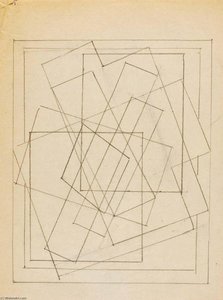
Blanche Lazzell’s artistic style evolved relentlessly throughout her career, moving from representational painting towards increasingly abstract compositions. Her work is characterized by a harmonious blend of geometric forms, floral motifs, and vibrant color palettes. Notable pieces like “Non Objective (b),” “Petunias II,” and numerous untitled abstract sketches exemplify this evolution. She was among the first American artists to wholeheartedly embrace non-objective art in both painting and printmaking, fearlessly pushing boundaries and challenging conventional notions of artistic representation.
Lazzell’s innovative white-line woodcuts were not merely technical achievements; they were expressions of a deeply felt aesthetic vision. Her courage to explore abstraction at a time when it was still considered radical positioned her as a pivotal figure in American Modernism, particularly as one of the first women to champion this new artistic language. Despite her significant contributions, Lazzell’s work remained largely overlooked during her lifetime and for decades after her death in 1956. However, recent exhibitions and scholarly attention have begun to rectify this historical oversight, recognizing her as a vital force in American art history—a true pioneer who carved a path for future generations of abstract artists.
Major Achievements & Recognition
- Pioneering White-Line Woodcut Technique: Developed and popularized the innovative white-line woodcut method, expanding the possibilities of color and detail in printmaking.
- Early Embrace of Abstraction: Among the first American artists to fully commit to non-objective art in both painting and printmaking.
- Founding Member of Provincetown Printers: Played a key role in establishing a significant artistic collective that fostered experimentation and innovation.
- Influence on American Modernism: Contributed significantly to the development of American Modernist art, bridging European influences with a uniquely American sensibility.