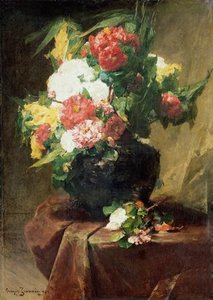
The Luminous Legacy of Georges Jeannin
In the heart of Paris, during the golden twilight of the Belle Époque, there lived an artist who possessed the rare ability to freeze the fleeting breath of nature upon canvas. Georges Jeannin (1841–1925) was not merely a painter of objects, but a poet of light and botanical grace. Born in Paris, his life unfolded amidst a city undergoing profound artistic metamorphosis. While the revolutionary spirit of Impressionism began to reshape the art world, Jeannin carved out a niche that married the meticulous precision of classical training with a modern sensitivity to atmosphere. His work serves as a quiet, enduring testament to an era where beauty was celebrated through the delicate observation of the natural world.
Jeannin’s artistic foundation was built upon rigorous discipline, having studied under the esteemed Victor Vincelet. This formal education instilled in him a profound respect for botanical anatomy, a trait that would become the hallmark of his oeuvre. However, he was far from a rigid academician. As the influence of luminaries like Claude Monet and Pierre-Auguste Renoir permeated the Parisian art scene, Jeannin began to infuse his still lifes with a newfound luminosity. He mastered the art of applying thin, translucent layers of oil paint, meticulously blending tones to capture the velvet texture of a rose petal or the dewy skin of a ripening peach. His technique allowed light to seemingly emanate from within the canvas, creating an ethereal quality that transcends simple representation.
A Symphony of Flora and Fruit
To gaze upon a Jeannin masterpiece is to enter a sanctuary of tranquility. His compositions often feature a graceful arrangement of seasonal treasures—lilies, chrysanthemums, roses, and peonies—interspersed with the rustic charm of grapes and peaches. There is a rhythmic harmony in how he places each element; nothing feels accidental. Instead, each stem and leaf contributes to a larger narrative of abundance and ephemeral beauty. His ability to render the subtle gradations of color—the softest blush of a peony or the deep, bruised purple of a grape—demonstrates a mastery over the spectrum that few of his contemporaries could match.
Beyond the mere depiction of flora, Jeannin’s work explores the interplay between shadow and radiance. He utilized soft, directional lighting to sculpt his subjects, giving them a three-dimensional presence that invites the viewer to reach out and touch the silkiness of a petal. This careful manipulation of light does more than illuminate; it evokes a sense of time passing, capturing a moment of perfection before the inevitable wilt. His paintings are not just still lifes; they are meditations on the transient nature of life itself, rendered with an exquisite, almost tactile, tenderness.
Recognition and Historical Eminence
The excellence of Jeannin’s vision did not go unnoticed by the prestigious institutions of his time. From 1875, he became a regular presence at the Paris Salon, contributing works that garnered significant acclaim. His dedication to his craft led to numerous accolades, including being named a member of the Sociétaire des Artistes Français in 1887 and receiving the prestigious honor of Chevalier de la Légion d’honneur in 1903. His influence extended into the very fabric of Parisian civic life; notably, he collaborated with the artist Cesbron to decorate the Salon de Passage at the Paris Hôtel de Ville, leaving a lasting mark on the city's architectural splendor.
Today, the historical significance of Georges Jeannin lies in his ability to bridge the gap between the meticulous detail of the old masters and the atmospheric freedom of the modern era. His works are preserved in esteemed collections across the globe, including:
- The Petit Palais in Paris
- The Ulster Museum
- Museums in Nancy, Mulhouse, and Rouen
- Various state-owned collections throughout France
As we look back upon his career, we find an artist who did not seek to disrupt the world with chaos, but rather to refine it through observation. Georges Jeannin remains a master of the delicate, reminding us that there is profound, monumental beauty to be found in the smallest bloom and the simplest fruit.
질의응답
Georges Jeannin의 출생지와 출생 연도는 언제인가요?
Georges Jeannin은(는) 1841년 Paris에서 태어났습니다.
Georges Jeannin은(는) 어느 시대에 활동했나요?
Georges Jeannin은(는) 19th Century 시대에 활동했습니다. 이 시기는 역사적 맥락에서 작가의 활동 위치를 보여줍니다.
Georges Jeannin의 작품 세계는 시간이 흐름에 따라 어떻게 변화했나요?
Georges Jeannin의 작품 세계를 시간순으로 정리한 기록은 아티스트 연대기 페이지에서 확인하실 수 있으며, 이곳에서는 각 시기별로 분류된 챕터를 따라 작품들을 제작 순서대로 만나보실 수 있습니다.
Georges Jeannin 작가의 출신 국가는 어디인가요?
Georges Jeannin은(는) France에서 태어났습니다.
Georges Jeannin 작가 작품의 컬러 프로필은 어디에서 확인할 수 있나요?
본 웹사이트에 등록된 작품 전반에 나타나는 Georges Jeannin의 색채 활용은 작가의 팔레트 지놈 페이지에서 확인하실 수 있습니다.
Georges Jeannin의 작품을 분위기별로 찾아볼 수 있나요?
Georges Jeannin의 무드 룸는 작가의 작품들을 분위기별로 모아볼 수 있는 페이지입니다.
Georges Jeannin의 출생 도시와 국가는 어디인가요?
Georges Jeannin은(는) France의 Paris에서 태어났습니다.