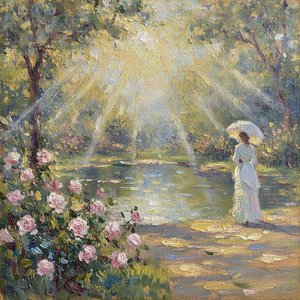
The Quiet Legacy of Hugo Löffler
In the grand tapestry of late nineteenth-century European art, certain names resonate with a profound, quiet strength, capturing the fleeting essence of an era in transition. Hugo Löffler, born in 1859, stands as a testament to this period of meticulous observation and atmospheric depth. While his name may not command the immediate roar of the avant-garde movements that sought to shatter tradition, his work embodies a sophisticated mastery of form and light that speaks directly to the soul of the classical tradition. His life, spanning from the mid-Victorian era through the tumultuous shifts of the early twentieth century until his passing in 1935, was defined by a commitment to the enduring beauty found within the natural world and the structured elegance of human composition.
Löffler’s artistic journey was one of disciplined refinement. Emerging from the established traditions of his time, he developed a technique that prioritized the interplay of shadow and luminosity. His canvases often serve as windows into a serene, almost meditative reality, where every brushstroke is calculated to evoke a specific mood. There is an inherent intimacy in his approach; he did not merely paint subjects, but rather sought to capture their very breath. Through a careful application of pigment, Löffler was able to imbue his landscapes and studies with a sense of permanence, making the ephemeral moments of light and weather feel as though they were etched into the fabric of time itself.
Technique and Artistic Vision
The brilliance of Löffler’s oeuvre lies in his ability to balance technical precision with emotional resonance. His mastery over texture allowed him to recreate the tactile qualities of the world—the roughness of bark, the softness of mist, and the reflective clarity of water. This dedication to verisimilitude was not merely an exercise in imitation but a way to deepen the viewer's connection to the subject matter. By focusing on the subtle gradations of tone, he created compositions that possess a remarkable sense of depth and atmosphere.
His development as an artist can be viewed through several key thematic lenses:
- The Mastery of Light: Löffler possessed an uncanny ability to capture the "golden hour," utilizing warm, diffused light to soften edges and create a nostalgic, dreamlike quality.
- Structural Composition: Even in his most atmospheric works, there remains a rigorous underlying structure, ensuring that his paintings possess a balanced and harmonious weight.
- Naturalistic Detail: His work reflects a deep reverence for the organic world, where botanical and geological details are rendered with both scientific accuracy and poetic grace.
Historical Significance and Enduring Impression
As the art world moved toward the fragmented perspectives of Modernism, Löffler remained a steadfast guardian of the classical aesthetic. This steadfastness allowed his work to serve as a vital bridge between the academic rigor of the past and the burgeoning interest in atmospheric impressionism. His significance lies not in the disruption of tradition, but in its elevation. He proved that there is infinite complexity to be found within the traditional modes of representation if one possesses the vision to look closely enough.
Today, the works of Hugo Löffler continue to captivate collectors and historians alike. They offer a sanctuary of stillness in an increasingly frenetic world. To stand before a Löffler painting is to enter a space of quiet contemplation, where the boundaries between the observer and the observed begin to blur. His legacy remains etched in the subtle textures and enduring light of his canvases, reminding us that true artistry lies in the ability to find the extraordinary within the ordinary.