

Paveikslėlyje: · Su rėmu:
 Peržiūrėti realaus dydžio版
 Pasidalinti
 Dalintis
 Išsamiau
 Vadovas

 Atsisiųsti
 Panašūs eksponatai
 Rentgeno spindulių nuotrauka
 Automatinė diorama
 问答
问答 Statistika
- 34.0 x 41.0 cm


€ 240
Rankų darbo aliejinės reprodukcijos
Rankiniu būdu tapytas aliejus ant droblio jūsų pageidaujamame dydį ir rėmuose – tai mūsų menininkų pagal užsakymą sukurtas darbas. ( Perjungti į spausdinamus版作品 Perejti prie skaitmeninių vaizdų)
Dydis
·Standartinis dydis
pagal užsakymą
CM
INCH
Pasirinkite iš mūsų nustatytų dydžių, atitinkančių originalaus meno kūrinio proporcijas.
Kraunami dydžiai...

plotis
aukštis
Įveskite jums reikiamą plotį ir aukštį, kad paveikslas atitiktų jūsų rėmą ar sieną. Kadangi šis darbas yra rankinio darbo, siekiant išgauti kitokios formos dydį, paveikslas gali būti šiek tiek didesnis (nuo kraštų bus palikta daugiau erdvės) arba mažesnis – pasirinkite jums patogiausią variantą. Prieš pradedant tapyti, atsiųsime jums skaitmeninį maketą patvirtinimui. Šioje puslapio nuotraukoje matomas vaizdas nėra galutinis rezultatas – jį parodys tik sukurtas maketas.
 Skaityti daugiau
Baigiamasis etapas
·
Baltas apasutojimas €1

Išblėstantis šonas €1

Išplėstinis €1

P118B €10

P118H €10

P118W €10

P438Z €10

P508JH €12

P508YH €12

P805H €10

P805Z €10

P919BZ €10

P919G €10

P919XJ €10

P959ZH €10

P968JZ €12

W106C €8

W218G €10

W218JH €8

W218Y €10

W307PJ €10

W316G €10

W316PJ €8

W316Y €10

W398PJ €8

W4111J €10

W500HY €15

W500JH €15

W692G €12

W849H €8

W940BG €15

W953PJ €8

H24-GOLD €30

H24-SILVER €30

H36-GOLD €45

H36-SILVER €45
Siunčiama saugiame vamzdelyje, paruošta patys sukomentuoti jūsų rėmeliais.
Virš 105 cm rėmas siunčiamas kaip rinkinys profesionaliam rėmininkui — skaitykite detales.
Papildomos paslaugos
nebūtinaKą apima papildomos paslaugos?
Pavyzdžiai, ką galima pakeisti: pakeisti veidą nuotrauka su klientu; pridėti augintinį (pvz., pakeisti kucingą šuniu); įtraukti paslaptingą žinutę fone; pakeisti fono kraštotvę ar elementus.
Gavus užsakymą, TopImpressionists.com komanda susisieks su klientu el. paštu dėl nurodymų ir pateiks preliminarią maketą.
Gavus užsakymą, TopImpressionists.com komanda susisieks su klientu el. paštu dėl nurodymų ir pateiks preliminarią maketą.
Pristatymas visame pasaulyje () per 3–4 savaites, o ne įprastai – per 5 savaites. (6 lapkritis). Kokybė lieka nepakeičiama.
Apsauginis lakas
Pavadinimo lentelė
Išgraviruotos bronzinės plokštelės detalės
This elegant plaque features the artist's name and the title of the artwork, finely engraved for a timeless presentation.
It is made from bronze with a refined, elegant finish. The text is precisely laser-engraved for a sharp and permanent result. Measuring 9x2 cm, the plaque is compact yet easy to read. It's built to be durable and scratch-resistant, offering a professional, museum-quality look. Mounting is simple thanks to the included adhesive backing.
Skaidrios akrilo plokštelės informacija
The plaque includes essential engraved details such as the artist's name, the title of the artwork, the date it was created, the type of media used-like oil on canvas or watercolor-a brief description of the piece, and a QR code that links to the complete artwork information.
It is crafted from clear acrylic, offering a sleek, modern appearance. The text is UV-engraved in black to ensure strong visual contrast. With a size of 10x15 cm, it ensures optimal readability. It comes equipped with two metal hooks for secure wall mounting. The plaque is designed to be weather-resistant, making it suitable for various environments, and it includes interactive features that work seamlessly with smartphone scanning.
Juodos akrilo plokštelės informacija
This elegant plaque includes engraved information such as the artist's name, the title of the artwork, the date it was created, the type of media used (like oil on canvas or watercolor), a short description of the artwork, and a QR code for quick access to more information.
The plaque itself is made from refined black acrylic with a premium finish. The text is laser-engraved in white for high contrast and readability. Its size is 10x15 cm, designed to be easy to read. It comes with two metal hooks for professional mounting. The design is sleek and fits any interior style. It is also weather-resistant and durable, with built-in digital integration for mobile compatibility.
Stiklo variantas prieinamas tik pasirinkus dydį iki 110 cm
 Stiklo variantas prieinamas tik pasirinkus dydį iki 110 cm
- Nemokamas greitasis pristatymas visame pasaulyje
- Aukštos kokybės lininis drobė
- Pilnas siuntimo draudimas
- Muitinės mokesčių grąžinimo garantija
- Tikro spalvų atitikimo garantija
- 100 dienų grąžinimo politika (tik esant įtaigoms)
- 100% pinigų grąžinimo garantija
- Nuolaida dideliems užsakymams


Kolekcinio objekto aprašas
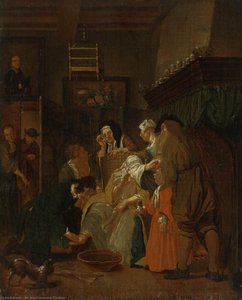
Witness the dramatic genre scene of 'Operation' by Jan Josef Horemans the Elder (1740), capturing 18th-century life with urgent realism; discover this masterpiece today.
Autoriaus biografija
Discover Jan Josef Horemans the Elder’s captivating genre scenes & medical studies! Belgian painter (1682-1759) known for detailed interiors & anatomical precision.
Apie paveisdelį
A Glimpse into Domestic Crisis: The Scene of Operation
This evocative painting transports us directly into an intimate moment of profound vulnerability—a domestic scene centered around a medical procedure. One can almost hear the hushed urgency in the air, the collective breath held by those gathered around the prone figure on the floor. The composition is rich with human drama; several figures cluster closely, their gestures suggesting focused concern and practiced activity. Objects scattered within the room—bowls, cups, and the simple presence of a chair—are not mere props but integral components of this narrative tableau. It speaks to a time when medicine was both rudimentary and deeply personal, played out within the confines of a private dwelling.
The Hand of Jan Josef Horemans the Elder
Painted around 1740 by Jan Josef Horemans the Elder, this work places us firmly in the milieu of 18th-century Flemish genre painting. Horemans was renowned for his meticulous chronicling of daily life in Antwerp; he possessed an eye that captured the texture of bourgeois existence with almost photographic precision. His style marries a detailed realism with a subtle Baroque sensibility, allowing him to elevate everyday occurrences into moments imbued with narrative weight. To own a reproduction of this piece is to acquire not just a painting, but a tangible connection to the daily rhythms and anxieties of life in the early 18th century.
Technique and Compositional Drama
Observe the masterful handling of light within the room; it seems to illuminate the critical action while leaving corners steeped in suggestive shadow. Horemans employs a rich palette characteristic of the period, allowing the viewer's eye to wander across the varied textures—the folds of clothing, the sheen on the objects, and the pale skin of the woman at the center. The inclusion of the two birds, one high in the corner and another near the floor, adds an unexpected layer of natural symbolism, perhaps representing life observing humanity’s struggle or simply serving as delicate compositional anchors that draw the eye through the scene.
Symbolism and Emotional Resonance for the Modern Collector
Beyond its historical documentation, this artwork resonates with universal themes: caregiving, fragility, and the human instinct to heal. For the collector or interior designer, it offers a powerful focal point—a piece that commands attention while inviting quiet contemplation. It speaks eloquently of community support during times of crisis. Reproducing such a work allows one to bring an atmosphere of thoughtful drama into a modern space, suggesting depth, history, and the enduring power of human connection.
Klausimai ir atsakymai
Kaip „Operation“ – Jan Josef Horemans The Elder sujungia Baroque su autoriaus gimtinė?
„Operation“ sujungia Baroque stilių su Belgium, atspindėdama kūrėjo gimimo vietą.
Kam rekomenduojamas naudojimui „Operation“ – Jan Josef Horemans The Elder?
Rekomenduojamas „Operation“ spausdinio naudojimas yra Focal.
Kokia spausdinimo konfigūracija rekomenduojama kūriniui „Operation“ – Jan Josef Horemans The Elder?
Medium dydis, Portrait orientacija: tai rekomenduojamas spausdinimo nustatymas kūriniui „Operation“ – Jan Josef Horemans The Elder.
Trumpos faktinės datos ir meno viktorina
Apie Jan Josef Horemans The Elder

Jan Josef Horemans The Elder
1682 - 1759, Belgium
Autoriaus biografija
A Chronicler of Antwerp Life: Jan Josef Horemans the Elder
Jan Josef Horemans the Elder, born in Antwerp in 1682 and passing away in the same city in 1759, stands as a fascinating figure within the tapestry of 18th-century Flemish painting. While not achieving the widespread renown of some contemporaries, his meticulous genre scenes offer an invaluable glimpse into the daily existence of bourgeois life in Antwerp during a period of significant social and economic change. He wasn’t merely recording what he saw; Horemans was crafting narratives, small windows into the habits, anxieties, and quiet dramas unfolding within the homes and streets of his native city. His work provides a unique historical record, painted with a precision that borders on photographic realism yet imbued with a distinctly Baroque sensibility.Early Life and Artistic Formation
Horemans’s artistic journey began in 1694 when he was registered as an apprentice at the Antwerp Guild of Saint Luke, initially under the tutelage of the sculptor Michiel van der Voort the Elder. This early exposure to sculpture likely instilled a keen understanding of form and three-dimensionality that would later manifest in his carefully constructed compositions. He subsequently moved into the studio of Jan van Pee, where he honed his skills as a painter. In 1706, Horemans achieved master status within the Guild, marking a pivotal moment in his career. A year later, he solidified both his personal and professional life through marriage to Maria Francisca van der Voort, the daughter of his first mentor. This familial connection would prove significant, as his son, Jan Josef Horemans the Younger, also followed in his artistic footsteps, creating a legacy that spanned generations. The elder Horemans’s commitment to his craft was further demonstrated by his role as a teacher, guiding both his younger brother Peter Jacob and his son along their own creative paths.The World Within Walls: Themes and Style
Horemans carved out a niche for himself with his genre scenes – intimate depictions of everyday life. Unlike the grand historical or religious paintings that dominated much of the artistic landscape, Horemans focused on the domestic sphere. Interiors teeming with activity—families sharing meals, merchants conducting business, children at play—became his signature subject matter. He also ventured into portraiture and allegorical works, but it was in these smaller, anecdotal scenes that his talent truly shone. His style is characterized by a remarkable attention to detail; objects are rendered with painstaking accuracy, fabrics shimmer with texture, and faces convey subtle emotions. However, Horemans’s palette tended towards darker tones—a characteristic that earned him the nicknames “le brun” (the dark one) and “le sombre” (the shadowy one), distinguishing his work from that of his son, who favored a lighter approach. Despite this somewhat somber coloration, his paintings are far from bleak; they possess a lively energy, capturing the bustle and vibrancy of Antwerp life.Influences and Legacy
While Horemans developed a distinctly personal style, he was undoubtedly influenced by the 17th-century Flemish genre painters who preceded him—artists like Pieter Bruegel the Younger and David Teniers the Younger. He inherited their penchant for detailed observation and narrative storytelling but infused his work with a more refined elegance and a greater emphasis on contemporary subject matter. His paintings reflect a shift in artistic focus, moving away from purely moralistic or allegorical themes towards a more straightforward depiction of everyday reality. The sheer volume of small paintings he produced—often executed as part of larger series—suggests a thriving market for his work among the burgeoning bourgeois class. Horemans’s legacy extends beyond his individual artworks; he is remembered as a leading chronicler of 18th-century Antwerp, providing an invaluable visual record of a society undergoing transformation. His son, Jan Josef Horemans the Younger, continued this tradition, further solidifying the family's place in Flemish artistic history.Historical Significance and Modern Appreciation
Today, Jan Josef Horemans the Elder is increasingly recognized for his unique contribution to Flemish painting. While he may not be a household name, his work offers a compelling window into a specific time and place—a world of bustling commerce, domestic intimacy, and subtle social dynamics. His paintings are prized by collectors and scholars alike for their meticulous detail, narrative richness, and historical significance. The fact that over 300 artworks attributed to him have appeared at auction speaks to the enduring appeal of his vision. Horemans’s scenes aren't merely decorative; they are social documents, offering insights into the material culture, customs, and values of 18th-century Antwerp. He stands as a testament to the power of genre painting—a reminder that even the most seemingly mundane subjects can reveal profound truths about the human condition. His ability to capture the essence of everyday life with such precision and sensitivity ensures his continued relevance in the world of art history.Trumpa informacija apie Jan Josef Horemans The Elder
- Full Name: Jan Josef Horemans the Elder
- Nationality: Flemish
- Date Of Birth: 1682
- Date Of Death: 1759
- Place Of Birth: Antwerp, Belgium
- Notable Artworks:
- Operation
- At the Painter's Studio
- Operations in a Surgery
- Artistic Movement Or Style: Genre scenes, portraits
- Artists Who Influenced This Artist: ['Michiel van der Voort']
- Artists Or Movements Influenced By This Artist: ['Rubens']
Jan Josef Horemans The Elder
Operation
() ·
Su rėmu: · Rankiniu būdu tapyta aliejumi ant lineno
Viso suma