Atelieris — Nemokamas pristatymas visame pasaulyje — Pristatymo laikas – 2–6 savaitės
      Donatelo, 1386 – 1466

      Donatelo: 100 žymiausi paveiksliai

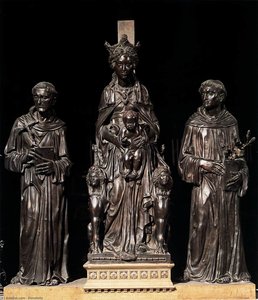
      Iš visų Donatelo paveikslų garsiausias yra Madona su Šeimele tarp Šv. apaštalo Pranciškaus ir Šv. Antano (1448); jis eksponuojamas Sant'Antonio bazilika, Paduva. Net už jų seka Cantoria (1439) ir Sužaidimas (1447). Iš 148 Donatelo kūrinių mūsų kataloge šie 100 yra garsiausi – kiekvienas su datą, muziejų ir istoriją nurodančia informacija.

      Rango vieta nulegiama pagal mūsų populiarumumo balas, kurią sudaro kiekvieno kūrinio paieškos, apsilankėjimai ir užsakėjimai. Atnaujinta lapkritis 2026. Kiekvieną šioje pusėje esantį paveikslą galite užsisakyti kaip rankų darbą – aliejuje ant lino drobos atspirtį, arba kaip aukščiausios kokybės meninį spausdinį, pagamintą jūsų pasirinktu dydžiu.

      Donatelo portretas
      Donatelo · 1386 – 1466
      Gedė · mirė
      1386 – 1466, Florencija
      Judėjimas
      Early renaissance
      Darbai mūsų kataloge
      148
      Labiausiai žinomi
      Madona su Šeimele tarp Šv. apaštalo Pranciškaus ir Šv. Antano (1448)
      Daugiausia darbų –
      Museo dell'Opera del Duomo

      10 garsiausių Donatelo paveikslų

      Madona su Šeimele tarp Šv. apaštalo Pranciškaus ir Šv. Antano (1448) aut. Donatelo
      1

      Madona su Šeimele tarp Šv. apaštalo Pranciškaus ir Šv. Antano

      1448 · Bronza · Sant'Antonio bazilika, Paduva

      Italijos Renesanso širdyje, kur senovės šešalybė susitiko su besivystančiu humanizmo šviesos spinduliu, Donatelas įdievino metalą savo šedevru – Madona su Šeimele tarp Šv. apaštalo Pranciškaus ir Šv. Antano. Sukurta apie 1448 m., ši gili bronzinė skulptūra yra langas į nepanašų dvasinį ir meno transformacijos laikotarpį. Kompozicija yra simetriškos elegancijos meistriškumas; centre, Trečia Maryje glabuoja kūdikių Kristų, šalia kurios stovi gerbiamos Šv. Pranciškaus iš Asizijos ir Šv. Antano Abbato figūros. Šis…

      Cantoria (1439) aut. Donatelo
      2

      Cantoria

      1439 · Marmuras · Museo dell'Opera del Duomo, Firenka

      Stovėti priešais Donatello kūrinį „Cantoria“ yra tarsi stebėti akimirką, kai Renesansas pajautė savo pulso ritmą. Baigtas maždaug 1439 metais Florencijos Santa Maria del Fiore katedrai, šis monumentalus marmuro reliefas yra kur kas daugiau nei tiesiog funkcinė dainuotojų galerija; tai kvapą gausi judesio ir dvasinės ekstazės išsiveržimas. Nors didžioji to laikotarpio skulptūra vis dar buvo siejama su statišku, formaliu Bizantijos stiliaus tradicijomis, Donatello išsivenė iš šių rėgžių, į savo marmurą įliejęs…

      Sužaidimas (1447) aut. Donatelo
      3

      Sužaidimas

      1447 · Aliejus ant drobės · Sant'Antonio bazilika, Paduva

      Stovėti priešais Donatello Erdiniamųjų pavyzdį yra sava manera pasinerti į liūdesio atmosferą, kuri yra tokia tanki, kad ji tampa beveik lytėja. Ši scena peržengia paprasto pasakojimo iliustracijos ribas; tai gili meditacija apie praradimą, aukojimą ir solemnią žmogaus atsidavimą. Kompozicija įtraukia žiūrovą į neįtikėtinos tragedijos akimirką. Jėzus Kristus gulio ne tik kaip pagrindinis vaizdo objektas, bet kaip stilingas ir tylus centras, aplink kurį sukliūto visos aplinkos emocijos. Figūrų skaičius – šio…

      Ranku tapyta aliejaus reprodukcija nuo $195 28 × 36 cm Pusė kaip originalo $1005 139 × 188 cm Užsakyti originalų dydį →
      Atonuojančio sūnaus stebuklas (1447) aut. Donatelo
      4

      Atonuojančio sūnaus stebuklas

      1447 · Akrilas · Sant'Antonio bazilika, Paduva

      Donatello’s bronze sculpture, "Miracle of the Repentant Son," transcends mere representation; it's a profound meditation on faith, remorse, and divine grace. Created in 1447 during the apex of his artistic maturity, this work embodies the burgeoning humanism and emotional depth that defined the Early Renaissance in Florence. More than just a depiction of a biblical miracle – the restoration of a severed limb by St. Anthony – it’s a study…

      Ranku tapyta aliejaus reprodukcija nuo $195 23 × 43 cm Pusė kaip originalo $391 57 × 123 cm Užsakyti originalų dydį →
      Mečytas (1412) aut. Donatelo
      5

      Mečytas

      1412 · Akrilas ant drobės · Santa Croce, Florencija

      Donatello's 1412 Crucifix, housed within the Basilica of Santa Croce in Florence, isn’t merely a depiction of Christ on the cross; it’s a visceral experience. This early Renaissance masterpiece transcends simple representation, plunging the viewer into the heart of Christian theology and embodying the profound tension between suffering and redemption. Crafted from richly-toned pearwood, the sculpture immediately commands attention with its remarkably realistic portrayal of the human form – a…

      Ranku tapyta aliejaus reprodukcija nuo $245 26 × 38 cm Pusė kaip originalo $1149 168 × 173 cm Užsakyti originalų dydį →
      Pradū̃s (1435) aut. Donatelo
      6

      Pradū̃s

      1435 · Akrilas ant drobės · Santa Croce, Florencija

      Donatelo 1435 metų „Pradū̃s“, esantis Florancijos Santa Croce bazilikoje, nėra tik biblijinio akimirkos vaizdas; tai gili meditacija apie malonę, pokląpybę ir transformuojančią tikėjimo galią. Užsisakytas svarbiu meno inovacijų laikotarpiu – jungiančiu gotikos ir renesanso eras – ši skulptūra įkūnija revoliucinį Donatelo požiūrį į humanizmą ir jo meistrišką klasikos formų valdymą. Scena atsivelo su intrigingu tiesumu: Marija, sėdinti ant paprasto suoliuko, gauna supainiojančią žinią nuo žiebtriau angelas Gabrieliaus. Kompozicija nėra grandioziškai…

      Ranku tapyta aliejaus reprodukcija nuo $195 26 × 39 cm Pusė kaip originalo $1340 168 × 218 cm Užsakyti originalų dydį →
      Šv. Jerono (detalė) (1416) aut. Donatelo
      7

      Šv. Jerono (detalė)

      1416 · Marmuras · Museo Nazionale del Bargello, Firenka

      The marble figure of St. George, sculpted by Donatello around 1416, stands as more than just a depiction of a saint; it's a pivotal moment in the evolution of Renaissance sculpture – a testament to the artist’s innovative spirit and his profound understanding of human form and narrative. Originally gracing the north wall of Orsanmichele, Florence’s imposing guildhall, this statue immediately captivated viewers with its dynamic energy and strikingly realistic…

      Herodo puota (1427) aut. Donatelo
      8

      Herodo puota

      1427 · Bronza · Sienos krikščytojų namai, Siena

      Donatello's Herod’s Banquet, crafted around 1427 for the baptismal font of Siena’s San Giovanni Baptistery, isn’t merely a depiction of a biblical episode; it’s a profound meditation on power, betrayal, and the chilling consequences of unchecked ambition. Commissioned amidst the competitive fervor of Renaissance Florence and Siena, this bronze relief stands as a testament to Donatello's burgeoning mastery – a pivotal work that showcases his innovative approach to sculpture and…

      Barzatusis Prorokas (1418) aut. Donatelo
      9

      Barzatusis Prorokas

      1418 · Bronza · Museo dell'Opera del Duomo, Firenka

      In the heart of the Florentine Renaissance, where the shadows of antiquity began to dance with the light of new humanism, Donatello breathed life into bronze with his Bearded Prophet. Created around 1418, this monumental figure is far more than a mere sculpture; it is a profound meditation on the weight of divine knowledge and the solemnity of faith. As one gazes upon the weathered surface of the bronze, there…

      Šventasis apaštinas Jonas Evangelistas (1415) aut. Donatelo
      10

      Šventasis apaštinas Jonas Evangelistas

      1415 · Marmuras

      St. John the Evangelist is a marble sculpture created by the artist Donatello. Dated 1410, this work depicts one of the twelve apostles of Jesus. The subject is rendered as an elderly man, presented with a face etched with lines and a gaze that suggests a state of contemplation and wisdom. This choice of representation presents the figure as a philosopher-like individual.

      Donatelo tapiai, iš rango nuo 11 iki 100

      Šventasis Markas (1411) aut. Donatelo
      #11

      Šventasis Markas

      1411 · Orsanmichele

      Within the echoing halls of Orsanmichele in Florence, stands Donatello's sculpture of St. Mark – more than just a depiction of a biblical figure; it is a profound…

      Pranokėlis su pergamentu (detalė) (1418) aut. Donatelo
      #12

      Pranokėlis su pergamentu (detalė)

      1418 · Museo dell'Opera del Duomo

      To stand before this detail of a prophet is to encounter a moment suspended in time—a profound echo from the heart of the Italian Renaissance. The marble itself,…

      Šventasis Jonas Patmos saloje (1428) aut. Donatelo

      Šventasis Jonas Patmos saloje – tai stulbinantis Renesanso meno pavyzdys, sukurtas 1428 metais garsiojo meistro Donatelo ranko. Šis šedevras yra tikras Donatelo meistriškumo ir lėidimo įžvalgumo įrodymas, demonstruojantis…

      David (detail) (1409) aut. Donatelo
      #14

      David (detail)

      1409 · Museo Nazionale del Bargello

      To stand before this detail of Donatello's David is to encounter not merely a sculpture, but a profound meditation on nascent heroism. The marble seems to breathe with…

      Pietà (1447) aut. Donatelo
      #15

      Pietà

      1447 · Sant'Antonio bazilika

      In the quiet sanctity of the Basilica di Sant’Antonio in Padua, there exists a moment frozen in bronze, a profound intersection of divine tragedy and human vulnerability. Donatello’s…

      Pulpit (on the right) (1465) aut. Donatelo
      #16

      Pulpit (on the right)

      1465 · San Lorenzo

      In the hallowed, sun-drenched silence of the Basilica of San Lorenzo in Florence, there exists a sculptural marvel that captures the very essence of a soul nearing its…

      Prophet Jeremiah (1423) aut. Donatelo
      #17

      Prophet Jeremiah

      1423 · Museo dell'Opera del Duomo

      To stand before Donatello’s Prophet Jeremiah is to encounter not merely carved stone, but the very weight of human contemplation. This marble masterpiece transports us into a moment…

      Prophet Habakkuk (1427) aut. Donatelo
      #18

      Prophet Habakkuk

      1427 · Museo dell'Opera del Duomo

      In the heart of Florence, within the hallowed halls of the Museo dell'Opera del Duomo, stands a figure that seems to breathe with the weight of centuries. Donatello’s…

      Pulpit (1438) aut. Donatelo
      #19

      Pulpit

      1438 · Prato katedros muziejus

      The Pulpit by Donatello emerged from the stone and the shared vision of a workshop. In 1438, the artist completed this marble structure, working alongside collaborators Michelozzo and…

      Miracle of the New-born Child (detail) (1447) aut. Donatelo
      #20

      Miracle of the New-born Child (detail)

      1447 · Sant'Antonio bazilika

      This bronze detail captures an aged figure rendered with profound realism. The sculpture focuses on the upper torso and head, where deep wrinkles and facial contours convey experience…

      Miracle of the Ass (1447) aut. Donatelo
      #21

      Miracle of the Ass

      1447 · Sant'Antonio bazilika

      In the heart of the Italian Renaissance, amidst the burgeoning humanism of Florence, Donatello breathed life into metal with his 1447 masterpiece, The Miracle of the Ass. This…

      Cantoria (detail) (1439) aut. Donatelo
      #22

      Cantoria (detail)

      1439 · Museo dell'Opera del Duomo

      The “Cantoria,” or Singing Gallery, crafted by the towering figure of Donatello between 1439 and 1440, isn't merely a decorative element within Florence’s Duomo; it’s an immersive experience,…

      Pulpit (detail) (1438) aut. Donatelo
      #24

      Pulpit (detail)

      1438 · Museo dell'Opera del Duomo

      To look closely at this detail from the pulpit is to witness a quiet revolution in stone. The marble figures emerge from their setting with a sense of…

      Christ before Pilate and Caiaphas (1460) aut. Donatelo
      #25

      Christ before Pilate and Caiaphas

      1460 · San Lorenzo

      Donatello's 1460 bronze sculpture, “Christ Before Pilate and Caiaphas,” stands as a monumental achievement within the burgeoning artistic landscape of the Italian Renaissance. Housed in the San Lorenzo…

      David (1409) aut. Donatelo
      #26

      David

      1409 · Museo Nazionale del Bargello

      To stand before Donatello’s David is not merely to observe a sculpture; it is to witness a suspended moment of profound human potential. Carved from luminous marble, this…

      St George and the Dragon (1416) aut. Donatelo
      #27

      St George and the Dragon

      1416 · Museo Nazionale del Bargello

      Gazing upon this marble bust is to confront a moment frozen in time—a powerful confluence of classical revivalism and raw human emotion. The subject, rendered with breathtaking verisimilitude,…

      Saint George (1417) aut. Donatelo
      #28

      Saint George

      1417 · Museo Nazionale del Bargello

      In the heart of Florence, where the echoes of the Quattrocento still resonate through the cobblestone streets, stands a figure of unparalleled poise and quiet strength. Donatello’s Saint…

      St John the Evangelist (detail) (1410) aut. Donatelo
      #29

      St John the Evangelist (detail)

      1410 · Museo dell'Opera del Duomo

      Donatello's “St John the Evangelist (detail),” a remarkably preserved marble sculpture created around 1410-1411, stands as a pivotal work in the transition from the late Gothic to the…

      St John the Evangelist (1410) aut. Donatelo
      #30

      St John the Evangelist

      1410 · Museo dell'Opera del Duomo

      St John the Evangelist is a marble sculpture created by the artist Donatello. The work is dated 1410. It depicts one of the twelve apostles of Jesus, specifically…

      North pulpit (1460) aut. Donatelo
      #33

      North pulpit

      1460 · San Lorenzo

      To stand before the North Pulpit is to witness a profound moment in the evolution of Western art, where the rigid structures of the Middle Ages began to…

      David (1430) aut. Donatelo
      #35

      David

      1430 · Museo Nazionale del Bargello

      Michelangelo’s “David,” a colossal marble sculpture residing within the Galleria dell’Accademia in Florence, isn't merely a depiction of a biblical hero; it’s an embodiment of human potential, a…

      Atneškite šį šviesą į savo namus nuo $195 →
      Miracle of the Avaricious Man's Heart (1447) aut. Donatelo
      #37

      Miracle of the Avaricious Man's Heart

      1447 · Sant'Antonio bazilika

      Within the hallowed, sun-drenched walls of the Basilica di Sant’Antonio in Padua, there exists a moment frozen in time, a bronze whisper of the divine captured by the…

      Allegoric Figure of a Boy (Atys), rear view (1430) aut. Donatelo
      #38

      Allegoric Figure of a Boy (Atys), rear view

      1430 · Museo Nazionale del Bargello

      To stand before an image evoking this bronze figure is to feel the very breath of the Renaissance wind against one's skin. This depiction, titled Allegoric Figure of…

      St George (detail) (1416) aut. Donatelo
      #39

      St George (detail)

      1416 · Museo Nazionale del Bargello

      In the heart of Florence, within the hallowed halls of the Museo Nazionale del Bargello, resides a fragment of eternal courage. Donatello’s St. George, specifically captured in this…

      Cantoria (detail) (1439) aut. Donatelo
      #40

      Cantoria (detail)

      1439 · Museo dell'Opera del Duomo

      In the heart of Florence, within the hallowed halls of the Museo dell’Opera del Duomo, lies a fragment of divine ecstasy known as the Cantoria. Created by the…

      Equestrian Statue of Gattamelata (11) (1447) aut. Donatelo
      #41

      Equestrian Statue of Gattamelata (11)

      1447 · Piazza del Santo

      In the Equestrian Statue of Gattamelata (11) by Donatello, the bronze figure of Erasmo da Narni emerges with a commanding presence. Known to history as Gattamelata, the man…

      Marzocco (1419) aut. Donatelo
      #43

      Marzocco

      1419 · Museo Nazionale del Bargello

      In the heart of the Renaissance, amidst the political tremors and cultural rebirth of 15th-century Florence, Donatello breathed life into stone to create one of the city's most…

      Herod's Banquet (detail) (1427) aut. Donatelo
      #46

      Herod's Banquet (detail)

      1427 · Sienos krikščytojų namai

      In the hallowed, quiet corridors of the Siena Baptistery, there exists a moment frozen in time, captured not in paint, but in the enduring strength of bronze. Donatello’s…

      Miracle of the Avaricious Man's Heart (detail) (1447) aut. Donatelo
      #47

      Miracle of the Avaricious Man's Heart (detail)

      1447 · Sant'Antonio bazilika

      Created in 1447 for the Basilica di Sant'Antonio in Padua, Italy, this bronze relief captures a moment of profound spiritual tension. The work belongs to a series of…

      Bearded Prophet (detail) (1418) aut. Donatelo
      #48

      Bearded Prophet (detail)

      1418 · Museo dell'Opera del Duomo

      Donatello's "Bearded Prophet" – often referred to as “Pensieroso,” meaning “the Thinker” – stands not merely as a sculpture, but as a profound meditation on humanity’s relationship with…

      Prophet Jeremiah (1423) aut. Donatelo
      #50

      Prophet Jeremiah

      1423 · Museo dell'Opera del Duomo

      Prophet Jeremiah is a marble sculpture created by the artist Donatello. Dated 1423, the work represents a significant religious subject through the depiction of the biblical prophet. The…

      South pulpit (1460) aut. Donatelo
      #51

      South pulpit

      1460 · San Lorenzo

      Donatello’s Passion Pulpit, a monumental bronze ensemble housed within the Basilica of San Lorenzo in Florence, isn’t merely a religious depiction; it’s a visceral embodiment of the artist’s…

      Užsisakykite šį plėtmenį nuo $195 →
      Deposition (1465) aut. Donatelo
      #52

      Deposition

      1465 · San Lorenzo

      Donatello's Deposition, completed in 1465, isn’t merely a sculpture; it’s a profound meditation on loss, faith, and the raw vulnerability of humanity. Carved from rich, burnished bronze –…

      St George (1416) aut. Donatelo
      #53

      St George

      1416 · Museo Nazionale del Bargello

      Donatello’s “St. George,” sculpted in 1416 for the Museo Nazionale del Bargello in Florence, isn’t merely a depiction of a biblical hero; it’s a potent distillation of Renaissance…

      Cantoria (1439) aut. Donatelo
      #54

      Cantoria

      1439 · Museo dell'Opera del Duomo

      Within the hallowed halls of the Museo dell'Opera del Duomo in Florence resides a sculpture that transcends mere stone and marble – it is an embodiment of Renaissance…

      Faith (1427) aut. Donatelo
      #55

      Faith

      1427 · Sienos krikščytojų namai

      Donatello's "Faith," crafted in bronze around 1427-1429 for the baptismal font within Siena Cathedral, stands as a pivotal work bridging the late Gothic and burgeoning Early Renaissance styles.…

      Old Sacristy (1428) aut. Donatelo
      #56

      Old Sacristy

      1428 · San Lorenzo

      To step into the Old Sacristy within the Basilica of San Lorenzo is to leave the chaotic bustle of Florence behind and enter a realm of profound mathematical…

      Prophet with Scroll (1418) aut. Donatelo
      #59

      Prophet with Scroll

      1418 · Museo dell'Opera del Duomo

      Donatello’s “Prophet with Scroll,” crafted between 1415 and 1418, stands as a pivotal work in the burgeoning Early Renaissance of Florence. More than simply a depiction of biblical…

      Prophet Habakkuk (1427) aut. Donatelo
      #61

      Prophet Habakkuk

      1427 · Museo dell'Opera del Duomo

      In the hallowed, sun-drenched halls of the Museo dell'Opera del Duomo in Florence, there exists a figure that seems to breathe with the heavy weight of centuries. Donatello’s…

      Entombment (1465) aut. Donatelo
      #62

      Entombment

      1465 · San Lorenzo

      Donatello's “Entombment,” completed around 1465 in Florence, stands as a monumental achievement within the Early Renaissance—a sculpture that transcends mere representation to embody profound human emotion and theological…

      Lamentation over the Dead Christ aut. Donatelo
      #64

      Lamentation over the Dead Christ

      Victoria and Albert Museum

      The Lamentation over the Dead Christ is a relief panel by the Italian Renaissance sculptor Donatello. This bronze work emerged from a period of intense creation between 1450…

      St George (1416) aut. Donatelo
      #65

      St George

      1416 · Museo Nazionale del Bargello

      Donatello's *Saint George*, sculpted in 1416 during the nascent Renaissance, is more than just a marble statue; it’s a potent distillation of classical ideals interwoven with burgeoning humanist…

      Chellini Madonna, verso aut. Donatelo
      #68

      Chellini Madonna, verso

      Victoria and Albert Museum

      Donatello's "Chellini Madonna," a bronze relief cast in the mid-15th century, stands as a remarkably intimate and profoundly moving work within the artist’s oeuvre. More than simply a…

      St Cosmas and St Damian (1428) aut. Donatelo

      Two figures emerge from an ornate stone backdrop, their presence defined by a quiet, shared intensity. These men, identified as the twin saints Cosmas and Damian, are positioned…

      St Mary Magdalen (1457) aut. Donatelo
      #70

      St Mary Magdalen

      1457 · Museo dell'Opera del Duomo

      St Mary Magdalen is a sculptural work created by the Italian Renaissance sculptor Donatello. This figure is slightly larger than life size and was originally made for the…

      Bust of Niccolo da Uzzano (1430) aut. Donatelo
      #71

      Bust of Niccolo da Uzzano

      1430 · Museo Nazionale del Bargello

      Donatello's 1430s marble bust of Niccolò da Uzzano is more than just a sculpted likeness; it’s a profound meditation on leadership, duty, and the quiet strength required to…

      Crucifixion (1465) aut. Donatelo
      #72

      Crucifixion

      1465 · Museo Nazionale del Bargello

      Created in 1465, the bronze sculpture Crucifixion by Donatello represents a significant moment in the Florentine Renaissance. Commissioned for the Santa Croce Basilica in Florence, the work captures…

      Prophet Habbakuk (1426) aut. Donatelo
      #74

      Prophet Habbakuk

      1426

      To stand before this marble figure is to encounter a man caught in a moment of profound spiritual tension. Created between 1423 and 1426, this sculpture of the…

      The Feast of Herod (1427) aut. Donatelo

      The air in the room feels heavy, thick with the tension of a moment that refuses to pass. Around a central banquet table, figures are caught in a…

      St Stephen and St Lawrence (1428) aut. Donatelo

      The artwork presents two figures positioned within a recessed, arched niche. These figures are rendered in a relief sculpture technique, where the forms emerge from a flat plane…

      Evangelist Mark (1428) aut. Donatelo
      #77

      Evangelist Mark

      1428

      This high-relief marble sculpture captures a moment of quiet scholarly devotion. Within an oval frame, the figure of the Evangelist is seated at a writing desk, his attention…

      Herod's Banquet (1435) aut. Donatelo
      #78

      Herod's Banquet

      1435 · Palais des Beaux-Arts de Lille

      This high-relief marble sculpture depicts a crowded, dramatic biblical scene. The composition is densely packed with figures arranged across multiple planes to create a sense of depth and…

      Funeral Monument to John XXIII (detail) (1435) aut. Donatelo

      The Funeral Monument to John XXIII (detail) is a work by the sculptor Donatello. This specific fragment captures a moment of stillness within a larger funerary structure. It…

      Chellini Madonna, recto aut. Donatelo
      #82

      Chellini Madonna, recto

      Victoria and Albert Museum

      To gaze upon the Chellini Madonna is to step into the very heart of the Florentine Renaissance, where the divine and the human intersect through the masterful hands…

      Hope (1427) aut. Donatelo
      #83

      Hope

      1427 · Sienos krikščytojų namai

      Within the quiet, hallowed space of the Baptistery of San Giovanni in the Siena Cathedral, a figure emerges from the shadows of a shallow marble niche. This is…

      St Mark (1411) aut. Donatelo
      #84

      St Mark

      1411 · Orsanmichele

      In the Orsanmichele of Florence, a marble figure of St Mark emerges from its Gothic niche, marking a departure from the rigid traditions of the Middle Ages. Created…

      St Louis (1413) aut. Donatelo
      #85

      St Louis

      1413 · Museo dell'Opera di Santa Croce

      The sculpture depicts a young man, identified as Saint Louis of Toulouse, rendered in gilded bronze. The figure is positioned in a manner that emphasizes a vertical, slender…

      St Rossore (1425) aut. Donatelo
      #86

      St Rossore

      1425 · Museo Nazionale di San Matteo

      In the quiet presence of Donatello’s St Rossore, one does not merely observe a sculpture; one encounters a profound dialogue between the earthly and the divine. Created around…

      Putti of the trabeation (1428) aut. Donatelo

      The work titled Putti of the trabeation emerged from the hands of Donatello in 1428. It is a piece that carries the specific weight of the artist's early…

      The Sacrifice of Isaac (1418) aut. Donatelo
      #88

      The Sacrifice of Isaac

      1418 · Museo dell'Opera del Duomo

      The Sacrifice of Isaac is a marble sculpture by the Italian Renaissance sculptor Donatello. It captures a heavy biblical episode through the tension of stone. The work depicts…

      Candelabra Angels (1430) aut. Donatelo

      Two cherubic figures emerge from the shadows, frozen in a moment of celestial play. They sit side-by-side upon a white marble pedestal, their bronze bodies catching the light…

      Musician Angels (1447) aut. Donatelo
      #90

      Musician Angels

      1447 · Sant'Antonio bazilika

      In the hallowed stillness of the Basilica of Saint Anthony in Padua, there exists a moment where time seems to suspend itself, captured forever in the shimmering bronze…

      Virgin and Child (1420) aut. Donatelo
      #91

      Virgin and Child

      1420 · Museo Bardini

      This terracotta sculpture, dated to 1420, presents the Virgin Mary seated within an ornate, architectural archway. The figure of the Virgin is positioned centrally, her body draped in…

      Door with the representation of Apostles (1440) aut. Donatelo

      Created around 1440, these bronze doors represent a departure from the decorative traditions of the early Renaissance. The work features twenty panels depicting the forty Apostles and Doctors…

      Door with the representation of Martyrs (1440) aut. Donatelo

      The Door with the representation of Martyrs is a metalwork piece dated to 1440. It consists of several rectangular panels that form a door, each containing intricate carvings.…

      Miracle of the Ass (detail) (1447) aut. Donatelo
      #94

      Miracle of the Ass (detail)

      1447 · Sant'Antonio bazilika

      In the Basilica di Sant'Antonio in Padua, Italy, a bronze relief captures a profound spiritual intersection. Created in 1447, this work depicts the moment an ass, previously stubborn…

      Funeral Monument to John XXIII (detail) (1435) aut. Donatelo

      The Funeral Monument to John XXIII (detail) by Donatello captures a quiet shift in the stone of Florence. Created in collaboration with Michelozzo, this marble-and-bronze tomb honors Antipope…

      Equestrian Statue of Gattamelata (9) (1447) aut. Donatelo
      #96

      Equestrian Statue of Gattamelata (9)

      1447 · Piazza del Santo

      The Equestrian Statue of Gattamelata (9) by Donatello is a bronze monument located in Padua, Italy. It portrays the condottiere Erasmo da Narni, a man known to history…

      Equestrian Statue of Gattamelata (detail) (1447) aut. Donatelo
      #97

      Equestrian Statue of Gattamelata (detail)

      1447 · Piazza del Santo

      This close-up view focuses on a detail of the Equestrian Statue of Gattamelata (detail), a significant bronze work by the Florentine sculptor Donatello. The sculpture portrays the condottiere…

      Equestrian Statue of Gattamelata (detail) (1447) aut. Donatelo
      #98

      Equestrian Statue of Gattamelata (detail)

      1447 · Piazza del Santo

      The gaze of the commander meets the viewer in this close-up view of the Equestrian Statue of Gattamelata (detail). Created by the Florentine sculptor Donatello about 1447, the…

      Protome Carafa (1465) aut. Donatelo
      #99

      Protome Carafa

      1465

      To stand before this bronze horse's head is to witness a profound study of muscular tension and anatomical truth. The sculpture, a profile view of an equine head…

      Dancing children (one of a pair) (1770) aut. Donatelo

      The artwork titled Dancing children (one of a pair) is a relief sculpture designed by the artist Donatello. This specific piece functions as one of a pair of…

      Donatelo plėstiniai, pagal laikotarpį

      Daugiausiai paveikęs Donatelo

      Ketverios dažniausiai pasitaikančios šių plėstinių temos, kiekvienos su geriausiu pavyzdžiu.

      Kur kabinami Donatelo plėtoiniai

      8 muziejai, kuriuose saugoma daugiausia šioje pusėje esamų paveikslų.

      Muzejaus Miestas Donatelo darbai Šiojo sąrašo paveikslai
      Museo dell'Opera del Duomo, FirenkaMuseo dell'Opera del Duomo Firenka 22 Cantoria, Barzatusis Prorokas, Pranokėlis su pergamentu (detalė)
      Museo Nazionale del Bargello, FirenkaMuseo Nazionale del Bargello Firenka 13 Šv. Jerono (detalė), David (detail), David
      Sant'Antonio bazilika, PaduvaSant'Antonio bazilika Paduva 12 Madona su Šeimele tarp Šv. apaštalo Pranciškaus ir Šv. Antano, Sužaidimas, Atonuojančio sūnaus stebuklas
      San Lorenzo, FlorencijaSan Lorenzo Florencija 12 Pulpit (on the right), Christ before Pilate and Caiaphas, Deposition (detail)
      Piazza del Santo, PaduvaPiazza del Santo Paduva 6 Equestrian Statue of Gattamelata (8), Equestrian Statue of Gattamelata (11), Equestrian Statue of Gattamelata
      Sienos krikščytojų namai, SienaSienos krikščytojų namai Siena 4 Herodo puota, Herod's Banquet (detail), Faith
      Santa Croce, FlorencijaSanta Croce Florencija 3 Mečytas, Pradū̃s, Annunciation (detail)
      Victoria and Albert Museum, LondonasVictoria and Albert Museum Londonas 3 Lamentation over the Dead Christ, Chellini Madonna, verso, Chellini Madonna, recto

      Kas dešimtmetė: garsiausias Donatelo plėdikas

      1. 1400s
        David (detail) (1409) aut. Donatelo
        14 iš 100

        David (detail)

        Amžius 14–23 · Museo Nazionale del Bargello

        To stand before this detail of Donatello's David is to encounter not merely a sculpture, but a profound meditation on nascent heroism. The marble seems to breathe with…

      2. 1410s
        Mečytas (1412) aut. Donatelo
        Lėno drobė 5 iš 100

        Mečytas

        Amžius 24–33 · Santa Croce

        Donatello's 1412 Crucifix, housed within the Basilica of Santa Croce in Florence, isn’t merely a depiction of Christ on the cross; it’s a visceral experience. This early Renaissance…

      3. 1420s
        Herodo puota (1427) aut. Donatelo
        8 iš 100

        Herodo puota

        Amžius 34–43 · Sienos krikščytojų namai

        Donatello's Herod’s Banquet, crafted around 1427 for the baptismal font of Siena’s San Giovanni Baptistery, isn’t merely a depiction of a biblical episode; it’s a profound meditation on…

      4. 1430s
        Cantoria (1439) aut. Donatelo
        2 vieta iš 100

        Cantoria

        Amžius 44–53 · Museo dell'Opera del Duomo

        Stovėti priešais Donatello kūrinį „Cantoria“ yra tarsi stebėti akimirką, kai Renesansas pajautė savo pulso ritmą. Baigtas maždaug 1439 metais Florencijos Santa Maria del Fiore katedrai, šis monumentalus marmuro…

      5. 1440s
        Madona su Šeimele tarp Šv. apaštalo Pranciškaus ir Šv. Antano (1448) aut. Donatelo
        1 iš 100

        Madona su Šeimele tarp Šv. apaštalo Pranciškaus ir Šv. Antano

        Amžius 54–63 · Sant'Antonio bazilika

        Italijos Renesanso širdyje, kur senovės šešalybė susitiko su besivystančiu humanizmo šviesos spinduliu, Donatelas įdievino metalą savo šedevru – Madona su Šeimele tarp Šv. apaštalo Pranciškaus ir Šv. Antano.…

      6. 1450s
        St Mary Magdalen (1457) aut. Donatelo
        70 iš 100

        St Mary Magdalen

        Amžius 64–73 · Museo dell'Opera del Duomo

        St Mary Magdalen is a sculptural work created by the Italian Renaissance sculptor Donatello. This figure is slightly larger than life size and was originally made for the…

      7. 1460s
        Pulpit (on the right) (1465) aut. Donatelo
        Lėno drobė 16 iš 100

        Pulpit (on the right)

        Amžius 74–80 · San Lorenzo

        In the hallowed, sun-drenched silence of the Basilica of San Lorenzo in Florence, there exists a sculptural marvel that captures the very essence of a soul nearing its…

      Atsakimai į jūsų klausimus apie Donatelo paveikslus

      Kuri yra garsiausia Donatelo tapioja?Perskaitykite atsakymą

      Madona su Šeimele tarp Šv. apaštalo Pranciškaus ir Šv. Antano (1448), Sant'Antonio bazilika, Paduva. Sekia Cantoria (1439) ir Sužaidimas (1447).

      Kiek metų buvo Donatelo, kai buvo sukurtas Madona su Šeimele tarp Šv. apaštalo Pranciškaus ir Šv. Antano?Perskaitykite atsakymą

      Donatelo, gimęs 1386, buvo 62 metų amžiaus: Madona su Šeimele tarp Šv. apaštalo Pranciškaus ir Šv. Antano datuojamas 1448 m.

      Kurios tende de lygiausiai žinomos Donatelo tapiojamos?Perskaitykite atsakymą

      Madona su Šeimele tarp Šv. apaštalo Pranciškaus ir Šv. Antano, Cantoria, Sužaidimas, Atonuojančio sūnaus stebuklas, Mečytas, Pradū̃s, Šv. Jerono (detalė), Herodo puota, Barzatusis Prorokas ir Šventasis apaštinas Jonas Evangelistas. Kiekvienas viršuje esančiame reitinge nurodytas platinas yra su nurodyta gamybos metų ir muziejaus informacija.

      Kiek žinoma Donatelo paveikslų?Perskaitykite atsakymą

      Mūsų kataloge yra 148 Donatelo darbų, datuoti nuo 1406 iki 1465.

      Kuriuose muzeumuose eksponuojami žymiausi Donatelo plėnalstai?Perskaitykite atsakymą

      Daugiausia – Museo dell'Opera del Duomo (Firenka), Museo Nazionale del Bargello (Firenka) ir Sant'Antonio bazilika (Paduva); viršuje esančiame sąraše nurodytas kiekvienas muziejus ir jo plėtojimo darbai.

      Kuriomis laikotarpiais Donatelo tapo savo garsiausiais paveiksliais?Perskaitykite atsakymą

      1420s laikotarpiu, kurio metu buvo pateikta 21 iš 100 šioje pusėje esančių darbų, tarp jų buvo Herodo puota.

      Kokie yra pirmasis ir paskutinis Donatelo garsieji plėtoiniai?Perskaitykite atsakymą

      Čia esamasis plėslas yra Prophet (left of the Porta della Mandorla) (1406), o vėliausias – Pulpit (on the right) (1465).

      Kokie motyvai dažniausiai pasikrausto Donatelo paveiksluose?Perskaitykite atsakymą

      Sculpture (35), Donatello (32) ir Marble (20) iš 100 šioje pusėje esamų darbų.

      Kuo paprastai dirbo Donatelo?Perskaitykite atsakymą

      Marble, naudojamas 28 iš 100 šioje pusėje esančių darbų.

      Kelią meno kryptį priklauso Donatelo?Perskaitykite atsakymą

      Early renaissance, kaip tai rodo šio puslapio plėtočiai.

      Ką galėčiau pamatyti Donatelo darbus Museo dell'Opera del Duomo?Perskaitykite atsakymą

      Museo dell'Opera del Duomo, Firenka kolekcijoje yra 21 šioje pusėje esančių veikalų, iš jų – Cantoria, Barzatusis Prorokas ir Pranokėlis su pergamentu (detalė).

      Ar galiu užsakyti rankinio darbo Donatelo paveikslą?Perskaitykite atsakymą

      Taip. Kiekvieną šioje pusėje esantį paveikslą galite užsakyti iš jo individualios puslapio versijos kaip ranku dažytą aliejinį reprodukciją arba kaip aukščiausios kokybės spausdinį pasirinktuoju dydžiu.

      Donatelo: paveikslastotojo istorija

      The Life and Identity of Donatello

      Born as Donato di Niccolò di Betto Bardi, the man known to history as Donatello spent his life within the walls of Florence, Italy. He arrived in the world around 1386, a time when the city was beginning to reshape its own image through stone and bronze. His presence in the Florentine landscape was constant, marked by a steady hand and a focus on the physical reality of his subjects. He was an Italian Renaissance sculptor who understood the weight of the materials he handled, from the hardness of marble to the fluidity of wax.

      His work was not a solitary pursuit of perfection but a series of responses to the needs of his time. He moved through the streets of Florence, working in various mediums and leaving behind a trail of figures that captured a specific, human presence. While he was known to be amiable and well-liked by those around him, he struggled with the practicalities of running a business. He often took on more work than his hands could finish in a timely manner, sometimes leaving the final touches to others or delivering pieces later than expected. This tendency toward over-commitment suggests a man more concerned with the act of creation than the management of a workshop.

      Donatello died in Florence on December 13, 1466. He left behind a body of work that changed how sculptors approached the human form, moving away from the rigid traditions of the past toward something more grounded and expressive. His life was tied to the city, and his identity remains inseparable from the Florentine soil where he lived and worked.

      Early Life and Artistic Training

      Born in Florence, Italy, Donatello grew up in a city that acted as the primary epicenter for the burgeoning Renaissance. This environment provided the essential cultural energy for his development. He spent his early years immersed in the local atmosphere, where the shift away from rigid medieval traditions was already taking hold. His connection to the Florentine landscape was deep, as the city's evolving values shaped his early approach to form and figure.

      His training involved a close study of classical sculpture. This focus on antiquity helped him move toward a new style that prioritized realism and humanism. Before finding his own voice, he learned the International Gothic style from Lorenzo Ghiberti. This period of learning allowed him to master the technical skills of his craft before he began to deviate from those established traditions. He worked with various materials, including stone, bronze, wood, clay, stucco, and wax, often using glass in inventive ways to achieve specific effects.

      Patrons, Workshop and Commissions

      Donatello’s hands were often full. He had a habit of accepting more work than his schedule could hold, a tendency that sometimes meant projects were finished late or handed off to others to complete. This heavy workload required a steady presence in his workshop, where he worked alongside several assistants. A group of four was a typical number for his studio, helping him manage the physical demands of stone, bronze, and clay.

      The Medici family provided steady support, offering the kind of patronage that allowed him to work through different phases of his life. His reach extended far beyond the streets of Florence; he traveled to work on commissions in Rome, Padua, and Siena. This movement between cities meant his practice was never confined to a single place, as he carried his methods and his assistants to various centers of activity.

      Innovative Techniques and Artistic Style

      Donatello’s approach to sculpture moved away from the rigid traditions of the International Gothic style. He developed an Early Renaissance style that favored a new kind of realism. This was often achieved through a deep understanding of the human form and the way light hits a surface. He was not limited to a single medium, working instead with stone, bronze, wood, clay, stucco, and wax. He even found ways to use glass in inventive ways to add detail to his figures.

      One of his most specific technical contributions was the development of rilievo stiacciato. This is a very shallow type of bas-relief where the carving is so slight that it creates an illusion of depth through subtle shifts in thickness. By using this method, he could suggest perspective and distance on a nearly flat surface. His work often shows a tension between the physical weight of the material and the expressive movement of the subject. He could make marble appear as soft as skin or bronze carry a sense of heavy, muscular energy.

      Key Sculptural Masterpieces

      In 1416, he finished Saint George, a marble figure that captures a sense of resolute courage. The sculpture depicts the knight in armor, balancing on the balls of his feet rather than standing in a traditional contrapposto. There is a palpable sense of the muscular body working beneath the surface of the stone. This work was one of many commissioned by the guilds of Florence to decorate the external niches of the Orsanmichele Church.

      His bronze David remains a significant point in the history of sculpture. It is the first freestanding nude male sculpture produced since antiquity. The figure is depicted with an enigmatic smile, standing with a foot placed upon the severed head of Goliath. While the marble version of this subject was an early commission, the bronze version is noted for its delicate, androgynous physique and the way it uses the youth's nakedness to contrast with the heavy sword in hand.

      Later in his career, he moved toward different materials and scales. The Equestrian Monument of Gattamelata, created in 1453, is a massive bronze work located in Padua. Around 1440, he produced the Penitent Magdalene, a wooden sculpture carved from white poplar. This figure is gaunt and emaciated, departing from the typical depictions of a beautiful young woman. The carving is stark and highly detailed, showing a different side of his technical skill.

      • Saint George, 1416
      • David (bronze), c. 1440
      • Penitent Magdalene, c. 1440
      • Equestrian Monument of Gattamelata, 1453

      Legacy and Artistic Influence

      Donatello's approach to form did not find immediate acceptance within his community. His work moved through distinct phases, starting with a focus on classical monumentality and a growing sense of expressiveness. As his career progressed, this style gained traction, eventually becoming the most popular way of working in the region. His influence reached far beyond the borders of Florence, spreading to other Italian courts and affecting artists across Europe.

      The way he handled materials allowed for a range of emotional depths. He moved from the heavy, solid presence of his early marble figures to more stark, even brutal works in his later years. This shift showed a willingness to explore the human condition through varied textures, from the smooth surfaces of stone to the textured, emaciated wood of his later religious carvings. His ability to capture a sense of movement and psychological weight changed how sculptors approached the human figure.