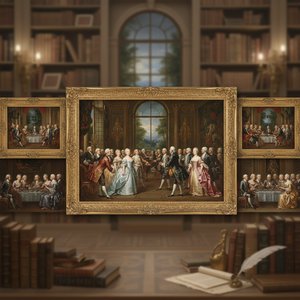
The Grace of the French Portrait: The Life of Pauline Augustin
In the luminous era of nineteenth-century France, a period defined by shifting social tides and an enduring passion for classical elegance, the name Pauline Augustin resonates with the quiet dignity of the Neoclassical tradition. Born in Paris in 1781 as Madeleine-Pauline du Cruet de Barailhon, her life was woven into the very fabric of French artistic and aristocratic circles. To look upon her work is to step into a world of refined sensibilities, where the subtle interplay of light and shadow serves to immortalize the character of her subjects. Her journey through the art world was not merely one of professional pursuit but was deeply intertwined with her personal identity, as she navigated the complexities of a society transitioning from the remnants of the Ancien Régime into a new, modern age.
The artistry of Augustin is most profoundly felt in her mastery of portraiture, a genre that demands both technical precision and an empathetic eye. Her canvases often capture individuals—ranging from distinguished gentlemen like Monsieur du Cruet to ethereal young women—with a sense of psychological depth that transcends mere likeness. There is a certain poetic stillness in her compositions; she possessed a remarkable ability to render the texture of a winter coat, the soft glow of skin, or the contemplative gaze of a reader by a fireplace. This technical prowess was likely nurtured within the vibrant artistic atmosphere of Paris, where the legacies of great masters provided a foundation for her delicate brushwork and sophisticated use of palette.
A Legacy Captured in Light and Line
The development of Augustin's style reflects a profound commitment to the nuances of human emotion and social standing. Her works often feature a meticulous attention to detail that speaks to the prestige of her sitters, yet she never allowed ornamentation to overshadow the soul of the subject. In her portraits, one finds a harmonious balance between the formal requirements of the era and a burgeoning interest in more intimate, naturalistic expressions. This duality is particularly evident in her depictions of youth and femininity, where a sense of innocence is often paired with a sophisticated command of light that lends the figures an almost otherworldly presence.
Throughout her career, Augustin’s contributions to the French school of painting have been preserved through significant collections and notable auction histories. Her ability to capture the essence of her era has ensured that her work remains a vital point of study for those interested in the nineteenth-century portraiture tradition. Some of the enduring highlights of her oeuvre include:
- A Gentleman called Monsieur du Cruet, seated next to a fireplace reading a book: A masterpiece of atmosphere and intimacy that stands as one of her most celebrated auction achievements.
- Portrait de jeune femme portant un manteau d'hiver: An exquisite display of her ability to render heavy textures and the soft, diffused light of a winter setting.
- Jeune fille blonde en buste et robe blanche: A testament to her skill in capturing the purity and luminous quality of light reflecting off white fabrics.
As we reflect on the life of Pauline Augustin, who passed away in 1865 in Triguères, we see more than just a painter of faces; we see a chronicler of an age. Her work remains a window into the elegance, the social hierarchies, and the quiet, profound moments of human existence that defined nineteenth-century France. Through her brush, the fleeting glances and dignified poses of the past are granted a permanent, breathtaking immortality.