Atelieris — Nemokamas pristatymas visame pasaulyje — Pristatymo laikas – 2–6 savaitės
      Emil Nolde, 1867 – 1956

      The 100 Most Famous Emil Nolde Paintings, Ranked

      The best-loved painting by Emil Nolde is Sunset. Sea with Red Sky and Couple on the beach (1903) come next among the canvases readers know best. Our catalogue holds 394 works by Emil Nolde: here are the 100 most famous, each with its year, its museum and what makes it memorable.

      Rangos vieta nulegiama pagal mūsų populiarumumo balas, kurį sudaro kiekvieno kūrinio paieškos, apsilankėjimai ir užsakėjimai. Atnaujinta spalis 2026. Each painting on this page can be ordered as an oil reproduction painted by hand on linen canvas, or as a fine art print, made to the size you choose.

      Emil Nolde portretas
      Emil Nolde · 1867 – 1956
      Gedė · mirė
      1867 – 1956, Nolde
      Judėjimas
      German expressionism
      Darbai mūsų kataloge
      394
      Labiausiai žinomi
      Sunset
      Daugiausia darbų yra
      Bavarijos valstybinės paveikslų kolekcijos

      Top 10 Emil Nolde paintings: the canvases everyone knows

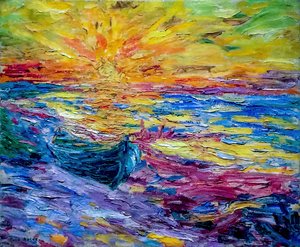
      Sunset aut. Emil Nolde
      1

      Sunset

      Oil On Canvas

      The sun hangs as a heavy, bright circle at the center of the sky, a singular eye watching the descent of the day. Below it, the atmosphere burns with shades of yellow, orange, and red, bleeding into one another to create a warm, thick air. The ocean receives this light, its waves rolling gently toward the shore in a rhythmic, quiet motion. A lone boat floats upon the water, a…

      Sea with Red Sky aut. Emil Nolde
      2

      Sea with Red Sky

      Oil

      Sea with Red Sky is an expressionist painting by Emil Nolde. The canvas captures a moment of intense color, where the sky burns with a deep, saturated red. This work belongs to the early movements of expressionism, a style that prioritizes the internal pulse of a subject over its literal likeness. The artist sought to translate raw sensation into pigment, moving beyond the surface of the natural world to reach…

      Couple on the beach (1903) aut. Emil Nolde
      3

      Couple on the beach

      1903 · Oil

      In "Couple on the beach" by Emil Nolde, painted about 1903, the arrangement of figures creates a quiet sense of intimacy against a vast landscape. At the center of the composition, a man and a woman stand close together. He has his arm around her, and she is dressed in a long dress. Their bodies are oriented toward the water, their gazes fixed on the horizon. This shared focus directs…

      Masks (1911) aut. Emil Nolde
      4

      Masks

      1911 · Acrylic On Canvas · Nelson-Atkins Museum of Art, Kansas City

      Emil Nolde's "Masks," painted in 1911, isn’t merely a depiction of carnival revelry; it’s a profound exploration of identity, hidden desires, and the unsettling duality inherent within human nature. Created during his time as a key member of Die Brücke – “The Bridge” – a group pushing the boundaries of German Expressionism in Dresden and Berlin, the painting embodies the movement's core tenets: a rejection of academic realism in favor…

      Christ among the Children aut. Emil Nolde
      5

      Christ among the Children

      Oil On Canvas

      Emil Nolde’s “Christ Among the Children” is not merely a depiction of a biblical scene; it’s an immersive experience, a visceral outpouring of emotion rendered with the raw energy characteristic of his mature style. This large-scale painting captures a moment of profound intimacy – Christ surrounded by children – yet it vibrates with a primal intensity that speaks to the core of human connection and faith. The photograph reveals a…

      The Great Gardener aut. Emil Nolde
      6

      The Great Gardener

      The Great Gardener emerges from the brush of Emil Nolde, a man whose very name carries the weight of his birthplace. Born in 1867 in Nolde, Denmark, the artist carries the essence of his origins into every stroke. He moves through the world of color with a sense of purpose, much like the subject of this work. The painting, titled The Great Gardener, captures a moment of quiet connection within…

      Light-flooded Sea (Green) aut. Emil Nolde
      7

      Light-flooded Sea (Green)

      Watercolor

      Light-flooded Sea (Green) is a work by Emil Nolde. This piece presents a highly stylized and abstracted seascape, stripping the horizon of its literal boundaries. The subject matter focuses on the meeting of water and sky, rendered through a lens of intense, personal feeling rather than precise representation.

      Marshy Landscape under the Evening Sky aut. Emil Nolde
      8

      Marshy Landscape under the Evening Sky

      Watercolor

      The scene unfolds in Marshy Landscape under the Evening Sky, a work that carries the unmistakable hand of the artist Emil Nolde. This piece captures a specific, quiet moment where the land meets a heavy, atmospheric sky. The artist, Emil Nolde, was born in Nolde, Denmark, in 1867, and his connection to the natural world remains palpable in the way he approaches the canvas. He lived until 1956, leaving behind…

      Animal and Figures (1912) aut. Emil Nolde
      9

      Animal and Figures

      1912 · Black and White Photography · Bavarijos valstybinės paveikslų kolekcijos, Miunchas

      A monochrome stillness settles over the scene. Two men stand in the rigid geometry of early 20th-century military attire, their forms anchored against a dark, featureless void. They are framed by a slender pedestal that divides the composition with mathematical precision. On the left, a hand rests firmly on a hip; on the right, a hand finds rest upon the stand. The fabric of their tunics, the heavy weave of…

      Anna Wieds Garden aut. Emil Nolde
      10

      Anna Wieds Garden

      Acrylic

      Emile Nolde, a prominent German-Danish painter and printmaker, is renowned for his vibrant and expressive works of art. One of his notable pieces, Anna Wieds Garden, exemplifies the essence of Expressionism, a modernist movement that emerged in the early 20th century. This captivating oil painting is a testament to Nolde's unique style, which blends elements of Expressionism with a deep appreciation for nature. The Expressionist Style Expressionism, as described by…

      More Emil Nolde canvases, 11 to 100

      Festival Girls (1918) aut. Emil Nolde
      #11

      Festival Girls

      1918 · Bavarijos valstybinės paveikslų kolekcijos

      Festival Girls is a painting by Emil Nolde, executed in 1918. The work measures 67 x 58.5 cm and is rendered on canvas. This piece was created during…

      Order this canvas →
      Nordermühle (1932) aut. Emil Nolde
      #14

      Nordermühle

      1932 · Bavarijos valstybinės paveikslų kolekcijos

      is a studio portrait by the German artist Emile Nolde, dating to 1932. The work captures four individuals in a formal arrangement, presented as a monochromatic study of…

      Order this canvas →
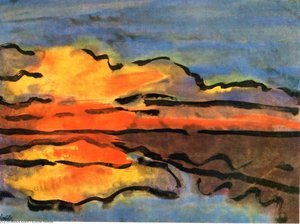
      untitled (1534) aut. Emil Nolde
      #15

      untitled (1534)

      The horizon is a wound of orange and red. Light bleeds through heavy, dark silhouettes of clouds, casting a warm glow over the quiet landscape. Below, the sand…

      Order this canvas →
      Shivering Russians (1914) aut. Emil Nolde
      #16

      Shivering Russians

      1914 · Statens Museum For Kunst

      The painting presents two figures in a tight, cropped composition, focusing on their upper bodies as they huddle together. They are enveloped in thick, heavy clothing that obscures…

      Bring this light home →
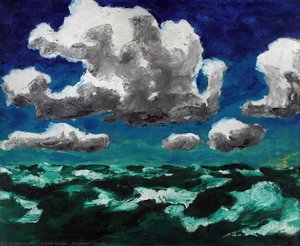
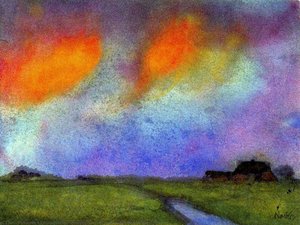
      Summer Clouds aut. Emil Nolde
      #17

      Summer Clouds

      Summer Clouds is an expressionist work by Emil Nolde. Born in 1867 in Nolde, Denmark, the artist developed a visual language centered on intense, personal feeling and the…

      Order this canvas →
      Wild Animals (1921) aut. Emil Nolde
      #24

      Wild Animals

      1921 · Bavarijos valstybinės paveikslų kolekcijos

      The work belongs to a period of intense experimentation. It reflects a shift toward the subjective, where the internal world dictates the external appearance. The textures are thick…

      Have it painted by hand →
      Autumn Sea aut. Emil Nolde
      #25

      Autumn Sea

      Emile Nolde’s “Autumn Sea” is not merely a depiction of a seascape; it’s an immersion into the raw, untamed heart of nature itself. Painted during his most intensely…

      Have it painted by hand →
      Mills (1924) aut. Emil Nolde
      #33

      Mills

      1924 · Bavarijos valstybinės paveikslų kolekcijos

      In the large-scale black and white group portrait titled "Mills" by Emil Nolde, a dense assembly of men is positioned in front of a wooden structure. The composition…

      Bring this light home →
      Robbers at Bombüll (1917) aut. Emil Nolde
      #34

      Robbers at Bombüll

      1917 · Statens Museum For Kunst

      Robbers at Bombüll is a painting by the German artist Emile Nolde. Created in 1917, this work belongs to the Expressionist movement. The piece focuses on a group…

      Have it painted by hand →
      Mask Still Life III, (1911) aut. Emil Nolde
      #35

      Mask Still Life III,

      1911

      The painting features five different faces on masks, each displaying unique expressions. These masks are arranged across the canvas in a specific configuration: the first face is in…

      Order this canvas →
      Šūka Kristui (1909) aut. Emil Nolde
      #36

      Šūka Kristui

      1909

      „Šriftgelehrte“ – Emil Nolde Emil Nolde, vienas iš žymiausių Vokelio ekspresionistų kūrėjų, gimė Hans Emil Hansen 1867 m. rugsėjo 7 d., Šleswig-Holšteino Nolde miestelyje. Jis kilęs iš šeimos…

      Have it painted by hand →
      The Blacksmith (1912) aut. Emil Nolde
      #38

      The Blacksmith

      1912 · Statens Museum For Kunst

      is an oil painting by Emil Nolde, executed in 1912. The work emerged during a period of significant artistic transition for the creator, who was establishing a distinct…

      Have it painted by hand →
      Young Women (1947) aut. Emil Nolde
      #69

      Young Women

      1947 · Statens Museum For Kunst

      In this work, titled Young Women, we encounter a significant piece from the later period of Emil Nolde. Painted in 1947, the canvas reflects the artist's continued engagement…

      Bring this light home →
      Large Sunflowers (1928) aut. Emil Nolde
      #70

      Large Sunflowers

      1928 · Metropolitano meno muziejus

      The Presence of the Bloom In this 1928 oil painting on wood, the sunflowers emerge with a heavy, physical presence. There is no attempt at delicate botanical precision…

      Have it painted by hand →
      Figures and Dahlias (1919) aut. Emil Nolde
      #71

      Figures and Dahlias

      1919 · Statens Museum For Kunst

      Emile Nolde produced Figures and Dahlias in 1919. The artist, born in 1867 in Nordel, Germany, developed a practice centered on the physical properties of his materials. His…

      Bring this light home →
      Garden path aut. Emil Nolde
      #72

      Garden path

      A Symphony of Red: Exploring Emile Nolde’s “Garden Path” “Garden Path” by German-Danish Expressionist painter Emile Nolde is a captivating oil painting that plunges the viewer into an…

      Bring this light home →
      Masks (1911) aut. Emil Nolde
      #79

      Masks

      1911 · Nelson-Atkins Museum of Art

      In the evocative realm of German Expressionism, few works capture the raw, unbridled energy of the human psyche quite like Emil Nolde’s Masks. Painted in 1911, this masterpiece…

      Have it painted by hand →
      Mother and Child aut. Emil Nolde
      #80

      Mother and Child

      Mother and Child, also known by the German title Mutter und Kind, is a work by the German artist Emil Nolde. Born in 1867, Nolde remained a significant…

      Order this canvas →
      In the coffee aut. Emil Nolde
      #82

      In the coffee

      In the coffee is a genre painting by Emil Nolde. Created in 1911, the work captures a social gathering within a cafe setting. The canvas holds a moment…

      Have it painted by hand →
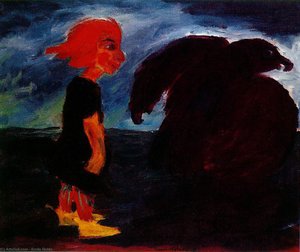
      Child and Large Bird (1912) aut. Emil Nolde
      #100

      Child and Large Bird

      1912 · Statens Museum For Kunst

      The painting Child and Large Bird by Emile Nolde is a captivating work of art that showcases the artist's unique style and technique. Created in 1912, this oil…

      Have it painted by hand →

      Emil Nolde's canvases, period by period

      What Emil Nolde painted most

      The four subjects that return most often on these canvases, each with its best-loved example.

      Where Emil Nolde's canvases hang

      7 muziejai, kuriuose saugoma daugiausia šioje pusėje esamų paveikslų.

      Muzejaus Miestas Emil Nolde darbai Šiojo sąrašo paveikslai
      Bavarijos valstybinės paveikslų kolekcijos, MiunchasBavarijos valstybinės paveikslų kolekcijos Miunchas 10 Animal and Figures, Festival Girls, Nordermühle
      Statens Museum For Kunst, KopenhagaStatens Museum For Kunst Kopenhaga 10 Shivering Russians, Robbers at Bombüll, The Blacksmith
      Nelson-Atkins Museum of Art, Kansas CityNelson-Atkins Museum of Art Kansas City 2 Masks, Masks
      Staatliche Kunsthalle Karlsruhe, KarlsruheStaatliche Kunsthalle Karlsruhe Karlsruhe 4 At the Fountain
      Brücke Museum, BerlinasBrücke Museum Berlinas 2 Ridicule (Verspottung)
      Museum Kunstpalast, DiuseldorfasMuseum Kunstpalast Diuseldorfas 1 Žydrinės sodas (Mergaitė ir skalbimo lenta)
      Metropolitano meno muziejus, NiujorkasMetropolitano meno muziejus Niujorkas 1 Large Sunflowers

      Emil Nolde's best-loved canvas of each decade

      1. 1900s
        Couple on the beach (1903) aut. Emil Nolde
        Canvas 3 of 100

        Couple on the beach

        Amžius 33 – 42

        In "Couple on the beach" by Emil Nolde, painted about 1903, the arrangement of figures creates a quiet sense of intimacy against a vast landscape. At the center…

      2. 1910s
        Masks (1911) aut. Emil Nolde
        4 of 100

        Masks

        Amžius 43 – 52 · Nelson-Atkins Museum of Art

        Emil Nolde's "Masks," painted in 1911, isn’t merely a depiction of carnival revelry; it’s a profound exploration of identity, hidden desires, and the unsettling duality inherent within human…

      3. 1920s
        Wild Animals (1921) aut. Emil Nolde
        Canvas 24 of 100

        Wild Animals

        Amžius 53 – 62 · Bavarijos valstybinės paveikslų kolekcijos

        The work belongs to a period of intense experimentation. It reflects a shift toward the subjective, where the internal world dictates the external appearance. The textures are thick…

      4. 1930s
        Nordermühle (1932) aut. Emil Nolde
        14 of 100

        Nordermühle

        Amžius 63 – 72 · Bavarijos valstybinės paveikslų kolekcijos

        is a studio portrait by the German artist Emile Nolde, dating to 1932. The work captures four individuals in a formal arrangement, presented as a monochromatic study of…

      5. 1940s
        Young Women (1947) aut. Emil Nolde
        Ranked 69 of 100

        Young Women

        Amžius 73 – 82 · Statens Museum For Kunst

        In this work, titled Young Women, we encounter a significant piece from the later period of Emil Nolde. Painted in 1947, the canvas reflects the artist's continued engagement…

      About Emil Nolde's canvases: your questions answered

      What is the best-known painting by Emil Nolde?Read the answer

      Sunset, followed by Sea with Red Sky and Couple on the beach (1903).

      What are the 10 most famous paintings by Emil Nolde?Read the answer

      Sunset, Sea with Red Sky, Couple on the beach, Masks, Christ among the Children, The Great Gardener, Light-flooded Sea (Green), Marshy Landscape under the Evening Sky, Animal and Figures ir Anna Wieds Garden. Each canvas in the ranking above comes with its year and its museum.

      How many works did Emil Nolde paint in all?Read the answer

      394 works by Emil Nolde are in our catalogue, dated 1903 to 1947.

      Where can I see Emil Nolde's most famous canvases?Read the answer

      Mostly in Bavarijos valstybinės paveikslų kolekcijos (Miunchas), Statens Museum For Kunst (Kopenhaga) ir Nelson-Atkins Museum of Art (Kansas City); the list above names each museum and its canvases.

      When did Emil Nolde paint the best-loved canvases?Read the answer

      In 1910s, which gave 22 of the 100 works on this page, Masks among them.

      Which are Emil Nolde's earliest and latest famous canvases?Read the answer

      The earliest canvas here is Couple on the beach (1903); the latest is Young Women (1947).

      What did Emil Nolde paint most often?Read the answer

      Figures (11), Sky (10) ir Sea (10), across the 100 works on this page.

      Which medium did Emil Nolde paint in most often?Read the answer

      Oil On Canvas, used in 14 of the 100 works on this page.

      Which movement is Emil Nolde's painting part of?Read the answer

      German expressionism, as the canvases on this page show.

      Which Emil Nolde canvases hang at the Bavarijos valstybinės paveikslų kolekcijos?Read the answer

      The Bavarijos valstybinės paveikslų kolekcijos, Miunchas holds 7 of the works on this page, among them Animal and Figures, Festival Girls ir Nordermühle.

      Can I buy a reproduction of a Emil Nolde canvas?Read the answer

      Yes. Every painting on this page can be ordered from its own page as an oil reproduction painted by hand, or as a fine art print, in the size you choose.

      Emil Nolde: a life in paint

      Emilio Nolde: Gyvenimas ir Palikimas

      Emilis Nolde, garsus vokiečių-danų tapytojas, gimė Hansas Emilis Hansenas rugpjūčio 7 dieną, 1867 metais Nolde kaime, Šlėsvigo-Holšteine (Vokietija). Jis kilęs iš šeimos, turinčios stiprius ryšius su kaimo gyvenimu ir religiniais įsitikinimais – veiksniai, kurie turėjo didelį poveikį jo meninei vizijai. Nepaisant pradinio tėvų pasipriešinimo, kurie norėjo, kad jis pasirinktų tradiciškesnę karjerą, Nolde ryžtingai siekė savo aistros meno. Pradžioje jis dirbo medžio drožėju ir baldų dekoratoriumi, o vėliau, sulaukęs trisdešimties metų, visiškai atsidėjo tapybai.

      Meninis Ugdymas ir Įtakos

      Nolde’s meninė kelionė buvo žymima savišvieta ir tyrinėjimais. Jis daug keliavo, įsisavinant įvairių kultūrų ir meno formų įtaką. Ankstyviosioms įtakoms priklausė Vincent van Goghas, Paul Gauguinas ir tradicinis liaudies menas – ypač ekspresyvi primityvių kaukių ir drožinių galia. Šie susitikimai paskatino jį domėtis ryškiomis spalvomis, supaprastintomis formomis ir emociškai įkrautu turiniu. Pradžioje jis eksperimentavo su realizmu ir impresionizmu, tačiau greitai perėjo prie subjektyvesnio ir ekspresyvesnio stiliaus.

      „Die Brücke“ ir Ekspresionistinis Perversmas

      1905 metais Nolde bendradarbiavo įkuriant „Die Brücke” (Tiltas), svarbią vokiečių ekspresionistų grupę. Ši kolektyvinė siekė atsisakyti akademinės tradicijos ir išreikšti vidines emocijas per radikalius meno eksperimentus. Nolde’s indėlis į „Die Brücke” buvo reikšmingas; intensyvus spalvų naudojimas ir deformuotos formos stūmė reprezentacijos ribas. Tačiau jis išlaikė šiek tiek nepriklausomą poziciją grupėje, dažnai nukrypdamas nuo tematikos ir stilistinio požiūrio.

      Pagrindinės Temos ir Meninis Stilius

      Nolde’s kūryboje pasižymi keli besikartojantys motyvai: religinės scenos, kraštovaizdžiai, jūros peizažai ir portretai. Ypač jį domino kaukių galia – tiek kaip fiziniai objektai, tiek simbolinis primityvių emocijų atvaizdas. Jo meninį stilių apibrėžia:

      • Ryškios, sodrios spalvos, naudojamos emocionaliniam intensyvumui perteikti
      • Deformuotos formos, pabrėžiančios ekspresiją, o ne realistinį atvaizdą
      • Impasto technika – storas dažų sluoksnis, sukuriantis tekstūrą
      • Susitelkimas į vidinių psichologinių būsenų užfiksavimą

      Žymiausi Darbai ir Pasiekimai

      Visą savo karjerą Nolde sukūrė didžiulį kūrinių rinkinį. Kai kurie garsiausi jo paveikslai apima:

      • Kaukės (1906-1907) – demonstruojančios jo susidomėjimą primityviu menu
      • Kristaus pasijuokimas (1909) – galinga ir emociškai įkrauta religinė scena
      • Rudens jūra (1908) - rodanti jo ekspresyvią kraštovaizdžio tapybą.
      • Gėlių sodas (Merginėlė su skalbiniais) (1907)
      • Šokis aplink Aukso veršį (1909)

      Nepaisant kritikos ir cenzūros nacistinio režimo metais – jo darbai buvo paskelbti „degeneruotais” – Nolde tęsė tapybą slaptai. Šiuo laikotarpiu jis sukūrė didžiulį vandens spalvų paveikslų rinkinį, rodydamas savo tvirtą įsipareigojimą meninei išraiškai.

      Istorinė Reikšmė ir Palikimas

      Emilio Nolde’s novatoriškas spalvų naudojimas ir ekspresyvus potepis turėjo didelį poveikį ištisos kartos dailininkams. Jo darbai nutiesė tiltą tarp tradicinio reprezentacinio meno ir vėliau atsiradusių abstrakčių judėjimų. Jis išlieka centrine figūra Vokietijos ekspresionizmo istorijoje, garsėjantis savo emociniu intensyvumu, drąsiais eksperimentais ir nuolatiniu meniniu vizija. Jo palikimas tebeturi įkvėpti dailininkus ir meno mylėtojus visame pasaulyje.

      Visi 394 Emil Nolde darbai →