Atelieris — Nemokamas pristatymas visame pasaulyje — Pristatymo laikas – 2–6 savaitės
      Žoržas Rulo, 1871 – 1958

      Žoržas Rulo: 100 žymiausi paveiksliai

      Iš visų Žoržas Rulo paveikslų, Head of Christ yra garsiausias. Net už jų seka Head of Christ 1 ir The Breton Wedding (1937). Iš 268 Žoržas Rulo kūrinių mūsų kataloge šie 100 yra garsiausi – kiekvienas su datą, muziejų ir istoriją nurodančia informacija.

      Rangos vieta nulegiama pagal mūsų populiarumumo balas, kurį sudaro kiekvieno kūrinio paieškos, apsilankėjimai ir užsakėjimai. Atnaujinta spalis 2026.

      Žoržas Rulo portretas
      Žoržas Rulo · 1871 – 1958
      Gedė · mirė
      1871 – 1958, Parisas
      Judėjimas
      Fauvism
      Darbai mūsų kataloge
      268
      Labiausiai žinomi
      Head of Christ
      Daugiausia darbų yra
      Art Institute of Chicago

      10 garsiausių Žoržas Rulo paveikslų

      Head of Christ aut. Žoržas Rulo
      1

      Head of Christ

      Oil On Panel

      The face emerges from a deep, saturated blue background. It is a man's countenance, fixed with an intense and focused gaze that meets the viewer directly. His eyes are wide, open, and heavy with a quiet, introspective weight. A beard provides a rough texture to his features, grounding the ethereal color of the backdrop in something physical and tactile. On the left side of the face, a small bird rests,…

      Head of Christ 1 aut. Žoržas Rulo
      2

      Head of Christ 1

      Oil On Panel

      In this portrait, the face of Christ emerges from a profound, saturated blue, a space that offers no horizon and no sense of physical depth. The subject's countenance is fixed with an intense, focused gaze that meets the viewer directly, creating an immediate sense of intimacy and confrontation. There is a heavy, introspective weight in the eyes, which appear wide and open, as if carrying the gravity of existence itself.…

      The Breton Wedding (1937) aut. Žoržas Rulo
      3

      The Breton Wedding

      1937 · Oil On Canvas

      Georges Rouault’s “The Breton Wedding” is not merely a depiction of a rural ceremony; it's a profound meditation on faith, community, and the quiet dignity of everyday life. Painted in 1937, this canvas pulsates with an intensely personal vision, born from Rouault’s own devout Catholic beliefs and his deep empathy for the marginalized. The scene unfolds within a church or cathedral – a space traditionally imbued with solemnity – yet…

      The old king (1937) aut. Žoržas Rulo
      4

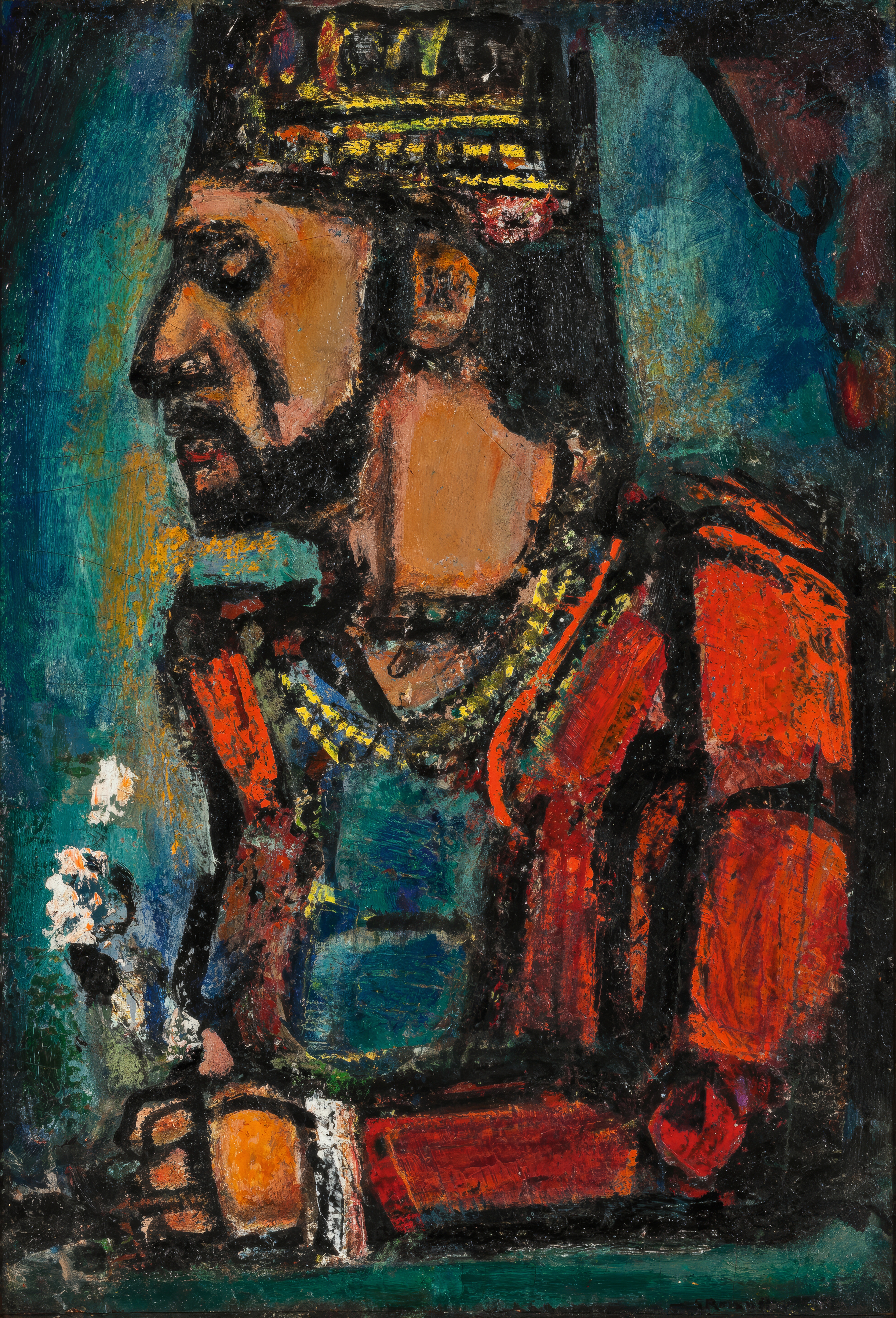
      The old king

      1937 · Oil On Canvas

      In the quiet, heavy atmosphere of Georges Rouault’s 1937 masterpiece, The Old King, one encounters a profound meditation on the human condition. The painting presents a solitary monarch, captured in profile, whose very presence seems to vibrate with an introspective melancholy. Draped in rich, crimson robes that catch the light with a somber intensity, the figure gazes inward, his expression etched with a deep, palpable sadness. This is not merely…

      Jesus on the cross as forgotten there aut. Žoržas Rulo
      5

      Jesus on the cross as forgotten there

      Acrylic On Canvas

      Georges Rouault’s “Jesus on the Cross as Forgotten There”: A Descent Into Spiritual Darkness The artwork presents a haunting meditation on faith and suffering, embodied in Georges Rouault's monumental print, "Jesus on the Cross as Forgotten There." Created in 1946 during the Second World War, amidst the pervasive anxieties of occupation and loss, this piece transcends mere depiction; it plunges into the abyss of existential despair, mirroring the artist’s own…

      Femme Affranchie, A Quatorze Heures, Chante Midi aut. Žoržas Rulo
      6

      Femme Affranchie, A Quatorze Heures, Chante Midi

      Acrylic

      Georges Rouault’s Femme Affranchie: A Portrait of Resilience Amidst Darkness The Denver Art Museum houses Georges Rouault's “Femme Affranchie, à Quatorze Heures, Chante Midi” (Woman Freed at Noon), a hauntingly beautiful engraving from his seminal Miserere et Guerre series completed in 1923. This artwork transcends mere visual representation; it embodies Rouault’s deeply felt empathy for the vulnerable and his unwavering commitment to exploring profound spiritual themes—a legacy born from witnessing…

      The Judges (1908) aut. Žoržas Rulo
      7

      The Judges

      1908 · Oil · Statens Museum For Kunst, Kopenhaga

      In this 1908 oil painting, three seated figures occupy a shallow, darkened space. The composition is arranged horizontally, with the figures positioned in a way that fills the frame, creating a sense of enclosure. The lighting is low-key, emerging from an indistinct source to illuminate only specific portions of the subjects, such as the pale, ghostly whites of facial features and the edges of clothing. The rest of the scene…

      Hollow dream aut. Žoržas Rulo
      8

      Hollow dream

      Oil On Canvas

      The artwork Hollow dream is an oil painting on canvas that presents a portrait of a person, likely male, rendered in an expressionistic style. The composition is a vertical frame that is tightly focused on the head and shoulders, with the subject facing forward and slightly turned toward the viewer's left. The figure fills most of the frame against a dark, undefined background.

      Žoržas Rulo tapiai, iš rango nuo 11 iki 100

      Bouquet II (1938) aut. Žoržas Rulo
      #13

      Bouquet II

      1938

      Georges Rouault: Bouquet II – A Meditation on Suffering and Beauty Georges Rouault’s “Bouquet II,” painted in 1929, stands as a poignant testament to the artist's unwavering commitment…

      Christ aut. Žoržas Rulo
      #14

      Christ

      The painting is a portrait of Jesus with his head bowed down. The background features a sky that appears to be blue in color.

      Away the smile of Reims aut. Žoržas Rulo
      #15

      Away the smile of Reims

      A single figure occupies the center of the frame, a presence carved from darkness and light. The face is elongated, pulled by invisible forces into a mask of…

      The Three Judges (1928) aut. Žoržas Rulo
      #18

      The Three Judges

      1928 · Art Institute of Chicago

      The Three Judges is an oil and gouache work on paper, mounted on cardboard and backed with canvas, created by the French artist Georges Rouault. The piece was…

      Dolls, puppets fire hall and the ''Bride'' aut. Žoržas Rulo
      #19

      Dolls, puppets fire hall and the ''Bride''

      The air feels heavy, thick with the scent of old dust and greasepaint. In this claustrophobic corner of a theatrical world, three figures huddle together, their presence casting…

      Legendary Landscape (1935) aut. Žoržas Rulo
      #20

      Legendary Landscape

      1935

      The artwork is a vertically oriented oil painting on canvas that presents a stylized, dreamlike landscape. The composition features a simplified architectural structure, possibly a church or monastery,…

      'Man of myrrh' aut. Žoržas Rulo
      #22

      'Man of myrrh'

      The artwork presents a somber and emotionally charged scene depicting what appears to be a biblical or allegorical narrative. The composition is centered around a reclining figure, presumably…

      Pierrot (1910) aut. Žoržas Rulo
      #24

      Pierrot

      1910

      is a work by the French artist Georges Rouault, executed in 1910. Born in Paris, France, in 1871, Rouault remained connected to his home city until his death…

      Grotesque (1917) aut. Žoržas Rulo
      #25

      Grotesque

      1917

      Completed in 1917, Georges Rouault’s Grotesque is a profound exploration of human vulnerability and spiritual resilience. Created against the backdrop of the escalating anxieties of World War I,…

      Crucifixion aut. Žoržas Rulo
      #26

      Crucifixion

      The painting depicts a crucifixion scene where the central figure of Jesus Christ is shown on the cross. He is rendered with an elongated torso and contorted limbs,…

      Two Women's Heads (1902) aut. Žoržas Rulo
      #27

      Two Women's Heads

      1902

      The painting depicts two women's heads positioned within the frame. On the left side, a woman with long hair is shown looking toward something in front of her,…

      The holy face aut. Žoržas Rulo
      #28

      The holy face

      The artwork presents a stylized and emotionally charged depiction of a human face, likely intended to represent Christ or a holy figure. The composition is centered around the…

      Project for the reincarnation of Father Ubu 3 aut. Žoržas Rulo
      #29

      Project for the reincarnation of Father Ubu 3

      Georges Rouault's “Project for the Reincarnation of Father Ubu 3” presents not merely a depiction, but an immersion into a world sculpted by anxiety and unsettling satire. This…

      Christ and the Fisherman aut. Žoržas Rulo
      #30

      Christ and the Fisherman

      Fine Arts Museums of San Francisco

      Christ and the Fisherman is an oil painting by Georges Rouault. Created in France, the work emerged around 1937. The artist applied oil to paper, which was then…

      Eternally scourged aut. Žoržas Rulo
      #31

      Eternally scourged

      In this somber composition, we find ourselves face to face with a figure caught in a moment of profound exhaustion. The subject is positioned slightly off-center, its body…

      King Ubu 1 aut. Žoržas Rulo
      #34

      King Ubu 1

      The artwork presents a stylized and somewhat grotesque depiction of a seated figure, identified by the title as King Ubu. The composition is dominated by this central figure,…

      The Superman (1916) aut. Žoržas Rulo
      #35

      The Superman

      1916

      In the heavy, somber atmosphere of 1916, as the Great War tore through the heart of Europe, Georges Rouault captured something far more profound than a mere portrait;…

      The Dwarf (1937) aut. Žoržas Rulo
      #36

      The Dwarf

      1937 · Art Institute of Chicago

      In this 1937 work, The Dwarf, Georges Rouault presents a figure that occupies the periphery of social visibility. The artist, a Frenchman, turned his attention toward those living…

      Dancer for the Ballets Russes aut. Žoržas Rulo
      #37

      Dancer for the Ballets Russes

      Georges Rouault's "Dancer for the Ballets Russes" is a striking portrait that encapsulates the spirit of early 20th-century artistic innovation. Created likely around 1929, this artwork offers a…

      Pierrot 2 aut. Žoržas Rulo
      #38

      Pierrot 2

      Georges Rouault's 'Pierrot 2' isn’t merely a depiction of the iconic commedia dell’arte figure; it’s an immersion into a world steeped in sorrow, isolation, and a profound spiritual…

      Twilight or Ile de France aut. Žoržas Rulo
      #39

      Twilight or Ile de France

      Georges Rouault’s “Twilight or Ile de France” is a captivating exploration of light, color, and human emotion, firmly rooted in the heart of the Fauvist movement. Painted in…

      Night Fall aut. Žoržas Rulo
      #40

      Night Fall

      The artwork presents a stylized and emotionally charged scene depicting figures in what appears to be a coastal or rural setting at night. It carries a somber and…

      '... when the night came. The moon rose' aut. Žoržas Rulo
      #41

      '... when the night came. The moon rose'

      In the hauntingly beautiful tableau titled '... when the night came. The moon rose,' Georges Rouault invites us into a world where the boundaries between the physical landscape…

      The blind man sometimes consoles the light aut. Žoržas Rulo
      #42

      The blind man sometimes consoles the light

      Georges Rouault's “The Blind Man Sometimes Consoles the Light” is not merely a depiction of two figures; it’s an immersion into a world steeped in sorrow, faith, and…

      Nude with arms raised (combed) aut. Žoržas Rulo
      #43

      Nude with arms raised (combed)

      In the quiet, heavy atmosphere of Georges Rouault’s 1937 masterpiece, Nude with Arms Raised (combed), one does not merely observe a figure; one encounters a soul in the…

      Dura Lex Sed Lex aut. Žoržas Rulo
      #44

      Dura Lex Sed Lex

      “Dura lex sed lex” – "The law is hard, but it is the law" – this stark and profoundly moving portrait by Georges Rouault transcends a simple depiction…

      Newspaper Seller (1909) aut. Žoržas Rulo
      #45

      Newspaper Seller

      1909 · Antverpio karališkasis gražiųjų menų muziejus

      Žoržas Rulo plėstiniai, pagal laikotarpį

      Early 20th Century

      1907 – 1910 · 3 darbai šiame sąraše

      Daugiausiai paveikęs Žoržas Rulo

      Ketverios dažniausiai pasitaikančios šių plėstinių temos, kiekvienos su geriausiu pavyzdžiu.

      Kur kabinami Žoržas Rulo plėtoiniai

      7 muziejai, kuriuose saugoma daugiausia šioje pusėje esamų paveikslų.

      Muzejaus Miestas Žoržas Rulo darbai Šiojo sąrašo paveikslai
      Art Institute of Chicago, ČikagosArt Institute of Chicago Čikagos 2 The Three Judges, The Dwarf
      The Phillips Collection, VašingtonasThe Phillips Collection Vašingtonas 3 Verlaine
      Statens Museum For Kunst, KopenhagaStatens Museum For Kunst Kopenhaga 1 The Judges
      Fine Arts Museums of San Francisco, San FranciscoFine Arts Museums of San Francisco San Francisco 1 Christ and the Fisherman
      Antverpio karališkasis gražiųjų menų muziejus, AntverpysAntverpio karališkasis gražiųjų menų muziejus Antverpys 1 Newspaper Seller
      Kanados Nacionalinė galerija, OtavaKanados Nacionalinė galerija Otava 1 Christ on the Cross
      Chimei Museum, TainanChimei Museum Tainan 1 Profile of a Woman

      Kas dešimtmetė: garsiausias Žoržas Rulo plėdikas

      1. 1900s
        The Judges (1908) aut. Žoržas Rulo
        7 iš 100

        The Judges

        Amžius 29 – 38 · Statens Museum For Kunst

        In this 1908 oil painting, three seated figures occupy a shallow, darkened space. The composition is arranged horizontally, with the figures positioned in a way that fills the…

      2. 1910s
      3. 1920s
        The Three Judges (1928) aut. Žoržas Rulo
        18 iš 100

        The Three Judges

        Amžius 49 – 58 · Art Institute of Chicago

        The Three Judges is an oil and gouache work on paper, mounted on cardboard and backed with canvas, created by the French artist Georges Rouault. The piece was…

      4. 1930s
        The Breton Wedding (1937) aut. Žoržas Rulo
        3 vieta iš 100

        The Breton Wedding

        Amžius 59 – 68

        Georges Rouault’s “The Breton Wedding” is not merely a depiction of a rural ceremony; it's a profound meditation on faith, community, and the quiet dignity of everyday life.…

      Atsakimai į jūsų klausimus apie Žoržas Rulo paveikslus

      Kuri yra garsiausia Žoržas Rulo tapioja?Perskaitykite atsakymą

      Head of Christ, o po to – Head of Christ 1 ir The Breton Wedding (1937).

      Kurios tende de lygiausiai žinomos Žoržas Rulo tapiojamos?Perskaitykite atsakymą

      Head of Christ, Head of Christ 1, The Breton Wedding, The old king, Jesus on the cross as forgotten there, Femme Affranchie, A Quatorze Heures, Chante Midi, The Judges, Hollow dream, The Poulot or partner, Red Zone ir Landscape from the Bible, Christ and the fishermen. Kiekvienas viršuje esančiame reitinge nurodytas platinas yra su nurodyta gamybos metų ir muziejaus informacija.

      Kiek žinoma Žoržas Rulo paveikslų?Perskaitykite atsakymą

      Mūsų kataloge yra 268 Žoržas Rulo darbų, datuoti nuo 1902 iki 1938.

      Kuriuose muzeumuose eksponuojami žymiausi Žoržas Rulo plėnalstai?Perskaitykite atsakymą

      Daugiausia – Art Institute of Chicago (Čikagos), The Phillips Collection (Vašingtonas) ir Statens Museum For Kunst (Kopenhaga); viršuje esančiame sąraše nurodytas kiekvienas muziejus ir jo plėtojimo darbai.

      Kuriomis laikotarpiais Žoržas Rulo tapo savo garsiausiais paveiksliais?Perskaitykite atsakymą

      1900s laikotarpiu, kurio metu buvo pateikta 5 iš 100 šioje pusėje esančių darbų, tarp jų buvo The Judges.

      Kokie yra pirmasis ir paskutinis Žoržas Rulo garsieji plėtoiniai?Perskaitykite atsakymą

      Čia esamasis plėslas yra Two Women's Heads (1902), o vėliausias – Bouquet II (1938).

      Kokie motyvai dažniausiai pasikrausto Žoržas Rulo paveiksluose?Perskaitykite atsakymą

      Suffering (13), Darkness (11) ir Portrait (7) iš 100 šioje pusėje esamų darbų.

      Kuo paprastai dirbo Žoržas Rulo?Perskaitykite atsakymą

      Oil On Canvas, naudojamas 11 iš 100 šioje pusėje esančių darbų.

      Kelią meno kryptį priklauso Žoržas Rulo?Perskaitykite atsakymą

      Fauvism ir Expressionism, kaip tai rodo šio puslapio plėtočiai.

      Ką galėčiau pamatyti Žoržas Rulo darbus Art Institute of Chicago?Perskaitykite atsakymą

      Art Institute of Chicago, Čikagos kolekcijoje yra 2 šioje pusėje esančių veikalų, iš jų – The Three Judges ir The Dwarf.

      Žoržas Rulo: paveikslastotojo istorija

      Gyvenimas, iškovęs Parisio šešėliai

      Georges Rouault, gimęs 1871 m. Paryzuje, skaudžios Komunos suirutės metu, gyveno gyvenimą, giliai įimtą sunkumais ir dvasiniu ieškojimu. Jo pirmieji metai fiziškai praleisi šešėliuose – jo šeima ieškojo prieglobščio rūsyje miestas bombarduojant, ir ši įvykis vėliau per visą jo meninę viziją atsispindėjo. Šis skaudus pradžia, kartu su motinos auginama garbinga katolika kultūra, įsimegė į jį gilią empatiją prieš marinalizuotus ir kančinančius – temas, kurios tapo jo kūrybos pagrindu. Jis nebuvo paskirtas akademinei privilegijai; vietoj to, keturioliolika metų pasenė jis pradėjo mokytis stiklo dažytojo – amato, kuris neįtikėtinai paveikė jo estetinę jautrią. Ryškios spalvos ir drąsūs kontūrai, būdingi vitražiams, tapo jo brandaus stiliaus pamatu – tai charakteriška tamsių linijų naudojimas, apgaubiantis šviesius spalvų laukus, primenančius viduramžių meną. Šis ankstyvas pasindulimas nebuvo tik techninis; jis buvo dvasinis, suteikdamas jam gebėjimą pajusti šviesos ir vaizdo pasakojimo galią. Tuo pačiu metu jis mokėsi École des Beaux-Arts mokykloje, kur tapo ištikimu Gustave Moreau mokinio – jo simbolizmo tendencijos dar labiau puoselėjo Rouault skatino į emocinėmis prigimimais užpildytas temas.

      Nuo fauvizmo švelnumo iki ekspresionistinių gilių

      Rouault meno kelionė nebuvo kupina staigus atpažinimo ar lengvo klasifikuojimo. Nors iš pradžių buvo paveiktas simbolistų, ankstyvojo XX amžiaus pradžioje jis buvo pritrauktas augančio fauvizmo judėjimo orbitos. Jis draugaujaujo su tokiais menininkais kaip Henri Matisse ir Albert Marquet, dalyvavo kartu su jais parodoje, tačiau jo temperamentas visada vedė jį į tamsesnį ir introspektyvesnį kelią nei grynai estetinės jo samtvorių tyrimai. Fauvizmo ryškios spalvos tarnavo kaip trampas, tačiau Rouault greitai peržengė jų ribas, savo plėtnė įliejdamas emocinį intensyvitetą, kuris užsiminėjo ekspresionizmą. Jis pradėjo susikoncentruoti į temas, kurios dažnai buvo praleistos šalia arba laikomos nevertos meno dėmesio: prostitutės, klounai, teisėjai ir kaliniai. Tai nebūvo tik visuomenės išsidėvinusių žmonių vaizdinimas; tai buvo įtampinti alegorijai žmogaus būklei – tyrimai apie nuobatią kaltę, atpūtą ir prigimtį, slypanti kančionėse. Jo charakterizacijos, dažnai groteskiškos, tačiau giliai empatiškos, rezonavo su augančiu nerimu ir išgirtumu modernioje visuomenėje, įtakodamos ekspresionistų kartai, siekiančiai per iškraiptas formas ir sukrėtiančias spalvas perteikti vidinę turbulenciją. Moralusis kompasas drobtulėse ir grafikoje Pirmojo pasaulinio karo metai tapo lūžio metu Rouault, sustiprindami jo atsidavimą religinei tikomybei ir padindami meno moralinę svorio svarbę. Šiuo laikotarpiu jis daugeliui išėjęs iš viešųjų parodų, pasislėpdamas į itin asmeniškus projektus, tokius kaip *Miserere* ciklas – monumentali litografijų serija, vaizduojanti žmogaus kančios scenes, įkvėptas Psalmių. Šie darbai, kūriems truko daugiau nei dešimtmetį, yra jo stipriausias ir ilgaamžiškiusias pasiekimas. Patys plokštelės buvo nuolat perdirbamos, atspindėdami Rouault nepalingą siekį pasiekti emocinę tiesą ir dvasinį supratimą. Jis neinteresavosi grynu vaizdavimu; jis siekė įamžinti žiaugią žmogaus patirties esmę – agoniją, neviltį, bet ir šviesos skrupsnį, kuris išlieka net ir tamsiausiuose egzistencijos kampuose. Be *Miserere*, jo tapyba toliau tyrinėjo panašias temas, dažnai vaizduodama izoliuotus, aplankuotus aplinkybėmis figūras, tačiau suteikiant jas ramią orumą. Pavyzdžiui, jo klounų vaizdai nebuvo tiesiog komiški; jie buvo tragiški veikėjai, įkūnijantys gyvenimo absurdiškumą ir vienatvę.

      Aisės ir dvasinio rezonanso palikimas Georges Rouault meno palikimas išsipina daug toli už jo techninių inovacijų ar stiliaus priklausomybių. Jis buvo itin dvasinis menininkas, kuris savo meistriškumą naudojo kaip moralinės apmąstymo ir empatiško ryšio priemonę. Jo kūriniai iššūkį nuteikė įprastoms grožio sampratom, priimdamas bjaurumą ir kančią kaip neatsiejamą žmogaus patirties dalį. Jis atsisakė grynai dekoratyvinio meno, rinkdamasis meną, kuris žiūrėtojus suderintų su nemaloniomis tiesomis apie juos ir jų visuomenę. Vėlesniajam gyvenime jis gavo užsakymus religiniams kūriniams, įskaitant dizainus Sergejui Diagilevui skirtam baletui *Prarastasis sūnus*, taip dar labiau įtvirtindamas savo reputaciją kaip unikalaus tikėjimo menininko. Įdomi ir galbūt tragiška jo karjeros pastabė yra ta, kad vėliau gyvenime Rouault sunaikino apie 300 savo tapybos veikalų – šis aktas buvo grįstas savikritika ir nekaltamu siekiu pasiekti meninę tolygumą. Šis dramatiškas gestas pabrėžia jo kūrybinio proceso intensyvumą ir nepriklausomą įsipareigojimą išreikšti savo vidinę viziją. Rouault mirė Paryzuje 1958 m., palikdamas kūrybą, kuri šiandien vis dar sujaudina auditoriją – tai liudijimas neblėstančiai meno galiyai, gimtoje iš meilės, tikėjimo ir nebijojančio žvilgsnio į sudėtingą žmogaus širdį. Jo paveikslai nėra tik vaizdai; jie yra langai į sielą.

      Visi 268 Žoržas Rulo darbai →