

The Rejection of Excess: Finding Clarity in the Wake of Rococo
To understand the Neoclassical impulse, one must first recall the atmosphere of the mid-18th century. Before the arrival of order, the European aesthetic was dominated by the Rococo—a style defined by asymmetry, pastel frivolity, and a certain restless, ornamental grace. It was an art of the salon, designed for pleasure and the soft textures of aristocratic leisure. However, as the Enlightenment began to take hold, this perceived lack of structure felt increasingly disconnected from the burgeoning intellectual rigor of the age. The movement that followed was not merely a change in fashion, but a deliberate withdrawal from the ornate towards the essential.
This shift finds its historical echo in the transition from the exuberant dynamism of the Baroque to the disciplined restraint of the Renaissance. Just as the masters of the 16th century sought to find harmony through proportion, the Neoclassicists sought to strip away the unnecessary. They looked to the works of Nicolas Poussin, whose paintings prioritized clarity and an idealized beauty over theatrical excess. In his work Mars and Venus, we see the rejection of the swirling, chaotic energy of the previous era in favor of a composed, balanced stillness. This pursuit of the essential remains a cornerstone for those who value art as a medium of intellectual clarity rather than mere decoration.
The movement succeeded in replacing the whimsical with the purposeful, establishing a visual language that favored the straight line and the stable plane.
The Weight of Virtue: Heroism and the Moral Canvas
 Patroclus
, Jacques-Louis David
Neoclassicism was never solely an aesthetic concern; it was a moral one. As the political landscapes of Europe shifted, particularly during the waning years of the Ancien Régime, artists felt a responsibility to use their brushes to address civic duty and stoic virtue. The subject matter moved away from the mythological dalliances of the Rococo and toward the heavy, often tragic, themes of self-sacrifice and duty to the state. Art was expected to be didactic, teaching the viewer the importance of character and the weight of one's actions.
This commitment to moral gravity finds its echo in the ancient Greek and Roman ideals of the hero. The artists of the 18th century were not merely copying old shapes; they were attempting to resurrect the perceived integrity of the ancients. Consider Jacques-Louis David’s Patroclus, painted in 1780. In this work, the warrior figure embodies a sense of strength and stoicism that resonates with the classical notions of heroism found in the sculptures of Phidias. The painting does not seek to entertain with lightness, but to command respect through the gravity of its subject and the precision of its form.
By imbuing their canvases with these heavy themes, Neoclassical painters transformed the act of viewing into an act of contemplation regarding the human condition.
The Architecture of Reason: Symmetry and the Palladian Echo
 Andrea Palladio
Explore the world of Andrea Palladio (1508-1580), the influential Italian Renaissance architect behind iconic villas & 'The Four Books of Architecture'. Discover his classical designs!
The principles of Neoclassicism extended far beyond the canvas, manifesting in a built environment that sought to impose order upon the landscape. Architecture became a physical expression of the Enlightenment’s belief in logic and universal truths. The era saw a departure from the complex, undulating facades of the Baroque, moving instead toward the stability of the temple front, the colonnade, and the pediment. It was an architecture of permanence, designed to suggest that the values of the past were the bedrock of the present.
This architectural logic draws its lineage directly from the Renaissance works of Andrea Palladio. The Palladian style, with its emphasis on mathematical proportion and symmetry, provided the blueprint for a new kind of civic dignity. The Neoclassical architects of the 18th and 19th centuries looked to these principles to create structures that felt inevitable and grounded. Whether in the grand scale of a state building or the refined proportions of a private villa, the goal was a sense of equilibrium that mirrored the perceived order of the natural and rational world.
The result was a landscape of stone and brick that prioritized the clarity of the whole over the complexity of the part.
The Precision of Antiquity: From Pompeian Ruins to the Studio
The very foundation of the Neoclassical movement was laid in the earth, specifically in the soil of Italy. The rediscovery of Pompeii and Herculaneum provided something more valuable to the artists of the time than mere inspiration: it provided evidence. For the first time, the actual textures, colors, and domestic arrangements of the ancient world were laid bare. This archaeological precision changed the way artists approached their craft, moving them away from the generalized "classical" style toward a more specific, historically grounded realism.
This obsession with the authentic finds its echo in the Grand Tour, the traditional journey taken by European art students through Italy. These travelers returned to their home countries not just with memories, but with a tangible understanding of Greco-Roman ideals. They brought back a new way of seeing, one that demanded a meticulous attention to detail. This is evident in the way Neoclassical painters handled light and shadow, using them to define form with a sculptural precision that mimicked the very artifacts being unearthed in the Italian excavations.
The movement was, in many ways, a response to the physical presence of the past, demanding that art reflect the tangible reality of antiquity.
The Rhythmic Return: Finding Balance in Compositional Form
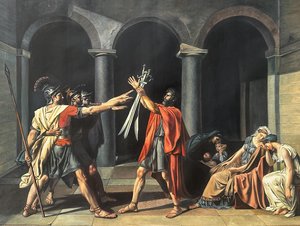 The Oath of the Horatii
, Jacques-Louis David
Composition in Neoclassical art is characterized by a profound sense of structural stability. There is a rejection of the diagonal, chaotic movement that defined the Baroque; instead, the eye is guided through a scene by clear, logical paths. The use of linear perspective and the arrangement of figures often mimic the shallow, frieze-like quality of classical relief sculpture. This creates a sense of containment and focus, ensuring that the viewer's attention is directed toward the central moral or narrative tension of the work.
We see this rhythmic control echoed in the musical structures of the 18th century, where clarity, economy, and emotional restraint were the primary virtues. Just as a composer might use a clear, contrapuntal texture to create a sense of order, the Neoclassical painter used the arrangement of space to create a sense of inevitability. In Jacques-Louis David’s The Oath of the Horatii, the composition is strikingly structured; a strong diagonal axis created by the swords draws the eye toward the focal point of the brothers' pledge, creating a sense of drama that is contained within a rigid, almost architectural, framework.
Through this controlled arrangement, the artist achieves a sense of permanence, as if the moment depicted were frozen in marble.
The Enduring Canon: Why the Classical Spirit Remains
The specific fashions of the 18th century have long since passed, yet the impulse toward order and reason remains a fundamental part of the artistic dialogue. Neoclassicism represented a recalibration of the artist's relationship to history, rather than a closed chapter. It suggested that the past is a reservoir of principles—symmetry, proportion, and dignity—rather than a mere collection of old objects that can be revisited whenever the present feels too fragmented.
This influence is visible in the way we seek balance in our built environments. In Kassel, the Museum Fridericianum, designed by Carl Wilhelm Schulze, maintains a sense of permanence through its neoclassical elegance and structured proportions. Similarly, the Alte Nationalgalerie in Berlin, with its use of Triassic sandstone and iron, is a temple of art where the interplay of light and shadow creates a contemplative atmosphere. These structures demonstrate how the structured ideals of the past can anchor a space, providing stability even as architectural philosophies evolve from the rigid lines of the 18th century to the organic fluidity of later eras.
For those who value the strength of tradition, the Neoclassical spirit offers a reminder that quality is found in the marriage of technical precision and intellectual depth. For a deeper study of these historical movements and their lasting influence, TopImpressionists.com offers extensive archival information.


