Atelier — Gratis verzending wereldwijd — Levertijd 2–6 weken
      George Bellows, 1882 – 1925

      De 100 bekendste schilderijen van George Bellows

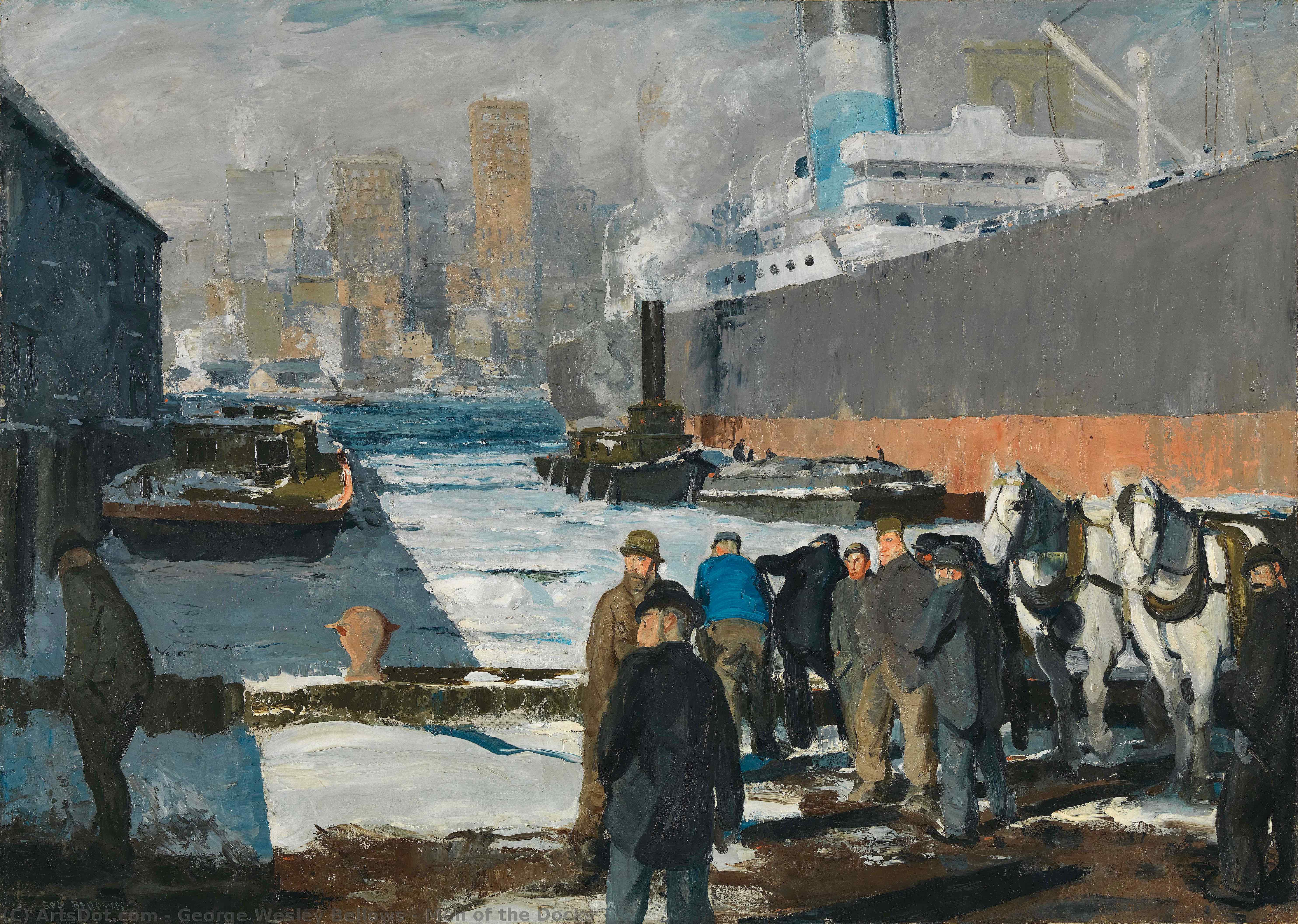
      Men of the Docks (1912) is het schilderij waar George Bellows het meest om bekendstaat; het maakt deel uit van de collectie van het National Gallery, Londen. Ringside Seats (1924) en Forty-Two Kids (1907) maken het trio van meest geliefde doeken compleet. Onze catalogus bevat 318 werken van George Bellows. Hier zijn de 100 bekendste, inclusief het jaar, het museum en het verhaal achter elk canvas.

      Gerangschikt op basis van onze populariteitsscore, die de zoekopdrachten, bezoeken en bestellingen voor elk werk combineert. Bijgewerkt in oktober 2026. Elk schilderij op deze pagina kan worden besteld als een handgeschilderde oliereductie op linnen canvas, of als een fine art print, uitgevoerd in de door u gekozen afmeting.

      Portret van George Bellows
      George Bellows · 1882 – 1925
      Geboren · overleden
      1882 – 1925, Columbus
      Stroming
      Realism
      Werken in onze catalogus
      318
      Meest bekend
      Men of the Docks (1912)
      Meeste werken in
      National Gallery of Art

      De tien meest geliefde schilderijen van George Bellows

      Men of the Docks (1912) door George Bellows
      1

      Men of the Docks

      1912 · Olieverf op canvas · National Gallery, Londen

      Een boeiende maritieme scène van stedelijke industrie Dompel uzelf onder in een levendige weergave van het leven aan de kade in het begin van de 20e eeuw, waar menselijke activiteit en industriële vooruitgang samenkomen. Deze dynamische scène vangt een bruisende haven, vol met havenarbeiders, schepen en het omringende stadsbeeld, en biedt een aangrijpend kijkje in de rauwe werkelijkheid van stedelijke arbeid. De figuren, gekleed in ingetogen tinten, belichamen de veerkracht…

      Ringside Seats (1924) door George Bellows
      2

      Ringside Seats

      1924 · Oil On Canvas

      In the heart of the early twentieth century, amidst the grit and burgeoning energy of New York City, George Wesley Bellows captured a moment of pure, unadulterated tension in his 1924 masterpiece, Ringside Seats. This dramatic oil painting serves as more than just a depiction of a boxing match; it is a visceral window into the soul of the Ashcan School. The composition pulls the viewer directly into the fray,…

      Forty-Two Kids (1907) door George Bellows
      3

      Forty-Two Kids

      1907 · Oil On Canvas · National Gallery of Art, Washington

      In the heart of 1907, George Wesley Bellows captured a fleeting moment of raw, uninhibited energy in his masterpiece, Forty-Two Kids. This large-scale oil on canvas serves as a breathtaking window into a bygone era of urban leisure, transporting the viewer to the edge of a dilapidated wharf jutting out over New York City’s East River. The scene is teeming with life, presenting a band of nude and partially clothed…

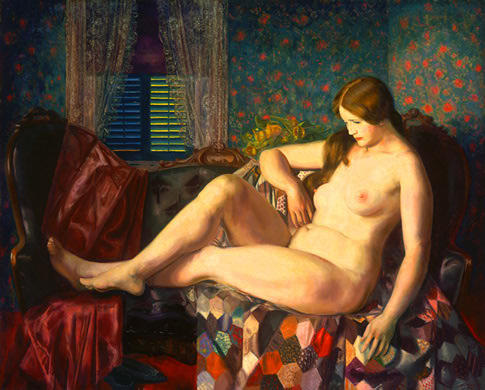
      Nude with Hexagonal Quilt (1924) door George Bellows
      4

      Nude with Hexagonal Quilt

      1924 · Acrylic On Canvas · National Gallery of Art, Washington

      George Wesley Bellows’s “Nude with Hexagonal Quilt,” painted in 1924, is more than just a depiction of a reclining woman; it's a carefully constructed tableau that encapsulates the burgeoning complexities of American life at the cusp of the 20th century. Emerging from the heart of the Ashcan School movement, Bellows masterfully blends realism with a subtle undercurrent of social commentary and psychological depth, all within a remarkably intimate domestic setting.…

      The Germans Arrive (1918) door George Bellows
      5

      The Germans Arrive

      1918 · Acrylic On Canvas · National Gallery of Art, Washington

      The Raw Edge of War: Bellows’ “The Germans Arrive” George Wesley Bellows' "The Germans Arrive," painted in 1918, isn’t merely a depiction of a battlefield; it’s a visceral plunge into the heart of World War I’s brutal reality. Captured during a period of immense national upheaval and fueled by the anxieties of a rapidly changing world, the painting confronts viewers with an unsettling honesty rarely found in historical art. Bellows,…

      The Sea (1911) door George Bellows
      6

      The Sea

      1911 · Oil On Canvas · Hirshhorn Museum and Sculpture Garden, Washington, D.C.

      George Wesley Bellows’ “The Sea,” painted in 1911, isn't merely a depiction of an ocean scene; it’s a visceral experience. This oil on canvas, now residing within the Hirshhorn Museum and Sculpture Garden in Washington D.C., captures a pivotal moment – the raw, untamed power of nature colliding with the steadfast solidity of land. The painting immediately draws the viewer into a world of turbulent energy: colossal waves relentlessly assault…

      Pennsylvania Station Excavation (1909) door George Bellows
      7

      Pennsylvania Station Excavation

      1909 · Oil On Canvas · Brooklyn Museum, New York

      George Wesley Bellows’ “Pennsylvania Station Excavation,” painted in 1909, is more than just a depiction of a landscape; it's a vibrant snapshot of America on the cusp of profound change. This large-scale oil on canvas captures a fleeting moment – a group of figures exploring an industrial site, a castle-like structure billowing with smoke, and a solitary horse adding an unexpected layer to the scene. Bellows, a key figure in…

      Little Girl in White (also known as Queenie Barnett) (1907) door George Bellows
      8

      Little Girl in White (also known as Queenie Barnett)

      1907 · Oil On Canvas · National Gallery of Art, Washington

      George Wesley Bellows' “Little Girl in White,” more commonly known as “Queenie Barnett,” is far more than a simple portrait of a young girl. Painted in 1907, this work stands as a poignant window into the realities of early 20th-century New York City – a city grappling with rapid industrialization and the struggles of its working class. Bellows, a pivotal figure in American realism, wasn’t interested in romanticizing poverty; instead,…

      Hudson at Saugerties (1920) door George Bellows
      9

      Hudson at Saugerties

      1920 · Oil On Canvas · Columbia Museum of Art, Columbus

      George Wesley Bellows' "Hudson at Saugerties," painted in 1920, isn't merely a depiction of a river landscape; it’s a carefully constructed tableau of light, atmosphere, and the quiet dignity of rural life. Housed originally within the Columbia Museum of Art in Columbus, Ohio, this oil on canvas transports the viewer to the heart of the Hudson River Valley, capturing a fleeting moment of tranquility amidst the burgeoning energy of early…

      Emma in the Black Print (1919) door George Bellows
      10

      Emma in the Black Print

      1919 · Oil On Canvas · Museum of Fine Arts, Boston

      Emma in the Black Print by George Wesley Bellows George Wesley Bellows’ “Emma in the Black Print,” completed in 1919, stands as a testament to his mastery of realist portraiture and his profound engagement with the spirit of American modernity. Housed at the Museum of Fine Arts, Boston, this oil-on-canvas painting transcends mere representation; it captures a moment frozen in time—a glimpse into the domestic life of Bellows’ wife, Emma…

      George Bellows: doeken 11 tot 100 van de ranglijst

      A Grandmother (1914) door George Bellows
      #12

      A Grandmother

      1914 · Thyssen-Bornemisza Museum

      In the quiet light of summer 1914, George Bellows finds himself on Monhegan, a small island off the coast of Maine. Here, amidst the salt air and the…

      Laat het met de hand schilderen →
      Katherine Rosen (1921) door George Bellows
      #13

      Katherine Rosen

      1921 · Yale University Art Gallery

      George Wesley Bellows' 1921 painting, "Katherine Rosen," residing within the hallowed halls of the Yale University Art Gallery, isn’t merely a portrait; it’s a carefully constructed tableau of…

      Laat het met de hand schilderen →
      Mrs. T. in Cream Silk, No.2 (1920) door George Bellows
      #16

      Mrs. T. in Cream Silk, No.2

      1920 · Minneapolis Institute of Art

      Mrs. T. in Cream Silk, No.2 is an oil on canvas painting by George Bellows. Created in 1920, the work identifies its subject as Mrs. Mary Brown Tyler.…

      Bestel dit canvas →
      Mrs. Chester Dale (1919) door George Bellows
      #17

      Mrs. Chester Dale

      1919 · Metropolitan Museum of Art

      The room falls into deep shadow, leaving only the figure of Mrs. Chester Dale to hold the light. She sits with a quiet, heavy dignity, her form emerging…

      Bestel dit canvas →
      Love of Winter (1914) door George Bellows
      #18

      Love of Winter

      1914 · Art Institute of Chicago

      This evocative portrayal of winter’s delight stands as a cornerstone of American realist art, demonstrating Bellows' profound understanding of both visual artistry and human psychology. Its legacy continues…

      Laat het met de hand schilderen →
      Evening Group (1914) door George Bellows
      #20

      Evening Group

      1914

      To gaze upon George Wesley Bellows' Evening Group is to step directly into a sun-drenched moment suspended in time. This magnificent painting, executed in 1914, transcends a mere…

      Laat het met de hand schilderen →
      Frankie the Organ Boy (1907) door George Bellows
      #21

      Frankie the Organ Boy

      1907 · Nelson-Atkins Museum of Art

      George Wesley Bellows’ “Frankie the Organ Boy,” painted in 1907, isn't merely a portrait; it’s a carefully constructed tableau of urban life, imbued with a poignant sense of…

      Laat het met de hand schilderen →
      Tennis Tournament (1920) door George Bellows
      #22

      Tennis Tournament

      1920 · National Gallery of Art

      A Masterpiece of Realism "CITE>George Wesley Bellows" was a prominent figure in the early 20th-century American art scene, known for his vivid depictions of everyday life and sports.…

      Haal dit licht in huis →
      Cross-Eyed Boy (1906) door George Bellows
      #23

      Cross-Eyed Boy

      1906

      To stand before George Wesley Bellows’ "Cross-Eyed Boy" is not merely to observe a painting; it is to be drawn into a moment of profound, unscripted encounter. Created…

      Haal dit licht in huis →
      The Newsboy (1908) door George Bellows
      #24

      The Newsboy

      1908 · Brooklyn Museum

      The Newsboy is an oil on canvas painting created by the American artist George Bellows in 1908. The subject of this portrait is a working-class newsboy, identified in…

      Bestel dit canvas →
      Nude with Red Hair (1920) door George Bellows
      #34

      Nude with Red Hair

      1920 · National Gallery of Art

      In this 1920 oil on canvas, we find a moment of profound stillness. The subject is a woman seated upon a bed, her form partially obscured by a…

      Bestel dit canvas →
      The Circus (1912) door George Bellows
      #43

      The Circus

      1912 · Addison Gallery of American Art

      The Circus is a large oil on canvas painted by George Wesley Bellows in 1912. The scene depicts a circus performance occurring within a tent, characterized by a…

      Laat het met de hand schilderen →
      Waldo Peirce (1920) door George Bellows
      #44

      Waldo Peirce

      1920 · Fine Arts Museums of San Francisco

      George Bellows' 1920 oil painting, "Waldo Peirce," isn’t merely a likeness; it’s a carefully constructed tableau of late Edwardian masculinity – a study in weathered grace and understated…

      Laat het met de hand schilderen →
      Emma at the Piano (1914) door George Bellows
      #45

      Emma at the Piano

      1914

      To gaze upon George Wesley Bellows' masterpiece, Emma at the Piano, is to step directly into the intimate, warmly lit drawing-room of the early twentieth century. This painting,…

      Haal dit licht in huis →
      Iron Coast, Monhegan (1913) door George Bellows
      #46

      Iron Coast, Monhegan

      1913

      The Untamed Spirit of the Atlantic Coast In the heart of 1913, George Wesley Bellows captured a moment of profound elemental struggle in Iron Coast, Monhegan. This masterpiece…

      Haal dit licht in huis →
      Snow-Capped River (1911) door George Bellows
      #47

      Snow-Capped River

      1911

      George Wesley Bellows’ Snow-Capped River transports the viewer to a moment suspended in crystalline quietude. This painting, executed in 1911, is more than just a depiction of a…

      Bestel dit canvas →
      The Teamster (1916) door George Bellows
      #49

      The Teamster

      1916

      To stand before George Wesley Bellows' magnificent canvas, The Teamster, is to be transported directly into the vibrant, sweat-and-steam heart of early twentieth-century America. This painting is far…

      Laat het met de hand schilderen →
      Vine Clad Shore - Monhegan Island (1913) door George Bellows
      #50

      Vine Clad Shore - Monhegan Island

      1913 · Smithsonian American Art Museum

      George Wesley Bellows’ "Vine Clad Shore - Monhegan Island" transports the viewer to a moment suspended in time—a breathtaking tableau of rugged coastline meeting tranquil water. This painting…

      Haal dit licht in huis →
      Pueblo Tesuque, No. 2 (1917) door George Bellows
      #52

      Pueblo Tesuque, No. 2

      1917 · Nelson-Atkins Museum of Art

      George Bellows captured the quiet rhythms of New Mexican life in Pueblo Tesuque, No. 2. Painted in October 1917, this oil on canvas work offers a glimpse into…

      Bestel dit canvas →
      The Palisades (1909) door George Bellows
      #53

      The Palisades

      1909

      The landscape unfolds with a vast body of water dominating the foreground, set against the rising presence of the Palisades. A solitary man occupies the shore, his gaze…

      Haal dit licht in huis →
      Golf Course - California (1917) door George Bellows
      #55

      Golf Course - California

      1917 · Cincinnati Art Museum

      George Wesley Bellows’ "Golf Course - California" is more than just a depiction of a scenic outing; it is a vibrant meditation on leisure, the American landscape, and…

      Haal dit licht in huis →
      Shipyard Society (1916) door George Bellows
      #57

      Shipyard Society

      1916 · Virginia Museum of Fine Arts

      In the heart of George Wesley Bellows’ 1916 masterpiece, "Shipyard Society," lies a profound meditation on the pulse of early twentieth-century American life. This monumental oil on panel…

      Laat het met de hand schilderen →
      Rain on the River (1908) door George Bellows
      #58

      Rain on the River

      1908 · Rhode Island School of Design Museum of Art

      The painting Rain on the River by George Wesley Bellows is a beautiful representation of the landscape with a train traveling along the tracks near a body of…

      Haal dit licht in huis →
      The Big Dory door George Bellows
      #59

      The Big Dory

      New Britain Museum of American Art

      is a genre painting by George Wesley Bellows. Created in 1913, the work belongs to the American Realism movement. It captures a specific moment of physical labor as…

      Haal dit licht in huis →
      Monhegan Island (1913) door George Bellows
      #61

      Monhegan Island

      1913 · Worcester Art Museum

      A Storm’s Embrace: Bellows' Monhegan Island George Wesley Bellows’ “Monhegan Island,” painted in 1913, isn’t merely a depiction of a coastal scene; it’s a visceral embodiment of the…

      Laat het met de hand schilderen →
      The Village Houses (1920) door George Bellows
      #62

      The Village Houses

      1920 · Art Institute of Chicago

      is a painting by George Wesley Bellows. Also known by the alternative title Pigeon house, the work was created c. 1920. This piece belongs to the artist's body…

      Bestel dit canvas →
      Blue Morning (1909) door George Bellows
      #64

      Blue Morning

      1909 · National Gallery of Art

      The morning light filters through a hazy atmosphere in Blue Morning, a work painted by George Bellows in 1909. This scene captures the massive construction site of the…

      Laat het met de hand schilderen →
      The Picnic (1924) door George Bellows
      #69

      The Picnic

      1924 · Baltimore Museum of Art

      In the golden light of 1924, George Wesley Bellows captured more than just a landscape; he froze a heartbeat of American life in his masterpiece, "The Picnic." This…

      Haal dit licht in huis →
      Snow Dumpers (1911) door George Bellows
      #70

      Snow Dumpers

      1911

      In the frost-bitten landscape of 1911, George Wesley Bellows captured a moment that transcends mere seasonal documentation, offering instead a visceral encounter with the raw energy of American…

      Bestel dit canvas →
      Portrait of Anne (1915) door George Bellows
      #71

      Portrait of Anne

      1915 · High Museum of Art

      In the vast landscape of early 20th-century American realism, few works capture the intimate intersection of domestic peace and historical tension as poignantly as George Wesley Bellows’ “Portrait…

      Bestel dit canvas →
      The White Horse (1922) door George Bellows
      #72

      The White Horse

      1922 · Worcester Art Museum

      George Wesley Bellows: A Vision of Grit and Grace George Wesley Bellows (August 12 or August 19, 1882 – January 8, 1925) stands as a monumental figure in…

      Bestel dit canvas →

      De doeken van George Bellows, periode voor periode

      Wat George Bellows het meest schilderde

      De vier onderwerpen die het meest voorkomen op deze doeken, elk met zijn meest geliefde voorbeeld.

      Waar de doeken van George Bellows hangen

      De 8 musea met de meeste schilderijen op deze pagina.

      Museum Stad Werken van George Bellows Schilderijen uit deze lijst
      National Gallery of Art, WashingtonNational Gallery of Art Washington 21 Forty-Two Kids, Nude with Hexagonal Quilt, The Germans Arrive
      Metropolitan Museum of Art, New YorkMetropolitan Museum of Art New York 11 Mrs. Chester Dale, Padre, Samuel Knopf
      Museum of Fine Arts, Houston, HoustonMuseum of Fine Arts, Houston Houston 4 Haystacks and Barn, The Grove — Monhegan
      Yale University Art Gallery, HartfordYale University Art Gallery Hartford 3 Katherine Rosen, The Rope (also known as Builders of Ships)
      Art Institute of Chicago, ChicagoArt Institute of Chicago Chicago 3 Love of Winter, The Village Houses
      Rhode Island School of Design Museum of Art, ProvidenceRhode Island School of Design Museum of Art Providence 3 Portrait of Walter Littlefield, Rain on the River
      Brooklyn Museum, New YorkBrooklyn Museum New York 2 Pennsylvania Station Excavation, A Morning Snow - Hudson River
      Minneapolis Institute of Art, MinneapolisMinneapolis Institute of Art Minneapolis 2 Mrs. T. in Cream Silk, No.2, The Harbor, Monhegan Coast, Maine

      Het beroemdste canvas van George Bellows, decennium na decennium

      1. 1900s
        Forty-Two Kids (1907) door George Bellows
        Canvas 3 van 100

        Forty-Two Kids

        Leeftijd 18 – 27 · National Gallery of Art

        In the heart of 1907, George Wesley Bellows captured a fleeting moment of raw, uninhibited energy in his masterpiece, Forty-Two Kids. This large-scale oil on canvas serves as…

      2. 1910s
        Men of the Docks (1912) door George Bellows
        Canvas 1 van 100

        Men of the Docks

        Leeftijd 28 – 37 · National Gallery

        Een boeiende maritieme scène van stedelijke industrie Dompel uzelf onder in een levendige weergave van het leven aan de kade in het begin van de 20e eeuw, waar…

      3. 1920s
        Ringside Seats (1924) door George Bellows
        2 van 100

        Ringside Seats

        Leeftijd 38 – 43

        In the heart of the early twentieth century, amidst the grit and burgeoning energy of New York City, George Wesley Bellows captured a moment of pure, unadulterated tension…

      De doeken van George Bellows, vraag voor vraag

      Waarom wordt George Bellows het meest herinnerd om welk canvas?Lees het antwoord

      Men of the Docks (1912), National Gallery, Londen. Ringside Seats (1924) en Forty-Two Kids (1907) volgen.

      Men of the Docks: hoe oud was George Bellows toen dit werd geschilderd?Lees het antwoord

      George Bellows, geboren in 1882, was 30 jaar oud: Men of the Docks dateert uit 1912.

      Wat zijn de tien beroemdste doeken van George Bellows?Lees het antwoord

      Men of the Docks, Ringside Seats, Forty-Two Kids, Nude with Hexagonal Quilt, The Germans Arrive, The Sea, Pennsylvania Station Excavation, Little Girl in White (also known as Queenie Barnett), Hudson at Saugerties en Emma in the Black Print. Elk canvas in de bovenstaande ranglijst is voorzien van het jaartal en het museum.

      Hoeveel schilderijen heeft George Bellows gemaakt?Lees het antwoord

      318 werken van George Bellows zijn opgenomen in onze catalogus, gedateerd van 1905 tot 1924.

      Waar hangen de beroemdste doeken van George Bellows tegenwoordig?Lees het antwoord

      Voornamelijk in National Gallery of Art (Washington), Metropolitan Museum of Art (New York) en Museum of Fine Arts, Houston (Houston); de bovenstaande lijst vermeldt elk museum en de bijbehorende doeken.

      Wanneer schilderde George Bellows de beroemdste doeken?Lees het antwoord

      In 1910s, die 42 van de 100 werken op deze pagina vertegenwoordigt, waaronder Men of the Docks.

      Welk beroemd canvas van George Bellows was het eerst, en welke was het laatst?Lees het antwoord

      Het oudste canvas hier is Robin (also known as Portrait of Clifton Webb) (1905); het nieuwste is Ringside Seats (1924).

      Welke onderwerpen schilderde George Bellows het meest?Lees het antwoord

      American art (14), Portrait (11) en People (9), verspreid over de 100 werken op deze pagina.

      Welk medium komt het meest voor in de schilderijen van George Bellows?Lees het antwoord

      Oil On Canvas, gebruikt in 35 van de 100 werken op deze pagina.

      Bij welke stroming wordt George Bellows gerekend?Lees het antwoord

      Realism, zoals de doeken op deze pagina laten zien.

      Welke schilderijen van George Bellows zijn in de collectie van het National Gallery of Art?Lees het antwoord

      Het National Gallery of Art, Washington herbergt 8 van de werken op deze pagina, waaronder Forty-Two Kids, Nude with Hexagonal Quilt en The Germans Arrive.

      Waar kan ik een reproductie van een schilderij van George Bellows kopen?Lees het antwoord

      Ja. Elk schilderij op deze pagina kan via de eigen pagina worden besteld als een handgeschilderd olieverfreproductie, of als een fine art print, in de door u gekozen afmeting.

      Maak kennis met de schilder: George Bellows

      A Bold Vision of American Life: The World of George Bellows

      George Wesley Bellows, a name inextricably linked to the vibrant energy and burgeoning modernity of early 20th-century America, stands as a pivotal figure in realist painting. Born in Columbus, Ohio, on August 12 or 19, 1882, his journey from athletic promise to artistic renown is a testament to an unwavering passion and remarkable dedication. Even before formal schooling, young George displayed an innate talent for drawing, filling notebooks with sketches that hinted at the keen observational skills and burgeoning artistry within him. His upbringing wasn’t solely defined by art; he excelled in sports – both baseball and basketball – at Ohio State University – a duality that profoundly shaped his artistic perspective, imbuing his work with a palpable sense of dynamic movement and physicality. This athletic background instilled not only discipline but also an appreciation for the human form in action, a recurring theme throughout his most celebrated paintings. He ultimately left university before graduating, driven by an irresistible pull towards New York City and the promise of artistic training.

      Forging a Path: The Ashcan School and Beyond

      Arriving in New York in 1904, Bellows quickly found mentorship under Robert Henri, a leading figure of the Ashcan School. This group of artists – including John Sloan, William Glackens, and George Luks – deliberately rejected the rigid conventions of academic art, instead choosing to depict the gritty realities of urban life: crowded tenements, bustling streets, and the everyday struggles of working-class Americans. Bellows wholeheartedly embraced this ethos, initially mirroring Henri’s loose brushwork and commitment to social realism. However, he wasn't content merely replicating his teacher’s style; he possessed a burning ambition to forge his own distinct artistic voice. He established a studio with fellow artist Edward Keefe in 1906, marking the beginning of a prolific period of experimentation and self-discovery. His early works, often exhibited alongside those of his peers, were met with mixed reactions – some critics lauded their boldness and innovation, while others found them crude or unsettling. Bellows’s subject matter was frequently controversial for its time, challenging prevailing notions of what constituted “acceptable” art. He didn't shy away from portraying the less glamorous aspects of city life, capturing scenes of poverty, labor, and leisure with unflinching honesty.

      The Arena of Life: Boxing and Urban Spectacle

      While Bellows’s oeuvre encompassed a diverse range of subjects – portraits, landscapes, seascapes – he is perhaps most renowned for his powerful depictions of boxing matches. These weren't simply sporting events to him; they were microcosms of human drama, embodying themes of struggle, resilience, and the primal instincts that drive competition. He became a regular visitor to smoky boxing clubs, meticulously studying the movements of fighters, their intense gazes, and the raw energy of the crowd. Paintings like *Both Members of This Club* (1909) and *Stag at Sharkey’s* (1909) are masterful examples of his ability to capture this atmosphere, utilizing dramatic lighting, dynamic compositions, and a palpable sense of tension. The boxing scenes weren't merely about the sport itself; they were metaphors for life’s battles, reflecting the social Darwinism prevalent in American society at the time. Beyond boxing, Bellows also found inspiration in other spectacles of urban life – parades, circuses, and crowded streets – all offering opportunities to explore themes of movement, energy, and the collective experience.

      Evolving Style and Lasting Legacy

      As Bellows matured as an artist, his style underwent a subtle but significant evolution. While he retained his commitment to realism, he began to move away from the loose brushwork of his early years, adopting a more stylized aesthetic characterized by smoother curves, monumental forms, and a heightened sense of drama. This shift is evident in later works like *Dempsey and Firpo* (1924), a monumental canvas capturing the climactic moment of a legendary boxing match with breathtaking intensity. He also experimented with lithography, producing a series of striking prints that showcased his mastery of line and tone. Despite achieving considerable success during his lifetime – including election to the National Academy of Design in 1913 – Bellows remained committed to pushing artistic boundaries and challenging conventional norms. His untimely death in 1925 at the age of 42 cut short a promising career, but his legacy endures as one of America’s most important realist painters. *His paintings continue to resonate with audiences today*, offering a powerful and unflinching portrait of American life in the early 20th century – a world brimming with energy, conflict, and the enduring spirit of humanity. His influence can be seen in subsequent generations of artists who sought to capture the dynamism and complexity of modern urban experience.

      Major Works & Recognition

      • *Both Members of This Club* (1909) – A seminal work capturing the atmosphere of a boxing club.
      • *Stag at Sharkey’s* (1909) – Another iconic depiction of a boxing match, renowned for its dramatic lighting and composition.
      • *Men of the Docks* (1912) – A powerful portrayal of working-class laborers, showcasing Bellows's skill in capturing physicality and texture.
      • *The Germans Arrive* (1918) – A series of lithographs depicting the atrocities committed during World War I, demonstrating his engagement with social and political issues.
      • *Dempsey and Firpo* (1924) – A monumental canvas capturing a pivotal moment in boxing history, showcasing Bellows’s evolved style and mastery of composition.
      Bellows's work is held in major museum collections across the United States, including The Museum of Modern Art (New York), the National Gallery of Art (Washington D.C.), the Smithsonian American Art Museum, and the Whitney Museum of American Art. His paintings continue to be exhibited and studied by art historians and enthusiasts alike, solidifying his place as a cornerstone of American artistic heritage.

      Alle 318 werken van George Bellows →