Atelier — Gratis verzending wereldwijd — Levertijd 2–6 weken
      Thomas Couture, 1815 – 1879

      Thomas Couture: De 100 bekendste schilderijen

      Van alle schilderijen van Thomas Couture is The Romans of the Decadence het bekendst; het hangt in het Musée d'Orsay in Parijs. Direct daarna volgen Romans of the Decadence (1847) en Lust for Gold (1844). Van de 221 werken van Thomas Couture in onze catalogus zijn dit de 100 meest gevierde werken, elk getoond met de datum, het museum en het verhaal erachter.

      Gerangschikt op basis van onze populariteitsscore, die de zoekopdrachten, bezoeken en bestellingen voor elk werk combineert. Bijgewerkt in oktober 2026. Elk schilderij op deze pagina kan worden besteld als een handgeschilderde oliereductie op linnen canvas, of als een fine art print, uitgevoerd in de door u gekozen afmeting.

      Portret van Thomas Couture
      Thomas Couture · 1815 – 1879
      Geboren · overleden
      1815 – 1879, Senlis
      Stroming
      Academicism
      Werken in onze catalogus
      221
      Meest bekend
      The Romans of the Decadence
      Meeste werken in
      Museum of Fine Arts

      De 10 meest gevierde schilderijen van Thomas Couture

      The Romans of the Decadence door Thomas Couture
      1

      The Romans of the Decadence

      Oil On Canvas · Musée d'Orsay, Parijs

      The painting The Romans of the Decadence by Thomas Couture is a quintessential representation of the Academic art movement, which dominated the 19th century. This large-scale oil on canvas work, measuring 472 cm x 772 cm, was completed in 1847 and is now housed at the Musée d'Orsay in Paris. Historical Context The Academic art movement emerged as a response to the Romanticism that preceded it. It emphasized traditional forms…

      Romans of the Decadence (1847) door Thomas Couture
      2

      Romans of the Decadence

      1847 · Oil On Canvas · Musée d'Orsay, Parijs

      In the hallowed, quiet corridors of the Musée d'Orsay, there exists a window into a world of fading glory, captured through the masterful lens of Thomas Couture. His 1847 masterpiece, Romans in Their Decadence, is far more than a mere historical tableau; it is a visceral exploration of an empire in its twilight. This colossal oil on canvas, measuring an imposing 466 x 773 cm, stands as an arresting testament…

      Lust for Gold (1844) door Thomas Couture
      3

      Lust for Gold

      1844 · Oil On Canvas · Rijksmuseum, Amsterdam

      The air in the room feels heavy, thick with the scent of unwashed linen and the metallic tang of coin. A group of figures huddles around a table draped in a deep red cloth, their bodies pressing into a tight, claustrophobic circle. Light falls sharply across the scene, catching the pale curve of a woman's shoulder and the glint of yellow metal, while the rest of the room dissolves into…

      The Prodigal Son (1850) door Thomas Couture
      9

      The Prodigal Son

      1850 · Oil On Canvas · Walters Art Museum, Baltimore

      The heavy atmosphere of the scene centers on The Prodigal Son, a work by the French artist Thomas Couture. This painting, dating to 1850, captures a moment of profound emotional weight. It exists as a replica of a previous composition that once appeared before the public at the Paris Salon of 1841. The figures remain frozen in their dramatic tension, caught in a cycle of shadow and light that defines…

      Timon of Athens (1857) door Thomas Couture
      10

      Timon of Athens

      1857 · Oil On Canvas · Wallace Collection, Londen

      The oil on canvas known as Timon of Athens emerges from the brush of Thomas Couture, a painter who captures a heavy, dramatic moment of human frailty. Created in 1857, this work presents a profound allegory of greed. The scene draws its lifeblood from the themes of Shakespeare's play, transforming a literary tragedy into a visual meditation on the corrupting nature of wealth. Every figure within the frame seems caught…

      Schilderijen van Thomas Couture gerangschikt van 11 tot 100

      Drummer Boy (1857) door Thomas Couture
      #11

      Drummer Boy

      1857 · Detroit Institute of Arts

      This impressively scaled oil on canvas, titled Drummer Boy, was executed by the French painter Thomas Couture in 1857. It belongs to the genre art tradition, focusing on…

      Laat het met de hand schilderen →
      A Zouave (1859) door Thomas Couture
      #12

      A Zouave

      1859 · Yale University Art Gallery

      In this oil on canvas, titled A Zouave, the artist Thomas Couture presents a study of a single figure. The work is a painting that captures a soldier…

      Haal dit licht in huis →
      Alice Ozy (1855) door Thomas Couture
      #14

      Alice Ozy

      1855 · Toledo Museum of Art

      In this 1855 portrait, Thomas Couture presents us with Alice Ozy. The work captures a seated woman in a moment of quietude, a subject that allows the artist…

      Bestel dit canvas →
      Head of a Woman, Study door Thomas Couture
      #17

      Head of a Woman, Study

      Finnish National Gallery

      A soft, directional light spills from the upper left, carving the woman's features out of a deep, enveloping shadow. She sits in a state of quiet melancholy, her…

      Bestel dit canvas →
      Young Italian Girl (1877) door Thomas Couture
      #43

      Young Italian Girl

      1877 · Bristol Museum - Art Gallery

      Thomas Couture’s Young Italian Girl, painted in 1877, immediately draws the viewer into its intimate sphere. It is a portrait that transcends mere likeness; it captures a moment…

      Laat het met de hand schilderen →
      Horace and Lydia (1843) door Thomas Couture
      #45

      Horace and Lydia

      1843 · Wallace Collection

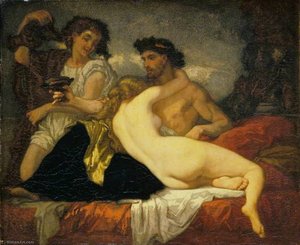
      Thomas Couture’s Horace and Lydia, painted in 1843, invites the viewer into an intimate tableau steeped in the rich, enveloping warmth of red. This is not merely a…

      Bestel dit canvas →
      Caught by the Tide (1875) door Thomas Couture
      #46

      Caught by the Tide

      1875 · National Gallery

      The oil painting depicts a group of three figures positioned upon a dark, jagged rock formation in the foreground. These figures are arranged in a triangular formation, creating…

      Bestel dit canvas →
      Horace and Lydia (1843) door Thomas Couture
      #57

      Horace and Lydia

      1843 · Wallace Collection

      Thomas Couture's "Horace and Lydia," painted in 1843, is more than just a portrait; it’s a carefully constructed tableau brimming with unspoken narratives and a subtle defiance against…

      Haal dit licht in huis →

      Wat Thomas Couture het meest schilderde

      De vier onderwerpen die het meest voorkomen op deze doeken, elk met zijn meest geliefde voorbeeld.

      Waar de doeken van Thomas Couture hangen

      De 8 musea met de meeste schilderijen op deze pagina.

      Museum Stad Werken van Thomas Couture Schilderijen uit deze lijst
      Museum of Fine Arts, BostonMuseum of Fine Arts Boston 8 Two Soldiers, Nymph and Cupids, Head of a Woman in Profile
      Wallace Collection, LondenWallace Collection Londen 6 The Young Drummer, Timon of Athens, Harlequin and Pierrot
      Musée d'Orsay, ParijsMusée d'Orsay Parijs 6 The Romans of the Decadence, Romans of the Decadence, Romans of the Decadence (detail)
      Walters Art Museum, BaltimoreWalters Art Museum Baltimore 4 The Prodigal Son, Horace and Lydia, Daydreams
      National Gallery of Ireland, DublinNational Gallery of Ireland Dublin 3 A Sleeping Judge, La Peinture Réaliste, Pifferaro
      Rhode Island School of Design Museum of Art, ProvidenceRhode Island School of Design Museum of Art Providence 4 Gamin, The Little Confectioner
      Petit Palais, ParijsPetit Palais Parijs 3 Study Made After Jules Michelet, Detail Study for "Les Romains de la décadence": The Two Philosophers
      Bayerische Staatsgemäldesammlungen, MünchenBayerische Staatsgemäldesammlungen München 2 Female Head (Study of a Model), Odalisque

      Decennium voor decennium: het meest gevierde canvas van Thomas Couture

      1. 1840s
        Romans of the Decadence (1847) door Thomas Couture
        Op nummer 2 van 100

        Romans of the Decadence

        Leeftijd 25 – 34 · Musée d'Orsay

        In the hallowed, quiet corridors of the Musée d'Orsay, there exists a window into a world of fading glory, captured through the masterful lens of Thomas Couture. His…

      2. 1850s
        The Young Drummer (1857) door Thomas Couture
        Op nummer 4 van 100

        The Young Drummer

        Leeftijd 35 – 44 · Wallace Collection

        The Young Drummer is an oil on canvas painting by the French artist Thomas Couture. Created in 1857, this work is also recognized by the alternative title Drummer…

      3. 1860s
        Nymph and Cupids (1860) door Thomas Couture
        Op nummer 32 van 100

        Nymph and Cupids

        Leeftijd 45 – 54 · Museum of Fine Arts
      4. 1870s
        Pifferaro (1877) door Thomas Couture
        Op nummer 38 van 100

        Pifferaro

        Leeftijd 55 – 64 · National Gallery of Ireland

      Uw vragen over de schilderijen van Thomas Couture beantwoord

      Wat is het meest gevierde schilderij van Thomas Couture?Lees het antwoord

      The Romans of the Decadence, Musée d'Orsay, Parijs. Romans of the Decadence (1847) en Lust for Gold (1844) volgen.

      Waar is Thomas Couture het meest bekend om vanwege welke tien schilderijen?Lees het antwoord

      The Romans of the Decadence, Romans of the Decadence, Lust for Gold, The Young Drummer, Reverie, La Noblesse, Portrait de jeune fille, La commandite, The Prodigal Son en Timon of Athens. Elk canvas in de bovenstaande ranglijst is voorzien van het jaartal en het museum.

      Hoeveel schilderijen van Thomas Couture zijn er bekend?Lees het antwoord

      221 werken van Thomas Couture zijn opgenomen in onze catalogus, gedateerd van 1840 tot 1879.

      In welke musea bevinden zich de bekendste doeken van Thomas Couture?Lees het antwoord

      Voornamelijk in Museum of Fine Arts (Boston), Wallace Collection (Londen) en Musée d'Orsay (Parijs); de bovenstaande lijst vermeldt elk museum en de bijbehorende doeken.

      In welke jaren schilderde Thomas Couture zijn/haar meest gevierde doeken?Lees het antwoord

      In 1850s, die 22 van de 100 werken op deze pagina vertegenwoordigt, waaronder The Young Drummer.

      Wat zijn de eerste en de laatste van de beroemde doeken van Thomas Couture?Lees het antwoord

      Het oudste canvas hier is A Widow (1840); het nieuwste is Le Petit Gilles (1879).

      Welke onderwerpen komen het vaakst voor in de schilderijen van Thomas Couture?Lees het antwoord

      Woman (7), Man (5) en Portraits (5), verspreid over de 100 werken op deze pagina.

      Waar schilderde Thomas Couture meestal mee?Lees het antwoord

      Oil On Canvas, gebruikt in 16 van de 100 werken op deze pagina.

      Bij welke kunststroming behoort Thomas Couture?Lees het antwoord

      Academicism en Romantic & realism, zoals de doeken op deze pagina laten zien.

      Wat kan ik zien van Thomas Couture in het Museum of Fine Arts?Lees het antwoord

      Het Museum of Fine Arts, Boston herbergt 7 van de werken op deze pagina, waaronder Two Soldiers, Nymph and Cupids en Head of a Woman in Profile.

      Kan ik een handgeschilderde kopie bestellen van een schilderij van Thomas Couture?Lees het antwoord

      Ja. Elk schilderij op deze pagina kan via de eigen pagina worden besteld als een handgeschilderd olieverfreproductie, of als een fine art print, in de door u gekozen afmeting.

      Thomas Couture: het verhaal van de schilder

      A Rebel in the Atelier: The Life and Legacy of Thomas Couture

      Thomas Couture (1815–1879) was a pivotal French Romantic & Realism painter renowned for historical scenes like 'Romans During the Decadence.' Influential teacher of Manet, Fantin-Latour & Puvis de Chavannes. Explore his art & legacy! Born in Senlis, France, Couture’s artistic journey began amidst considerable adversity. Despite repeated failures to secure the Prix de Rome—a prestigious scholarship guaranteeing residency at the Académie de France in Rome—these setbacks instilled within him a resolute conviction that the prevailing artistic system was fundamentally flawed. Rather than succumbing to disappointment, he channeled his frustration into forging an independent path, establishing an atelier where aspiring artists could pursue their visions outside of traditional academic constraints. This rebellious spirit would define his entire career and profoundly shape the trajectory of subsequent generations of painters.

      The Decadence of Empires and a New Artistic Vision

      Couture’s artistic breakthrough arrived in 1847 with *Romans During the Decadence*, a monumental canvas that immediately captivated audiences at the Paris Salon, albeit sparking considerable debate. Far from merely depicting Roman history, this painting functioned as a searing social critique—a response to Juvenal's satirical writings—that unflinchingly exposed the moral decay and opulent excess plaguing Roman society during its twilight years. Couture’s masterful manipulation of tonal contrasts – employing rich dark hues punctuated by dramatic highlights – amplified the painting’s symbolic weight, mirroring the perceived decadence of contemporary France under the Second Republic. The juxtaposition of classical ruins with lavish fabrics served as a deliberate provocation, prompting viewers to confront uncomfortable truths about societal values and artistic conventions. This ambitious undertaking cemented Couture's reputation as a visionary artist and established him as a formidable presence within the Parisian art world.

      A Masterful Technique: Embracing Impressionistic Influences

      Couture’s artistic approach distinguished itself from many of his contemporaries through its embrace of innovative techniques. He championed “quick painting,” anticipating methods later adopted by the Impressionists—a deliberate departure from the meticulous detail demanded by academic training. Couture prioritized capturing fleeting moments and conveying emotional intensity, prioritizing tonal values and expressive brushwork over precise representation. This commitment to immediacy was evident in numerous works, including *The Duel After Masked Ball*, where he skillfully rendered movement and atmosphere with remarkable sensitivity. His technique—characterized by loose brushstrokes and subtle gradations of color—became a cornerstone of his teaching methods, influencing artists like Édouard Manet and Fantin-Latour who would subsequently champion Impressionism’s groundbreaking aesthetic principles.

      A Legacy of Influence: Shaping Future Artistic Movements

      Beyond his own artistic accomplishments, Couture exerted an indelible influence on the development of subsequent art movements. He fostered a generation of painters who dared to challenge established dogma and prioritize personal vision—a legacy that extends far beyond his immediate pupils. Artists such as Puvis de Chavannes embraced Couture’s emphasis on symbolism and emotional expression, contributing to the emergence of Symbolism as a distinct artistic style. Moreover, Couture's pedagogical philosophy—characterized by encouragement of experimentation and critical thinking—resonated throughout the Belle Époque, shaping the intellectual landscape of Parisian art institutions. His enduring impact serves as a testament to his unwavering belief in the transformative power of art and its capacity to provoke profound contemplation about human experience.

      Notable Works: Exploring Couture’s Artistic Output

      Couture's oeuvre encompasses a diverse range of subjects—historical narratives, portraits, landscapes, and mythological scenes—each imbued with meticulous detail and expressive artistry. Among his most celebrated paintings are *Romans During the Decadence*, *The Duel After Masked Ball*, *A Lawyer Going to Court*, and *Portrait of Jean Couture*. These works exemplify Couture’s mastery of tonal contrasts, compositional balance, and psychological insight—qualities that continue to inspire admiration and scholarly study today. His artistic legacy stands as a beacon of Romantic idealism blended with Realist observation, securing his place among the titans of 19th-century French art.

      Alle 221 werken van Thomas Couture →