Atelier — Gratis verzending wereldwijd — Levertijd 2–6 weken
      William Kidd, 1790 – 1863

      De 18 beroemdste schilderijen van William Kidd, gerangschikt

      Het meest geliefde schilderij van William Kidd is Simon and Janet (1860), dat hangt in het The Stirling Smith Art Gallery - Museum, Stirling. Old Cottages at Petersfield, Hampshire (1820) en The Fish Stall (1831) volgen daarna in de lijst met doeken die lezers het beste kennen. Onze catalogus bevat 23 werken van William Kidd: hier zijn de 18 bekendste, elk met het jaartal, het museum en wat het werk zo bijzonder maakt.

      Gerangschikt op basis van onze populariteitsscore, die de zoekopdrachten, bezoeken en bestellingen voor elk werk combineert. Bijgewerkt in november 2026. Elk schilderij op deze pagina kan worden besteld als een handgeschilderde oliereductie op linnen canvas, of als een fine art print, uitgevoerd in de door u gekozen afmeting.

      Portret van William Kidd
      William Kidd · 1790 – 1863
      Geboren · overleden
      1790 – 1863, Edinburgh
      Werken in onze catalogus
      23
      Meest bekend
      Simon and Janet (1860)
      Meeste werken in
      Hospitalfield Arts

      Top 10 schilderijen van William Kidd: de doeken die iedereen kent

      Simon and Janet (1860) door William Kidd
      1

      Simon and Janet

      1860 · Oil On Canvas · The Stirling Smith Art Gallery - Museum, Stirling

      The oil on canvas work titled Simon and Janet is a creation of the artist William Kidd. This piece emerged about 1860, capturing a singular, heavy moment between two figures. It remains part of the collection at The Stirling Smith Art Gallery - Museum in Stirling, United Kingdom.

      Handgeschilderde olieverfreproductie vanaf $195 37 × 27 cm Zelfde formaat als het origineel $261 64 × 47 cm Bestel in de originele afmetingen →
      Old Cottages at Petersfield, Hampshire (1820) door William Kidd
      2

      Old Cottages at Petersfield, Hampshire

      1820 · Oil

      Old Cottages at Petersfield, Hampshire is a painting by the artist William Kidd. This work dates to about 1820. The composition focuses on a rural setting containing two houses with chimneys, positioned on the left and right sides of the frame. Several people and a horse are situated within the landscape, appearing alongside the structures.

      Handgeschilderde olieverfreproductie vanaf $195 39 × 25 cm Zelfde formaat als het origineel $198 39 × 28 cm Bestel in de originele afmetingen →
      The Fish Stall (1831) door William Kidd
      3

      The Fish Stall

      1831 · Oil

      A woman stands before a wooden table, her hands resting on her hips with a quiet, unyielding determination. She wears a red dress that anchors the composition, a bold splash of color against the utilitarian setting of the market. On the table, the silver scales of fish catch the light, resting near ceramic bowls and a single knife. The scene is a fragment of a busy morning, frozen in a…

      Handgeschilderde olieverfreproductie vanaf $195 29 × 35 cm
      Indulging (1832) door William Kidd
      4

      Indulging

      1832 · Oil On Panel · Scottish National Gallery, Edinburgh

      In "Indulging" by William Kidd, the oil-on-panel surface holds a scene of quiet, mischievous energy. The artist employs precise brushwork to define the textures of the room, from the heavy folds of an embroidered housecoat to the smooth, reflective surfaces of fine tableware. Every stroke contributes to a sense of immediate, lived-in reality, where the light catches the rim of a wine glass or the curve of an enormous oriental…

      Handgeschilderde olieverfreproductie vanaf $195 28 × 36 cm
      The Cottar's Saturday Night (1845) door William Kidd
      5

      The Cottar's Saturday Night

      1845 · Oil On Canvas · The Stirling Smith Art Gallery - Museum, Stirling

      The Cottar's Saturday Night is a significant work by the Scottish artist William Kidd. Created in 1845, this oil on canvas painting offers a quiet glimpse into the domestic realities of the mid-19th century. It captures a specific moment of communal life, rendered with the meticulous attention to detail that characterized Kidd's approach to genre painting.

      Handgeschilderde olieverfreproductie vanaf $195 39 × 26 cm Zelfde formaat als het origineel $328 86 × 59 cm Bestel in de originele afmetingen →
      The Navy door William Kidd
      6

      The Navy

      Oil On Canvas · Laing Art Gallery, Newcastle upon Tyne

      The oil painting titled "The Navy" by William Kidd presents a realistic scene set within a dimly lit corridor or doorway. The composition is dominated by two elderly men positioned slightly off-center. One man exhibits a prominent facial expression of distress, appearing as though he is choking, while the other man is depicted in the act of assisting him. The scene is characterized by a sense of hardship and suffering,…

      Handgeschilderde olieverfreproductie vanaf $220 27 × 38 cm Zelfde formaat als het origineel $312 53 × 72 cm Bestel in de originele afmetingen →
      John Anderson, My Jo (1848) door William Kidd
      7

      John Anderson, My Jo

      In the gentle embrace of William Kidd’s 1848 masterpiece, John Anderson, My Jo, we are transported to a sun-drenched afternoon in the mid-19th century, where the boundaries between humanity and nature seem to dissolve into a singular, harmonious moment. This evocative portrait is far more than a mere gathering of figures; it is a profound study of companionship and the quiet dignity of rural life. Kidd, an artist renowned for…

      Handgeschilderde olieverfreproductie vanaf $195 36 × 27 cm Zelfde formaat als het origineel $587 132 × 99 cm Bestel in de originele afmetingen →
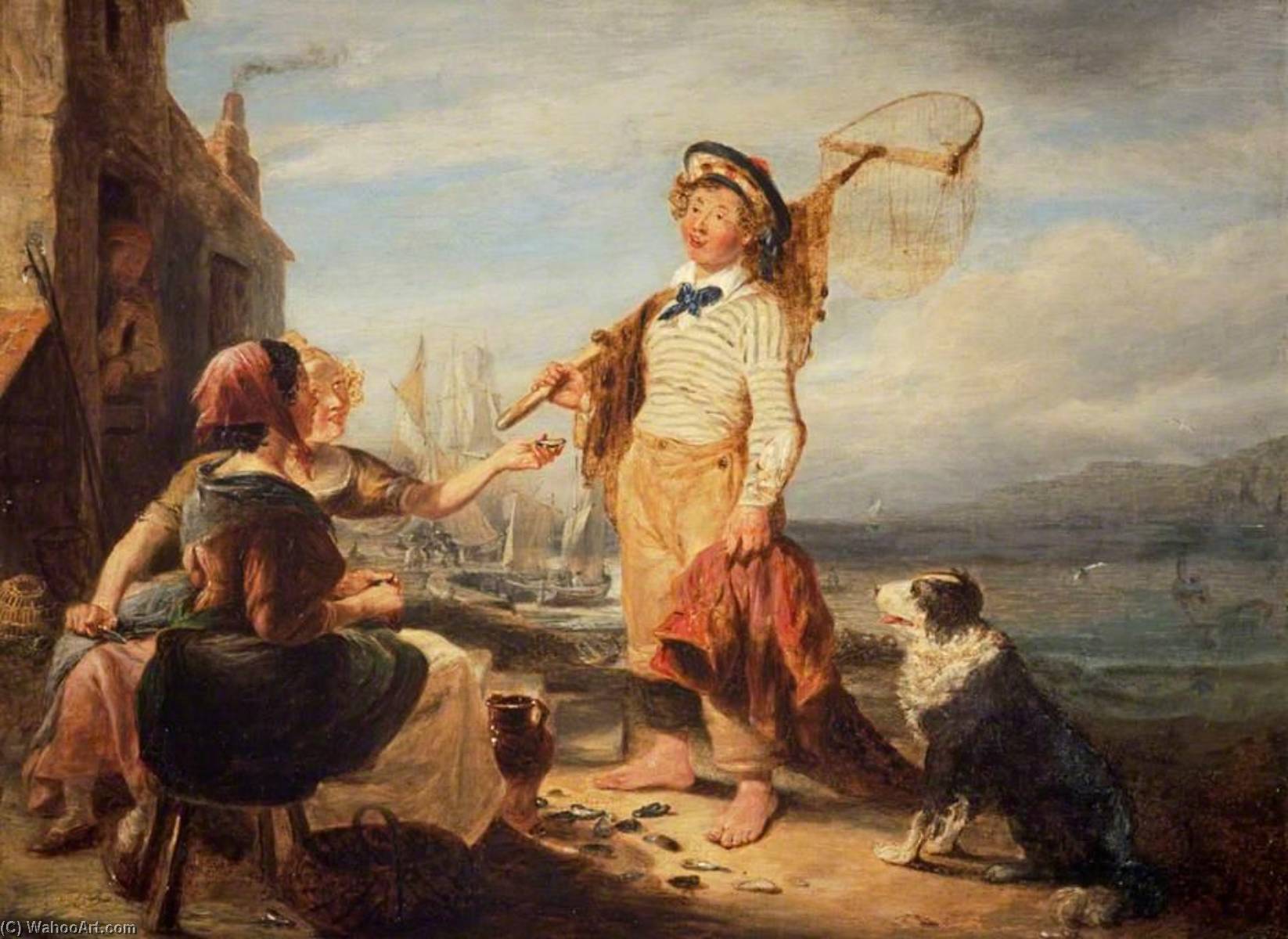
      Fisher Folk door William Kidd
      8

      Fisher Folk

      Oil · Scottish National Gallery, Edinburgh

      Fisher Folk is a genre painting by the Scottish artist William Kidd. The work captures a quiet moment of coastal life, focusing on the figures who inhabit the salt-aired edges of the sea. In this scene, a man stands as a central figure, his hands occupied with a fishing net. He is flanked by two women who appear to be fisher folk, their gazes fixed upon the scene as they…

      Handgeschilderde olieverfreproductie vanaf $195 37 × 27 cm
      Jonathan and William door William Kidd
      9

      Jonathan and William

      Oil On Canvas · Hospitalfield Centre For Art - Culture, Arbroath

      is a genre painting by the Scottish artist William Kidd. Executed during the 19th Century, the work belongs to the Romanticism movement. Kidd, born in Edinburgh, United Kingdom, established a reputation for capturing the nuances of human interaction and domesticity through a meticulous attention to detail.

      Handgeschilderde olieverfreproductie vanaf $195 38 × 27 cm
      Asleep door William Kidd
      10

      Asleep

      Oil · Hospitalfield Arts, Arbroath

      The painting depicts a man seated in a chair with his legs crossed. He is in a state of sleep. Another person stands nearby, leaning forward to pour a liquid from a vessel into a cup. The setting is an interior room, containing a dining table and several chairs. A vase is positioned within the space, contributing to the arrangement of the furniture. The light falls across the scene, illuminating…

      Handgeschilderde olieverfreproductie vanaf $195 27 × 37 cm Zelfde formaat als het origineel $208 32 × 43 cm Bestel in de originele afmetingen →

      Meer canvassen van William Kidd, van 11 tot 18

      The False Parcel door William Kidd
      #11

      The False Parcel

      Leeds Art Gallery

      The work reflects a commitment to the nuances of human interaction within an ordinary setting. Through a warm palette and soft lighting, the scene avoids the dramatic in…

      Bestel dit canvas vanaf $195 →
      Interior Scene door William Kidd
      #12

      Interior Scene

      Sheffield City Art Galleries

      In "Interior Scene" by William Kidd, a bustling atmosphere fills a cramped, cluttered workshop. The air seems thick with the activity of an apothecary or a laboratory, where…

      Bestel dit canvas vanaf $195 →
      The Army door William Kidd
      #13

      The Army

      Laing Art Gallery

      In the painting titled "The Army," two men are depicted standing side by side upon a staircase. Both figures are dressed in red coats, though their appearances differ;…

      Bestel dit canvas vanaf $195 →

      Wat William Kidd het meest schilderde

      De vier onderwerpen die het meest voorkomen op deze doeken, elk met zijn meest geliefde voorbeeld.

      Waar de doeken van William Kidd hangen

      De 7 musea met de meeste schilderijen op deze pagina.

      Museum Stad Werken van William Kidd Schilderijen uit deze lijst
      Hospitalfield Arts, ArbroathHospitalfield Arts Arbroath 5 Asleep, The Astrologer, Self Portrait with the Artist's Wife
      The Stirling Smith Art Gallery - Museum, StirlingThe Stirling Smith Art Gallery - Museum Stirling 3 Simon and Janet, The Cottar's Saturday Night, John Anderson, My Jo
      Scottish National Gallery, EdinburghScottish National Gallery Edinburgh 2 Indulging, Fisher Folk
      Laing Art Gallery, Newcastle upon TyneLaing Art Gallery Newcastle upon Tyne 2 The Navy, The Army
      Hospitalfield Centre For Art - Culture, ArbroathHospitalfield Centre For Art - Culture Arbroath 1 Jonathan and William
      Leeds Art Gallery, LeedsLeeds Art Gallery Leeds 1 The False Parcel
      Sheffield City Art Galleries, SheffieldSheffield City Art Galleries Sheffield 1 Interior Scene

      De meest geliefde canvas van William Kidd uit elk decennium

      1. 1820s
        Old Cottages at Petersfield, Hampshire (1820) door William Kidd
        2 van 18

        Old Cottages at Petersfield, Hampshire

        Leeftijd 30 – 39

        Old Cottages at Petersfield, Hampshire is a painting by the artist William Kidd. This work dates to about 1820. The composition focuses on a rural setting containing two…

      2. 1830s
        The Fish Stall (1831) door William Kidd
        Canvas 3 van 18

        The Fish Stall

        Leeftijd 40 – 49

        A woman stands before a wooden table, her hands resting on her hips with a quiet, unyielding determination. She wears a red dress that anchors the composition, a…

      3. 1840s
        The Cottar's Saturday Night (1845) door William Kidd
        Op nummer 5 van 18

        The Cottar's Saturday Night

        Leeftijd 50 – 59 · The Stirling Smith Art Gallery - Museum

        The Cottar's Saturday Night is a significant work by the Scottish artist William Kidd. Created in 1845, this oil on canvas painting offers a quiet glimpse into the…

      4. 1860s
        Simon and Janet (1860) door William Kidd
        Canvas 1 van 18

        Simon and Janet

        Leeftijd 70 – 73 · The Stirling Smith Art Gallery - Museum

        The oil on canvas work titled Simon and Janet is a creation of the artist William Kidd. This piece emerged about 1860, capturing a singular, heavy moment between…

      Over de doeken van William Kidd: uw vragen beantwoord

      Wat is het bekendste schilderij van William Kidd?Lees het antwoord

      Simon and Janet (1860), The Stirling Smith Art Gallery - Museum, Stirling. Old Cottages at Petersfield, Hampshire (1820) en The Fish Stall (1831) volgen.

      Hoe oud was William Kidd toen Simon and Janet werd geschilderd?Lees het antwoord

      William Kidd, geboren in 1790, was 70 jaar oud: Simon and Janet dateert uit 1860.

      Wat zijn de 10 bekendste schilderijen van William Kidd?Lees het antwoord

      Simon and Janet, Old Cottages at Petersfield, Hampshire, The Fish Stall, Indulging, The Cottar's Saturday Night, The Navy, John Anderson, My Jo, Fisher Folk, Jonathan and William en Asleep. Elk canvas in de bovenstaande ranglijst is voorzien van het jaartal en het museum.

      Hoeveel werken heeft William Kidd in totaal geschilderd?Lees het antwoord

      23 werken van William Kidd zijn opgenomen in onze catalogus, gedateerd van 1820 tot 1860.

      Waar kan ik de beroemdste doeken van William Kidd bekijken?Lees het antwoord

      Voornamelijk in Hospitalfield Arts (Arbroath), The Stirling Smith Art Gallery - Museum (Stirling) en Scottish National Gallery (Edinburgh); de bovenstaande lijst vermeldt elk museum en de bijbehorende doeken.

      Wanneer schilderde William Kidd deze geliefde doeken?Lees het antwoord

      In 1830s, die 2 van de 18 werken op deze pagina vertegenwoordigt, waaronder The Fish Stall.

      Wat zijn de vroegste en laatste beroemde doeken van William Kidd?Lees het antwoord

      Het oudste canvas hier is Old Cottages at Petersfield, Hampshire (1820); het nieuwste is Simon and Janet (1860).

      Wat schilderde William Kidd het vaakst?Lees het antwoord

      Man (10), Table (8) en Chair (7), verspreid over de 18 werken op deze pagina.

      Met welk medium schilderde William Kidd het vaakst?Lees het antwoord

      Oil, gebruikt in 8 van de 18 werken op deze pagina.

      Welke doeken van William Kidd hangen in het Hospitalfield Arts?Lees het antwoord

      Het Hospitalfield Arts, Arbroath herbergt 5 van de werken op deze pagina, waaronder Asleep, The Astrologer en Self Portrait with the Artist's Wife.

      Kan ik een reproductie van een William Kidd canvas kopen?Lees het antwoord

      Ja. Elk schilderij op deze pagina kan via de eigen pagina worden besteld als een handgeschilderd olieverfreproductie, of als een fine art print, in de door u gekozen afmeting.

      William Kidd: een leven in verf

      William Kidd: A Romantic Observer of Everyday Life

      William Kidd (1796 – 1863) emerges from the annals of 19th-century British art as a quietly compelling figure, an observer of domesticity and rural life rendered with a charming blend of realism and gentle humor. While not commanding the same immediate fame as his contemporaries like Turner or Constable, Kidd’s prolific output – over 200 paintings – offers a remarkably intimate glimpse into the social fabric of his time, revealing a keen eye for detail and an ability to capture the nuances of human interaction within seemingly ordinary scenes.

      Born in Edinburgh in 1796, Kidd's early life remains somewhat shrouded in mystery. He began his artistic training under James Howe, a renowned animal painter, gaining foundational skills that would later inform his approach to depicting figures and settings. This apprenticeship instilled a meticulousness and attention to detail, particularly evident in his rendering of fabrics, furniture, and the subtle expressions on his subjects’ faces. Kidd's career unfolded primarily in London, where he established himself as a successful artist catering to a discerning clientele who appreciated his ability to portray familiar scenes with an air of gentle amusement.

      The Style and Themes of a Romantic Observer

      Kidd’s artistic style is often categorized within the broader framework of Romanticism, though it possesses distinct characteristics that set him apart. He eschewed the dramatic landscapes favored by some of his contemporaries, instead focusing on scenes of everyday life – cozy interiors, bustling market squares, and quiet moments in rural settings. His paintings are characterized by a warm palette, soft lighting, and an emphasis on domestic tranquility. He frequently depicted scenes of leisure and indulgence, often featuring wealthy gentlemen enjoying their estates or indulging in convivial gatherings.

      A recurring theme in Kidd’s work is the contrast between wealth and simple pleasures. He masterfully portrays the opulence of the upper classes – lavish furnishings, exotic fruits, and fine clothing – juxtaposed with scenes of quiet contentment and modest enjoyment. This subtle commentary on social hierarchy and human nature is a hallmark of his artistic sensibility. His illustrations for works by Walter Scott and Robert Burns further cemented his reputation as a skilled draughtsman and interpreter of literary themes.

      Influences and Artistic Development

      Kidd’s artistic development was undoubtedly shaped by the work of David Wilkie, a Scottish painter known for his scenes of London life. Wilkie's ability to capture fleeting moments of human interaction with remarkable immediacy and realism served as a significant influence on Kidd’s approach to composition and characterization. The influence is particularly evident in works like “Indulgence,” where the languid pose of the elderly gentleman, surrounded by symbols of wealth and comfort, mirrors the relaxed atmosphere depicted in Wilkie's paintings.

      Furthermore, Kidd’s meticulous attention to detail and his skillful rendering of fabrics and textures owe a debt to the Dutch Masters, particularly Rembrandt. He meticulously studied their use of light and shadow, employing similar techniques to create depth and volume within his compositions. His work also reflects the influence of English portraiture, with its emphasis on capturing individual character and personality.

      Major Works and Legacy

      Among Kidd’s most celebrated works are “Indulgence,” a delightful depiction of an elderly gentleman enjoying the fruits of his wealth; “The Shoemaker,” which captures the quiet dignity of a humble craftsman; and numerous illustrations for Walter Scott's novels, including "Ivanhoe" and "Rob Roy." These paintings demonstrate his versatility as an artist, showcasing his ability to render both grand scenes and intimate portraits with equal skill.

      Despite not achieving widespread fame during his lifetime, William Kidd’s legacy endures through the sheer volume of his output and the enduring appeal of his charming genre scenes. His work offers a valuable window into the social customs and domestic life of 19th-century Britain, revealing a keen eye for detail and a subtle commentary on human nature. Today, his paintings are treasured in private collections and public galleries alike, testament to their lasting artistic merit.

      A Continuing Exploration

      Further research into William Kidd’s life and work continues to reveal new insights into this enigmatic artist. His prolific output provides a rich source of material for art historians and scholars seeking to understand the complexities of 19th-century British society. His paintings remain a testament to his skill, observation, and enduring ability to capture the beauty and humor of everyday life.