Amadeo de Souza-Cardoso: A Pioneer of Portuguese Modernism
Amadeo de Souza-Cardoso, a name resonating with the vibrant energy of early 20th-century modernism, remains a somewhat enigmatic figure despite his pivotal role in bridging Portuguese art to the international avant-garde. Born on November 14, 1887, in Manhufe, Mancelos, Amarante, Portugal, his brief but intensely creative life was marked by a restless spirit and an unwavering dedication to artistic innovation. From humble beginnings rooted in the rural landscapes of his homeland, Souza-Cardoso embarked on a journey that would lead him to the heart of Parisian modernism, where he forged connections with some of the most influential artists of his time – Modigliani, Brancusi, Delaunay, and Gris among them. His early education began with architectural studies in Lisbon, but it was the allure of painting, particularly the expressive power of caricature, that truly captured his imagination and set him on a path toward artistic exploration. This initial foray into art wasn’t merely technical training; it was an awakening to the potential of visual language as a means of commentary and self-expression.
- Early Life & Education: Amadeo’s formative years were spent in Manhufe, where he absorbed the traditions of rural Portugal. His architectural studies provided him with foundational knowledge but it was caricature—a medium that allowed for biting social critique—that ignited his artistic passion.
- Parisian Encounters & Artistic Development: In 1906, Souza-Cardoso relocated to Paris, immersing himself in the city’s burgeoning artistic milieu. He quickly embraced Cubism and Futurism, establishing himself as one of Portugal's first true modern painters. His style was characterized by bold forms, vibrant colors, and dynamic compositions—a deliberate rejection of academic conventions.
- Key Influences: Souza-Cardoso drew inspiration from masters like Brancusi and Gris, whose sculptural and painterly explorations mirrored his own quest for expressive abstraction. He actively participated in Salon des Indépendants and the Armory Show, showcasing his innovative work to an international audience.
- Synthesis of Styles: Unlike many artists of his era who merely adopted trends, Souza-Cardoso synthesized them with his unique sensibility. His paintings weren’t simply representations of reality; they were investigations into perception, emotion, and the essence of form itself—a testament to his artistic genius.
Notable Works & Artistic Style
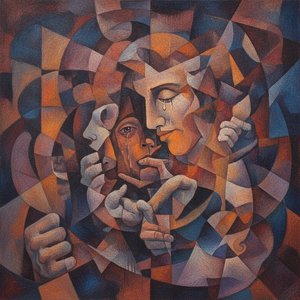
Souza-Cardoso's oeuvre is marked by a distinctive stylistic approach that blended Cubism, Futurism, and Expressionism. His canvases pulsated with vibrant color palettes and dynamic compositions—often employing fragmented perspectives to challenge conventional viewpoints. Consider *Saut du Lapin* (1911) and *Cabeça* (1913)—works that exemplify his experimentation with abstraction while retaining a palpable connection to Portuguese cultural heritage. These paintings weren’t chaotic; they were carefully balanced structures revealing a profound artistic vision beneath the surface. His participation in exhibitions like the Salon des Indépendants cemented his reputation as a vanguard artist, bringing Portuguese innovation to the forefront of European art discourse.
Recognition & Legacy
Despite initial obscurity following Souza-Cardoso’s untimely death in 1918—a victim of the Spanish Flu pandemic—his contributions to Portuguese modernism have gained renewed appreciation in recent decades. Two major retrospectives – one in 1958 and another at the Grand Palais in Paris in 2016 – reintroduced his work to a wider audience, solidifying his place in art history. Today, his paintings reside in museums across Europe, including Plymouth City Museum & Art Gallery, alongside masterpieces by other prominent artists of the era. His legacy continues to inspire contemporary painters—a reminder that artistic innovation transcends temporal boundaries and cultural distinctions.
Concluding Thoughts
Amadeo de Souza-Cardoso’s brief but impactful life stands as a beacon for Portuguese art history. He wasn't merely an artist; he was a translator of ideas, bridging the gap between tradition and modernity—a pioneer who dared to reimagine visual language as a tool for profound artistic expression.



 Forhåndsvisning
 Kjøp trykk
 Send
Send Del med andre
 Vis detaljer

 Last ned bildet
 Liknende objekter
 Røntgenundersøkelse
 Lysbildefremvisning


 Vis hele teksten






































 Glassalternativet er kun tilgjengelig i størrelser under 110 cm