Pablo Picasso – Seated Man with Sword and Flower— A Portrait of Complexity
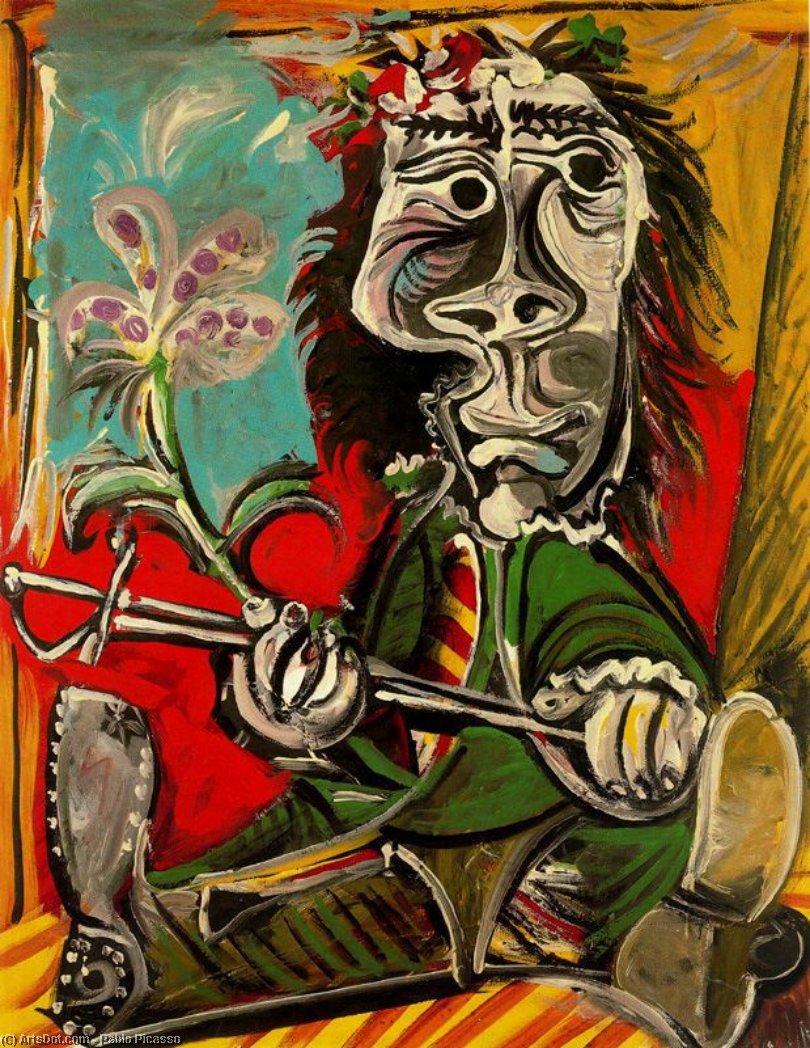
Pablo Picasso's "Seated Man with Sword and Flower," painted in 1969, isn’t merely a portrait; it’s a meticulously constructed puzzle box of fragmented forms, muted colors, and profound psychological depth. This work, residing within the prestigious Museum Quartier Des Héronnières in Fontainebleau, France, stands as a potent example of Picasso's late-career exploration of Cubism – a movement he essentially pioneered alongside Georges Braque. It’s a piece that invites prolonged contemplation, rewarding viewers with layers of meaning and technical brilliance. The painting immediately draws the eye to the central figure, a man seated in repose, yet radiating an undeniable tension. He holds a gleaming sword aloft, its sharp edges juxtaposed against the delicate curve of a single flower held gently in his left hand — a potent symbol of both aggression and vulnerability.
Picasso’s masterful manipulation of perspective is immediately apparent. The figure isn't rendered with traditional realism; instead, he’s broken down into geometric shapes—rectangles, triangles, and circles—that are simultaneously presented from multiple viewpoints. This simultaneous representation creates a sense of dynamism and instability, mirroring the complexities of human emotion and experience. Notice how the torso is flattened, almost dissolving into planes, while the head retains a degree of solidity, hinting at an underlying awareness. The background, featuring two chairs — one occupied, the other empty — adds another layer to this visual dialogue, suggesting themes of solitude, contemplation, or perhaps even loss.
The Roots of Cubism: Deconstructing Reality
To truly appreciate “Seated Man with Sword and Flower,” it’s essential to understand the context of Cubism. Born out of a desire to move beyond the limitations of Renaissance perspective, Picasso and Braque sought to represent objects as they are *perceived*, rather than simply as they appear from a single vantage point. They achieved this by fracturing forms into geometric components and presenting them in overlapping planes. This wasn’t merely an aesthetic choice; it was a radical attempt to capture the essence of reality, stripping away superficial appearances to reveal its underlying structure. The influence of Paul Cézanne's emphasis on form and geometry is particularly evident here, as Picasso builds upon Cézanne’s exploration of spatial relationships.
Interestingly, Picasso’s Cubist period wasn’t solely defined by geometric abstraction. He drew inspiration from diverse sources, including Surrealism — a movement that explored the realm of dreams and the subconscious — and Expressionism — which prioritized emotional intensity over objective representation. The muted color palette—primarily browns, grays, and ochres—contributes to the painting’s somber mood, while the sharp lines and fragmented forms evoke a sense of unease or even anxiety. The sword, in particular, is a powerful symbol of conflict and aggression, hinting at an internal struggle within the figure.
Symbolism and Emotional Resonance
Beyond its formal innovations, “Seated Man with Sword and Flower” resonates deeply on an emotional level. The juxtaposition of the sword and the flower creates a compelling tension between masculine and feminine energies — strength and fragility. The flower could represent beauty, peace, or even remembrance, offering a counterpoint to the man’s assertive posture and the menacing presence of the weapon. Some art historians suggest that the empty chair behind the figure represents a lost companion or a past relationship, adding another layer of melancholy to the composition.
Picasso's late-career work often grappled with themes of mortality, memory, and the passage of time. “Seated Man with Sword and Flower” is no exception. The painting’s quiet intensity invites viewers to contemplate their own experiences of loss, conflict, and the enduring power of beauty amidst adversity. It remains a testament to Picasso’s genius—a complex, layered masterpiece that continues to captivate audiences decades after its creation.
For a meticulously crafted, hand-painted reproduction of this iconic artwork, please visit TopImpressionists.com.
Photo Description: The painting is a portrait of a man holding a sword in his right hand while sitting on a chair. The man appears to be wearing a green jacket and has a flower in his left hand. There are two chairs visible in the image, one being occupied by the man with the sword and another empty chair located behind him. The painting is quite detailed, featuring the man’s facial expression and the intricate design of the sword he holds. The background of the painting also includes a vase, adding to the overall composition of the artwork.
Size: Unknown
Date: Unknown
ARTIST INFORMATION:
==================
Artist: Pablo Ruiz Picasso
Birth Year: 1881
Death Year: 1973
Birth City: Malaga
Birth Country: Spain
Biography:
A Revolutionary Spirit: The Life and Art of Pablo Picasso
Pablo Diego José Francisco de Paula Juan Nepomuceno María de los Remedios Cipriano de la Santísima Trinidad Ruiz y Picasso (25 October 1881 – 8 April 1973) was a Spanish painter, sculptor, printmaker, ceramicist, and theatre designer who spent most of his adult life in France. One of the most influential artists of the 20th century, he is known for co-founding the Cubist movement, the invention of constructed sculpture, the co-invention of collage, and for the wide variety of styles that he helped develop and explore. Among his most famous works are the proto-Cubist Les Demoiselles d'Avignon (1907) and the anti-war painting Guernica (1937), a dramatic portrayal of the bombing of Guernica by German and Italian air forces during the Spanish Civil War.\nBeginning his formal training under his father José Ruiz y Blasco (1838–1913) in Málaga, Picasso demonstrated extraordinary artistic talent from an early age. Ruiz was a traditional academic artist and instructor, who believed that proper training required disciplined copying of the masters, and drawing the human body from plaster casts and live models. His son became preoccupied with art to the detriment of his classwork.\nPicasso's family moved to A Coruña in 1891, where his father became a professor at the School of Fine Arts. They stayed for almost four years. On one occasion, the father found his son painting over his unfinished sketch of a pigeon. Observing the precision of his son’s technique, an apocryphal story relates, Ruiz felt that the thirteen-year-old Picasso had surpassed him, and vowed to give up painting, though paintings by him exist from later years.\nIn 1895, Picasso was traumatized when his seven-year-old sister, Conchita, died of diphtheria. After her death, the family moved to Barcelona, where Ruiz took a position at its School of Fine Arts. Picasso thrived in the city, regarding it in times of sadness or nostalgia as his true home. Ruiz persuaded the officials at the academy to allow his son to take an entrance exam for the advanced class. This process often took students a month, but Picasso completed it"


 Bestill trykk
 Send
Send Del med andre
 Vis detaljer

 Last ned bildet
 Liknende objekter
 Røntgenundersøkelse
 Lysbildefremvisning

 Vis hele teksten






































 Glassalternativet er kun tilgjengelig i størrelser under 110 cm



