A Vision of Cosmic Conflict: William Blake’s “The Great Red Dragon and the Woman Clothed with the Sun”
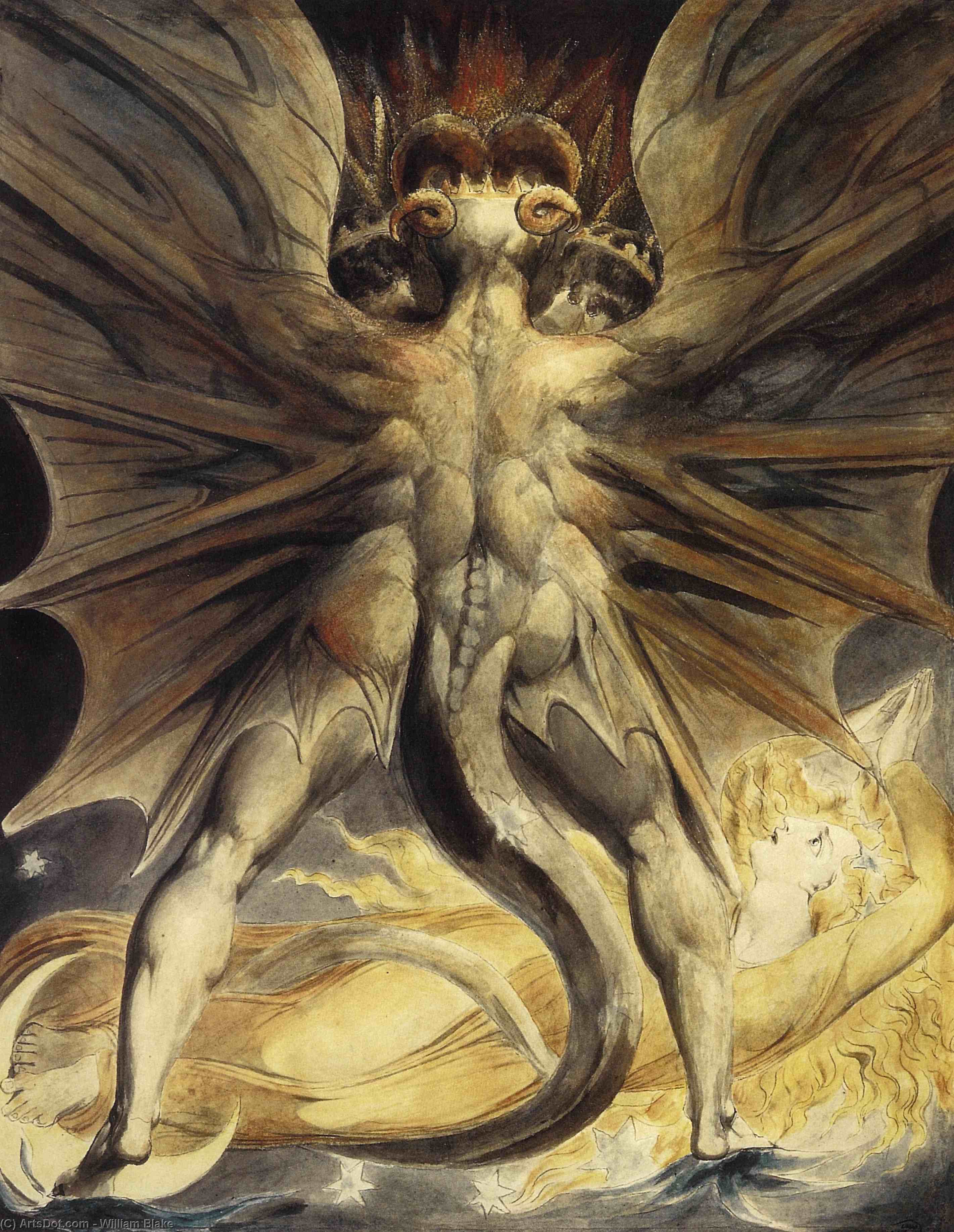
William Blake's 1805 watercolour, *The Great Red Dragon and the Woman Clothed with the Sun*, is a powerful testament to the artist’s unique vision and his place within the Romantic movement. This work isn’t merely an illustration; it’s a vibrant embodiment of spiritual struggle and apocalyptic prophecy drawn directly from the Book of Revelation. The painting pulsates with energy, inviting viewers into a realm where myth, religion, and imagination collide. It captures the essence of Blake's profound engagement with biblical themes and his unwavering belief in the transformative power of artistic expression.
Decoding the Symbolic Imagery
The composition is dominated by the colossal figure of the Red Dragon – a terrifying representation of Satan, as described in Revelation 12. Its serpentine body writhes across the lower portion of the painting, wings outstretched in a menacing display of power. Two smaller figures are subtly placed within the scene: one near the dragon’s left side and another to the right. These figures, though less prominent, contribute to the narrative tension, perhaps representing fallen angels or humanity caught in the crossfire of this cosmic battle. Above, barely visible, is a woman clothed with the sun – symbolizing the Virgin Mary and embodying divine grace threatened by the forces of evil. The dragon’s intent is clear: to devour the child she carries, representing Christ.
The symbolism isn't static; it’s dynamic, suggesting an ongoing struggle between good and evil. Blake meticulously crafted this image to convey not just a depiction *of* Revelation but rather an attempt to translate its emotional and spiritual weight onto canvas.
Artistic Style & Technique
Blake’s style is immediately recognizable for its emotional intensity and rejection of academic convention. He wasn’t interested in realistic representation but rather in conveying inner vision. The watercolour medium lends a delicate, almost ethereal quality to the painting, creating an intriguing contrast with the raw power of the dragon. His technique involves fluid washes of colour layered with precise linework, resulting in a luminous and textured surface.
The vibrant reds, fiery oranges, and deep blues contribute to the dramatic atmosphere. This is not simply a depiction *of* Revelation; it’s an attempt to visually translate its emotional and spiritual weight. Blake's masterful use of color and line demonstrates his profound understanding of artistic expression as a vehicle for conveying complex theological ideas.
Historical & Religious Context
Created during a period of intense religious and political upheaval, Blake's work reflects his own radical beliefs. He rejected the rigid doctrines of the Church of England and embraced a personal form of spirituality rooted in imagination and visionary experience. He was commissioned to create paintings illustrating scenes from the Bible, but he approached these subjects with unparalleled freedom, imbuing them with his unique symbolic language. The painting’s connection to Revelation 12 places it within a long tradition of apocalyptic art, yet Blake's interpretation is distinctly original and deeply personal. This artwork speaks to the anxieties and aspirations of its time—a moment when faith was questioned and societal norms challenged.
Blake &; Catherine Boucher: A Collaborative Vision
It’s crucial to acknowledge the integral role of Blake’s wife, Catherine Boucher, in his artistic process. She wasn’t merely an assistant but a skilled printmaker and colourist who collaborated closely with him on many projects. Her expertise enabled Blake to realize his ambitious visions, particularly in illuminated printing – a technique that combined poetry and visual art into a single unified work.
Their partnership was essential to the creation of numerous pieces, including this powerful watercolour. Boucher’s dedication to Blake's artistic endeavors ensured that his visionary ideas were brought to life with remarkable precision and beauty.
Collecting & Interior Design
A high-quality reproduction of this painting would serve as a striking focal point in any interior space. Its rich colours and dramatic composition lend themselves well to both traditional and contemporary settings. Consider pairing it with muted tones to allow the artwork’s vibrancy to shine, or incorporating elements that echo its symbolic themes – such as celestial motifs or bold geometric patterns.
- Ideal for libraries, studies, or living rooms seeking a touch of intellectual depth.
- Complements both classic and modern furniture styles.
- A conversation starter that invites contemplation and discussion.
Photo Description: --Overall Impression-- The artwork is a dramatic and unsettling depiction of a winged figure, seemingly demonic or infernal, dominating the composition. It’s an oil painting with a highly detailed and expressive style reminiscent of Romanticism and possibly influenced by occult symbolism. The central figure is imposing, positioned centrally but slightly off-center, creating a sense of unease. The background is dark and turbulent, suggesting chaos and a threatening atmosphere. Compositionally, the image utilizes a pyramidal structure with the figure at its apex, drawing the viewer's eye upwards. Lines are dynamic and swirling, contributing to the chaotic feel. Shapes are predominantly organic – wings, limbs, and flowing drapery – combined with angular forms in the horns and facial features. Texture is rich and layered, achieved through impasto technique, creating a sense of depth and physicality. Lighting is dramatic, with strong contrasts between light and shadow emphasizing the figure's musculature and the swirling background. Perspective appears somewhat flattened, prioritizing emotional impact over strict realism. Depth is suggested through atmospheric perspective – the background fades into darkness. The subject matter centers on a monstrous, dual-headed figure, possibly representing chaos or evil. Symbolic elements include the horns, wings, and overall menacing appearance, aligning with themes of temptation, damnation, and the darker aspects of human nature. The style is highly expressive and emotive, prioritizing feeling over accurate representation. The technique involves layering oil paint to build up texture and create a luminous effect. Materials used are primarily oil paints on canvas.
Size: 43 x 34 cm
Date: 1805
ARTIST INFORMATION:
==================
Artist: William Blake
Birth Year: 1757
Death Year: 1827
Birth City: London
Birth Country: United Kingdom
Biography:
A Visionary’s Journey: The Life and Art of William Blake
William Blake, born on November 28, 1757, was a figure perpetually out of step with his time, yet destined to become one of the most celebrated artists and poets of the Romantic Age. His life unfolded against the backdrop of a rapidly changing England—a world grappling with industrialization, political upheaval, and shifting spiritual beliefs. From humble beginnings as the son of a hosier, Blake's early years were marked by an intensely vivid imagination and a propensity for visionary experiences that would profoundly shape his artistic trajectory. Though largely self-taught in formal academics, he received drawing instruction at a young age, quickly revealing a talent that hinted at the extraordinary path ahead. His apprenticeship with engraver James Basire proved pivotal, providing him not only with technical mastery but also an understanding of printmaking techniques he would later use to create illuminated printing—a technique that combined poetry and visual art into a single unified work. Blake's unwavering commitment to his own artistic vision—characterized by its rejection of academic conventions and embrace of imaginative expression—established him as a pioneer of Romanticism. He defied societal expectations, prioritizing spiritual exploration over material success, and forging an independent path that would resonate across generations. Blake’s fascination with mythology and folklore—particularly the tales of Merlin and Faust—influenced his artistic output and underscored his belief in the transformative potential of storytelling. His poetic imagination was equally remarkable; he produced a prolific body of work encompassing poems, engravings, and illuminated manuscripts—a testament to his unparalleled ability to synthesize disparate disciplines into a cohesive aesthetic experience. Blake’s exploration of symbolism—particularly its use in conveying complex theological ideas—became a hallmark of his artistic style. He sought to communicate profound truths about human existence through evocative imagery and carefully crafted narratives—challenging viewers to contemplate the mysteries of faith and morality. Despite facing considerable criticism during his lifetime, Blake's legacy endured, securing his place as one of the most influential artists and poets of the Romantic Age. His enduring influence can be seen in subsequent movements such as Symbolism and Surrealism, where artists drew inspiration from Blake’s visionary aesthetic and philosophical convictions. Blake’s unwavering belief in the power of imagination—as “the body of God”—remains a source of fascination for scholars and artists alike. He championed the role of intuition and emotion in artistic creation—rejecting rational thought as inadequate to grasp the complexities of human experience. Blake's poetic output—including poems such as *Songs of Innocence* and *Songs of Experience*, *The Marriage of Heaven and Hell*, and *A Vision of Piers Plowman*—continues to inspire readers with its lyrical beauty and moral depth. His exploration of themes such as redemption, morality, and the relationship between humanity and divinity cemented his reputation as a prophet of his time—a figure who dared to challenge conventional beliefs and advocate for radical social reform. Blake’s artistic output—spanning painting, engraving, and illuminated printing—demonstrated his mastery of diverse media—each chosen with meticulous care to convey specific emotional and intellectual dimensions. His distinctive style—characterized by its bold colors, dynamic lines, and symbolic imagery—became instantly recognizable and profoundly influential on subsequent artists."


 Forhåndsvisning
 Bytt til trykk
 Send
Send Del med andre
 Vis detaljer

 Last ned bildet
 Liknende objekter
 Røntgenundersøkelse
 Lysbildefremvisning


 Vis hele teksten






































 Glassalternativet er kun tilgjengelig i størrelser under 110 cm



