

Shown: · With its frame:
 Forhåndsvisning
 Send
Send Del
Del
 Vis detaljer
 Utskriftsvennlig guide

 Last ned bilde
 Liknende objekter
 Røntgenundersøkelse
 Lysbildefremvisning
 Q&A
Q&A Statistikk


Nkr 2589
Håndlaget oljereproduksjon
Håndmalt olje på lerret i din valgte størrelse og ramme, laget på bestilling av våre kunstnere. ( Bytt til trykk Bytt til digitalt bilde)
Size
·Standardformat
skreddersydd
CM
INCH
Velg mellom våre forhåndsdefinerte størrelser som bevarer kunstverkets opprinnelige proporsjoner.
Loading sizes...

bredde
høyde
Skriv inn ønsket bredde og høyde for å tilpasse bildet til din ramme eller vegg. Siden dette er håndmalt, kan kunstneren male litt mer rundt motivet eller beskjære det noe dersom du velger et annet format — valget er ditt. Vi sender deg en digital mockup til godkjenning før maleriet påbegynnes. Bildet som vises på denne siden representerer ikke det faktiske resultatet — kun mockuppen viser det endelige uttrykket.
 Les mer om dette
Finish
·
White Nkr1

Blurside Nkr1

Extended Nkr1

P118B Nkr10

P118H Nkr10

P118W Nkr10

P438Z Nkr10

P508JH Nkr12

P508YH Nkr12

P805H Nkr10

P805Z Nkr10

P919BZ Nkr10

P919G Nkr10

P919XJ Nkr10

P959ZH Nkr10

P968JZ Nkr12

W106C Nkr8

W218G Nkr10

W218JH Nkr8

W218Y Nkr10

W307PJ Nkr10

W316G Nkr10

W316PJ Nkr8

W316Y Nkr10

W398PJ Nkr8

W4111J Nkr10

W500HY Nkr15

W500JH Nkr15

W692G Nkr12

W849H Nkr8

W940BG Nkr15

W953PJ Nkr8

H24-GOLD Nkr30

H24-SILVER Nkr30

H36-GOLD Nkr45

H36-SILVER Nkr45
Shipped in a protective tube, ready for your own framer.
Above 105 cm the frame is shipped as a kit for a professional framer — read the details.
Extras
optionalWhat do the extras include?
Examples of what can be changed: Replace face with customer photo; Add pet (e.g., replace cat with dog); Include hidden message in background; Change background landscape or elements.
After order, TopImpressionists.com team will email client for instructions and provide a mockup preview
After order, TopImpressionists.com team will email client for instructions and provide a mockup preview
Verdensomspennende levering () på 3–4 uker i stedet for standard 5 uker. (2 November). Ingen kompromisser med kvaliteten.
Beskyttende ferniss
Navneskilt
Detaljer om gravert bronseplate
This elegant plaque features the artist's name and the title of the artwork, finely engraved for a timeless presentation.
It is made from bronze with a refined, elegant finish. The text is precisely laser-engraved for a sharp and permanent result. Measuring 9x2 cm, the plaque is compact yet easy to read. It's built to be durable and scratch-resistant, offering a professional, museum-quality look. Mounting is simple thanks to the included adhesive backing.
Detaljer om gjennomsiktig akrylplate
The plaque includes essential engraved details such as the artist's name, the title of the artwork, the date it was created, the type of media used-like oil on canvas or watercolor-a brief description of the piece, and a QR code that links to the complete artwork information.
It is crafted from clear acrylic, offering a sleek, modern appearance. The text is UV-engraved in black to ensure strong visual contrast. With a size of 10x15 cm, it ensures optimal readability. It comes equipped with two metal hooks for secure wall mounting. The plaque is designed to be weather-resistant, making it suitable for various environments, and it includes interactive features that work seamlessly with smartphone scanning.
Detaljer om plakett i svart akryl
This elegant plaque includes engraved information such as the artist's name, the title of the artwork, the date it was created, the type of media used (like oil on canvas or watercolor), a short description of the artwork, and a QR code for quick access to more information.
The plaque itself is made from refined black acrylic with a premium finish. The text is laser-engraved in white for high contrast and readability. Its size is 10x15 cm, designed to be easy to read. It comes with two metal hooks for professional mounting. The design is sleek and fits any interior style. It is also weather-resistant and durable, with built-in digital integration for mobile compatibility.
Glassalternativet er kun tilgjengelig i størrelser under 110 cm
 Glassalternativet er kun tilgjengelig i størrelser under 110 cm
- Gratis ekspressfrakt over hele verden
- Lerretsduk av lin av høy kvalitet
- Full transportforsikring
- Garanti for refusjon av toll og importavgifter
- Garantert fargegjengivelse
- 100 dagers returrett ved fabrikasjonsfeil
- 100% pengene tilbake-garanti
- Rabatt ved flere kjøp


Beskrivelse av objektet
Om kunstneren
Jacopo Tintoretto: En dramatisk venetiansk mester kjent for sin kraftfulle stil, dynamiske komposisjoner og innovative bruk av lys & perspektiv. Oppdag hans varme kunstneriske arv!
About the painting
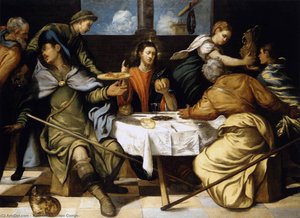
A Drama of Suffering and Spectacle: Tintoretto’s “The Crucifixion (Detail)”
Jacopo Tintoretto's "The Crucifixion (detail)," painted in 1565, is not merely a depiction of Christ’s agonizing death; it’s a visceral experience. Emerging from the bustling workshops of Venice during the High Renaissance and transitioning into the dramatic fervor of the early Baroque, this painting embodies Tintoretto’s signature style – a masterful manipulation of light, shadow, and human emotion that continues to captivate viewers centuries later. The detail presented here offers a glimpse into a scene brimming with both profound sorrow and unsettling observation, revealing a complex narrative far beyond the simple act of sacrifice.
The immediate impact is one of overwhelming scale and movement. Tintoretto doesn’t offer a serene tableau; instead, he plunges us directly into the chaos surrounding Christ's execution. The figures are not arranged in a static composition but rather surge forward, pulled by an unseen force – perhaps the weight of grief, or the sheer horror of the event unfolding before them. Notice how Tintoretto employs a dramatic chiaroscuro, utilizing pools of intense light to highlight key elements while shrouding others in deep shadow. This technique isn’t just for aesthetic effect; it serves to amplify the emotional intensity and create a sense of theatricality, as if we are witnessing a grand stage production.
The Anatomy of Emotion: Tintoretto's Humanistic Approach
Tintoretto’s genius lay in his profound understanding of human anatomy and its capacity for expressing intense emotion. He meticulously studied the musculature of Christ, rendering the agony etched into his body with startling realism. The contorted limbs, the strained facial features – all speak to a physical suffering that transcends mere representation. But it's not just Christ who embodies this raw emotion; the surrounding figures are equally compelling. Some weep openly, their faces buried in despair, while others stand back, seemingly detached yet undeniably affected by the spectacle. The inclusion of these onlookers is crucial, elevating the scene from a purely religious one to a broader commentary on human nature – our capacity for both compassion and indifference.
The presence of animals—horses prominently featured in the foreground and background—is particularly noteworthy. While crucifixion scenes rarely include livestock, Tintoretto’s decision to incorporate them adds an unsettling layer of complexity. Some scholars suggest these animals represent the Roman Empire's brutality and its role in perpetuating Christ’s suffering. Others interpret them as symbols of earthly power and the fleeting nature of worldly dominion, juxtaposed against the eternal sacrifice of Christ. The horses themselves are rendered with a remarkable degree of detail, their coats gleaming under Tintoretto’s masterful light, further emphasizing the dramatic quality of the scene.
A Window into Venetian Life and Artistic Innovation
"The Crucifixion (detail)" was created during a period of immense artistic innovation in Venice. Tintoretto, unlike many of his contemporaries who adhered to established conventions, relentlessly pushed the boundaries of painting technique. He experimented with layering pigments, creating an illusionistic depth that seemed almost three-dimensional. His use of loose brushstrokes and vibrant colors contributed to the dynamic energy of the composition, a hallmark of the Venetian style. This particular detail offers insight into his working process – a rapid, confident application of paint designed to capture not just the likenesses of the figures but also their emotional states.
Furthermore, the painting reflects the social and political context of 16th-century Venice. The city was a hub of commerce, intrigue, and religious fervor, and Tintoretto’s art often engaged with these themes. “The Crucifixion” is not simply a devotional image; it's a powerful statement about faith, suffering, and the human condition – a testament to Tintoretto’s enduring legacy as one of Venice’s greatest artistic masters. A reproduction captures this dramatic intensity and invites viewers to contemplate the profound questions raised by this unforgettable scene.
Spørsmål og svar
Hvem selger håndmalte kopier av "The Crucifixion (detail)" av Tintoretto?
"The Crucifixion (detail)" er tilgjengelig som en håndmalt oljereproduksjon på linlerret. Du kan bestille på siden Håndmalt oljereproduksjon, hvor du kan velge mellom ulike størrelser.
Hvilken fase av Tintoretto sin kunstneriske utvikling representerer "The Crucifixion (detail)"?
I Tintoretto sin karriere tilhører "The Crucifixion (detail)" Mature Period. Denne perioden gjør det mulig å sammenligne verket med kunstnerens øvrige arbeider.
Er fargene i "The Crucifixion (detail)" sterke eller dempede?
"The Crucifixion (detail)" av Tintoretto er gjengitt med en Muted metning og en Monochromatic intensitet.
Quick facts and art quiz
About Tintoretto

Tintoretto
1518 - 1594, Italia
Om kunstneren
A Venetian Master of Drama and Light
Jacopo Tintoretto, født Jacopo Robusti i Venezia rundt 1518, forblir en av de mest fascinerende og gåtefulle figurene i den høye renessansen og den tidlige barokken. Hans egen kallenavn, “Tintoretto” – «den lille maleren» – avslører familiens yrke, men skjuler samtidig den enorme kunstneriske dyktigheten som ville skille ham fra alle andre. I motsetning til mange kunstnere som benyttet seg av strukturert læretid under en mester, var Tintorettos vei i stor grad selvbestemt, drevet av en grenseløs nysgjerrighet og en utrettelig søken etter innovasjon. Selv om det finnes rapporter om et kort og mislykket opphold under Titian, den anerkjente maleren av venetiansk fargebruk, virker det som denne erfaringen viste seg å være mer strid enn formende. Titans anklagede avvisning av den unge Jacopo – enten på grunn av jalousi eller kunstnerisk uenighet – stimulerte Tintoretto til en egen vei, preget av dristig eksperimentering og en unikt dynamisk stil. Han fordypet seg i anatomi-studier, antagelig gjennom dissekasjoner, og finpusset sine ferdigheter ved å nøye kopiere klassiske skulpturer og verkene til andre mestere. Denne dedikasjonen la grunnlaget for en karriere som ville omdefinere venetiansk maleri.Forging a Distinctive Style: *Il Furioso*
Tintorettos kunstneriske utvikling ble preget av en nesten feberaktig energi, noe som tjente ham en annen, evocative kallenavn: *Il Furioso* – «Den Vredesfulle». Dette kallenavnet var ikke bare beskrivende for hans arbeidsrytme, men fanget også intensiteten og den emosjonelle ladningen som gjennomsyrte hans lerret. Hans tidlige verk antydet allerede en avvik fra tradisjonelle venetianske konvensjoner. Selv om han anerkjnt Titian’s innflytelse i fargebruk, vendte Tintoretto seg mot Michelangelos kraftfulle figurer og dramatiske komposisjoner. Han syntetisere disse influensene til noe helt nytt: en stil preget av forlange former, virvlende draperier og et innovativt bruk av perspektiv som ofte skapte en følelse av blendende dybde og bevegelse. Han forlot den omhyggelige ferdigstillelsen som mange samtidige foretrakk, og valgte i stedet en rask, nesten skisseaktig penselstrøk som formidlet umiddelbarhet og rå emosjon. Denne teknikken, kombinert med hans mesterskap i å manipulere lys og skygge – *chiaroscuro* – tillot ham å skape scener av uovertruffen drama og psykologisk intensitet. Han malte ikke bare hendelser; han formidlet deres emosjonelle kjerne.Monumental Achievements: San Rocco and Beyond
Tintoretto’s enorme produksjon spennte over flere tiår, inkludert religiøse narrativer, historiske allegorier og portretter. Likevel er hans mest betydningsfulle prestasjon arbeidet han skapte for Scuola Grande di San Rocco, en venetiansk confraternite dedikert til helgen St. Roch. Over en periode på mer enn femti år, dekorerte Tintoretto Scuolaens haller med over seksti lerret, og transformerte det til et fantastisk visuelt vitnesbyrd om tro og menneskelig erfaring. Verk som «Den siste måltid» (fullført sent i livet hans), demonstrerer hans fortsatte eksperimentering med perspektiv og komposisjon. Avvikende fra tradisjonelle fremstillinger, plasserte Tintoretto scenen i et dramatisk opplyst, arkitektonisk ustabilt rom, og understrekte de emosjonelle spenningene knyttet til Kristus’ siste måltid med sine disipler. Andre bemerkelsesverdige verk inkluderer «Miraklet av St. Markus som frigjør en slave», et kraftfullt uttrykk for dynamisk komposisjon og forkortelse, og en rekke malerier for venetianske kirker og palasser som viser hans mesterskap i skala og narrativ fortelling. Disse monumentale prosjektene sikret Tintoretto’s rykte som en av Venedices viktigste kunstnere.Influences and Artistic Roots
Tintoretto's artistic journey was deeply rooted in the traditions of Venetian painting, yet he boldly pushed beyond them. He drew inspiration from the classical sculptures that adorned Venice’s public spaces, as well as the works of Michelangelo, whose powerful figures and dramatic compositions served as a key influence. His early training under Titian, though ultimately contentious, provided him with a foundation in color theory and technique. However, Tintoretto's independent spirit allowed him to develop his own unique style, characterized by its dynamism, emotional intensity, and innovative use of perspective. He was also influenced by the Mannerist painters of the late 15th century, particularly Parmigianino, whose elongated figures and complex compositions foreshadowed some of Tintoretto’s later innovations. Furthermore, he studied the works of other masters, including Leonardo da Vinci and Raphael, absorbing their techniques and ideas.Legacy and Historical Significance
Jacopo Tintoretto døde i Venezia i 1594, og etterlot seg et enormt og innflytelsesrikt kunstverk. Han brot gapet mellom den høye renessansen og barokken, og forutså mange av de stilistiske innovasjonene som skulle definere den sistnevnte. Hans dramatiske komposisjoner, uttrykksfulle penselstrøk og innovative bruk av lys og skygge påvirket kunstnere som Caravaggio, Rembrandt og Delacroix dypt. Han var ikke bare en maler; han var en visuell forteller som forsto hvordan man kunne bruke kunsten til å vekke følelser og inspirere undring. Som en av de tre store venetianske malerne på 1500-tallet – sammen med Titian og Paolo Veronese – spilte Tintoretto en avgjørende rolle i å forme kunstens landskap i Venezia under dets gullalder. Hans verk gjenspeiler ikke bare den religiøse fervor og politiske spenninger i sin tid, men også hans unikt personlige visjon som fortsatt resonerer med publikum i dag, og sikrer ham en plass blant historiens mest fascinerende kunstnere. *Hans arv er et vitnesbyrd om kunstnerisk innovasjonens vedvarende kraft og den transformerende potensialet til menneskelig kreativitet.*Quick facts about Tintoretto
- Artistic Movement Or Style: Renæssanse, Manierisme
- Artists Or Movements Influenced By This Artist:
- Caravaggio
- Barokke
- Artists Who Influenced This Artist:
- Tiziano
- Michelangelo
- Date Of Birth: 1518, Venezia
- Date Of Death: 1594, Venezia
- Full Name: Jacopo Robusti
- Nationality: Italiensk
- Notable Artworks:
- Mirakel St. Markus
- Seneste Søndag
- Helligånd
- Place Of Birth: Venezia, Italia
Utforsk kunstverk organisert etter temaer, stiler og kjennetegn.




Tintoretto
The Crucifixion (detail)
() ·
With its frame: · Hand-painted in oil on linen
Total