Atelier — Gratis frakt til hele verden — Leveringstid 2–6 uker
      Simon Vouet, 1590 – 1649

      De 100 mest kjente maleriene av Simon Vouet, rangert

      Det mest kjente maleriet av Simon Vouet er Venus og Adonis (1642), som henger i J. Paul Getty Museum, Los Angeles. The Muses of Urania and Calliope (1634) og Annunciation (1640) er de neste i rekken av maleriene leserne kjenner best. Vår katalog inneholder 166 verk av Simon Vouet: her er de 100 mest kjente, hver med årstall, museum og hva som gjør dem minneverdige.

      Rangert etter vår popularitetsscore, som kombinerer søk, besøk og bestillinger for hvert verk. Oppdatert October 2026. Hvert maleri på denne siden kan bestilles som en håndmalt oljereproduksjon på linlerret, eller som et kunsttrykk i ønsket størrelse.

      Portrett av Simon Vouet
      Simon Vouet · 1590 – 1649
      Født · død
      1590 – 1649, Paris
      Bevegelse
      French baroque
      Verker i vår katalog
      166
      Mest kjente
      Venus og Adonis (1642)
      Flest verk hos
      Louvre

      Topp 10 Simon Vouet-malerier: de mest kjente verkene

      Venus og Adonis (1642) av Simon Vouet
      1

      Venus og Adonis

      1642 · Akryl på lerret · J. Paul Getty Museum, Los Angeles

      Venus og Adonis – Et Klassisk Møte med Baroque Elegans Simon Vouet’s “Venus og Adonis,” malt i 1642, er et slående eksempel på fransk baroque kunst, som viser kunstnerens mesterskap innenfor fargebruk, komposisjon og hans assimilering av italienske kunstneriske trender. Dette fengslende øyeblikk fra Ovids *Metamorfoser* hvor den dødelige Adonis, fascinert av jakt, avslår Venus’s forsøk på å vinne hans kjærlighet, varsler hans tragiske skjebne. Maleriet er ikke bare en…

      The Muses of Urania and Calliope (1634) av Simon Vouet
      2

      The Muses of Urania and Calliope

      1634 · Acrylic On Canvas · National Gallery of Art, Washington

      Simon Vouet’s “The Muses Urania and Calliope”: A Symphony of Baroque Grace Simon Vouet (1590-1649) stands as a pivotal figure in the artistic landscape of 17th-century France, marking the decisive transition from Mannerism to the opulent grandeur of the Baroque style. His legacy resides not merely in his prolific output but also in his unwavering dedication to mastering Italian influences—a pursuit that fundamentally reshaped French painting and cemented Vouet’s place…

      Annunciation (1640) av Simon Vouet
      3

      Annunciation

      1640 · Oil On Canvas · Galleria degli Uffizi, Firenze

      Simon Vouet's "Annunciation," painted in 1640, is more than just a religious depiction; it’s a masterful orchestration of light, shadow, and human emotion. This captivating work transports the viewer to an intimate interior space, where the momentous announcement of Mary’s divine conception unfolds with breathtaking drama. The painting immediately draws the eye to the kneeling figure of the Virgin Mary, bathed in a warm, golden glow emanating from the right…

      The Fortuneteller (detail) (1617) av Simon Vouet
      4

      The Fortuneteller (detail)

      1617 · Oil On Canvas · Galleria Nazionale d'Arte Antica, Roma

      In the heart of 1617, amidst the vibrant and transformative atmosphere of Roman artistic circles, Simon Vouet captured a moment of profound human connection in his masterpiece, The Fortuneteller. This work, particularly when viewed in its intimate details, serves as much more than a mere portrait; it is an emblem of the burgeoning Baroque style that was beginning to reshape the visual landscape of Europe. The scene unfolds with a…

      Sleeping Venus (1630) av Simon Vouet
      5

      Sleeping Venus

      1630 · Acrylic On Canvas · Szépművészeti Múzeum, Budapest

      Simon Vouet's "Sleeping Venus," painted around 1630, is not merely a depiction of a reclining nude; it’s an exquisite distillation of Renaissance ideals and the burgeoning Baroque aesthetic. This captivating work transcends simple portraiture, offering instead a profound meditation on beauty, repose, and the delicate balance between earthly pleasure and spiritual contemplation. The painting immediately draws the viewer into a world of hushed tranquility, inviting us to share in the…

      Allegory of Virtue (1634) av Simon Vouet
      6

      Allegory of Virtue

      1634 · Acrylic On Canvas · Louvre, Paris

      Simon Vouet’s “Allegory of Virtue,” completed around 1634, stands as a testament to the burgeoning Baroque aesthetic infiltrating French artistic circles during Louis XIII's reign. More than just a portrait—though it undeniably depicts a woman radiating grace and authority—the painting delves into profound philosophical concepts rooted in humanist ideals prevalent at the time.

      The Entombment (1638) av Simon Vouet
      7

      The Entombment

      1638 · Oil On Canvas · Fitzwilliam College, Cambridge

      Simon Vouet's "The Entombment," painted in 1635–1638, is not merely a depiction of a biblical scene; it’s an exquisitely rendered meditation on grief, faith, and the profound dignity of sacrifice. This monumental work, currently residing within the collection of the Fitzwilliam Museum in Cambridge, transcends its subject matter to become a powerful testament to the Baroque era's ability to evoke intense emotion through masterful technique and carefully considered symbolism. Vouet,…

      Angels with Attributes of the Passion: Angel Holding the Vessel and Towel for washing the hands of Pontius Pilate (1624) av Simon Vouet
      8

      Angels with Attributes of the Passion: Angel Holding the Vessel and Towel for washing the hands of Pontius Pilate

      1624 · Oil · Minneapolis Institute of Art, Minneapolis

      A single celestial figure emerges from a deep, near-black void, commanding the space with an intimate and monumental presence. This angel, caught in a moment of profound spiritual devotion, gazes upward with eyes full of soulful contemplation or sorrow. The light descends from the upper left, carving the figure out of the darkness and casting soft, tender shadows across a face etched with emotion. Every detail feels immediate, from the…

      Saint John (1623) av Simon Vouet
      9

      Saint John

      1623 · Oil On Canvas · Philadelphia Museum of Art, Philadelphia

      A young man turns his face toward a light that remains unseen. His eyes, wide and searching, catch a glimmer that pulls his gaze upward, away from the dark, murky depths of the background. Thick, dark curls frame a pale face, creating a sharp contrast against the heavy shadows that swallow the space around him. He is caught in a moment of sudden, quiet realization. The light does not merely…

      Virgin and Child, with an Angel (1642) av Simon Vouet
      10

      Virgin and Child, with an Angel

      1642 · Oil On Panel · Philadelphia Museum of Art, Philadelphia

      The light falls softly upon the skin of the Virgin Mary, catching the curve of her cheek and the small, smooth hands of the Christ Child. They sit within a triangular arrangement that anchors the composition, surrounded by the deep shadows of a dense woodland. An angel leans into this intimate circle, its robes glowing with warm yellows and golds that contrast against the heavy, dark trees behind them. At…

      Flere lerreter av Simon Vouet, fra 11 til 100

      Madonna with Child (1625) av Simon Vouet
      #11

      Madonna with Child

      1625 · Eremitasjen

      The room falls away into a deep, near-black shadow, leaving only two figures bathed in a soft, directional light. From the upper left, a gentle glow spills across…

      Bestill dette lerretet →
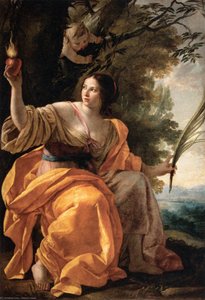
      Heavenly Charity (1640) av Simon Vouet
      #14

      Heavenly Charity

      1640 · Louvre

      A Beacon of Baroque Virtue: Simon Vouet’s Heavenly Charity Simon Vouet's "Heavenly Charity," completed around 1640, stands as a cornerstone of French Baroque painting—a testament to Louis XIII’s…

      Ta med deg dette lyset hjem →
      Allegory (1640) av Simon Vouet
      #15

      Allegory

      1640 · Musei Capitolini

      Simon Vouet executed Allegory during his residency in Rome, a period spanning from 1614 to 1627. The work was commissioned by Marcello Sacchetti, a 17th-century Italian merchant and…

      Ta med deg dette lyset hjem →
      Sacrifice of Isaac (1642) av Simon Vouet
      #17

      Sacrifice of Isaac

      1642 · Milwaukee Art Museum

      The painting titled Sacrifice of Isaac is a work of religious art. It is attributed to the French artist Simon Vouet (1590-1649) and Pierre Patel, the Elder (1605-1676).…

      Bestill dette lerretet →
      Suicide of Lucrece (1625) av Simon Vouet
      #21

      Suicide of Lucrece

      1625 · National Gallery Prague

      The heavy silence of a tragic end hangs in the air within Suicide of Lucrece. In this dramatic oil painting, the artist Simon Vouet captures the precise, harrowing…

      Ta med deg dette lyset hjem →
      The Muse Clio (1640) av Simon Vouet
      #22

      The Muse Clio

      1640 · Staatliche Kunsthalle Karlsruhe

      The Muse Clio is an oil on canvas painting by the artist Simon Vouet. Created about 1640, this work depicts the mythological figure Clio, who is recognized as…

      Bestill dette lerretet →
      Vanitas (1621) av Simon Vouet
      #24

      Vanitas

      1621 · Nasjonalmuseet i Warszawa

      In Vanitas, Simon Vouet centers the composition on a tight, intimate encounter between two figures. A young woman and an older man emerge from a deep, near-black background…

      Ta med deg dette lyset hjem →
      The Muses Urania and Calliope (1634) av Simon Vouet
      #55

      The Muses Urania and Calliope

      1634 · National Gallery of Art

      Simon Vouet's "The Muses Urania and Calliope," painted in 1634, isn’t merely a portrait; it’s an immersive experience—a vibrant tableau vivant capturing the essence of classical inspiration. This…

      Ta med deg dette lyset hjem →
      Toilet of Venus (1628) av Simon Vouet
      #64

      Toilet of Venus

      1628 · Cincinnati Art Museum

      To gaze upon Simon Vouet’s Toilet of Venus is to step directly into a moment suspended in opulent leisure—a scene dripping with the sensuality and refined drama characteristic…

      Bestill dette lerretet →
      Self-Portrait (1615) av Simon Vouet
      #65

      Self-Portrait

      1615 · Musée Réattu

      To stand before this self-portrait is to encounter not merely paint on canvas, but a direct conduit to the vibrant, ambitious spirit of early 17th-century Paris. Painted around…

      Ta med deg dette lyset hjem →
      LA VICTOIRE av Simon Vouet
      #66

      LA VICTOIRE

      Louvre

      To stand before this depiction of La Victoire is to encounter pure, unbridled apotheosis. It is not merely a painting; it is a dramatic narrative captured in oil,…

      Ta med deg dette lyset hjem →
      The Rape of Europa (1640) av Simon Vouet
      #67

      The Rape of Europa

      1640 · Thyssen-Bornemisza-museet

      To gaze upon Simon Vouet's depiction of The Rape of Europa is to step directly into the charged, dramatic heart of the Baroque era. This canvas is not…

      Bestill dette lerretet →
      Sophonisba Mottar Chalice (1623) av Simon Vouet
      #68

      Sophonisba Mottar Chalice

      1623 · Staatliche Museen Kassel

      Simon Vouet's “Sophonisba Receiving the Poisoned Chalice,” completed around 1623, stands as a cornerstone of French Baroque painting and a masterful depiction of biblical drama. Executed in Classicism…

      Få det malt for hånd →
      St Catherine (1614) av Simon Vouet
      #69

      St Catherine

      1614 · Quirinalpalasset

      To stand before Simon Vouet's depiction of St Catherine is to step directly into the vibrant, emotionally charged atmosphere of early seventeenth-century Paris. This portrait captures more than…

      Få det malt for hånd →
      The Holy Family (1630) av Simon Vouet
      #79

      The Holy Family

      1630 · Kunsthalle Bremen

      In the heart of the seventeenth century, as the rigid structures of Mannerism began to dissolve under the weight of a new, more visceral era, Simon Vouet emerged…

      Få det malt for hånd →
      Madonna and Child (1633) av Simon Vouet
      #80

      Madonna and Child

      1633 · National Gallery of Art

      In the intimate embrace of Simon Vouet’s Madonna and Child, we are invited into a moment of profound, quiet tenderness that transcends the centuries. Painted in 1633, this…

      Ta med deg dette lyset hjem →
      Allegory of Peace (1627) av Simon Vouet
      #82

      Allegory of Peace

      1627 · Galleria Nazionale d'Arte Antica

      Completed in 1627, Allegory of Peace by Simon Vouet offers a profound look into the intellectual fervor and humanist aspirations of the seventeenth century. This work emerged during…

      Bestill dette lerretet →
      Allegory of Wealth (1630) av Simon Vouet
      #83

      Allegory of Wealth

      1630 · Louvre

      Simon Vouet's 1630 *Allegory of Wealth* is not merely a painting; it’s an immersive experience, a meticulously crafted tableau that speaks volumes about the values and aspirations of…

      Bestill dette lerretet →
      The Fortune Teller (1618) av Simon Vouet
      #87

      The Fortune Teller

      1618 · National Gallery of Canada

      The Fortune Teller, painted in 1618 by the masterful Simon Vouet, offers a captivating glimpse into the social and artistic currents of early 17th-century France. This portrait, measuring…

      Ta med deg dette lyset hjem →
      Caritas Romana av Simon Vouet
      #92

      Caritas Romana

      Nasjonalmuseet i Warszawa

      In Caritas Romana, Simon Vouet presents a quiet, emotionally charged encounter between two figures. The composition centers on a woman cradling an older, bearded man, creating an intimate…

      Bestill dette lerretet →
      St Jerome and the Angel (1622) av Simon Vouet
      #93

      St Jerome and the Angel

      1622 · National Gallery of Art

      Simon Vouet’s “St. Jerome and the Angel,” painted in 1622, is more than just a depiction of a biblical scene; it's a carefully constructed meditation on divine guidance,…

      Bestill dette lerretet →
      The Fortune Teller (1617) av Simon Vouet
      #94

      The Fortune Teller

      1617 · Galleria Nazionale d'Arte Antica

      Simon Vouet's "The Fortune Teller," painted in 1617, isn’t merely a portrait; it’s a carefully constructed tableau brimming with intrigue and a palpable sense of the mystical. Housed…

      Få det malt for hånd →
      LE CHRIST EN CROIX av Simon Vouet
      #95

      LE CHRIST EN CROIX

      Louvre

      is a significant work by the French Baroque painter Simon Vouet. The composition centers on the crucifixion of Jesus Christ, a central event of the New Testament. The…

      Bestill dette lerretet →

      Simon Vouets lerreter, periode for periode

      Hva Simon Vouet malte mest av

      De fire motivene som går igjen oftest på disse lerretene, hver med sitt mest kjente eksempel.

      Der Simon Vouet sine lerreter henger

      De 8 museene som innehar flest av maleriene på denne siden.

      Museum By Verker av Simon Vouet Malerier fra denne listen
      Louvre, ParisLouvre Paris 20 Allegory of Virtue, Heavenly Charity, POLYMNIE, MUSE DE L'ELOQUENCE
      Szépművészeti Múzeum, BudapestSzépművészeti Múzeum Budapest 5 Sleeping Venus, Parnassus or Apollo and the Muses, Parnassus or Apollo and the Muses (detail)
      National Gallery of Art, WashingtonNational Gallery of Art Washington 4 The Muses of Urania and Calliope, The Muses Urania and Calliope, Madonna and Child
      Galleria Nazionale d'Arte Antica, RomaGalleria Nazionale d'Arte Antica Roma 4 The Fortuneteller (detail), Allegory of Peace, The Fortune Teller
      Nasjonalmuseet i Warszawa, WarszawaNasjonalmuseet i Warszawa Warszawa 4 Vanitas, Caritas Romana
      Los Angeles County Museum of Art, Los AngelesLos Angeles County Museum of Art Los Angeles 3 Model for Altarpiece in St. Peter's, Model for Altarpiece in St. Peter's
      Minneapolis Institute of Art, MinneapolisMinneapolis Institute of Art Minneapolis 2 Angels with Attributes of the Passion: Angel Holding the Vessel and Towel for washing the hands of Pontius Pilate, Angels with Attributes of the Passion, the Superscription from the Cross
      Philadelphia Museum of Art, PhiladelphiaPhiladelphia Museum of Art Philadelphia 2 Saint John, Virgin and Child, with an Angel

      Simon Vouets mest elskede lerreter fra hvert tiår

      1. 1610s
        The Fortuneteller (detail) (1617) av Simon Vouet
        Lerret 4 av 100

        The Fortuneteller (detail)

        Alder 20 – 29 · Galleria Nazionale d'Arte Antica

        In the heart of 1617, amidst the vibrant and transformative atmosphere of Roman artistic circles, Simon Vouet captured a moment of profound human connection in his masterpiece, The…

      2. 1620s
      3. 1630s
        The Muses of Urania and Calliope (1634) av Simon Vouet
        Lerret 2 av 100

        The Muses of Urania and Calliope

        Alder 40 – 49 · National Gallery of Art

        Simon Vouet’s “The Muses Urania and Calliope”: A Symphony of Baroque Grace Simon Vouet (1590-1649) stands as a pivotal figure in the artistic landscape of 17th-century France, marking…

      4. 1640s
        Venus og Adonis (1642) av Simon Vouet
        1 av 100

        Venus og Adonis

        Alder 50 – 59 · J. Paul Getty Museum

        Venus og Adonis – Et Klassisk Møte med Baroque Elegans Simon Vouet’s “Venus og Adonis,” malt i 1642, er et slående eksempel på fransk baroque kunst, som viser…

      Om Simon Vouet sine lerreter: dine spørsmål besvart

      Hva er det mest kjente maleriet av Simon Vouet?Les svaret

      Venus og Adonis (1642), J. Paul Getty Museum, Los Angeles. The Muses of Urania and Calliope (1634) og Annunciation (1640) følger.

      Hvor gammel var Simon Vouet da Venus og Adonis ble malt?Les svaret

      Simon Vouet, født i 1590, var 52 år gammel: Venus og Adonis er fra 1642.

      Hva er de 10 mest kjente maleriene til Simon Vouet?Les svaret

      Venus og Adonis, The Muses of Urania and Calliope, Annunciation, The Fortuneteller (detail), Sleeping Venus, Allegory of Virtue, The Entombment, Angels with Attributes of the Passion: Angel Holding the Vessel and Towel for washing the hands of Pontius Pilate, Saint John og Virgin and Child, with an Angel. Hvert lerret i rangeringen ovenfor er oppgitt med årstall og museum.

      Hvor mange verk malte Simon Vouet totalt?Les svaret

      166 verk av Simon Vouet finnes i vår katalog, datert fra 1614 til 1645.

      Hvor kan jeg se de mest kjente maleriene til Simon Vouet?Les svaret

      Hovedsakelig i Louvre (Paris), Szépművészeti Múzeum (Budapest) og National Gallery of Art (Washington); listen ovenfor navngir hvert museum og deres lerreter.

      Når malte Simon Vouet sine mest kjente lerreter?Les svaret

      I 1620s, som utgjorde 31 av de 100 verkene på denne siden, var Angels with Attributes of the Passion: Angel Holding the Vessel and Towel for washing the hands of Pontius Pilate blant dem.

      Hvilke er Simon Vouets tidligste og nyeste berømte malerier?Les svaret

      Det eldste lerretet her er fra Lovers (1614); det nyeste er fra Allegory of Prudence (1645).

      Hva malte Simon Vouet oftest?Les svaret

      Woman (15), Renaissance (12) og Mythology (9), fordelt på 100 verk på denne siden.

      Hvilket medium malte Simon Vouet oftest i?Les svaret

      Oil On Canvas, brukt i 40 av de 100 verkene på denne siden.

      Hvilken kunstretning tilhører maleriet til Simon Vouet?Les svaret

      French baroque, som lerretet på denne siden viser.

      Hvilke lerreter av Simon Vouet henger på Louvre?Les svaret

      Louvre, Paris har 12 av verkene på denne siden, inkludert Allegory of Virtue, Heavenly Charity og POLYMNIE, MUSE DE L'ELOQUENCE.

      Kan jeg kjøpe en reproduksjon av et lerret av Simon Vouet?Les svaret

      Ja. Hvert maleri på denne siden kan bestilles fra sin egen side som en håndmalt oljereproduksjon, eller som et kunsttrykk i den størrelsen du velger.

      Simon Vouet: et liv i maling

      Simon Vouet: En Bro mellom Italia og Frankrikes Barokk

      Simon Vouet, født i Paris i 1590, er en kunstner hvis navn kanskje ikke umiddelbart ringer noen bjeller utenfor kunsthistorikerkretser, men hans innflytelse på utviklingen av fransk maleri er udiskutabel. Han representerer et viktig skifte – overgangen fra manierismen til den mer dynamiske og teatralske barokken. Vouet var ikke bare en dyktig håndverker; han var en kulturell formidler, en brobygger mellom italienske kunstneriske tradisjoner og det franske hoffets økende interesse for nye stiler. Hans tidlige liv ble preget av et kunstnerisk hjemmemiljø – faren Laurent var maler, og også broren Aubin fulgte i farens fotspor. Denne familiære tilhørighet ga ham en solid base å bygge på, men det var hans reiser og studier som virkelig formet ham.

      Reise gjennom Europa: Fra England til Det Osmanske Rike og Roma

      Vouets unge år var preget av en rastløshet og et ønske om å lære. Allerede som 14-åring ble han sendt til England for å male et portrett, noe som vitner om hans tidlige talent og rykte. En fascinerende episode i hans liv var reisen gjennom Det Osmanske Rike i 1611–12, som en del av Baron de Sancys følge. Denne eksotiske opplevelsen ga ham et unikt perspektiv og utvidet horisonten hans. Men det var tiden han tilbrakte i Italia, spesielt i Roma fra 1614 til 1627, som definerte hans kunstneriske utvikling. Roma på denne tiden var et smeltedigel av kunstnerisk innovasjon, og Vouet kastet seg ut i den pulserende scenen med entusiasme.

      I Roma studerte han nøye de store mesterne – Caravaggios dramatiske bruk av lys og skygge, Veroneses elegante fargepaletter og di sotto in su-teknikken (den nedefra-og-opp perspektivet), samt Carraccis klassiske tilnærming. Han absorberte også elementer fra Guercino, Lanfranco og Guido Reni, og syntetiserte disse ulike stilene til en unik visjon som var både italiensk i sin inspirasjon og samtidig tydelig hans egen. Hans valg til president for Accademia di San Luca i 1624 var et bevis på hans anerkjennelse og dyktighet i den italienske kunstverdenen.

      Tilbake til Frankrike: Barokkens Ambassadør

      I 1627 ble Vouet tilbakekalt til Paris av kong Ludvig XIII, som utnevnte ham til Premier peintre du Roi – en posisjon som ga ham enorm innflytelse og muligheter. Dette markerte et vendepunkt i hans karriere og i fransk kunsthistorie. Han ble oppgaven å introdusere den italienske barokken for det franske hoffet, og han tok denne utfordringen på alvor. Hans stil var preget av en elegant balanse mellom dramatikk og klassisk ro – ikke like voldsom som Caravaggios mørke intensitet, men heller en mer raffinert og tilgjengelig form for barokk.

      Vouet etablerte en stor og aktiv atelier, hvor han veiledet en rekke talentfulle elever, blant annet Charles Le Brun, Valentin de Boulogne, Pierre Mignard og Eustache Le Sueur. Disse elevene spredte hans stil og teknikker over hele Frankrike, og bidro til å skape en distinkt fransk barokkskole. Han mottok mange prestisjetunge oppdrag, inkludert dekorative prosjekter for kongelige palasser og private herskapshus. Hans evne til å kombinere religiøse temaer med allegoriske motiver, og hans dyktighet i portrettmaleri, gjorde ham svært etterspurt.

      Et Varig Arv

      Simon Vouets betydning ligger ikke bare i hans egne verk, men også i den varige innflytelsen han hadde på fransk malerkunst. Han var en nøkkelfigur i overgangen fra manierismen til barokken, og han bidro til å forme den visuelle identiteten til det franske hoffet og aristokratiet. Hans evne til å absorbere og transformere italienske stiler, kombinert med hans talent for å skape et harmonisk og elegant uttrykk, sikret ham en sentral plass i kunsthistorien. Selv om han kanskje ikke er like kjent som noen av sine samtidige, er Simon Vouet en viktig figur å huske når man utforsker utviklingen av europeisk maleri på 1600-tallet – en bro mellom to kulturer og to kunstneriske epoker.

      Alle 166 verk av Simon Vouet →