

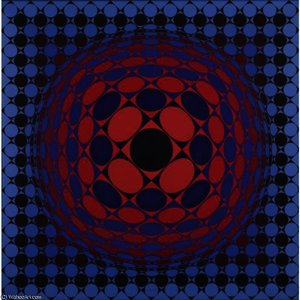
Bivega er maleriet Victor Vasarely er mest kjent for. Quadrature og ORION-MC fullfører trioen av de mest elskede maleriene. Vår katalog inneholder 776 verk av Victor Vasarely. Her er de 100 mest kjente, med årstall, museum og historien bak hvert lerret.
Rangert etter vår popularitetsscore, som kombinerer søk, besøk og bestillinger for hvert verk. Oppdatert October 2026.


Victor Vasarely's *Quadrature* isn't merely a painting; it’s an invitation – an invitation to question the very nature of visual reality. Created by a visionary who anticipated the digital age, this work embodies the core tenets of Op Art, a movement that sought to manipulate perception through carefully constructed geometric forms and vibrant color fields. Painted in 1960s, *Quadrature* showcases Vasarely’s mastery of optical illusion, transforming two dynamic spheres into…

Victor Vasarely's ORION-MC is not merely a painting; it’s an invitation to experience the world through a radically altered lens. This captivating work, rendered in a vibrant palette of red, yellow, green, blue, purple, orange, and black, exemplifies the core tenets of Op Art – Optical Art – pioneered by Vasarely himself. Born Károly Vaszary in 1906 in Pécs, Croatia, his artistic trajectory began with an unexpected detour into medicine…

The artwork titled Zebras (white on black) was created by the artist Victor Vasarely. This piece features two zebras positioned against a black background. The composition includes smaller figures of animals in the background, such as two birds and three additional zebras, which contribute to the depth of the image. The visual structure utilizes geometric shapes and patterns to form the figures.

Vega-Wa-3: A Dance of Geometric Illusion Victor Vasarely’s “Vega-Wa-3” isn't merely a painting; it’s an invitation to perceive reality differently. Created in 1968, this striking artwork embodies the spirit of Op Art – Optical Art – a movement that revolutionized visual perception during the mid-20th century and continues to inspire artists today. The piece presents a deceptively simple composition: concentric circles interwoven with smaller, repeating squares, predominantly rendered in shades…

To stand before Victor Vasarely’s Kaglo II is to enter a realm where the boundaries between the static and the kinetic dissolve into a rhythmic dance of light and color. Created in 1986, this masterful print serves as a profound testament to the enduring power of geometric abstraction. At first glance, the eye is drawn to a central, commanding red sphere, which acts as the sun within a private cosmos.…

Victor Vasarely’s *Vega 1* isn't merely a painting; it’s an invitation. An invitation to step outside the confines of traditional representation and into a world governed by perception itself. Born in 1906 in Pécs, Croatia – then part of Austria-Hungary – Vasarely’s artistic trajectory was initially rooted in medicine before he decisively embraced the burgeoning field of visual abstraction. This pivotal shift, fueled by his studies at the Podolini-Volkmann Academy…

Victor Vasarely’s “NB 22 Caope” is more than just an abstract painting; it's a meticulously crafted portal into the heart of Op Art, a movement that sought to redefine our perception of reality. This striking work, dominated by a precisely arranged grid of black and white circles, exemplifies Vasarely’s pioneering approach to visual illusion – a technique he developed with mathematical rigor and an almost obsessive attention to detail. The…

To stand before a work by Victor Vasarely is not merely to observe paint on canvas; it is to engage in a sophisticated dialogue with perception itself. This piece, characterized by its vibrant, almost pulsating geometric network, draws the viewer into a mesmerizing optical labyrinth. It speaks directly to the intellectual curiosity of the modern collector and the design sensibility of those who appreciate art as an architectural element. The…

To stand before Harmas is to step directly into the mind of its creator, Victor Vasarely. This piece is not merely an arrangement of color and pattern; it is a vibrant intellectual puzzle, a visual meditation on structure itself. The eye is immediately drawn into the intricate dance between the bold red checks and the myriad small circles that populate the background. It possesses the undeniable energy characteristic of Op…

Victor Vasarely's Pal-Ket, painted in 1974, isn’t merely a visual experience; it’s an invitation to reconsider the very nature of perception. This vibrant acrylic on canvas piece, measuring…

Victor Vasarely's "Vonal-2" is more than just a colorful pattern; it’s a meticulously crafted portal into the heart of Op Art and a testament to the revolutionary ideas…

In this 1957 work, titled Vega II, Victor Vasarely explores the fundamental mechanics of sight. The piece is a purely abstract composition, eschewing any recognizable subject matter in…

To stand before Victor Vasarely's Axo 99 is not merely to observe a painting; it is to engage in a visual dialogue with the very mechanics of sight…

Victor Vasarely's “Abstract Composition 9” is more than just a painting; it’s an invitation to experience the world through the lens of perception itself. Created by one of…

The artwork titled Zebras was created by the artist Victor Vasarely. This piece, dated 1938, emerged from a period of intense graphic experimentation. It is considered one of…

To encounter Victor Vasarely’s Kezdi-Ga is to step away from the stillness of traditional viewing and enter a realm where the canvas breathes, pulses, and vibrates with an…

Victor Vasarely’s ‘SIR-RIS,’ a captivating sculpture rendered in meticulous black and white, stands as a cornerstone of Op Art – a movement that fundamentally challenged our understanding of…

To stand before Victor Vasarely’s "Torony-Nagy" is not merely to observe paint on canvas; it is to engage in a sophisticated dialogue with perception itself. This vibrant 1969…

Victor Vasarely's 'Quasar' is not merely a painting; it’s an invitation into the very fabric of perception, a testament to the revolutionary impact of Op Art and the…

To stand before Victor Vasarely's Zett-Ka is not merely to observe a painting; it is to step into a meticulously constructed optical puzzle. This masterful piece, a quintessential…

Victor Vasarely's "Vega-Kontosh-Va" is not merely a painting; it’s an invitation to experience the world through a radically altered lens. This vibrant composition, dominated by a pulsating red…

We are looking at Vèga 3, a significant work by the artist Victor Vasarely. Created about 1968, this piece belongs to the Op Art movement, a style that…

Zoeld V, 1967 – En Pionjärs Vision av Geometri och Färg Victor Vasarely var en konstnär vars arbete revolutionerade konceptet för abstrakt konst och öppnade upp för nya…

Victor Vasarely: Pionereren innen Op Art og Demokratisering av Visuell Opplevelse Victor Vasarely (1906–1997) var en ungarskfødt kunstner som revolusjonerte kunstverdenen på midten av det 20. århundre gjennom…


In the realm of Op Art, few works capture the hypnotic essence of visual disruption as masterfully as Victor Vasarely’s Zebras (full body white on blue-black). This striking…

Victor Vasarely's "Kezdi-All," a captivating exploration of optical illusion and geometric abstraction, stands as a cornerstone of Op Art – a movement that fundamentally challenged our understanding of…

To stand before Harmas is to step directly into the mind of its creator, Victor Vasarely. This piece is not merely an arrangement of color and pattern; it…

To encounter Victor Vasarely’s 1951 masterpiece, “Terek,” is to step away from the static world of traditional representation and enter a realm where the canvas itself seems to…

To stand before this piece is to step through a portal built entirely of color and calculated form. It is an immediate confrontation with perception itself. The composition,…

To encounter Victor Vasarely's 'Folklore' is to step away from the stillness of traditional viewing and enter a realm where the canvas begins to breathe, pulse, and vibrate…

Victor Vasarely’s “O N D - I I - V A” is more than just a painting; it's an invitation to experience the world through a radically altered…

The artwork is a grid-based abstract composition dominated by concentric circles of varying sizes and shades of red and green. It presents a highly geometric and symmetrical design,…

Victor Vasarely's "F-VERT-BLEU" is not merely a puzzle; it’s a meticulously crafted portal into the heart of Op Art, a movement that fundamentally altered our perception of space…

Vonal-Lap: A Geometric Dance of Color and Illusion Victor Vasarely’s “Vonal-Lap,” created in 1969, isn't merely a painting; it’s an invitation to reconsider how we perceive visual reality.…

The painting Dia-Tuz-Neg is a blue and white composition characterized by a circular pattern. At the center of the work, a large circle is prominently featured, surrounded by…

Victor Vasarely’s “Caopeo” isn’t merely a painting; it’s an invitation, a carefully constructed illusion designed to challenge and delight the viewer. Created in 1962, this seminal work exemplifies…

Sorata-T is a painted glass triptych executed in 1953. The work is composed of three panels:

The artwork Triond features three colorful balls presented in various shades of blue, purple, pink, and green. These spheres are arranged in a triangular formation, with one ball…

Step closer to observe how the eye begins to move across the surface of Domb-B. At first glance, your attention is drawn to that central blue and yellow…

VP-115 by Victor Vasarely exists as a precise study in the mechanics of sight. The work operates through a calculated arrangement of geometric shapes, specifically a sphere and…

Victor Vasarely's 'Jong,' completed in 1968, is more than just an image; it’s an invitation to question the very nature of reality. This arresting work, a cornerstone of…

The artwork consists of four circles arranged in a square configuration. Each circle is assigned a specific color: blue, orange, yellow, and purple. These shapes are positioned at…

To encounter Victor Vasarely’s “Obor” is to step away from the stillness of traditional viewing and enter a realm where the canvas itself seems to breathe, pulse, and…

Victor Vasarely og ION 6-6: Et Kaleidoskop av Matematisk Harmoni Victor Vasarely (1906–1997) var en ungarskfødt kunstner som revolusjonerte kunstverdenen på midten av det 20. århundre gjennom sin…

A Dance of Circles on Crimson: Exploring Victor Vasarely's "Untitled 16" Victor Vasarely, a name synonymous with Op Art and kinetic abstraction, gifted the world a visual language…

Tridem K – A Geometric Revelation by Victor Vasarely Victor Vasarely (1906-1997) stands as an undisputed titan of Op Art, a movement that revolutionized visual perception in the…

The artwork Louisiana features a symmetrical, circular design composed of numerous small, overlapping circles in varying shades of red, orange, and brown. A blue grid subtly underlies the…

A Symphony of Geometry: Exploring Victor Vasarely's "Sikra-Z" Victor Vasarely, a name synonymous with Op Art and kinetic art, dedicated his life to unraveling the mysteries of perception…

Detta är ett verk där geometrisk abstraktion möter färgens kraft och erbjuder tittaren en unik möjlighet till estetiskt nöje och inspiration.

Victor Vasarely (1906-1997) var en ungarskfødt og franskstatsborger kunstner som ble kjent som far til Op Art-bevegelsen og en banebrytende figur innen kinetisk kunst. Hans kunstverk er karakterisert…

Quadrature ''X'' – En Pionerens Förebild Victor Vasarelys verk "Quadrature ''X'' är ett fascinerande exempel på Op Art, en stil som föddes ur efterkrigstidens europeiska konstscen och där…

A Dance of Light and Geometry: Unveiling Victor Vasarely’s “Untitled 18” Victor Vasarely's "Untitled 18" isn’t merely a painting; it’s an invitation to step into a world where…

Victor Vasarely (1906–1997) er en ungarskfødt fransk kunstner som ofte omtales som «far» til Op art-bevegelsen. Hans arbeid, spesielt bildet «Nobel IV», er et fascinerende eksempel på hvordan…

KALOTA T is an artwork created by the artist Victor Vasarely. Born in 1906 and passing away in 1997, the French/Hungarian artist developed a visual language centered on…

Victor Vasarely's "Sikra," painted in 1966, is more than just a colorful composition; it’s a meticulously crafted portal into the heart of Op Art and a testament to…

Victor Vasarely's "Dia-Or" is not merely a painting; it’s an invitation into the very fabric of perception. This captivating work, rendered in oil with meticulous attention to detail,…

To encounter Victor Vasarely's “Mahn” is to step into a realm where the canvas ceases to be a static surface and begins to breathe, pulse, and vibrate with…

Victor Vasarely og «Cheyt - L»: Et Kaleidoskop av Geometri og Farge Victor Vasarely var en ungarsk kunstner født i 1906, som gjennom Bauhaus og geometrisk abstraksjon ble…

To encounter Victor Vasarely’s Caribe Negatif is to step away from the stillness of traditional viewing and enter a realm where the canvas breathes, vibrates, and dances before…

To encounter Victor Vasarely's “Tomor” is to step away from the static world of traditional imagery and enter a realm where the canvas itself seems to breathe, pulse,…

Victor Vasarely's Rhombus-B is more than just a painting; it’s an invitation to question the very nature of visual perception. Created by one of the foremost figures in…

Victor Vasarely's "Sreeh" is more than just a painting; it’s an invitation into the heart of Op Art, a visual exploration of perception itself. This striking work, dominated…

Victor Vasarely's "Hetta," a deceptively simple composition of four vibrant circles – red, orange, green, and blue – is far more than just an abstract arrangement. It’s a…

Victor Vasarely's *Opus 2604* is not merely a painting; it’s an invitation to question the very nature of visual reality. This mesmerizing work, dominated by a vibrant blue…

This vibrant artwork, designated VY-47-C, is a captivating embodiment of Victor Vasarely's groundbreaking contributions to Op Art and his pioneering exploration of geometric abstraction. Executed with a masterful…

Vega-EG: A Dance of Spheres – Exploring Victor Vasarely’s Geometric Vision Victor Vasarely (1906-1997), born Károly Vaszary in Pécs, Croatia, stands as a monumental figure in the realm…

Guimen – Et Kaleidoskop av Perspektiv og Stil Victor Vasarelys Guimen er et verk som fascinerer ved sin tilsynelatende enkelhet og samtidig skjuler kompleksiteten til geometrisk abstraksjon og…

Victor Vasarely's "Molnar" is more than just a painting; it’s an invitation into the mesmerizing world of Op Art, a realm where perception itself becomes the subject. This…

Victor Vasarely's Folkokta is more than just a colorful arrangement of squares; it’s a meticulously crafted portal into the heart of Op Art and a testament to the…

Victor Vasarely: Pionir Op Art i demokratizacija vizuelnog iskustва Victor Vasarely (1906–1997) био је сликар који је револуционисао свет уметности својим иновативним приступима геометрији и перцепцији. Иако је…


Victor Vasarely's "Andromeda" isn't merely a painting; it’s an invitation into a realm where perception itself becomes the subject. This striking composition, dominated by a meticulously rendered geometric…

Victor Vasarely og Planetarisk Folklore – Et Kaleidoskop av Optiske Illusioner Victor Vasarely (1906–1997) var en ungarskfødt kunstner som revolusjonerte kunstverdenen på 1930-tallet gjennom sin banebrytende bruk av…
Victor Vasarely's "Versakk" is not merely a painting; it’s an invitation, a carefully constructed illusion that challenges our very perception of space and form. Created by the Hungarian…

Victor Vasarely's DVA-DVA is more than just a colorful square; it’s a meticulously crafted portal into the heart of Op Art and a testament to the revolutionary approach…

Victor Vasarely og Sfære – En Revolusjon innenfor Matematikken og Synet Sfære av Victor Vasarely er mer enn bare et abstrakt maleri; det er et vitenskapelig eksperiment pakket…

Victor Vasarely og Koska Kar – Et Kaleidoskop av Matematisk Harmoni Victor Vasarely (1906–1997) var en pioner innenfor Op Art og kinetisk kunst, kjent for sine geometriske abstraksjoner…

Louisiana 3: A Dance of Geometric Illusion Louisiana 3 av Victor Vasarely är ett fascinerande exempel på Op Art, en konstnärlig rörelse som blomstrade fram under efterkrigstiden och…

Victor Vasarely og Koentoesh – Et Kaleidoskop av Farge og Form Victor Vasarely (1906–1997) var en ungarskfødt fransk kunstner som ble kjent som «far» og leder for Op…

To encounter Victor Vasarely’s Tridim is to step into a realm where the boundaries of the two-dimensional canvas dissolve, replaced by a pulsating, architectural depth that defies the…

Koska-Pint av Victor Vasarely – En Pionjärs Dans med Geometri och Färg Victor Vasarely (1906–1997) var ingen konstnär som sökte efter lättsamhet eller enkelhet. Han föddes Károly Vaszary…


Victor Vasarely og kaleidoskopisk geometri: En utforskning av Untitled 22 Victor Vasarely (1906–1997) var en ungarskfødt fransk kunstner som ble kjent som «far» og leder for Op art-bevegelsen.…

Victor Vasarely’s “Illik,” created in 1971, stands as a cornerstone of Op Art – Optical Art – a movement that revolutionized visual perception during the mid-20th century. More…

“MEH2,” a captivating work by Hungarian artist Victor Vasarely, is more than just a painting; it's an invitation to explore the very nature of visual perception. Executed in…

Victor Vasarely's Vega-Fel is not merely a painting; it’s an invitation to experience the world through a radically altered lens. This captivating work, dominated by a monumental blue…

Victor Vasarely's "Attam" is more than just a painting; it’s an invitation into the very heart of perception, a testament to the revolutionary impact of Op Art and…

To encounter Victor Vasarely’s “Sikra” is to step away from the stillness of traditional viewing and enter a realm where the canvas breathes, pulses, and vibrates with an…

Victor Vasarely's "Atelier Arcay" isn’t merely a painting; it’s an invitation to a perceptual adventure. Created in the heart of the Op Art movement, this vibrant geometric abstraction…

Et kaleidoskop av geometrisk energi: En studie av Victor Vasarelys «Abstract Composition 5» Victor Vasarely var ingen vanlig kunstner; han var en pionjär inom Op Art och kinetisk…

Victor Vasarely's Composition 7 is more than just a colorful painting; it’s a portal into the heart of Op Art and a testament to the revolutionary ideas of…

Victor Vasarely’s "Variációk" (Variations), created in 1989, is more than just an arrangement of circles; it's a vibrant exploration of perception and the underlying mathematical order that governs…

A Dance of Geometry and Color: Exploring Victor Vasarely's "Abstract Composition 13" Victor Vasarely, a name synonymous with Op Art and kinetic art, gifted the world a visual…

Victor Vasarely's Firaxo II is more than just a colorful textile; it’s a meticulously constructed portal into the heart of Op Art and a testament to the revolutionary…

A Symphony in Black: Exploring Victor Vasarely's Serigraph Victor Vasarely’s serigraphy in black is more than just an image; it’s an experience, a visual puzzle that invites the…

“Vonal-Fegn,” created by Victor Vasarely, is more than just an abstract painting; it's a meticulously crafted exploration of perception itself. Painted in hues of orange, yellow, blue, gray,…

Victor Vasarely's "Ouivar," a captivating exploration of geometric abstraction, invites the viewer into a world where perception itself becomes the subject. This artwork, characterized by its precisely arranged…

Victor Vasarely's "Abstract Composition 17" is more than just an image; it’s an invitation to experience the world anew. Born in 1906 in Pécs, Croatia – then part…
De fire motivene som går igjen oftest på disse lerretene, hver med sitt mest kjente eksempel.
De 3 museene som innehar flest av maleriene på denne siden.
| Museum | By | Verker av Victor Vasarely | Malerier fra denne listen |
|---|---|---|---|
 Bechtler Museum of Modern Art |
Charlotte | 4 | NB 22 Caope, SIR-RIS, Tridem K |
 Inter-American Development Bank |
Washington, D.C. | 2 | Kaglo II |
 Bilbao Fine Arts Museum |
Bilbao | 1 | Pal-Ket |
The artwork titled Zebras was created by the artist Victor Vasarely. This piece, dated 1938, emerged from a period of intense graphic experimentation. It is considered one of…
In this 1957 work, titled Vega II, Victor Vasarely explores the fundamental mechanics of sight. The piece is a purely abstract composition, eschewing any recognizable subject matter in…

Vega-Wa-3: A Dance of Geometric Illusion Victor Vasarely’s “Vega-Wa-3” isn't merely a painting; it’s an invitation to perceive reality differently. Created in 1968, this striking artwork embodies the…
Victor Vasarely's Pal-Ket, painted in 1974, isn’t merely a visual experience; it’s an invitation to reconsider the very nature of perception. This vibrant acrylic on canvas piece, measuring…

To stand before Victor Vasarely’s Kaglo II is to enter a realm where the boundaries between the static and the kinetic dissolve into a rhythmic dance of light…
Bivega, etterfulgt av Quadrature og ORION-MC.
Bivega, Quadrature, ORION-MC, Zebras (white on black), Vega-Wa-3, Kaglo II, Vega 1, NB 22 Caope, Yon og Harmas. Hvert lerret i rangeringen ovenfor er oppgitt med årstall og museum.
776 verk av Victor Vasarely finnes i vår katalog, datert fra 1938 til 1986.
Hovedsakelig i Bechtler Museum of Modern Art (Charlotte), Inter-American Development Bank (Washington, D.C.) og Bilbao Fine Arts Museum (Bilbao); listen ovenfor navngir hvert museum og deres lerreter.
I 1960s, som utgjorde 10 av de 100 verkene på denne siden, var Vega-Wa-3 blant dem.
Det eldste lerretet her er fra Zebras (1938); det nyeste er fra Kaglo II (1986).
Visual perception (31), Color field (27) og Geometric abstraction (26), fordelt på 100 verk på denne siden.
Acrylic On Canvas, brukt i 41 av de 100 verkene på denne siden.
Optical art, som lerretet på denne siden viser.
Bechtler Museum of Modern Art, Charlotte har 3 av verkene på denne siden, inkludert NB 22 Caope, SIR-RIS og Tridem K.
Født som Károly Vaszary den 9. april 1906 i Pécs, Ungarn, begynte mannen som senere skulle bli kjent som Victor Vasarely sin livsreise i et helt annet felt enn det vi i dag forbinder med kunst. I 1925 trådte han inn i de akademiske salene ved Eötvös Loránd-universitetet i Budapest for å studere medisin. Den menneskelige kroppens logikk og vitenskapens strenge rammer opptok hans tid i to år, men lengselen etter visuelt uttrykk viste seg til slutt å være sterkere. Innen 1927 hadde han lagt medisinstudiene bak seg for å i stedet utforske det tradisjonelle akademiske maleriet ved Podolini-Volkmann-akademiet.
Hans kunstneriske dannelse fortsatte da han søkte til Sándor Bortnyiks műhely. Dette verkstedet var en smeltedigel der prinsippene fra Bauhaus-bevegelsen slo rot, med et intenst fokus på skjæringspunktet mellom funksjonelt design og geometrisk abstraksjon. Her skiftet tyngdepunktet mot det strukturelle og det systematiske. Lærdommen han tilegnet seg i disse atelierene la selve fundamentet for hans senere, dyptgående undersøkelser av hvordan former og farger samhandler med det menneskelige øyet.
Mellom 1929 og 1944 rettet Vasarely sitt fokus mot grafisk arbeid. Han tilbrakte disse årene med å eksperimentere med hvordan lys og skygge samspiller med enkle former. Hans tidlige grafiske periode frembrakte verk som Chess Board (1935) og Girl-power (1934). Han arbeidet også med Zebras i 1937. Disse verkene vitner om en voksende interesse for hvordan betrakteren oppfatter en flat overflate. Han beveget seg bort fra det tradisjonelle maleriet til fordel for en mer strukturert og grafisk tilnærming.
Fra 1944 til 1947 gjennomgikk retningen hans en markant endring. Han vandret gjennom flere stiler, inkludert kubistiske, futuristiske, ekspresjonistiske, symbolistiske og surrealistiske uttrykk. Til slutt beveget han seg forbi disse eksperimentene i søken etter en mer presis måte å organisere rommet på. Denne jakten på en ny logikk ledet ham til å publisere sitt Gule Manifest. Arbeidene hans handlet i økende grad mindre om individuell ekspresjon og mer om selve synets mekanikk. Denne systematiske metoden etablerte ham til slutt som en ledende skikkelse innen Op Art-bevegelsen.
Vasarelys tilnærming hviler på en systematisk bruk av geometri for å utløse en fysisk respons hos betrakteren. Han støttet seg ikke på tradisjonelle lyskilder eller klassisk chiaroscuro for å skape form. I stedet benyttet han et sofistikert samspill av høykontrast-pigmenter for å simulere dybde og bevegelse. Ved å manipulere fargetettheten, kunne han lure øyet til å oppfatte både tilbakeskyvning og fremspring på en flat flate. Denne metoden forvandler en statisk overflate til et rom som virker å svulme eller trekke seg tilbake.
Hans metode, som han selv refererte til som visuell kinetikk eller plastique cinétique, innebærer en presis arrangement av former. Han utnyttet teksturelle effekter, perspektiv, skygge og lys for å bygge opp disse illusjonene. Verkene hviler ofte på måten øyet tolker rytmisk, indre glød fremfor ekstern belysning. Gjennom bruk av rutenett og matematiske prinsipper skapte han sansninger av visuell vibrasjon og virvlende effekter. Resultatet er en følelse av bevegelse som eksisterer utelukkende i betrakterens persepsjon.
Presisjonen i teknikken hans er tydelig i hvordan han håndterer farge og linje for å skape arkitektonisk dybde. I verk som Torony-Nagy, skaper skjæringspunktet mellom skarpe hvite linjer og dype blåtoner og smaragdgrønne farger en rytmisk optisk vibrasjon. Disse elementene samvirker for å fremkalle en følelse av pulserende lys. Han brukte disse verktøyene for å bevege seg forbi enkel representasjon, og fokuserte i stedet på mekanismene bak hvordan vi faktisk ser.
I 1937 markerte skapelsen av Zebra et skifte mot det mange anser som de tidligste eksemplene på Op Art. Dette verket beveget seg bort fra tradisjonell representasjon og fokuserte i stedet på hvordan øyet tolker enkle former. Da vi nådde 1960-tallet, hadde hans eksperimenter med rytme og lys nådd et høydepunkt i verket Torony-Nagy fra 1969. Dette stykket benytter fire stiliserte tårn og en høykontrast-palett av blått, grønt og oransje for å skape en følelse av indre glød. Komposisjonen hviler på skjæringspunktene mellom hvite linjer og fargetetthet, noe som får den flate overflaten til å virke som om den pulserer og viker unna betrakteren.
Hans fascinasjon for bevegelse strakte seg langt utover det todimensjonale lerretet og inn i det tredimensjonale rommet og hverdagslige gjenstander. Han designet Georges Pompidou, et stort kinematisk objekt som integrerte hans visuelle teorier i en fysisk, bevegelig form. Denne interessen for den praktiske anvendelsen av hans geometri førte også til et samarbeid med Rosenthal Studio Linie. Dette partnerskapet resulterte i serviset Suomi, en serie på 500 deler som brakte hans geometriske mønstre inn i det private hjemmet.
I 1966 la Victor Vasarely grunnsteinen for det som skulle bli Fondation Vasarely. Dette prosjektet var dypt forankret i hans personlige visjoner om konseptet «kunst for alle» og hans dristige drøm om en «morgendagens by». Han søkte å skape et rom som brøt med den tradisjonelle gallerierfaringen, et sted som kunne reflektere disse idealene i praksis. Selve byggingen av dette monumentale prosjektet tok for alvor fatt i 1973.
Stiftelsen ble offisielt innviet den 14. februar 1976 i Aix-en-Provence i Frankrike. Stedet ble utformet for å huse hans omfattende livsverk, samtidig som det skulle fungere som en arena for hans teorier om samspillet mellom kunst og urban design. Selve arkitekturen i rommet var en integrert del av denne visjonen; bygningens layout var nøye planlagt for å understøtte den unike måten hans geometriske former var ment å oppleves på av publikum.
Rekkevidden av hans visuelle språk strakte seg langt forbi galleriets vegger. Hans mønstre og geometriske strukturer fant veien inn i hverdagens teksturer, og påvirket alt fra motens linjer og interiørdesignens komposisjoner til den grafiske designens logikk. Selv den tidlige utviklingen av datagrafikk bærer preg av hans systematiske tilnærming til form og persepsjon. Hans ideer var ikke begrenset til lerretet; de beveget seg inn i den funksjonelle verden av objekter og de digitale strukturene som fulgte.
I 1982 reiste hans verk ut i verdensrommet da serigrafier ble med om bord på det fransk-sovjetiske romskipet Salyut 7. Dette øyeblikket belyste forbindelsen mellom hans matematiske presisjon og menneskehetens overordnede streben etter utforskning. Han forble en sentral skikkelse i den moderne kunsthistorien frem til sin død i Paris, Frankrike, den 15. mars 1997.
Å spore den fysiske tilstedeværelsen av hans kunstneriske arv krever en reise gjennom flere steder i både Frankrike og Ungarn. I Aix-en-Provence i Frankrike finner vi Fondation Vasarely, som huser en betydelig del av hans produksjon. Dette museet ble grunnlagt av kunstneren selv for å fremme hans visjon om kunst for alle. Rommet er organisert i syv heksagonale celler, hver med en bredde på 14 meter og en høyde på 11 meter, spesialdesignet for å romme førtito storslåtte verk som måler 6 ganger 8 meter.
Hans nærvær i Ungarn er også sterkt til stede gjennom dedikerte museer. Vasarely-museet ligger i Pécs, fødebyen hans, og det finnes også et Vasarely-museum i Zichy-palasset i Óbuda, Budapest. Disse stedene gir publikum muligheten til et direkte møte med de geometriske formene og de optiske effektene som definerte hans virke. I Frankrike er også Vasarely-museet i Saint-Firmin-palasset i Gordes et viktig sted for hans kunst.
Utover disse spesifikke museene finnes hans innflytelse i en rekke institusjonelle samlinger. Enkelte av hans verk er bevart ved Bilbao Fine Arts Museum, mens andre inngår i samlingene til Inter-American Development Bank i Washington, D.C., og Bechtler Museum of Modern Art i Charlotte. Disse spredte lokasjonene sikrer at hans visuelle eksperimenter forblir tilgjengelige for et mangfoldig publikum over hele verden.


