Pracownia — Bezpłatna wysyłka na cały świat — Czas dostawy: 2–6 tygodni
      Henri Harpignies, 1819 – 1916

      Henri Harpignies: 100 najsłynniejszych obrazów

      Spośród wszystkich obrazów Henri Harpignies, najbardziej znanym jest Moonlight. Tuż za nimi plasują się Crémieu (1847) oraz Path through a Normandy Village (1877). Spośród 264 dzieł Henri Harpignies w naszym katalogu, tych 100 jest najbardziej znanych – każde z nich zostało przedstawione wraz z datą powstania, muzeum oraz historią.

      Ranking oparty na naszym wskaźniku popularności, który łączy liczbę wyszukiwań, wizyt oraz zamówień dla każdego dzieła. Aktualizacja: Październik 2026. Każdy obraz na tej stronie można zamówić jako ręcznie malowaną reprodukcję olejną na płótnie lnianym lub jako wysokiej jakości wydruk artystyczny, wykonany w wybranym przez Ciebie formacie.

      Portret Henri Harpignies
      Henri Harpignies · 1819 – 1916
      Urodzony · zmarł
      1819 – 1916, Valenciennes
      Nurt
      Barbizon school
      Dzieła w naszym katalogu
      264
      Najsłynniejsze
      Moonlight
      Najwięcej dzieł w
      Petit Palais

      10 najsłynniejszych obrazów artysty Henri Harpignies

      Moonlight autorstwa Henri Harpignies
      1

      Moonlight

      Oil On Canvas

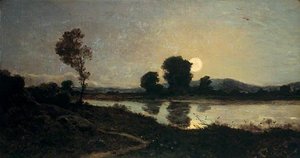
      The nocturnal scene known as Moonlight emerges from the brush of Henri Harpignies. This landscape captures a quiet moment where the sky and earth meet under a soft, luminous glow. The artist, Henri Harpignies, brings this specific vision to life through a careful study of the natural world. He was born in Valenciennes, France, and his life spanned from 1819 to 1916. Through his eyes, the night becomes a place…

      Hand-painted oil reproduction from $178 28 × 36 cm
      Crémieu (1847) autorstwa Henri Harpignies
      2

      Crémieu

      1847 · Oil On Canvas · Fitzwilliam College, Cambridge

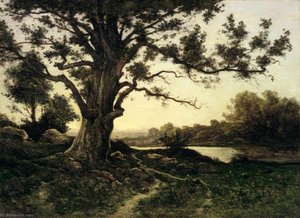
      Henri-Joseph Harpignies’ “Crémieu” (1847) is more than just a landscape painting; it's an immersive experience, a carefully constructed tableau that invites contemplation on the relationship between humanity and the vastness of nature. The scene unfolds within the foothills of the French Alps, depicting a rugged, almost primordial terrain dominated by towering cliffs and a winding path that draws the eye relentlessly into the distance. The painting immediately establishes a sense…

      Hand-painted oil reproduction from $178 35 × 29 cm Same size as the original $201 46 × 38 cm Order at original size →
      Path through a Normandy Village (1877) autorstwa Henri Harpignies
      3

      Path through a Normandy Village

      1877

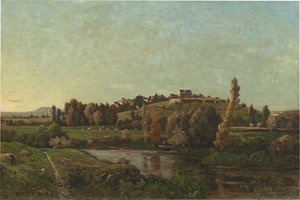
      A Glimpse of Rural Tranquility: Henri-Joseph Harpignies' "Path through a Normandy Village" This captivating landscape painting, “Path through a Normandy Village,” created in 1877 by French artist Henri-Joseph Harpignies, offers a serene glimpse into rural life. The artwork transports viewers to the heart of Normandy, France, depicting a picturesque village nestled amongst rolling hills under a cloudy sky. It’s a quintessential example of Impressionism, capturing not just what is seen…

      Hand-painted oil reproduction from $178 27 × 37 cm
      Landscape (1898) autorstwa Henri Harpignies
      4

      Landscape

      1898 · Oil On Canvas · National Gallery of Art, Waszyngton

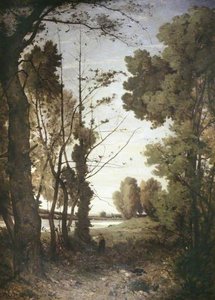
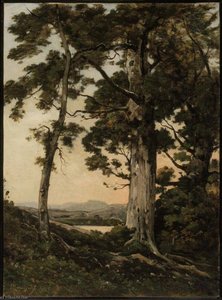
      There is a certain stillness that settles over this landscape, a moment caught in the soft, diffused light of a late afternoon. The scene unfolds through a river valley, where the eye is led from the rugged, textured bark of the foreground trees toward a distant, pale body of water. It is a composition of balance and organic movement, where the twisting branches of the trees on the right frame…

      Hand-painted oil reproduction from $178 35 × 29 cm Same size as the original $242 62 × 50 cm Order at original size →
      River and Hills (1855) autorstwa Henri Harpignies
      5

      River and Hills

      1855 · Oil On Canvas · National Gallery, Londyn

      A heavy, dark rock formation anchors the left foreground, its jagged edges pressing against the viewer. This shadow-drenched cliff creates a sense of enclosure, a rocky threshold that directs the eye toward the center of the canvas. Beyond this immediate barrier, a winding path leads the gaze through a landscape of ochre and sienna. The river flows with a quiet, reflective surface, mirroring the cool blues of the sky. In…

      Hand-painted oil reproduction from $178 37 × 27 cm Same size as the original $185 45 × 27 cm Order at original size →
      Avallon (1869) autorstwa Henri Harpignies
      6

      Avallon

      1869 · Oil On Canvas · Bristol Museum - Art Gallery, Bristol

      In the quietude of 1869, Henri-Joseph Harpignies captured more than just a landscape; he bottled a moment of eternal peace. Avallon serves as a breathtaking window into a world where time seems to slow, inviting the viewer to step onto a sun-dappled dirt road that winds through a lush, verdant countryside. The composition is masterfully orchestrated, leading the eye from the textured foreground—where the roughness of the path and the…

      Hand-painted oil reproduction from $178 40 × 25 cm Same size as the original $195 50 × 31 cm Order at original size →
      Fir Trees in Les Trembleaux, near Marlotte (Sapins aux Trembleaux à Marlotte) (1854) autorstwa Henri Harpignies
      7

      Fir Trees in Les Trembleaux, near Marlotte (Sapins aux Trembleaux à Marlotte)

      1854 · Acrylic On Canvas · Metropolitan Museum of Art, Nowy Jork

      Henri-Joseph Harpignies' "Fir Trees in Les Trembleaux, near Marlotte" is more than a landscape painting; it’s an invitation into a hushed sanctuary of the French countryside. Completed in 1854, this vertically oriented work captures a fleeting moment within the Forest of Fontainebleau, a region steeped in artistic tradition and profoundly influential on generations of painters. It's a piece that speaks to the Romantic ideal of nature as both sublime and…

      Hand-painted oil reproduction from $178 28 × 36 cm Same size as the original $188 32 × 41 cm Order at original size →
      The Lake (1897) autorstwa Henri Harpignies
      8

      The Lake

      1897 · Acrylic On Canvas · Fitzwilliam College, Cambridge

      Henri-Joseph Harpignies’ “The Lake,” painted in 1897, isn't merely a landscape; it’s an immersion into a profound sense of serenity. This evocative work, rendered with the meticulous detail characteristic of the Barbizon School, captures a fleeting moment on the shores of a still lake nestled within a dense, verdant forest. The scene unfolds beneath a diffuse, almost ethereal light – not the harsh glare of midday, but rather the soft,…

      Hand-painted oil reproduction from $178 39 × 26 cm Same size as the original $181 41 × 27 cm Order at original size →
      Landscape of the Côte d'Azur (Eze, Cap d'Ail, the "Tête de chien"), seen from Saint-Jean-Cap-Ferrat. (1865) autorstwa Henri Harpignies
      9

      Landscape of the Côte d'Azur (Eze, Cap d'Ail, the "Tête de chien"), seen from Saint-Jean-Cap-Ferrat.

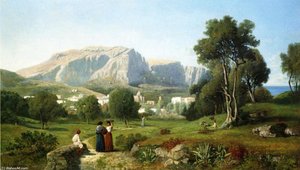
      1865 · Oil On Canvas · Montreal Museum of Fine Arts, Montreal

      The oil painting titled Landscape of the Côte d'Azur (Eze, Cap d'Ail, the "Tête de chien"), seen from Saint-Jean-Cap-Ferrat. was executed by the artist Henri Harpignies in 1865. This work depicts a specific coastal vista located in the region of Eze and Cap d'Ail, specifically focusing on the area known as the "Tête de chien" as viewed from the vantage point of Saint-Jean-Cap-Ferrat.

      Hand-painted oil reproduction from $178 35 × 29 cm
      The Railroad Bridge at Briare (1888) autorstwa Henri Harpignies
      10

      The Railroad Bridge at Briare

      1888 · Oil On Canvas · Philbrook Museum of Art, Tulsa

      In The Railroad Bridge at Briare, Henri Harpignies captures a quiet intersection of industry and the natural world. Painted about 1888, this work presents a grand bridge that spans across tranquil waters. It is a scene of steady, rhythmic movement, where a train glides beneath the massive iron structure, integrated into the landscape rather than disrupting it.

      Hand-painted oil reproduction from $178 38 × 26 cm

      Obrazy artysty Henri Harpignies od miejsca 11 do 100

      Moonrise (1885) autorstwa Henri Harpignies
      #46

      Moonrise

      1885 · Metropolitan Museum of Art

      Throughout his career, Harpignies maintained close ties with artists and friends in his native town of Valenciennes. He also had a studio in Paris and in 1883 signed…

      Zamów to płótno from $178 →

      Płótna Henri Harpignies epoka po epoce

      Co najczęściej malował Henri Harpignies

      Cztery tematy najczęściej pojawiające się na tych płótnach, z których każdy wraz z jego najbardziej cenionym przykładem.

      Gdzie wiszą płótna Henri Harpignies

      8 muzeów, w których znajduje się najwięcej obrazów z tej strony.

      Muzea Miasto Dzieła artysty Henri Harpignies Obrazy z tej listy
      Petit Palais, ParyżPetit Palais Paryż 11 Landscape of Hills, Forest Clearing, Fontainebleau, The Colosseum in Rome
      National Gallery, LondynNational Gallery Londyn 5 River and Hills, A River Scene, The Painter's Garden at Saint Privé
      Metropolitan Museum of Art, Nowy JorkMetropolitan Museum of Art Nowy Jork 3 Fir Trees in Les Trembleaux, near Marlotte (Sapins aux Trembleaux à Marlotte), Moonrise, The Rocky Path in the Morvan (Chemin des roches dans le Morvan)
      Museum Gouda, GoudaMuseum Gouda Gouda 3 Open Clearing in the Forest, with Pond, Evening Landscape, Landscape
      Museum Boijmans Van Beuningen, RotterdamMuseum Boijmans Van Beuningen Rotterdam 3 Landscape with two figures, Landscape By Moonlight, Hilly landscape with birches
      Fitzwilliam College, CambridgeFitzwilliam College Cambridge 4 Crémieu, The Lake
      National Gallery of Ireland, DublinNational Gallery of Ireland Dublin 3 A River Scene, A Landscape
      National Gallery of Art, WaszyngtonNational Gallery of Art Waszyngton 2 Landscape, Landscape in Auvergne

      Dekada po dekadzie: najsłynniejsze płótna Henri Harpignies

      1. 1840s
        Crémieu (1847) autorstwa Henri Harpignies
        2 z 100

        Crémieu

        Wiek 21 – 30 · Fitzwilliam College

        Henri-Joseph Harpignies’ “Crémieu” (1847) is more than just a landscape painting; it's an immersive experience, a carefully constructed tableau that invites contemplation on the relationship between humanity and…

      2. 1850s
        River and Hills (1855) autorstwa Henri Harpignies
        5 z 100

        River and Hills

        Wiek 31 – 40 · National Gallery

        A heavy, dark rock formation anchors the left foreground, its jagged edges pressing against the viewer. This shadow-drenched cliff creates a sense of enclosure, a rocky threshold that…

      3. 1860s
        Avallon (1869) autorstwa Henri Harpignies
        6 z 100

        Avallon

        Wiek 41 – 50 · Bristol Museum - Art Gallery

        In the quietude of 1869, Henri-Joseph Harpignies captured more than just a landscape; he bottled a moment of eternal peace. Avallon serves as a breathtaking window into a…

      4. 1870s
        Path through a Normandy Village (1877) autorstwa Henri Harpignies
        Płótno 3 z 100

        Path through a Normandy Village

        Wiek 51 – 60

        A Glimpse of Rural Tranquility: Henri-Joseph Harpignies' "Path through a Normandy Village" This captivating landscape painting, “Path through a Normandy Village,” created in 1877 by French artist Henri-Joseph…

      5. 1880s
        The Railroad Bridge at Briare (1888) autorstwa Henri Harpignies
        10 z 100

        The Railroad Bridge at Briare

        Wiek 61 – 70 · Philbrook Museum of Art

        In The Railroad Bridge at Briare, Henri Harpignies captures a quiet intersection of industry and the natural world. Painted about 1888, this work presents a grand bridge that…

      6. 1890s
        Landscape (1898) autorstwa Henri Harpignies
        4 z 100

        Landscape

        Wiek 71 – 80 · National Gallery of Art

        There is a certain stillness that settles over this landscape, a moment caught in the soft, diffused light of a late afternoon. The scene unfolds through a river…

      7. 1900s
        The Bay of Mentone (1905) autorstwa Henri Harpignies
        Miejsce 83 z 100

        The Bay of Mentone

        Wiek 81 – 90 · Bawarskie Państwowe Zbiory Malarstwa

      Odpowiedzi na pytania dotyczące obrazów Henri Harpignies

      Który obraz autorstwa Henri Harpignies jest najbardziej znany?Przeczytaj odpowiedź

      Moonlight, a następnie Crémieu (1847) i Path through a Normandy Village (1877).

      Z jakich dziesięciu obrazów najbardziej słynie Henri Harpignies?Przeczytaj odpowiedź

      Moonlight, Crémieu, Path through a Normandy Village, Landscape, River and Hills, Avallon, Fir Trees in Les Trembleaux, near Marlotte (Sapins aux Trembleaux à Marlotte), The Lake, Landscape of the Côte d'Azur (Eze, Cap d'Ail, the "Tête de chien"), seen from Saint-Jean-Cap-Ferrat. i The Railroad Bridge at Briare. Każde płótno w powyższym rankingu zawiera informację o roku powstania oraz muzeum.

      Ile znanych obrazów namalował Henri Harpignies?Przeczytaj odpowiedź

      W naszym katalogu znajduje się 264 dzieł artysty Henri Harpignies, datowanych od 1847 do 1909.

      W których muzeach znajdują się najsłynniejsze płótna Henri Harpignies?Przeczytaj odpowiedź

      Większość znajduje się w Petit Palais (Paryż), National Gallery (Londyn) i Metropolitan Museum of Art (Nowy Jork); powyższa lista wymienia każde muzeum oraz jego płótna.

      W których latach Henri Harpignies namalował swoje najsłynniejsze płótna?Przeczytaj odpowiedź

      W 1890s, który obejmuje 29 z 100 dzieł na tej stronie, wśród nich znajduje się Landscape.

      Jakie są pierwsze i ostatnie słynne płótna Henri Harpignies?Przeczytaj odpowiedź

      Najwcześniejsze płótno pochodzi z Crémieu (1847), a najpóźniejsze z A Landscape (1909).

      Jakie tematy najczęściej powracają w obrazach Henri Harpignies?Przeczytaj odpowiedź

      Landscape (19), Trees (6) i Water (5), w ramach 100 dzieł na tej stronie.

      Czym zazwyczaj malował Henri Harpignies?Przeczytaj odpowiedź

      Oil On Canvas, użyte w 9 z 100 dzieł na tej stronie.

      Do jakiego nurtu artystycznego należy Henri Harpignies?Przeczytaj odpowiedź

      Barbizon school i Impressionism, co pokazują płótna na tej stronie.

      Co można zobaczyć od Henri Harpignies w Petit Palais?Przeczytaj odpowiedź

      Muzeum Petit Palais, Paryż posiada 9 dzieł widocznych na tej stronie, w tym Landscape of Hills, Forest Clearing, Fontainebleau i The Colosseum in Rome.

      Czy mogę zamówić ręcznie malowaną kopię obrazu autorstwa Henri Harpignies?Przeczytaj odpowiedź

      Tak. Każdy obraz na tej stronie można zamówić z jego własnej podstrony jako ręcznie malowaną reprodukcję olejną lub jako wysokiej jakości wydruk artystyczny w wybranym przez Ciebie rozmiarze.

      Henri Harpignies: historia artysty

      Henri Harpignies – A Master of Barbizon Landscape

      Henri-Joseph Harpignies (ur. 28 czerwca 1819 w Valenciennes, zm. 28 sierpnia 1916 w Saint-Privé) – francuski malarz i grafik związany ze barbizończykami. Urodził się w zamożnej rodzinie mieszczańskiej, gdy zdecydował się na karierę artystyczną został odtrącony przez bliskich i poszedł na piechotę do Paryża, by realizować swoje plany życiowe. Początkowo pracował jako nauczyciel rysunku, uczył się w paryskim atelier malarza Jeana Acharda, gdzie rozwijał swoje umiejętności rysunkowe. Po powrocie z podróży do Włoch zaprzyjaźnił się z Jeanem Corotem i zainteresował twórczością barbizończyków. Pierwszy duży sukces Harpignies odniósł późno, bo dopiero w 1861 w paryskim Salonie zauważono jego obraz Lisière de bois sur les bords de l'Allier. Od tego roku artysta systematycznie wystawiał w Paryżu, kilkakrotnie otrzymując medale. W 1878 przeniósł się na stałe do Auxerre, gdzie dożył późnej starości. W 1911 otrzymał Krzyż Wielki Legii Honorowej.
      • Early Life and Training: Harpignies’s upbringing instilled in him a desire for independence and artistic pursuits despite familial expectations. His formal training began in Paris with Jean Achard, focusing on mastering draughtsmanship – a foundational skill that would define his approach to landscape painting.

      The Barbizon School and Italian Influence

      His formative encounter with the Barbizon School’s philosophy profoundly impacted Harpignies' artistic vision. Artists like Jean-Baptiste-Camille Corot championed direct observation of nature and realistic depictions of rural life, principles that resonated deeply within Harpignies’s soul. The trip to Italy in 1848 solidified his connection with these influential painters and broadened his artistic horizons.
      • Collaborative Journey: Harpignies embarked on a memorable expedition with Corot to Italy in 1860, immersing himself in the landscapes and traditions of the Renaissance.

      Artistic Development and Style

      Harpignies’s distinctive style is characterized by serene and idyllic portrayals of the French countryside. He skillfully captured subtle nuances of light and atmosphere, creating landscapes that evoke tranquility and harmony. His technique involved meticulous observation combined with a refined understanding of composition. Harpignies developed his own artistic voice while retaining the Barbizon School's commitment to realism.
      • Technique: Harpignies favored oil paints and aquarelle, allowing him to convey textures and moods with remarkable precision.

      Notable Works

      • Soir sur les bords de la Loire (Evening on the Banks of the Loire): This iconic painting exemplifies Harpignies’s mastery of atmospheric perspective, capturing the golden hues of twilight over the Loire Valley.
      • Les Corbeaux (The Ravens): Demonstrating his ability to convey emotion and detail within a natural setting, “Les Corbeaux” remains one of Harpignies' most recognizable pieces.
      • Le Soir (Evening): Harpignies’s depiction of dusk is imbued with a palpable sense of stillness and beauty.
      • La Loire (The Loire): Another stunning portrayal of the Loire River, showcasing Harpignies’s exceptional skill in capturing water reflections and light effects.
      • Vue de Saint-Privé (View of Saint-Privé): This picturesque scene captures the charm of a French village with delicate brushstrokes and harmonious color palettes.

      Legacy and Influence

      Harpignies’s artistic legacy extends beyond his own paintings. He served as a dedicated teacher, nurturing talent in numerous students who would carry on his artistic traditions. His influence can be seen in the subsequent generations of landscape painters who embraced his approach to capturing nature's grandeur with honesty and sensitivity. Harpignies’s work continues to inspire admiration for its beauty and technical excellence.

      Historical Significance

      Henri-Joseph Harpignies stands as a pivotal figure in the history of French landscape painting, representing a culmination of Barbizon ideals. His unwavering devotion to observation and artistic integrity cemented his place among the most respected artists of his era. Today, Harpignies’s paintings reside in prominent museums across Europe and America, ensuring that his enduring contribution to art history is recognized worldwide.