Pracownia — Bezpłatna wysyłka na cały świat — Czas dostawy: 2–6 tygodni
      Balthus, 1908 – 2001

      100 najsłynniejszych obrazów artysty Balthus, zestawienie

      Najbardziej uwielbianym obrazem Balthus jest Ulica (1933). Następne w zestawieniu płócien najlepiej znanych czytelnikom są Dziewczyna z kotem (1937) oraz The Guitar Lesson (1934). Nasz katalog zawiera 200 dzieł autorstwa Balthus: oto 100 najsłynniejszych z nich, z podaniem roku powstania, muzeum oraz tego, co czyni je wyjątkowymi.

      Ranking oparty na naszym wskaźniku popularności, który łączy liczbę wyszukiwań, wizyt oraz zamówień dla każdego dzieła. Aktualizacja: Listopad 2026.

      Portret Balthus
      Balthus · 1908 – 2001
      Urodzony · zmarł
      1908 – 2001, Paryż
      Nurt
      Symbolism
      Dzieła w naszym katalogu
      200
      Najsłynniejsze
      Ulica (1933)
      Najwięcej dzieł w
      Art Institute of Chicago

      Najsłynniejsze 10 obrazów Balthus: płótna, które zna każdy

      Ulica (1933) autorstwa Balthus
      1

      Ulica

      1933 · Obraz olejny na płótnie

      Balthus i „Ulica” – Klasyka z Szczytkiem Surrealizmu „Ulica” Balthusa powstała w roku 1933 i stanowi fascynujące połączenie realizmu z delikatną surrealistyczną estetyką. Jest to monumentalna kompozycja (195 x 240 cm), która uchwyciła ruchliwe życie miasta, przedstawiając szereg postaci zajętych różnymi czynnościami – od spacerujących ludzi po dzieci bawiące się na ulicy. Obraz Balthusa nie tylko wiernie oddaje rzeczywistość, ale także subtelnie wpisuje się w świat marzeń i emocji, co…

      Dziewczyna z kotem (1937) autorstwa Balthus
      2

      Dziewczyna z kotem

      1937 · Obraz olejny na płótnie · Art Institute of Chicago, Chicago

      "Dziewczyna z kotem" (1937) to urzekające arcydzieło Balthusa, artysty słynącego z onirycznych kompozycji i nasyconych psychologicznie portretów. Dzieło to zaprasza widzów do intymnej chwili między młodą dziewczynką a jej kocim towarzyszem, przywołując poczucie spokoju oraz głębokiej introspekcji.

      The Guitar Lesson (1934) autorstwa Balthus
      3

      The Guitar Lesson

      1934 · Oil On Canvas

      The air in the room feels heavy, thick with a silence that is not peaceful. A young girl lies arched across the lap of a woman, her body a pale curve against the darker tones of the setting. The teacher’s hands are positioned with a clinical, almost musical intent, yet the gesture is fraught with a strange, unsettling weight. One hand reaches toward the girl's hair, pulling it downward, while…

      La Patience (Solitaire) autorstwa Balthus
      4

      La Patience (Solitaire)

      Oil On Canvas

      A young woman leans over a small wooden table, her body forming a heavy diagonal that pulls the eye toward the lower right corner of the canvas. She is caught in a moment of stillness, her posture suggesting a quiet, inward focus. The room is defined by the sharp, vertical rhythm of window blinds, their white and tan stripes cutting through the warmth of the scene. Deep reds, ochres, and…

      Study to ''Guitar lesson'' (1934) autorstwa Balthus
      5

      Study to ''Guitar lesson''

      1934 · Graphite Pencil

      Study to ''Guitar lesson'' is a preparatory sketch by Balthus, executed in 1934. This work functions as a study for the artist's larger composition of the same name. It captures a fragment of the human figure, specifically an arm and torso in the act of holding a guitar.

      Guitar lesson (1934) autorstwa Balthus
      6

      Guitar lesson

      1934 · Oil On Canvas

      The painting depicts a provocative encounter between a music teacher, a woman in her early twenties, and a student, a girl thought to be about twelve years old. The teacher has thrown the girl across her lap, pulling her black dress up over her waist. The girl is naked from her navel to her knees, though her lower legs are covered by white socks. The teacher's hand yanks a chunk…

      Girl at the window (1955) autorstwa Balthus
      7

      Girl at the window

      1955 · Oil On Canvas

      In this 1957 portrait, we find ourselves in a room defined by a profound sense of stillness. A woman sits in a chair, her gaze directed toward the greenery visible through a window. The composition is anchored by the starkness of a white wall, which provides a sharp contrast to the lush, natural life outside. There is a certain weight to the atmosphere, a feeling of suspended time that invites…

      The King of the Cats (1935) autorstwa Balthus
      8

      The King of the Cats

      1935 · Oil

      The King of the Cats emerges from the brush of Balthus, a Polish-French modern artist who navigated the complex currents of the twentieth century. Born in Paris on February 29, 1908, the artist carries a lineage of intellectual and artistic depth, shaped by a family steeped in the traditions of the Old Masters. This specific work, created in 1935, captures a moment of stillness and tension. It presents a man…

      The Cat in the Mediterranean (1949) autorstwa Balthus
      9

      The Cat in the Mediterranean

      1949 · Oil On Canvas

      The Cat in the Mediterranean is a work by Balthus. Created in 1949, this oil on canvas presents a stage-like interior that feels like a dream. It is also known by the title Nude with cat (Nu au chat). The image captures a sense of repose and stillness within a private, quiet space.

      Le passage du Commerce Saint-Andre Private (1954) autorstwa Balthus
      10

      Le passage du Commerce Saint-Andre Private

      1954 · Oil On Canvas

      We are looking at Le passage du Commerce Saint-Andre Private, a significant oil on canvas by Balthus. The scale of this work is substantial, measuring 294 x 330 cm. It possesses a physical presence that demands a certain stillness from the viewer. Balthus brought this large-scale composition to its completion in 1954.

      Więcej płócien artysty Balthus, od 11 do 100

      The white skirt (1937) autorstwa Balthus
      #11

      The white skirt

      1937

      In the hushed atmosphere of Balthus’s 1937 masterpiece, The White Skirt, we are invited into a moment of profound stillness. The painting presents a solitary young woman seated…

      Children Blanchard (1937) autorstwa Balthus

      The painting titled Children Blanchard emerged from the brush of Balthus in 1937. This work belongs to the era of the Polish-French modern artist, a man whose life…

      Therese autorstwa Balthus
      #13

      Therese

      is a work by the artist Balthus, also known as Balthasar Klossowski. Created in 1938, the painting focuses on a young girl positioned within a murky, interior setting.…

      Naked in the mirror (1981) autorstwa Balthus

      A woman stands with her back to the viewer, her skin rendered in pale tones against the surrounding environment. She is positioned before a mirror, her body unclothed.…

      The Dream (1955) autorstwa Balthus
      #15

      The Dream

      1955

      To stand before Balthus’s The Dream is to step across the threshold into a meticulously constructed, yet deeply unsettling, private moment. This painting, dating from around 1955, captures…

      Thérèse Dreaming (1938) autorstwa Balthus

      Thérèse Dreaming is a work by the artist Balthus, also known as Balthasar Klossowski. Created in 1938, the painting focuses on a young girl positioned within a murky,…

      Large landscape trees (the triangular field) (1955) autorstwa Balthus

      Large landscape trees (the triangular field) is a work by Balthus. Created about 1955, the painting reflects the artist's continued engagement with the landscape and the human presence…

      Nude at Rest (1977) autorstwa Balthus
      #18

      Nude at Rest

      1977

      To stand before Balthus’s Nude at Rest is to enter a space suspended between wakefulness and dream. The composition centers on a figure seated in an armchair, enveloped…

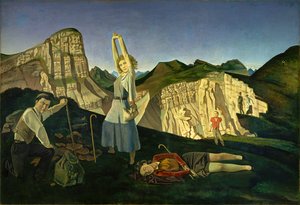
      The Mountain autorstwa Balthus

      The Mountain is a large-scale oil painting by Balthus. The artist, born in Paris, France, in 1908, created this work during a period of significant development in his…

      Figure in Front of a Mantel (1955) autorstwa Balthus

      In the quietude of mid-century modernism, Balthus captures a moment that feels both profoundly ordinary and hauntingly eternal. Figure in Front of a Mantel invites the viewer into…

      Self-Portrait (detail) (1940) autorstwa Balthus

      In the painting Self-Portrait (detail) by Balthus, the artist Balthus presents himself in a three-quarter view. He is positioned against a dark and indistinct background that lacks specific…

      The Cat in the Mirror (1988) autorstwa Balthus

      The Cat in the Mirror is an oil on canvas work by the artist Balthus. Executed in 1990, the piece is categorized within the Expressionism style. The composition…

      Patience (1955) autorstwa Balthus
      #23

      Patience

      1955

      We are looking at Patience, a work by Balthus. Created about 1955, this piece belongs to a period in the artist's career marked by a deep sense of…

      Getting Up (1977) autorstwa Balthus
      #24

      Getting Up

      1977

      In this 1977 painting, a woman is depicted sitting on a bed with her legs spread open. The scene is characterized by an intimate and relaxed atmosphere. Beside…

      Terese Dreaming autorstwa Balthus

      In Terese Dreaming, Balthus presents a quiet, interior moment that has long occupied the center of his artistic focus. Created in 1938, the work captures the eleven-year-old Thérèse…

      Window (1933) autorstwa Balthus
      #26

      Window

      1933

      In this oil on canvas, Balthus presents Window, a work dating from about 1933. The painting captures a young woman positioned within an urban setting, seated upon a…

      Landscape Champrovent (1942) autorstwa Balthus

      Landscape Champrovent is a work by Balthus, executed about 1942. The composition centers on a rural valley, where a reclining figure rests upon a grassy slope in the…

      The victim (1939) autorstwa Balthus
      #28

      The victim

      1939

      In "The victim" by Balthus, the composition is defined by a profound sense of stillness. The subject occupies most of the frame, lying diagonally across the space in…

      The heyday (1945) autorstwa Balthus
      #29

      The heyday

      1945

      In The heyday by Balthus, the composition anchors itself upon a single, central figure. A young woman reclines within the embrace of an armchair, positioned near the hearth.…

      Reclining Nude (1945) autorstwa Balthus
      #30

      Reclining Nude

      1945

      In Reclining Nude by Balthus, the composition is structured around a diagonal arrangement. The female form occupies the majority of the frame, positioned from the left toward the…

      The Cat (detail) (1949) autorstwa Balthus
      #31

      The Cat (detail)

      1949

      The Cat (detail) is a cropped segment from a larger composition titled 'The Cat' by the artist Balthus. Created in 1949, this specific detail focuses on a feline…

      The toilet (1957) autorstwa Balthus
      #32

      The toilet

      1957

      The scene unfolds within a private interior, where the viewer finds themselves a witness to a quiet, solitary moment. In this 1957 work, titled The Toilet, the artist…

      Coffee Cup (1959) autorstwa Balthus
      #33

      Coffee Cup

      1959

      The artwork titled Coffee Cup by Balthus presents a domestic interior scene. The central subject is a young woman positioned in a state of repose. She occupies a…

      Girl preparing for the bath (blue cloth) (1958) autorstwa Balthus

      We are looking at Girl preparing for the bath (blue cloth), a work by Balthus. This piece was painted about 1958, a period that reflects the artist's continued…

      The moth (1959) autorstwa Balthus
      #35

      The moth

      1959

      The moth is a work by Balthus. It is a painting of a female nude. The artist captured this figure in 1960. A quiet stillness settles over the…

      The Three Sisters (1964) autorstwa Balthus

      In the quietude of a private interior, The Three Sisters unfolds as a scene of stillness. The artist, Balthus, captures three young women caught in a moment of…

      Katia asleep (1969) autorstwa Balthus
      #37

      Katia asleep

      1969

      The scene unfolds in a quiet, private moment with the artwork titled Katia asleep. Created by the artist Balthus, this piece captures a young girl lost in sleep.…

      Study for the painting ''Nude Resting'' (1972) autorstwa Balthus

      The work titled Study for the painting ''Nude Resting'' is a graphite drawing by Balthus. Created about 1972, this piece exists as a preparatory study for a larger…

      Bare rest (1977) autorstwa Balthus
      #39

      Bare rest

      1977

      In the quietude of a private interior, the figure of a woman in repose occupies the center of Bare rest. This work, painted by Balthus, captures a moment…

      Waiting (1995) autorstwa Balthus
      #40

      Waiting

      1995

      We are looking at Waiting, a work produced by Balthus around 1995. This piece emerged from the later period of an artist who spent his life navigating the…

      Still Life with Lamp (1958) autorstwa Balthus

      To gaze upon this depiction, Still Life with Lamp, is to step into a moment suspended in amber—a quiet drama played out across the canvas. Balthus, ever the…

      Study for Girl with a window autorstwa Balthus

      Study for Girl with a window is a preparatory work by the French artist Balthus. This sketch functions as a study of a girl positioned near a window,…

      The enthronement of Ogier autorstwa Balthus

      The enthronement of Ogier is a work by Balthus. The artist, born in Paris, France, in 1908, maintained a presence in the twentieth-century art world until his death…

      Lucrecia y Tarquino autorstwa Balthus

      The painting Lucrecia y Tarquino emerges from the brush of Balthus, a Polish-French modern artist whose presence in the art world remains deeply felt. Born in Paris, France,…

      Nude with Cat (1949) autorstwa Balthus
      #51

      Nude with Cat

      1949

      To stand before Balthus’s Nude with Cat is to step into a meticulously constructed dreamscape, one steeped in the quiet melancholy and profound stillness characteristic of his genius.…

      The Cat in the Mirror (1990) autorstwa Balthus

      To stand before Balthus’s The Cat in the Mirror is not merely to observe a painting; it is to step through a veil into a meticulously constructed, dreamlike…

      Drawing room (1942) autorstwa Balthus
      #53

      Drawing room

      1942

      The Expressionism movement has given birth to some of the most thought-provoking and visually stunning works of art in history. One such masterpiece is the "Drawing Room" by…

      Płótna Balthus epoka po epoce

      Co najczęściej malował Balthus

      Cztery tematy najczęściej pojawiające się na tych płótnach, z których każdy wraz z jego najbardziej cenionym przykładem.

      Gdzie wiszą płótna Balthus

      Muzeum, w którym znajduje się najwięcej obrazów prezentowanych na tej stronie.

      Muzea Miasto Dzieła artysty Balthus Obrazy z tej listy
      Art Institute of Chicago, ChicagoArt Institute of Chicago Chicago 1 Dziewczyna z kotem

      Najukochańsze płótno Balthus z każdej dekady

      1. 1920s
      2. 1930s
        Ulica (1933) autorstwa Balthus
        Miejsce 1 z 100

        Ulica

        Wiek 22 – 31

        Balthus i „Ulica” – Klasyka z Szczytkiem Surrealizmu „Ulica” Balthusa powstała w roku 1933 i stanowi fascynujące połączenie realizmu z delikatną surrealistyczną estetyką. Jest to monumentalna kompozycja (195…

      3. 1940s
        The Cat in the Mediterranean (1949) autorstwa Balthus
        9 z 100

        The Cat in the Mediterranean

        Wiek 32 – 41

        The Cat in the Mediterranean is a work by Balthus. Created in 1949, this oil on canvas presents a stage-like interior that feels like a dream. It is…

      4. 1950s
        Girl at the window (1955) autorstwa Balthus
        Miejsce 7 z 100

        Girl at the window

        Wiek 42 – 51

        In this 1957 portrait, we find ourselves in a room defined by a profound sense of stillness. A woman sits in a chair, her gaze directed toward the…

      5. 1960s
        The Three Sisters (1964) autorstwa Balthus
        Miejsce 36 z 100

        The Three Sisters

        Wiek 52 – 61

        In the quietude of a private interior, The Three Sisters unfolds as a scene of stillness. The artist, Balthus, captures three young women caught in a moment of…

      6. 1970s
        Nude at Rest (1977) autorstwa Balthus
        18 z 100

        Nude at Rest

        Wiek 62 – 71

        To stand before Balthus’s Nude at Rest is to enter a space suspended between wakefulness and dream. The composition centers on a figure seated in an armchair, enveloped…

      7. 1980s
        Naked in the mirror (1981) autorstwa Balthus
        14 z 100

        Naked in the mirror

        Wiek 72 – 81

        A woman stands with her back to the viewer, her skin rendered in pale tones against the surrounding environment. She is positioned before a mirror, her body unclothed.…

      8. 1990s
        Waiting (1995) autorstwa Balthus
        Płótno 40 z 100

        Waiting

        Wiek 82 – 91

        We are looking at Waiting, a work produced by Balthus around 1995. This piece emerged from the later period of an artist who spent his life navigating the…

      O płótnach Balthus: odpowiedzi na Twoje pytania

      Jakie jest najsłynniejsze dzieło Balthus?Przeczytaj odpowiedź

      Ulica (1933), a następnie Dziewczyna z kotem (1937) i The Guitar Lesson (1934).

      W jakim wieku był Balthus, gdy namalowano Ulica?Przeczytaj odpowiedź

      Balthus, urodzony/a w 1908, miał/a 25 lat: Ulica pochodzi z 1933.

      Jakie są 10 najsłynniejszych obrazów autorstwa Balthus?Przeczytaj odpowiedź

      Ulica, Dziewczyna z kotem, The Guitar Lesson, La Patience (Solitaire), Study to ''Guitar lesson'', Guitar lesson, Girl at the window, The King of the Cats, The Cat in the Mediterranean i Le passage du Commerce Saint-Andre Private. Każde płótno w powyższym rankingu zawiera informację o roku powstania oraz muzeum.

      Ile dzieł namalował Balthus?Przeczytaj odpowiedź

      W naszym katalogu znajduje się 200 dzieł artysty Balthus, datowanych od 1926 do 1995.

      Gdzie mogę zobaczyć najsłynniejsze płótna Balthus?Przeczytaj odpowiedź

      Większość znajduje się w Art Institute of Chicago (Chicago); powyższa lista wymienia każde muzeum oraz jego płótna.

      Kiedy Balthus namalował swoje najbardziej uwielbiane płótna?Przeczytaj odpowiedź

      W 1930s, który obejmuje 21 z 100 dzieł na tej stronie, wśród nich znajduje się Ulica.

      Które z najsłynniejszych płócien Balthus powstały na początku i na końcu jego twórczości?Przeczytaj odpowiedź

      Najwcześniejsze płótno pochodzi z The First Communicants (1926), a najpóźniejsze z Waiting (1995).

      Co najczęściej malował Balthus?Przeczytaj odpowiedź

      Woman (21), Chair (10) i People (10), w ramach 100 dzieł na tej stronie.

      W jakiej technice najczęściej malował Balthus?Przeczytaj odpowiedź

      Oil On Canvas, użyte w 35 z 100 dzieł na tej stronie.

      Do jakiego nurtu należy obraz Balthus?Przeczytaj odpowiedź

      Symbolism, co pokazują płótna na tej stronie.

      Balthus: życie w malarstwie

      A World Apart: The Enigmatic Vision of Balthus

      Balthasar Klossowski de Rola, universally known as Balthus, remains one of the most compelling and controversial figures in 20th-century art. Born in Paris on February 29, 1908, into a family steeped in intellectual and artistic circles, his life was marked by an early immersion in culture and a deliberate rejection of prevailing artistic trends. His father, Erich Klossowski, was a respected art historian, while his mother, Baladine Klossowska, was a painter herself, fostering an environment where aesthetic contemplation was not merely encouraged but lived. This upbringing instilled in the young Balthus a deep reverence for the Old Masters and a skepticism towards the burgeoning avant-garde movements that dominated the Parisian scene. He wasn’t interested in breaking with tradition; rather, he sought to revitalize classical forms with a distinctly modern sensibility, creating a world uniquely his own—a world often unsettling, always captivating.

      Formative Years and Artistic Awakening

      Balthus's early life was nomadic, disrupted by the outbreak of World War I and his parents’ subsequent separation. These experiences instilled in him a sense of displacement and introspection that would profoundly influence his artistic vision. He began drawing at a remarkably young age, demonstrating an exceptional talent for capturing form and atmosphere. Mentored by Rainer Maria Rilke during his mother's relationship with the poet, Balthus received encouragement to pursue his artistic inclinations. This period was crucial in shaping his aesthetic sensibilities; Rilke’s poetic explorations of inner life resonated deeply with the young artist, fostering a fascination with psychological depth and symbolic resonance. He absorbed influences from diverse sources—pre-Renaissance Italian painters like Piero della Francesca and Simone Martini, as well as literary figures such as Emily Brontë and Lewis Carroll—creating a unique artistic language that defied easy categorization. His early works already hinted at the themes that would define his career: adolescence, solitude, and the complex interplay between innocence and desire. The influence of Rilke’s melancholic beauty is particularly evident in Balthus's early landscapes, which possess a haunting stillness and an almost unbearable sense of longing.

      Controversy and Recognition

      Balthus first exhibited publicly in 1934, presenting a body of work that immediately sparked controversy. Paintings like *The Guitar Lesson*, with its ambiguous depiction of a young girl receiving instruction from an older man, ignited debate about the artist’s intentions and the nature of his gaze. Critics were divided, some condemning the perceived eroticism while others praised the painting's psychological complexity and technical mastery. The subject matter itself – a seemingly innocent scene imbued with a subtle undercurrent of tension – became a focal point of discussion. This controversy, however, only served to solidify Balthus’s reputation as a provocative and unconventional artist. He deliberately cultivated an air of mystery around himself, resisting attempts at biographical interpretation and insisting that his paintings should be experienced directly, without the filter of external commentary. Throughout the 1930s and 40s, he continued to develop his distinctive style, characterized by elongated figures, dramatic lighting, and a meticulous attention to detail. His compositions often featured young girls in states of reverie or contemplation, their poses both graceful and unsettling. The paintings were not simply portraits; they were explorations of mood, memory, and the unspoken anxieties of youth.

      A Legacy of Introspection and Influence

      Despite remaining somewhat aloof from the mainstream art world, Balthus achieved significant recognition during his lifetime. He held major exhibitions at the Museum of Modern Art in New York (1956) and throughout Europe, solidifying his position as a leading figure in 20th-century painting. In 1977, he was appointed director of the Académie de France in Rome, a prestigious post that further cemented his status within the artistic establishment. His influence can be seen in the work of numerous contemporary artists, including Jan Saudek, Will Barnet, Duane Michals, and John Currin, who share his interest in figurative painting, psychological realism, and the exploration of complex emotional states. Balthus’s enduring appeal lies not only in his technical virtuosity but also in his ability to tap into universal human experiences—the longing for connection, the fear of isolation, and the search for meaning in a chaotic world. His work continues to be studied and debated, revealing new layers of complexity with each viewing.

      Key Works and Enduring Themes

      Throughout his career, Balthus consistently returned to certain motifs and themes. *La Rue* (1933) exemplifies his early mastery of composition and atmosphere, depicting a street scene with an unsettling sense of isolation. *The Mountain* (1937), a monumental work featuring two adolescent girls in a stark landscape, embodies the artist’s fascination with youth and solitude. Later works, such as *Girl at a Window* (1957) – famously featured in François Truffaut's film Domicile Conjugal – showcase his ability to capture fleeting moments of introspection and vulnerability. His paintings are often characterized by a sense of stillness and silence, inviting viewers to contemplate the inner lives of his subjects. He was also deeply influenced by music, particularly the works of Wolfgang Amadeus Mozart, which he believed reflected the same balance between order and emotion that he sought to achieve in his art. Balthus’s enduring appeal lies not only in his technical skill but also in his ability to create images that resonate with a profound sense of mystery and emotional depth. His paintings are not merely representations; they are windows into a world of dreams, anxieties, and unspoken desires—a testament to the enduring power of art to challenge our perceptions and illuminate the hidden corners of the human soul.