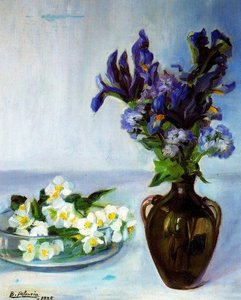
Benjamin Palencia stands as a luminous figure in the tapestry of Spanish art, a painter whose brush captured not just the terrain of Castile, but its very soul. Emerging from the profound spirit of the ‘98 Generation, his work represents a departure from the rigid constraints of academic formalism, seeking instead a deep, spiritual engagement with the rural landscape. His canvases are more than mere depictions; they are echoes of a land defined by its serene beauty and quiet intensity. Through a masterful command of watercolor, Palencia achieved a sense of atmosphere that feels almost tactile, where cool blues and soft light converge to invite the viewer into a state of profound contemplation.
A Journey Through Tradition and Modernity
The foundations of Palencia’s distinctive style were laid amidst the hallowed halls of the Prado Museum. As a young man in Madrid, he found profound inspiration in the works of masters like Diego Velázquez and El Greco, meticulously copying their techniques to understand the secrets of light and form. This deep reverence for tradition did not tether him to the past; rather, it provided the technical scaffolding upon which he built his modern vision. His artistic orbit expanded as he befriended luminaries such as Salvador Dalí and Pancho Gutiérrez Cossío, eventually venturing to Paris to immerse himself in the burgeoning avant-garde movements of Europe. This period of international exposure refined his ability to blend classical draughtsmanship with a contemporary, expressive energy.
The Vanguard of the Vallecas School
In the early decades of the twentieth century, Palencia became a central architect of a new artistic consciousness in Spain. Alongside the sculptor Alberto Sánchez, he co-founded the Vallecas School, a movement that sought to revitalize Spanish art by embracing spontaneity and emotional depth. This school rejected the stale structures of Neoclassicism in favor of a more visceral, gestural approach. Palencia’s contributions to this movement are characterized by:
A focus on the spontaneous gesture that mirrors the dynamism of life.
The use of expressive brushwork to convey internal landscapes as much as external ones.
An emphasis on emotional intensity over precise, photographic representation.
His work during this era, such as the evocative Untitled (200), captures religious processions and rural life with a vibrancy that feels both timeless and revolutionary.
A Lasting Legacy of Light and Color
The enduring significance of Benjamin Palencia lies in his ability to transform the ephemeral qualities of light into permanent artistic truths. His mastery of watercolor allowed him to layer and blend pigments to create a luminous, breathing quality within his landscapes. Whether capturing the focused intensity of an artist in Untitled (379) or the quiet domesticity of a still life in Untitled (945), Palencia’s oeuvre remains a testament to the power of the impressionistic spirit. He left behind a legacy that bridged the gap between the classical heritage of Spain and the modern necessity for emotional expression, ensuring that the essence of the Castilian landscape would continue to resonate through the ages.
Zespół Redakcyjny TopImpressionists.com
Mały quiz
Do każdego pytania dotyczy tylko jedna poprawna odpowiedź.
21st century Spanish painters like Águeda Isabel Ruiz de la Prada y Sentmenat, Javier Pérez González, and Isaac Cordal are featured at TopImpressionists.com.
Jak znaleźć wszystkie dzieła Benjamin Palencia wykonane w danej technice?
Aby znaleźć wszystkie dzieła artysty Benjamin Palencia wykonane w danej technice, odwiedź stronę Wszystkie techniki.
Gdzie mogę zobaczyć dzieła Benjamin Palencia w porządku chronologicznym?
Dzieła Benjamin Palencia można obejrzeć w porządku chronologicznym na stronie Chronologia dzieł artysty.
Gdzie można zobaczyć wszystkie dzieła Benjamin Palencia?
Wszystkie dzieła Benjamin Palencia dostępne w niniejsza strona można przeglądać na stronie Wszystkie dzieła artysty.
Czy istnieje zestawienie wszystkich tematów, które malował Benjamin Palencia?
Strona Atlas tematów prezentuje dzieła Benjamin Palencia pogrupowane według tematów.
Do jakiej epoki należał/a Benjamin Palencia?
Benjamin Palencia tworzył w okresie Modern. Epoka ta osadza twórczość artysty w kontekście historycznym.
Jak zmieniała się twórczość Benjamin Palencia na przestrzeni lat?
Kariera Benjamin Palencia rozwija się etap po etapie na stronie Osiągnięcia artystyczne: jako pozioma oś czasu dzieł, pogrupowanych w rozdziały odpowiadające poszczególnym okresom twórczości.
Gdzie i w którym roku urodził(a) się Benjamin Palencia?
Benjamin Palencia urodził się w Barrax w 1894 roku.
Gdzie mogę zobaczyć dzieła Benjamin Palencia w wirtualnej galerii 3D?
Dzieła Benjamin Palencia można podziwiać w galerii 3D na stronie Wirtualna Galeria 3D artysty.
Ile dzieł Benjamin Palencia można przejrzeć w katalogu?
Możesz przeglądać 43 dzieł sztuki dzieł autorstwa Benjamin Palencia na stronie Wszystkie dzieła.