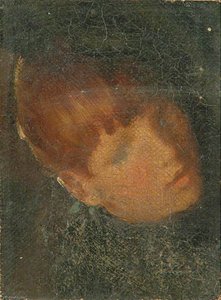
HRH Arthur (1850–1943), Duke of Connaught, President of the Royal Academy of Music (1901–1942) (copy after Philip Alexius de László)
Mary
Louis Ginnett (1875–1946): A Quiet Master of Victorian Domesticity
Louis Ginnett was born in Brighton, England, on July 24th, 1875, into a family steeped in artistic tradition. His father, William Ginnett, was a sculptor and instilled in Louis a lifelong appreciation for craftsmanship and observation—skills that would prove crucial to his burgeoning career as a painter. While biographical details remain somewhat sparse, Ginnett’s formative years were spent absorbing the aesthetic sensibilities of Victorian England, an era characterized by meticulous detail and a fascination with capturing everyday life.
Early Training & Influences: Ginnett's artistic education began at the École Supérieure des Beaux-Arts in Paris, where he honed his skills under the tutelage of Jean Le Bret and Henri Matisse. This exposure to Impressionism and Fauvism undoubtedly broadened his artistic horizons and encouraged him to experiment with bolder color palettes—though Ginnett ultimately favored a more restrained approach.
Academic Recognition & Return to Brighton: He graduated from the École Julian in Paris, securing prestigious honors and establishing himself as a respected artist within the Parisian avant-garde. However, Ginnett’s heart remained firmly rooted in his hometown of Brighton, where he established a prolific studio and dedicated himself to teaching at the Brighton School of Art from 1909 until his retirement in 1939.
A Painter of Interiors & Domestic Scenes
Ginnett’s artistic style is instantly recognizable for its serene beauty and remarkable accuracy. He excelled particularly in portraying interiors—drawing rooms, bedrooms, kitchens—with an astonishing level of realism that captured the subtle nuances of light and texture. Unlike many artists of his time who sought grand narratives or dramatic compositions, Ginnett focused on capturing the quiet dignity of domestic life, presenting scenes of ordinary people engaged in commonplace activities with remarkable sensitivity. His canvases are imbued with a palpable sense of atmosphere—a feeling for the warmth of hearth fires, the dappled sunlight filtering through curtains, and the comforting familiarity of familiar surroundings.
Technique & Materials: Ginnett employed meticulous brushwork and layered glazes to achieve his signature effect – achieving luminous surfaces that seemed to emanate from within. He favored oil paints on canvas, meticulously blending colors to create harmonious tonal relationships and capturing the subtle gradations of light with exceptional precision.
Notable Works: Among his most celebrated paintings are “The Drawing Room,” “Mrs. Arthur Finch’s Bedroom” and "Still Life with Fruit," each demonstrating Ginnett's mastery of technique and his profound understanding of visual perception. These works reside in the permanent collections of Brighton Museum & Art Gallery and Imperial War Museum, testament to their enduring artistic merit.
War Artist & Patronage
Ginnett’s involvement with the First World War extended beyond mere observation; he actively participated as a war artist, documenting the realities of trench warfare for the British War Office. His depictions of soldiers and landscapes conveyed both solemn dignity and poignant empathy—reflecting Ginnett's humanist sensibilities. He was awarded an MBE (Member of the Order of the British Empire) for his service during the conflict. Furthermore, Ginnett’s artistic reputation garnered him considerable patronage from wealthy benefactors who recognized his talent and supported his creative endeavors.
Legacy & Recognition
Louis Ginnett died peacefully in Brighton in 1946, leaving behind a legacy of exquisitely rendered paintings that continue to inspire admiration for their understated elegance and profound psychological insight. He served as President of the Royal Society of Portrait Painters from 1939 until his death, upholding the highest standards of artistic excellence and ensuring that his work would be remembered for generations to come. His enduring influence can be seen in the continuing appreciation for Victorian domestic interiors and the meticulous observation of everyday life—a testament to Ginnett’s singular vision as a painter.
Zespół Redakcyjny TopImpressionists.com
Mały quiz
Do każdego pytania dotyczy tylko jedna poprawna odpowiedź.
Pytanie 1:
What artistic movement is Louis Ginnett primarily associated with?
Pytanie 2:
Where did Louis Ginnett receive his initial artistic training?
Pytanie 3:
During which significant historical event did Louis Ginnett contribute as a war artist?
Pytanie 4:
What institution honored Louis Ginnett with the presidency role?
Pytanie 5:
Which museum houses a notable collection of Louis Ginnett’s artworks?
Czy mogę przeglądać dzieła Louis Ginnett według techniki wykonania?
Aby znaleźć wszystkie dzieła artysty Louis Ginnett wykonane w danej technice, odwiedź stronę Wszystkie techniki.
Jak mogę znaleźć dzieła artysty Louis Ginnett w konkretnej palecie barw?
Prace artysty Louis Ginnett można przeglądać według palety kolorystycznej na stronie Według palet kolorystycznych artysty.
Czy istnieje zestawienie wszystkich tematów, które malował Louis Ginnett?
Strona Atlas tematów prezentuje dzieła Louis Ginnett pogrupowane według tematów.
Które dzieła Louis Ginnett są najczęściej oglądane?
Dla artysty Louis Ginnett dostępna jest strona Statystyki odwiedzin, która prezentuje statystyki dotyczące jego dzieł w serwisie niniejsza strona.
Gdzie można znaleźć dzieła Louis Ginnett pogrupowane według słów kluczowych?
Dzieła artysty Louis Ginnett można przeglądać według słów kluczowych na stronie Według słów kluczowych. Każde słowo kluczowe grupuje powiązane ze sobą dzieła.
Jak zmieniała się twórczość Louis Ginnett na przestrzeni lat?
Kariera Louis Ginnett rozwija się etap po etapie na stronie Osiągnięcia artystyczne: jako pozioma oś czasu dzieł, pogrupowanych w rozdziały odpowiadające poszczególnym okresom twórczości.
Czy mogę przeglądać dzieła Louis Ginnett według kolorów?
Indeks kolorystyczny artysty Louis Ginnett to strona, która porządkuje jego dzieła według kolorów.
Czy mogę przeanalizować sposób użycia koloru przez Louis Ginnett we wszystkich jego/jej dziełach?
Genom Palety artysty Louis Ginnett to strona prezentująca profil kolorystyczny całego dorobku twórczego tego artysty.