Early Life and Artistic Beginnings
Sanford Robinson Gifford, a name synonymous with the serene beauty of American landscapes, was born on July 10th, 1823, in Greenfield, New York – a small town nestled amidst the rolling hills of Saratoga County. His early life was deeply intertwined with the rhythms of rural existence; his father, a successful iron foundry owner and bank director, provided a stable environment that fostered Gifford’s burgeoning artistic inclinations. Unlike many artists of his time who hailed from established families of wealth and privilege, Gifford's exposure to art began somewhat unexpectedly – through his elder brother, Charles, an avid collector of prints, particularly those by the renowned British watercolorist, John Rubens Smith. This early introduction sparked a lifelong fascination with capturing the essence of nature on canvas. Following in Charles’ footsteps, Gifford sought instruction from Smith himself, immersing himself in the fundamentals of drawing and perspective – skills considered essential for any aspiring artist. He also attended classes at the National Academy of Design in New York City, further honing his technical abilities and absorbing the prevailing artistic trends of the era.The Influence of the Hudson River School
Gifford’s artistic journey was profoundly shaped by the burgeoning movement known as the Hudson River School. This group of American landscape painters, including Thomas Cole, Frederic Church, and Albert Bierstadt, sought to depict the majestic beauty of the American wilderness with a romantic sensibility. Inspired by Cole's pioneering work – particularly his evocative scenes of the Catskill Mountains – Gifford abandoned his initial focus on portraiture and embraced the challenge of translating the grandeur of nature onto canvas. He was captivated by the School’s emphasis on capturing light, atmosphere, and the sublime qualities of the natural world. Unlike some of his contemporaries who incorporated elements of European Romanticism, Gifford deliberately sought to create a distinctly American landscape style – one that celebrated the unique character of the United States.European Travels and Artistic Transformation
In 1855, at the age of thirty-two, Gifford embarked on a transformative journey to Europe, a period that would fundamentally alter his artistic vision. He spent over two years traversing the continent, immersing himself in the art and culture of England, Scotland, France, Belgium, Holland, and Germany. This extensive travel experience proved pivotal in shaping his distinctive Luminist style. He was particularly influenced by J.M.W. Turner, the celebrated English Romantic painter known for his atmospheric landscapes and masterful use of light. Gifford meticulously studied Turner’s techniques, absorbing his innovative approach to color, composition, and brushwork. His time in Italy proved equally enriching, allowing him to observe firsthand the classical ruins and dramatic landscapes that had inspired generations of artists. These experiences broadened his artistic horizons and provided him with a new perspective on the relationship between humanity and nature.A Distinctive Luminist Style and Notable Works
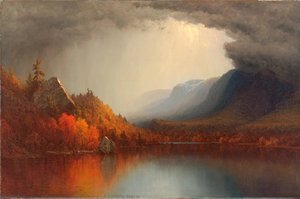
Upon his return to America in 1857, Gifford established a studio in New York City, where he began to develop his signature Luminist style – characterized by its soft, diffused light, subtle atmospheric effects, and delicate brushwork. He eschewed bold colors and dramatic contrasts, instead favoring a muted palette and an emphasis on capturing the ephemeral qualities of light and shadow. Gifford’s landscapes often depicted serene scenes of mountains, valleys, and forests, evoking a sense of tranquility and contemplation. Among his most celebrated works are *Tivoli* (1868), currently housed in the Metropolitan Museum of Art, and *Mount Mansfield* (1858), which was exhibited at the National Academy of Design. These paintings exemplify Gifford’s mastery of light and atmosphere, capturing the essence of the American wilderness with remarkable sensitivity and grace.Legacy and Historical Significance
Sanford Robinson Gifford died in New York City on August 29th, 1880, leaving behind a legacy as one of the most important landscape painters of the Hudson River School. His work continues to resonate with viewers today, offering a glimpse into the beauty and serenity of the American wilderness. Gifford’s contributions to American art are undeniable, and his paintings can be found in numerous museums across the country. He is remembered not only for his technical skill but also for his ability to capture the spirit of the American landscape – its vastness, its tranquility, and its enduring appeal. His legacy endures as a testament to the power of observation, imagination, and artistic vision.Pytania i odpowiedzi
Jak znaleźć wszystkie dzieła Sanford Robinson Gifford wykonane w danej technice?
Aby znaleźć wszystkie dzieła artysty Sanford Robinson Gifford wykonane w danej technice, odwiedź stronę Wszystkie techniki.
Gdzie można znaleźć dzieła Sanford Robinson Gifford pogrupowane według nurtów artystycznych?
Nurty, w których tworzył/a Sanford Robinson Gifford, można zobaczyć na stronie Wszystkie nurty artystyczne artysty, gdzie dzieła są pogrupowane według nurtów.
Czy istnieje zestawienie wszystkich tematów, które malował Sanford Robinson Gifford?
Atlas tematów artysty Sanford Robinson Gifford to strona, która grupuje dzieła artysty według ich tematyki.