Pracownia — Bezpłatna wysyłka na cały świat — Czas dostawy: 2–6 tygodni
      Charles Edward Conder, 1868 – 1909

      Charles Edward Conder: 100 najsłynniejszych obrazów

      Spośród wszystkich obrazów Charles Edward Conder, najbardziej znanym jest Colombo (1890); znajduje się on w National Gallery of Victoria w Melbourne. Tuż za nimi plasują się Rickett's Point (1890) oraz A Shady Hollow by a Dusty Road (also known as Pugh's Lagoon or A Cove on the Hawkesbury) (1887). Spośród 100 dzieł Charles Edward Conder w naszym katalogu, tych 100 jest najbardziej znanych – każde z nich zostało przedstawione wraz z datą powstania, muzeum oraz historią.

      Ranking oparty na naszym wskaźniku popularności, który łączy liczbę wyszukiwań, wizyt oraz zamówień dla każdego dzieła. Aktualizacja: Październik 2026. Każdy obraz na tej stronie można zamówić jako ręcznie malowaną reprodukcję olejną na płótnie lnianym lub jako wysokiej jakości wydruk artystyczny, wykonany w wybranym przez Ciebie formacie.

      Portret Charles Edward Conder
      Charles Edward Conder · 1868 – 1909
      Urodzony · zmarł
      1868 – 1909, Tottenham
      Nurt
      Impressionism
      Dzieła w naszym katalogu
      100
      Najsłynniejsze
      Colombo (1890)
      Najwięcej dzieł w
      National Gallery of Victoria

      10 najsłynniejszych obrazów artysty Charles Edward Conder

      Colombo (1890) autorstwa Charles Edward Conder
      1

      Colombo

      1890 · Oil On Panel · National Gallery of Victoria, Melbourne

      The Heidelberg School emerged during a period of significant artistic experimentation in Australia. Influenced by Impressionism originating in France, artists like Conder sought to depict the Australian landscape with unprecedented sensitivity and immediacy. This movement challenged academic conventions and championed plein air painting—working outdoors directly from nature—a radical departure from studio practice at the time.

      Rickett's Point (1890) autorstwa Charles Edward Conder
      2

      Rickett's Point

      1890 · Akryl na płótnie · National Gallery of Victoria, Melbourne

      Rickett's Point – Odysemia Australijskiej Malarstwa Heidelbergzkiego Rickett’s Point, namalowany przez Charlesa Edwarda Condera w roku 1890, stanowi jeden z najbardziej rozpoznawalnych obrazów reprezentujących ducha australijskiego malarstwa Heidelbergzkiego. Jest to impresjonistyczna scena plażowa, która uchwyciła piękno australijskiej przyrody i atmosferę spokoju oraz radości życia na łonie morza – elementy charakterystyczne dla tego okresu artystycznego. Obraz przedstawia grupę ludzi wypoczywających nad wodą, otoczonych przez ciepłe promienie słońca i delikatną bryzę morską.…

      A Shady Hollow by a Dusty Road (also known as Pugh's Lagoon or A Cove on the Hawkesbury) (1887) autorstwa Charles Edward Conder
      3

      A Shady Hollow by a Dusty Road (also known as Pugh's Lagoon or A Cove on the Hawkesbury)

      1887 · National Gallery of Victoria, Melbourne

      In the delicate brushstrokes of Charles Edward Conder’s 1887 masterpiece, A Shady Hollow by a Dusty Road, we are invited to step into a moment of profound tranquility. This evocative landscape, also known as Pugh's Lagoon, captures more than just a geographical location; it captures a feeling of suspended time. The scene unfolds along a sun-drenched shoreline where the gentle rhythm of the water meets the soft textures of the…

      On the River Yarra near Heidelberg, Victoria (1890) autorstwa Charles Edward Conder
      4

      On the River Yarra near Heidelberg, Victoria

      1890 · Oil On Canvas · Art Gallery of New South Wales, Sydney

      In the gentle light of 1890, Charles Edward Conder captured a moment of profound tranquility in his masterpiece, On the River Yarra near Heidelberg, Victoria. This evocative oil on canvas serves as more than just a landscape; it is a window into the soul of the Australian countryside during a pivotal era of artistic discovery. The scene unfolds along the banks of the Yarra River, where the water rests in…

      The Moulin Rouge (1890) autorstwa Charles Edward Conder
      5

      The Moulin Rouge

      1890 · Oil On Canvas · Manchester Art Gallery, Manchester

      In the heart of late Victorian Paris, amidst the bohemian pulse of the Pigalle district, Charles Edward Conder captured a fleeting moment of pure, unadulterated joy. The Moulin Rouge is not merely a painting of a cabaret; it is an immersive descent into the vibrant energy of the Belle Époque. Through his masterful lens, the canvas breathes with the spirit of a society indulging in its most exuberant pleasures. The…

      Night in the Garden in Spain (1895) autorstwa Charles Edward Conder
      7

      Night in the Garden in Spain

      1895 · Oil On Canvas

      Night in the Garden in Spain is an oil on canvas painted by Charles Conder. The work emerged in 1895, capturing a specific moment of evening light and shadow. It remains part of the permanent collection at the Art Gallery of Western Australia in Perth, Australia.

      Dieppe (1895) autorstwa Charles Edward Conder
      8

      Dieppe

      1895 · Oil On Canvas · Manchester Art Gallery, Manchester

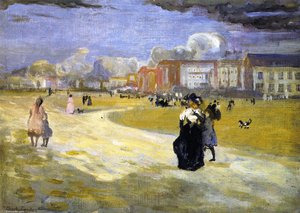
      Charles Edward Conder’s “Dieppe,” painted in 1895, isn't merely a depiction of a coastal scene; it’s an immersion into a fleeting moment of tranquility and observation. The canvas breathes with the muted palette of a late afternoon – a symphony of blues deepening towards the horizon, punctuated by the warm ochres and yellows of the sand and distant buildings. The composition immediately draws the eye along a gentle diagonal path…

      The Farm, Richmond, New South Wales (1888) autorstwa Charles Edward Conder
      9

      The Farm, Richmond, New South Wales

      1888 · Oil On Canvas · National Gallery of Victoria, Melbourne

      To gaze upon Charles Edward Conder's "The Farm, Richmond, New South Wales" is to step through a veil of time directly into the sun-drenched heart of colonial Australian life. Painted in 1888, this oil on canvas is far more than a mere depiction of rural scenery; it is an evocative meditation on peace, community, and the enduring rhythm of agricultural existence. Conder masterfully captures a moment suspended in amber—a tableau…

      Obrazy artysty Charles Edward Conder od miejsca 11 do 100

      Sketch Portrait (1889) autorstwa Charles Edward Conder
      #24

      Sketch Portrait

      1889 · National Gallery of Victoria

      In the delicate dance between light and shadow, Charles Edward Conder’s Sketch Portrait emerges as a captivating study of elegance and poise. Painted in 1889, this evocative work…

      Zamów ręczne malowanie →
      William Orpen (1900) autorstwa Charles Edward Conder
      #26

      William Orpen

      1900 · National Gallery of Ireland

      The air in the studio feels heavy with the scent of oil and the weight of a silent gaze. A man sits before us, his dark hair framing…

      Zamów ręczne malowanie →
      MIrage (1889) autorstwa Charles Edward Conder
      #30

      MIrage

      1889 · National Gallery of Victoria

      Charles Edward Conder's "Mirage," painted in 1889, isn’t merely a depiction of a landscape; it’s an invitation into a realm where reality subtly bends, inviting contemplation on the…

      Zamów ręczne malowanie →
      Springime (1892) autorstwa Charles Edward Conder
      #31

      Springime

      1892 · Tate Gallery

      Charles Edward Conder's "Springime," painted in 1892, isn’t merely a depiction of springtime; it’s an immersion into the very essence of renewal. This oil on canvas, currently residing…

      Zamów ręczne malowanie →
      Swnage (1900) autorstwa Charles Edward Conder
      #33

      Swnage

      1900 · Tate Gallery

      “Swnage,” painted by Charles Edward Conder in approximately 1901, isn't merely a depiction of a beach scene; it’s an immersive experience of the Australian coastline captured with Impressionistic…

      Zamów ręczne malowanie →
      Czas Kawowy (1888) autorstwa Charles Edward Conder
      #50

      Czas Kawowy

      1888 · Art Gallery of South Australia

      „Czas Kawowy” – Odzieżycieł Heidelbergzkiego Stylu i Jego Znaczeniu „Czas Kawowy”, obraz autorstwa Charlesa Edwarda Condera z roku 1888, stanowi fascynujące świadectwo ducha australijskiej szkółki heidelbergzkiej oraz umiejętności…

      Zamów ręczne malowanie →
      Newquay (Town Beach) (1906) autorstwa Charles Edward Conder
      #83

      Newquay (Town Beach)

      1906 · Walker Art Gallery

      Charles Edward Conder’s “Newquay (Town Beach)” isn't merely a depiction of a seaside scene; it’s a vibrant distillation of a summer day, captured with the bold confidence and…

      Zamów to płótno →
      Springtime (1888) autorstwa Charles Edward Conder
      #84

      Springtime

      1888 · National Gallery of Victoria

      Charles Edward Conder's "Springtime," painted in 1888, isn’t merely a depiction of a rural scene; it’s a vibrant distillation of the Heidelberg School’s artistic philosophy – a celebration…

      Zamów ręczne malowanie →
      A Dream of Handel's Largo (1889) autorstwa Charles Edward Conder
      #85

      A Dream of Handel's Largo

      1889 · Art Gallery of South Australia

      “A Dream of Handel’s Largo” by Charles Edward Conder is more than just a painting; it’s an invitation into a moment frozen in time—a snapshot of Sydney Cove…

      Zamów ręczne malowanie →
      The Hot Sands, Mustapha (1891) autorstwa Charles Edward Conder
      #87

      The Hot Sands, Mustapha

      1891 · Art Gallery of New South Wales

      In the shimmering heat of 1891, Charles Edward Conder captured a moment that transcends the simple boundaries of a beach scene, inviting the viewer into a world where…

      Zamów ręczne malowanie →
      Coogee Bay (1888) autorstwa Charles Edward Conder
      #88

      Coogee Bay

      1888 · National Gallery of Victoria

      Charles Edward Conder’s “Coogee Bay,” painted in 1888, stands as a quintessential example of the Heidelberg School movement—a group of Australian artists who sought to capture the fleeting…

      Zabierz to światło do swojego domu →
      Windy Day at Brighton (1905) autorstwa Charles Edward Conder
      #89

      Windy Day at Brighton

      1905 · Tate Gallery

      “Windy Day at Brighton” by Charles Edward Conder stands as a testament to the burgeoning Impressionist movement in Britain during the early 20th century. Created in 1905 and…

      Zamów to płótno →
      Delegacja Orientu (1890) autorstwa Charles Edward Conder
      #90

      Delegacja Orientu

      1890 · Manchester Art Gallery

      Smoke and Chrysanthemum Flowers – A Moment Frozen in Time Charles Edward Conder’s “Smoke and Chrysanthemum Flowers,” painted circa 1890, is more than just a depiction of floral…

      Zamów ręczne malowanie →
      The Yarra, Heidelberg (1890) autorstwa Charles Edward Conder
      #95

      The Yarra, Heidelberg

      1890 · National Gallery of Australia

      The painting The Yarra, Heidelberg by Charles Edward Conder is a beautiful representation of the Yarra River in Heidelberg, Australia. Created in 1890, this oil on canvas painting…

      Zamów ręczne malowanie →
      In the Domain, Sydney (1888) autorstwa Charles Edward Conder
      #98

      In the Domain, Sydney

      1888

      The painting In the Domain, Sydney by Charles Edward Conder is a masterpiece that embodies the essence of rural life in the late 19th century. Created in 1888,…

      Zamów to płótno →
      Bronte Beach (1888) autorstwa Charles Edward Conder
      #99

      Bronte Beach

      1888 · National Gallery of Australia

      Charles Conder was one of a celebrated group of artists who painted landscapes outdoors around Sydney and Melbourne during the 1880s. Together with Tom Roberts and Arthur Streeton…

      Zamów ręczne malowanie →
      A Holiday at Mentone (1888) autorstwa Charles Edward Conder
      #100

      A Holiday at Mentone

      1888 · Art Gallery of South Australia

      'A Holiday at Mentone' is a captivating beach scene painting created by Charles Edward Conder in 1888. This stunning oil on canvas masterpiece is currently housed in the…

      Zamów ręczne malowanie →

      Płótna Charles Edward Conder epoka po epoce

      Co najczęściej malował Charles Edward Conder

      Cztery tematy najczęściej pojawiające się na tych płótnach, z których każdy wraz z jego najbardziej cenionym przykładem.

      Gdzie wiszą płótna Charles Edward Conder

      8 muzeów, w których znajduje się najwięcej obrazów z tej strony.

      Muzeum Miasto Dzieła artysty Charles Edward Conder Obrazy z tej listy
      National Gallery of Victoria, MelbourneNational Gallery of Victoria Melbourne 11 Colombo, Rickett's Point, A Shady Hollow by a Dusty Road (also known as Pugh's Lagoon or A Cove on the Hawkesbury)
      National Gallery of Australia, CanberraNational Gallery of Australia Canberra 9 Going home (The Gray and Gold), Ricketts Point, Beaumaris, Riddell's Creek
      Art Gallery of South Australia, AdelaideArt Gallery of South Australia Adelaide 7 All on a summer's day, How We Lost Poor Flossie, Czas Kawowy
      Art Gallery of New South Wales, SydneyArt Gallery of New South Wales Sydney 6 On the River Yarra near Heidelberg, Victoria, An Impressionist (Tom Roberts), Sunset, Sydney Harbour
      Manchester Art Gallery, ManchesterManchester Art Gallery Manchester 3 The Moulin Rouge, Dieppe, Delegacja Orientu
      Tate Gallery, LondynTate Gallery Londyn 3 Springime, Swnage, Windy Day at Brighton
      Narodowa Galeria Kanady, OttawaNarodowa Galeria Kanady Ottawa 2 Portrait of Mrs. Aikins, Beach Scene, Newquay
      Birmingham Museum and Art Gallery, BirminghamBirmingham Museum and Art Gallery Birmingham 1 Beauvais - The Inconstant, The Silenus, The Charlatan

      Dekada po dekadzie: najsłynniejsze płótna Charles Edward Conder

      1. 1880s
      2. 1890s
        Colombo (1890) autorstwa Charles Edward Conder
        Miejsce 1 z 100

        Colombo

        Wiek 22 – 31 · National Gallery of Victoria

        The Heidelberg School emerged during a period of significant artistic experimentation in Australia. Influenced by Impressionism originating in France, artists like Conder sought to depict the Australian landscape…

      3. 1900s

      Odpowiedzi na pytania dotyczące obrazów Charles Edward Conder

      Który obraz autorstwa Charles Edward Conder jest najbardziej znany?Przeczytaj odpowiedź

      Colombo (1890), National Gallery of Victoria, Melbourne. Następują po nim Rickett's Point (1890) oraz A Shady Hollow by a Dusty Road (also known as Pugh's Lagoon or A Cove on the Hawkesbury) (1887).

      Ile lat miał(a) Charles Edward Conder w czasie powstania Colombo?Przeczytaj odpowiedź

      Charles Edward Conder, urodzony/a w 1868, miał/a 22 lat: Colombo pochodzi z 1890.

      Z jakich dziesięciu obrazów najbardziej słynie Charles Edward Conder?Przeczytaj odpowiedź

      Colombo, Rickett's Point, A Shady Hollow by a Dusty Road (also known as Pugh's Lagoon or A Cove on the Hawkesbury), On the River Yarra near Heidelberg, Victoria, The Moulin Rouge, Sandringham, Night in the Garden in Spain, Dieppe, The Farm, Richmond, New South Wales i All on a summer's day. Każde płótno w powyższym rankingu zawiera informację o roku powstania oraz muzeum.

      Ile znanych obrazów namalował Charles Edward Conder?Przeczytaj odpowiedź

      W naszym katalogu znajduje się 100 dzieł artysty Charles Edward Conder, datowanych od 1886 do 1907.

      W których muzeach znajdują się najsłynniejsze płótna Charles Edward Conder?Przeczytaj odpowiedź

      Większość znajduje się w National Gallery of Victoria (Melbourne), National Gallery of Australia (Canberra) i Art Gallery of South Australia (Adelaide); powyższa lista wymienia każde muzeum oraz jego płótna.

      W których latach Charles Edward Conder namalował swoje najsłynniejsze płótna?Przeczytaj odpowiedź

      W 1890s, który obejmuje 40 z 100 dzieł na tej stronie, wśród nich znajduje się Colombo.

      Jakie są pierwsze i ostatnie słynne płótna Charles Edward Conder?Przeczytaj odpowiedź

      Najwcześniejsze płótno pochodzi z Landscape with Two Small Figures Richmond, New South Wales (1886), a najpóźniejsze z Beach Scene, Newquay (1907).

      Jakie tematy najczęściej powracają w obrazach Charles Edward Conder?Przeczytaj odpowiedź

      Landscape (20), Beach (9) i Australian landscape (7), w ramach 100 dzieł na tej stronie.

      Czym zazwyczaj malował Charles Edward Conder?Przeczytaj odpowiedź

      Oil On Canvas, użyte w 17 z 100 dzieł na tej stronie.

      Do jakiego nurtu artystycznego należy Charles Edward Conder?Przeczytaj odpowiedź

      Impressionism i Heidelberg school, co pokazują płótna na tej stronie.

      Co można zobaczyć od Charles Edward Conder w National Gallery of Victoria?Przeczytaj odpowiedź

      Muzeum National Gallery of Victoria, Melbourne posiada 11 dzieł widocznych na tej stronie, w tym Colombo, Rickett's Point i A Shady Hollow by a Dusty Road (also known as Pugh's Lagoon or A Cove on the Hawkesbury).

      Czy mogę zamówić ręcznie malowaną kopię obrazu autorstwa Charles Edward Conder?Przeczytaj odpowiedź

      Tak. Każdy obraz na tej stronie można zamówić z jego własnej podstrony jako ręcznie malowaną reprodukcję olejną lub jako wysokiej jakości wydruk artystyczny w wybranym przez Ciebie rozmiarze.

      Charles Edward Conder: historia artysty

      Early Life and Artistic Journey

      Charles Edward Conder (1868 – 1909) was an English-born painter, lithographer and designer who emigrated to Australia and became a pivotal figure in the Heidelberg School*, arguably marking the genesis of a distinctive Australian tradition within Western art. Born in Tottenham, Middlesex, on October 24, 1868, Conder’s formative years were shaped by his mother's untimely passing in India when he was merely four; he subsequently returned to England and attended several schools including Eastbourne Preparatory School from 1877. Despite his father’s inclination towards a civil engineering career—a path antithetical to Conder’s innate artistic inclinations—he pursued this profession nonetheless, recognizing the practical necessities of securing financial stability.

      Artistic Career in Australia

      In 1884, at the age of 16, Conder ventured to Sydney, Australia, where he commenced employment with his uncle, a surveyor for the New South Wales government. However, he quickly discerned that surveying was not his true calling and gravitated towards drawing landscapes—a passion that would define much of his artistic output. By 1886, he secured a position as an artist for *Illustrated Sydney News*, collaborating alongside prominent artists such as Albert Henry Fullwood and Frank Mahony. This association fostered connections with fellow creatives like Julian Ashton and Tom Roberts, establishing him within the burgeoning Heidelberg School movement. His engagement with G. P. Nerli—an itinerant Italian painter who championed European artistic currents—significantly impacted his artistic evolution.

      The Heidelberg School and Notable Works

      Conder’s magnum opus, *Departure of the Orient – Circular Quay* (1888), stands as a testament to his newfound mastery of form and brushwork. This evocative depiction of Sydney Harbour at the moment of the *Orient*'s departure for England captured the essence of the Heidelberg School's aesthetic—characterized by luminous color palettes and expressive handling of light—and swiftly garnered acclaim from the Art Gallery of New South Wales, securing its place as Conder’s inaugural work within a public collection. Alongside Roberts and Ashton, he participated in the Heidelberg School’s seminal exhibition in Melbourne, cementing his position as one of Australia's foremost Impressionist painters. His artistic endeavors extended beyond landscape painting; he produced captivating portraits and executed lithographs that showcased his versatility and technical prowess.

      Legacy and Later Life

      Conder’s later years were marred by debilitating illness—primarily paralysis resulting from syphilis—which nonetheless spurred him to continue creating art until his untimely demise in 1909. Despite facing considerable physical challenges, Conder persevered in his artistic pursuits, leaving behind a legacy as an indispensable contributor to Australian Impressionism and cementing his place within the annals of art history. His paintings are prominently displayed at Tate Britain and the Art Gallery of New South Wales, serving as enduring reminders of his remarkable talent and contribution to the visual arts.

      Wszystkie 100 dzieła artysty Charles Edward Conder →