Pracownia — Bezpłatna wysyłka na cały świat — Czas dostawy: 2–6 tygodni
      Emanuel Leutze, 1816 – 1868

      100 najsłynniejszych obrazów artysty Emanuel Leutze, zestawienie

      Najbardziej cenionym obrazem Emanuel Leutze jest Washington przeprawiający się przez Delaware (1851), który znajduje się w Metropolitan Museum of Art w Nowy Jork. Następne w zestawieniu płócien najlepiej znanych czytelnikom są Washington Crossing the Delaware (1851) oraz Westward The Course of Empire Takes Its Way (1861). Nasz katalog zawiera 184 dzieł autorstwa Emanuel Leutze: oto 100 najsłynniejszych z nich, z podaniem roku powstania, muzeum oraz tego, co czyni je wyjątkowymi.

      Ranking oparty na naszym wskaźniku popularności, który łączy liczbę wyszukiwań, wizyt oraz zamówień dla każdego dzieła. Aktualizacja: Październik 2026. Każdy obraz na tej stronie można zamówić jako ręcznie malowaną reprodukcję olejną na płótnie lnianym lub jako wysokiej jakości wydruk artystyczny, wykonany w wybranym przez Ciebie formacie.

      Portret Emanuel Leutze
      Emanuel Leutze · 1816 – 1868
      Urodzony · zmarł
      1816 – 1868, Schwäbisch Gmünd
      Nurt
      Romanticism
      Dzieła w naszym katalogu
      184
      Najsłynniejsze
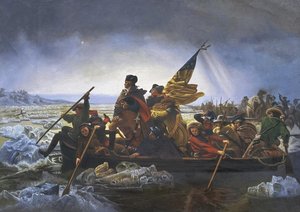
      Washington przeprawiający się przez Delaware (1851)
      Najwięcej dzieł w
      Metropolitan Museum of Art

      Najsłynniejsze 10 obrazów Emanuel Leutze: płótna, które zna każdy

      Washington przeprawiający się przez Delaware (1851) autorstwa Emanuel Leutze
      1

      Washington przeprawiający się przez Delaware

      1851 · Obraz olejny na płótnie · Metropolitan Museum of Art, Nowy Jork

      Scena rozwija się w ciężkiej, mroźnej atmosferze amerykańskiej wojny o niepodległość. W tym dziele, zatytułowanym Washington przeprawiający się przez Delaware, artysta Emanuel Leutze uchwycił moment głębokiej walki. Powietrze zdaje się gęste od ciężaru zmagań rodzącego się narodu o wolność. Obserwujemy, jak George Washington i jego wojska przedzierają się przez zdradliwe, lodowate wody rzeki Delaware. To chwila zamrożona w czasie, w której los rewolucji zależy od siły tych, którzy wiosłują pod…

      Washington Crossing the Delaware (1851) autorstwa Emanuel Leutze
      2

      Washington Crossing the Delaware

      1851 · Oil On Canvas · Metropolitan Museum of Art, Nowy Jork

      In the grand tapestry of American iconography, few images command as much reverence and emotional gravity as Emanuel Gottlieb Leutze’s Washington Crossing the Delaware. Completed in 1851, this colossal masterpiece transcends its role as a historical record to become a profound allegory of courage and national identity. The canvas captures the breathless tension of December 25-26, 1776, a night when the fate of a nascent nation hung in the balance…

      Westward The Course of Empire Takes Its Way (1861) autorstwa Emanuel Leutze
      3

      Westward The Course of Empire Takes Its Way

      1861 · Oil On Canvas

      In the sweeping expanse of Emanuel Gottlieb Leutze’s 1861 masterpiece, Westward The Course of Empire Takes Its Way, the viewer is transported to a pivotal moment in the American consciousness. This monumental oil on canvas serves as more than just a landscape; it is a profound historical narrative captured through the lens of Romanticism. As the sun dips below the horizon, casting long, dramatic shadows and bathing the desert in…

      The Amazon and Her Children, (painting) (1851) autorstwa Emanuel Leutze
      4

      The Amazon and Her Children, (painting)

      1851 · Oil On Canvas

      The Amazon and Her Children, (painting) by Emanuel Leutze presents a scene centered on a woman reclining against a thick tree trunk. Two nude children cling to her body, their forms positioned in the foreground. The subject matter follows a classical or mythological theme, focusing on the figures within a natural setting. This work was created about 1851.

      Edouard Rudolf Mayer, (painting) (1843) autorstwa Emanuel Leutze
      5

      Edouard Rudolf Mayer, (painting)

      1843 · Oil

      In Edouard Rudolf Mayer, (painting), Emanuel Leutze presents a formal portrait of a young boy, likely from a privileged social class, as indicated by his structured attire. The composition is tightly framed, focusing primarily on the child's head and upper body. This central emphasis on the face creates a direct engagement between the subject and the viewer. Set against a dark, undifferentiated background, the boy's features emerge with clarity, a…

      Indians Attacking a Wagon Train, (painting) (1863) autorstwa Emanuel Leutze
      6

      Indians Attacking a Wagon Train, (painting)

      1863 · Oil On Canvas

      In this 1863 work, we find ourselves thrust into a moment of profound instability on the American frontier. The scene captures a sudden, violent disruption of the westward movement, as a party of pioneers is caught in the midst of an impending attack by Native American warriors. There is a palpable sense of suspense built into the very arrangement of the figures. The composition draws the eye toward the central…

      George Washington As A Master Mason autorstwa Emanuel Leutze
      7

      George Washington As A Master Mason

      Oil On Canvas

      In this portrait, we find George Washington depicted not as a general on a battlefield, but as a man immersed in the quiet dignity of a master mason. He is presented in a black suit, accented by a blue sash that provides a subtle point of focus against the darker tones of his attire. A white hat rests nearby, adding to the sense of a moment captured in a private,…

      The Storming Of The Teocalli autorstwa Emanuel Leutze
      8

      The Storming Of The Teocalli

      Oil On Canvas

      The Storming of the Teocalli by Cortez and his Troops is an oil on canvas painting created by the German American history painter Emanuel Leutze in 1848. The work depicts a specific historical episode: the Spanish assault on the pyramid temple of Yopico. This scene captures the intense combat occurring at the teocalli, focusing on the physical struggle between the Spanish forces and the indigenous defenders during the conquest.

      Elizabeth and Raleigh (1848) autorstwa Emanuel Leutze
      9

      Elizabeth and Raleigh

      1848 · Oil On Canvas

      A Glimpse into the Past The painting Elizabeth and Raleigh by Emanuel Gottlieb Leutze is a captivating historical scene that transports viewers to the 16th century. Created in 1848, this oil on canvas masterpiece depicts Queen Elizabeth I of England and Sir Walter Raleigh engaged in conversation, surrounded by other figures from their era. The Main Figures At the center of the painting, Elizabeth I stands on the left side,…

      Bird Nesting (1837) autorstwa Emanuel Leutze
      10

      Bird Nesting

      1837 · Oil On Canvas · Smithsonian American Art Museum, Waszyngton

      A young boy reaches upward into the dense, tangled architecture of a forest canopy. Clad in a light-colored jacket and blue trousers, his small form is framed by the dark, irregular silhouettes of branches and foliage. The composition draws the eye vertically, following his gaze toward a bird's nest tucked high within the shadows. This interaction between the child and the natural world is rendered with a sense of quiet…

      Więcej płócien artysty Emanuel Leutze, od 11 do 100

      Nathaniel Hawthorne (1862) autorstwa Emanuel Leutze
      #84

      Nathaniel Hawthorne

      1862 · National Portrait Gallery

      This oil on canvas portrait, painted in 1862, presents the likeness of the American novelist Nathaniel Hawthorne. The artist, Emanuel Leutze, captured the subject during a period of…

      Zamów ręczne malowanie →
      Washington Crossing the Delaware - Emanuel Leutze (2026) autorstwa Emanuel Leutze
      #85

      Washington Crossing the Delaware - Emanuel Leutze

      2026

      Emanuel Leutze's iconic depiction of George Washington leading his troops across the Delaware River on Christmas night, 1776, isn’t merely a painting; it’s an embodiment of American spirit.…

      Angel on the Battlefield autorstwa Emanuel Leutze
      #87

      Angel on the Battlefield

      Chrysler Museum of Art

      In the hauntingly beautiful oil painting “Angel on the Battlefield,” Emanuel Gottlieb Leutze invites us into a moment of profound spiritual intervention amidst the visceral carnage of conflict.…

      Zamów ręczne malowanie →

      Co najczęściej malował Emanuel Leutze

      Cztery tematy najczęściej pojawiające się na tych płótnach, z których każdy wraz z jego najbardziej cenionym przykładem.

      Gdzie wiszą płótna Emanuel Leutze

      8 muzeów, w których znajduje się najwięcej obrazów z tej strony.

      Muzeum Miasto Dzieła artysty Emanuel Leutze Obrazy z tej listy
      Metropolitan Museum of Art, Nowy JorkMetropolitan Museum of Art Nowy Jork 4 Washington przeprawiający się przez Delaware, Washington Crossing the Delaware, Portrait of a Gentleman
      Smithsonian American Art Museum, WaszyngtonSmithsonian American Art Museum Waszyngton 5 Bird Nesting, James Barnett Dodson, The Countess
      New York Historical Society, Nowy JorkNew York Historical Society Nowy Jork 3 William Henry Seward (1801-1872), Princess Elizabeth in the Tower
      Cincinnati Museum Center at Union Terminal, CincinnatiCincinnati Museum Center at Union Terminal Cincinnati 1 Nathan Flint Baker
      Bawarskie Państwowe Zbiory Malarstwa, MonachiumBawarskie Państwowe Zbiory Malarstwa Monachium 1 Juliane Lottner, (painting)
      Kunsthalle Bremen, BremaKunsthalle Bremen Brema 1 Washington Crossing the Delaware, (painting)
      Het Prinsenhof, DelftHet Prinsenhof Delft 1 Abraham Cozzens, (painting)
      National Portrait Gallery, WaszyngtonNational Portrait Gallery Waszyngton 1 Nathaniel Hawthorne

      Najukochańsze płótno Emanuel Leutze z każdej dekady

      1. 1830s
        Bird Nesting (1837) autorstwa Emanuel Leutze
        10 z 100

        Bird Nesting

        Wiek 14 – 23 · Smithsonian American Art Museum

        A young boy reaches upward into the dense, tangled architecture of a forest canopy. Clad in a light-colored jacket and blue trousers, his small form is framed by…

      2. 1840s
        Edouard Rudolf Mayer, (painting) (1843) autorstwa Emanuel Leutze
        Płótno 5 z 100

        Edouard Rudolf Mayer, (painting)

        Wiek 24 – 33

        In Edouard Rudolf Mayer, (painting), Emanuel Leutze presents a formal portrait of a young boy, likely from a privileged social class, as indicated by his structured attire. The…

      3. 1850s
        Washington przeprawiający się przez Delaware (1851) autorstwa Emanuel Leutze
        Płótno 1 z 100

        Washington przeprawiający się przez Delaware

        Wiek 34 – 43 · Metropolitan Museum of Art

        Scena rozwija się w ciężkiej, mroźnej atmosferze amerykańskiej wojny o niepodległość. W tym dziele, zatytułowanym Washington przeprawiający się przez Delaware, artysta Emanuel Leutze uchwycił moment głębokiej walki. Powietrze…

      4. 1860s
        Westward The Course of Empire Takes Its Way (1861) autorstwa Emanuel Leutze
        Płótno 3 z 100

        Westward The Course of Empire Takes Its Way

        Wiek 44 – 52

        In the sweeping expanse of Emanuel Gottlieb Leutze’s 1861 masterpiece, Westward The Course of Empire Takes Its Way, the viewer is transported to a pivotal moment in the…

      O płótnach Emanuel Leutze: odpowiedzi na Twoje pytania

      Jakie jest najsłynniejsze dzieło Emanuel Leutze?Przeczytaj odpowiedź

      Washington przeprawiający się przez Delaware (1851), Metropolitan Museum of Art, Nowy Jork. Następują po nim Washington Crossing the Delaware (1851) oraz Westward The Course of Empire Takes Its Way (1861).

      W jakim wieku był Emanuel Leutze, gdy namalowano Washington przeprawiający się przez Delaware?Przeczytaj odpowiedź

      Emanuel Leutze, urodzony/a w 1816, miał/a 35 lat: Washington przeprawiający się przez Delaware pochodzi z 1851.

      Jakie są 10 najsłynniejszych obrazów autorstwa Emanuel Leutze?Przeczytaj odpowiedź

      Washington przeprawiający się przez Delaware, Washington Crossing the Delaware, Westward The Course of Empire Takes Its Way, The Amazon and Her Children, (painting), Edouard Rudolf Mayer, (painting), Indians Attacking a Wagon Train, (painting), George Washington As A Master Mason, The Storming Of The Teocalli, Elizabeth and Raleigh i Bird Nesting. Każde płótno w powyższym rankingu zawiera informację o roku powstania oraz muzeum.

      Ile dzieł namalował Emanuel Leutze?Przeczytaj odpowiedź

      W naszym katalogu znajduje się 184 dzieł artysty Emanuel Leutze, datowanych od 1836 do 1868.

      Gdzie mogę zobaczyć najsłynniejsze płótna Emanuel Leutze?Przeczytaj odpowiedź

      Większość znajduje się w Metropolitan Museum of Art (Nowy Jork), Smithsonian American Art Museum (Waszyngton) i New York Historical Society (Nowy Jork); powyższa lista wymienia każde muzeum oraz jego płótna.

      Kiedy Emanuel Leutze namalował swoje najbardziej uwielbiane płótna?Przeczytaj odpowiedź

      W 1850s, który obejmuje 32 z 100 dzieł na tej stronie, wśród nich znajduje się Washington przeprawiający się przez Delaware.

      Które z najsłynniejszych płócien Emanuel Leutze powstały na początku i na końcu jego twórczości?Przeczytaj odpowiedź

      Najwcześniejsze płótno pochodzi z Eliza Birch Veacock, the Artist's Daughter, (painting) (1836), a najpóźniejsze z Triumph of the Cross, (painting) (1868).

      Co najczęściej malował Emanuel Leutze?Przeczytaj odpowiedź

      Portrait (6), 19th century (5) i Landscape (4), w ramach 100 dzieł na tej stronie.

      W jakiej technice najczęściej malował Emanuel Leutze?Przeczytaj odpowiedź

      Oil On Canvas, użyte w 10 z 100 dzieł na tej stronie.

      Do jakiego nurtu należy obraz Emanuel Leutze?Przeczytaj odpowiedź

      Romanticism, co pokazują płótna na tej stronie.

      Które płótna Emanuel Leutze znajdują się w Metropolitan Museum of Art?Przeczytaj odpowiedź

      Muzeum Metropolitan Museum of Art, Nowy Jork posiada 4 dzieł widocznych na tej stronie, w tym Washington przeprawiający się przez Delaware, Washington Crossing the Delaware i Portrait of a Gentleman.

      Czy mogę kupić reprodukcję płótna autorstwa Emanuel Leutze?Przeczytaj odpowiedź

      Tak. Każdy obraz na tej stronie można zamówić z jego własnej podstrony jako ręcznie malowaną reprodukcję olejną lub jako wysokiej jakości wydruk artystyczny w wybranym przez Ciebie rozmiarze.

      Emanuel Leutze: życie w malarstwie

      Emanuel Gottlieb Leutze: Bridging Worlds, Painting American Identity

      Emanuel Gottlieb Leutze’s life unfolded as a remarkable confluence of artistic ambition and cultural transformation, a journey that saw him traverse the Atlantic and ultimately synthesize European artistic traditions with the nascent identity of America. Born in 1816 in Schwäbisch Gmünd, Germany, his early years were shaped by hardship – the untimely death of his father thrust upon him a premature immersion into the world of labor. Yet, even amidst these challenges, a spark ignited within him: an innate artistic talent that initially manifested as a means of occupying time during his father’s illness, gradually evolving into a source of livelihood through modest portrait commissions. This formative period instilled not only technical proficiency – he charged a mere five dollars for a portrait – but also a profound sense of self-reliance and a deep understanding of the practical realities inherent in an artist's existence. His formal training commenced later, under the guidance of John Rubens Smith in Philadelphia, providing a crucial foundation before his pivotal relocation to Germany in 1840 and enrollment at the prestigious Kunstakademie Düsseldorf – a decision that would irrevocably alter the trajectory of his artistic career.

      Düsseldorf: The Crucible of Romantic Vision

      The years Leutze spent in Düsseldorf were transformative, shaping him not merely as a technician but as an artist deeply immersed in a specific aesthetic philosophy. He wasn’t simply acquiring skills; he was absorbing a worldview – the tenets of German Romanticism, powerfully championed by Karl Friedrich Lessing. Lessing's emphasis on dramatic composition, emotional intensity, and the exploration of profound human experiences resonated profoundly with Leutze, informing the grand scale and narrative power that would characterize his later works. Düsseldorf’s artistic environment fostered experimentation and a willingness to challenge established conventions, encouraging Leutze to push beyond mere imitation. His studies under Cornelius and Kaulbach broadened his artistic horizons, exposing him to diverse techniques and styles, while journeys to Venice and Rome brought him face-to-face with the titans of the Renaissance – Titian and Michelangelo. These encounters weren’t simply acts of admiration; they were rigorous intellectual exercises, prompting Leutze to analyze the masters' approaches to form, color, and composition, seeking to integrate their lessons into his own evolving style. It was during this period that he created “Columbus Before the Council of Salamanca,” a painting that immediately garnered attention for its dramatic lighting, meticulous detail, and ambitious historical scope – a clear indication of Leutze’s burgeoning artistic voice and his ambition to engage with weighty themes. The work demonstrated an early mastery of symbolism and narrative, foreshadowing the larger canvases he would soon undertake.

      The Return to America: A Patriot's Palette

      In 1859, Leutze made a deliberate return to the United States, establishing studios in both New York City and Washington D.C. This relocation wasn’t merely a geographical shift; it represented a conscious decision to dedicate his art to the burgeoning American narrative – a nation grappling with its identity and forging its own destiny. While he continued to accept portrait commissions, capturing the likenesses of prominent figures like Chief Justice Roger Brooke Taney and fellow artist William Morris Hunt, his true passion lay in historical painting, specifically works that could embody the spirit of the nation. This ambition culminated in “Washington Crossing the Delaware,” a monumental work that instantly became an iconic symbol of American courage, leadership, and the relentless pursuit of freedom. The painting’s enduring appeal lies not just in its dramatic depiction of a pivotal moment – the crossing of the Delaware River during George Washington's winter campaign – but also in its carefully constructed symbolism: the diverse group of soldiers representing the unity of the colonies, the perilous journey mirroring the risks inherent in revolution, and the central figure of Washington himself embodying strength and resolve. Beyond “Washington Crossing the Delaware,” Leutze continued to explore themes of American heroism and sacrifice, notably with "Angel on the Battlefield," a poignant response to the human cost of the Civil War – a work born from the grim realities reported in newspapers and intended as a meditation on loss and remembrance.

      Influences and Artistic Style

      Leutze’s artistic style was a complex synthesis of European Romanticism and American influences. He drew heavily from the traditions of Düsseldorf, particularly the dramatic lighting and emotional intensity championed by Lessing. However, he adapted these techniques to suit the specific needs of his American subjects, imbuing them with a sense of rugged individualism and patriotic fervor. His early training in Philadelphia exposed him to elements of Hudson River School painting, characterized by its emphasis on landscape and natural beauty – influences that subtly informed his compositions. Furthermore, Leutze’s exposure to Renaissance masters like Titian and Michelangelo instilled in him a deep appreciation for classical form and composition, which he skillfully integrated into his own work. His paintings are marked by a meticulous attention to detail, a dramatic use of light and shadow, and a powerful sense of narrative – all hallmarks of his distinctive style.

      Legacy and Enduring Significance

      Emanuel Gottlieb Leutze’s contribution to American art extends far beyond individual canvases; he played a crucial role in establishing a visual language for American history painting, creating powerful images that helped shape national identity during a period of profound social and political change. “Washington Crossing the Delaware” remains arguably the most recognizable image in American art, its reproduction ubiquitous across countless platforms – a testament to its enduring power and symbolic resonance. Leutze’s ability to blend Romantic ideals with historical accuracy resulted in works that were both emotionally resonant and intellectually stimulating. His paintings are now housed in prestigious institutions such as the Metropolitan Museum of Art, the Kunsthalle Bremen, and Harvard Law School, ensuring his legacy endures for generations to come. He wasn't simply a painter of history; he was a creator of myth, forging enduring symbols that continue to inspire dialogue about the American experience – a testament to the lasting impact of an artist who bridged worlds and painted a nation’s soul.
      • Born: May 24, 1816, Schwäbisch Gmünd, Germany
      • Died: July 18, 1868
      • Movement: Romanticism, Düsseldorf School of Painting
      • Notable Works: Washington Crossing the Delaware, Columbus Before the Council of Salamanca, Angel on the Battlefield

      Wszystkie 184 dzieła artysty Emanuel Leutze →