

Bivega to obraz, z którego najbardziej znany jest Victor Vasarely. Quadrature oraz ORION-MC dopełniają trio najbardziej uwielbianych płócien. Nasz katalog obejmuje 776 dzieł autorstwa Victor Vasarely. Oto 100 najsłynniejszych z nich, wraz z rokiem powstania, informacją o muzeum oraz historią każdego płótna.
Ranking oparty na naszym wskaźniku popularności, który łączy liczbę wyszukiwań, wizyt oraz zamówień dla każdego dzieła. Aktualizacja: Październik 2026.


Victor Vasarely's *Quadrature* isn't merely a painting; it’s an invitation – an invitation to question the very nature of visual reality. Created by a visionary who anticipated the digital age, this work embodies the core tenets of Op Art, a movement that sought to manipulate perception through carefully constructed geometric forms and vibrant color fields. Painted in 1960s, *Quadrature* showcases Vasarely’s mastery of optical illusion, transforming two dynamic spheres into…

Victor Vasarely's ORION-MC is not merely a painting; it’s an invitation to experience the world through a radically altered lens. This captivating work, rendered in a vibrant palette of red, yellow, green, blue, purple, orange, and black, exemplifies the core tenets of Op Art – Optical Art – pioneered by Vasarely himself. Born Károly Vaszary in 1906 in Pécs, Croatia, his artistic trajectory began with an unexpected detour into medicine…

The artwork titled Zebras (white on black) was created by the artist Victor Vasarely. This piece features two zebras positioned against a black background. The composition includes smaller figures of animals in the background, such as two birds and three additional zebras, which contribute to the depth of the image. The visual structure utilizes geometric shapes and patterns to form the figures.

Vega-Wa-3: A Dance of Geometric Illusion Victor Vasarely’s “Vega-Wa-3” isn't merely a painting; it’s an invitation to experience visual perception in a radically new way. Created in 1968, this artwork embodies the spirit of Op Art – Optical Art – a movement that sought to challenge our ingrained assumptions about how we see and interpret color and form. The image itself presents a deceptively simple composition: concentric circles interwoven with…

To stand before Victor Vasarely’s Kaglo II is to enter a realm where the boundaries between the static and the kinetic dissolve into a rhythmic dance of light and color. Created in 1986, this masterful print serves as a profound testament to the enduring power of geometric abstraction. At first glance, the eye is drawn to a central, commanding red sphere, which acts as the sun within a private cosmos.…

Victor Vasarely’s *Vega 1* isn't merely a painting; it’s an invitation. An invitation to step outside the confines of traditional representation and into a world governed by perception itself. Born in 1906 in Pécs, Croatia – then part of Austria-Hungary – Vasarely’s artistic trajectory was initially rooted in medicine before he decisively embraced the burgeoning field of visual abstraction. This pivotal shift, fueled by his studies at the Podolini-Volkmann Academy…

Victor Vasarely’s “NB 22 Caope” is more than just an abstract painting; it's a meticulously crafted portal into the heart of Op Art, a movement that sought to redefine our perception of reality. This striking work, dominated by a precisely arranged grid of black and white circles, exemplifies Vasarely’s pioneering approach to visual illusion – a technique he developed with mathematical rigor and an almost obsessive attention to detail. The…

To stand before a work by Victor Vasarely is not merely to observe paint on canvas; it is to engage in a sophisticated dialogue with perception itself. This piece, characterized by its vibrant, almost pulsating geometric network, draws the viewer into a mesmerizing optical labyrinth. It speaks directly to the intellectual curiosity of the modern collector and the design sensibility of those who appreciate art as an architectural element. The…

To stand before Harmas is to step directly into the mind of its creator, Victor Vasarely. This piece is not merely an arrangement of color and pattern; it is a vibrant intellectual puzzle, a visual meditation on structure itself. The eye is immediately drawn into the intricate dance between the bold red checks and the myriad small circles that populate the background. It possesses the undeniable energy characteristic of Op…

Victor Vasarely's Pal-Ket, painted in 1974, isn’t merely a visual experience; it’s an invitation to reconsider the very nature of perception. This vibrant acrylic on canvas piece, measuring…

Victor Vasarely's "Vonal-2" is more than just a colorful pattern; it’s a meticulously crafted portal into the heart of Op Art and a testament to the revolutionary ideas…

In this 1957 work, titled Vega II, Victor Vasarely explores the fundamental mechanics of sight. The piece is a purely abstract composition, eschewing any recognizable subject matter in…

To stand before Victor Vasarely's Axo 99 is not merely to observe a painting; it is to engage in a visual dialogue with the very mechanics of sight…

Victor Vasarely's “Abstract Composition 9” is more than just a painting; it’s an invitation to experience the world through the lens of perception itself. Created by one of…

The artwork titled Zebras was created by the artist Victor Vasarely. This piece, dated 1938, emerged from a period of intense graphic experimentation. It is considered one of…

To encounter Victor Vasarely’s Kezdi-Ga is to step away from the stillness of traditional viewing and enter a realm where the canvas breathes, pulses, and vibrates with an…

Victor Vasarely’s ‘SIR-RIS,’ a captivating sculpture rendered in meticulous black and white, stands as a cornerstone of Op Art – a movement that fundamentally challenged our understanding of…

To stand before Victor Vasarely’s "Torony-Nagy" is not merely to observe paint on canvas; it is to engage in a sophisticated dialogue with perception itself. This vibrant 1969…

Victor Vasarely's 'Quasar' is not merely a painting; it’s an invitation into the very fabric of perception, a testament to the revolutionary impact of Op Art and the…

To stand before Victor Vasarely's Zett-Ka is not merely to observe a painting; it is to step into a meticulously constructed optical puzzle. This masterful piece, a quintessential…

Victor Vasarely's "Vega-Kontosh-Va" is not merely a painting; it’s an invitation to experience the world through a radically altered lens. This vibrant composition, dominated by a pulsating red…

We are looking at Vèga 3, a significant work by the artist Victor Vasarely. Created about 1968, this piece belongs to the Op Art movement, a style that…

Zoeld V, 1967 – A Geometric Dance of Color Victor Vasarely’s “Zoeld V” stands as a cornerstone of Op Art—a movement that revolutionized visual perception in the mid-20th…

Victor Vasarely: A Geometric Pioneer Shaping Modern Art Victor Vasarely (1906-1997) stands as one of the most influential figures in Op Art – Optical Art – a movement…

SIR-RIS-B: A Geometric Symphony of Color and Illusion Victor Vasarely’s “SIR-RIS-B” transcends mere visual representation; it embodies the very essence of Op Art – Optical Art – a…

In the realm of Op Art, few works capture the hypnotic essence of visual disruption as masterfully as Victor Vasarely’s Zebras (full body white on blue-black). This striking…

Victor Vasarely's "Kezdi-All," a captivating exploration of optical illusion and geometric abstraction, stands as a cornerstone of Op Art – a movement that fundamentally challenged our understanding of…

To stand before Harmas is to step directly into the mind of its creator, Victor Vasarely. This piece is not merely an arrangement of color and pattern; it…

To encounter Victor Vasarely’s 1951 masterpiece, “Terek,” is to step away from the static world of traditional representation and enter a realm where the canvas itself seems to…

To stand before this piece is to step through a portal built entirely of color and calculated form. It is an immediate confrontation with perception itself. The composition,…

To encounter Victor Vasarely's 'Folklore' is to step away from the stillness of traditional viewing and enter a realm where the canvas begins to breathe, pulse, and vibrate…

Victor Vasarely’s “O N D - I I - V A” is more than just a painting; it's an invitation to experience the world through a radically altered…

The artwork is a grid-based abstract composition dominated by concentric circles of varying sizes and shades of red and green. It presents a highly geometric and symmetrical design,…

Victor Vasarely's "F-VERT-BLEU" is not merely a puzzle; it’s a meticulously crafted portal into the heart of Op Art, a movement that fundamentally altered our perception of space…

Victor Vasarely: A Pioneer of Geometric Abstraction and Optical Illusion Victor Vasarely (1906-1997), born Károly Vaszary in Pécs, Hungary – now Croatia – embarked on an artistic journey…

The painting Dia-Tuz-Neg is a blue and white composition characterized by a circular pattern. At the center of the work, a large circle is prominently featured, surrounded by…

Victor Vasarely’s “Caopeo” isn’t merely a painting; it’s an invitation, a carefully constructed illusion designed to challenge and delight the viewer. Created in 1962, this seminal work exemplifies…

Sorata-T is a painted glass triptych executed in 1953. The work is composed of three panels:

The artwork Triond features three colorful balls presented in various shades of blue, purple, pink, and green. These spheres are arranged in a triangular formation, with one ball…

Step closer to observe how the eye begins to move across the surface of Domb-B. At first glance, your attention is drawn to that central blue and yellow…

VP-115 by Victor Vasarely exists as a precise study in the mechanics of sight. The work operates through a calculated arrangement of geometric shapes, specifically a sphere and…

Victor Vasarely's 'Jong,' completed in 1968, is more than just an image; it’s an invitation to question the very nature of reality. This arresting work, a cornerstone of…

The artwork consists of four circles arranged in a square configuration. Each circle is assigned a specific color: blue, orange, yellow, and purple. These shapes are positioned at…

To encounter Victor Vasarely’s “Obor” is to step away from the stillness of traditional viewing and enter a realm where the canvas itself seems to breathe, pulse, and…

Victor Vasarely: A Pioneer of Geometric Abstraction and Sensory Illusion Victor Vasarely (1906-1997), born Károly Vaszary in Pécs, Croatia, stands as a monumental figure in the history of…

A Dance of Circles on Crimson: Exploring Victor Vasarely's "Untitled 16" Victor Vasarely, a name synonymous with Op Art and kinetic abstraction, gifted the world a visual language…

Tridem K – A Geometric Revelation by Victor Vasarely Victor Vasarely (1906-1997) stands as an undisputed titan of Op Art, a movement that revolutionized visual perception in the…

The artwork Louisiana features a symmetrical, circular design composed of numerous small, overlapping circles in varying shades of red, orange, and brown. A blue grid subtly underlies the…

A Symphony of Geometry: Exploring Victor Vasarely's "Sikra-Z" Victor Vasarely, a name synonymous with Op Art and kinetic art, dedicated his life to unraveling the mysteries of perception…

Vertically oriented, "Kalota-MC" presents a clear sense of order despite the overlapping forms. Shapes are strategically positioned to generate optical illusions through intersections and overlaps—a testament to Vasarely's…

Victor Vasarely (1906-1997), born Győző Vásárhelyi in Pécs, Croatia, stands as a monumental figure in the history of 20th-century art. More than just an artist; he was a…

Victor Vasarely’s “Quadrature ”X” stands as a cornerstone of Op Art, an artistic movement that emerged in the mid-1960s and captivated audiences with its mesmerizing ability to deceive…

A Dance of Light and Geometry: Unveiling Victor Vasarely’s “Untitled 18” Victor Vasarely's "Untitled 18" isn’t merely a painting; it’s an invitation to step into a world where…

Victor Vasarely (1906-1997) stands as an undisputed titan of Op art, a movement that irrevocably altered the landscape of 20th-century visual culture. Born Károly Vásárhelyi in Pécs, Hungary…

KALOTA T is an artwork created by the artist Victor Vasarely. Born in 1906 and passing away in 1997, the French/Hungarian artist developed a visual language centered on…

Victor Vasarely's "Sikra," painted in 1966, is more than just a colorful composition; it’s a meticulously crafted portal into the heart of Op Art and a testament to…

Victor Vasarely's "Dia-Or" is not merely a painting; it’s an invitation into the very fabric of perception. This captivating work, rendered in oil with meticulous attention to detail,…

To encounter Victor Vasarely's “Mahn” is to step into a realm where the canvas ceases to be a static surface and begins to breathe, pulse, and vibrate with…

Victor Vasarely i „Cheyt - L”: Pionier Op Art i Symbole Geometrycznej Estetyki Victor Vasarely (1906 – 1997), austriacki lekarz urodzony w Pécs, który z zamiłowaniem skupił się…

To encounter Victor Vasarely’s Caribe Negatif is to step away from the stillness of traditional viewing and enter a realm where the canvas breathes, vibrates, and dances before…

To encounter Victor Vasarely's “Tomor” is to step away from the static world of traditional imagery and enter a realm where the canvas itself seems to breathe, pulse,…

Victor Vasarely's Rhombus-B is more than just a painting; it’s an invitation to question the very nature of visual perception. Created by one of the foremost figures in…

Victor Vasarely's "Sreeh" is more than just a painting; it’s an invitation into the heart of Op Art, a visual exploration of perception itself. This striking work, dominated…

Victor Vasarely's "Hetta," a deceptively simple composition of four vibrant circles – red, orange, green, and blue – is far more than just an abstract arrangement. It’s a…

Victor Vasarely's *Opus 2604* is not merely a painting; it’s an invitation to question the very nature of visual reality. This mesmerizing work, dominated by a vibrant blue…

This vibrant artwork, designated VY-47-C, is a captivating embodiment of Victor Vasarely's groundbreaking contributions to Op Art and his pioneering exploration of geometric abstraction. Executed with a masterful…

Vega-EG: A Dance of Spheres – Exploring Victor Vasarely’s Geometric Vision Victor Vasarely's Vega-EG is more than just a painting; it’s an invitation to step into a realm…

Guimen – A Symphony of Geometric Illusion Victor Vasarely’s “Guimen” stands as an emblem of Op Art—Optical Art—a movement that fundamentally challenged our perception of reality in the…

Victor Vasarely's "Molnar" is more than just a painting; it’s an invitation into the mesmerizing world of Op Art, a realm where perception itself becomes the subject. This…

Victor Vasarely's Folkokta is more than just a colorful arrangement of squares; it’s a meticulously crafted portal into the heart of Op Art and a testament to the…

Victor Vasarely: Pioneering Op Art & Democratizing Visual Experience Victor Vasarely (1906–1997) stands as one of the most influential figures in 20th-century art, recognized globally for his groundbreaking…


Victor Vasarely's "Andromeda" isn't merely a painting; it’s an invitation into a realm where perception itself becomes the subject. This striking composition, dominated by a meticulously rendered geometric…

Victor Vasarely i Jego „Planetary Folklore Participations No. 1”: Geometry jako Ekspresja Percepcji Victor Vasarely (Francuski, urodzony w węgierskim Pécsie w 1906 roku – 1997) był postacią niezwykle…
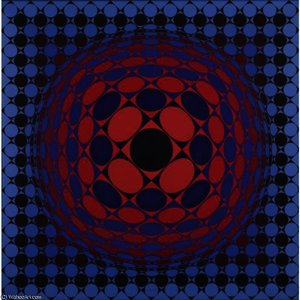
Victor Vasarely's "Versakk" is not merely a painting; it’s an invitation, a carefully constructed illusion that challenges our very perception of space and form. Created by the Hungarian…

Victor Vasarely's DVA-DVA is more than just a colorful square; it’s a meticulously crafted portal into the heart of Op Art and a testament to the revolutionary approach…

Sphere – A Geometric Revelation by Victor Vasarely Victor Vasarely’s “Sphere” transcends mere visual representation; it embodies a profound exploration of perception and the very nature of reality.…

Koska Kar – A Geometric Dance of Perception by Victor Vasarely Victor Vasarely’s “Koska Kar,” created in 1975, stands as a quintessential example of Op Art—Optical Art—a movement…


Victor Vasarely i Jego „Koentoesh”: Pionier Optycznej Sztuki Victor Vasarely (1906–1997), węgiersko-francuski artysta, jest powszechnie uznawany za „dziadka” i lider ruchu Optycznej Sztuki. Jego twórczość, która rozpoczęła się…

To encounter Victor Vasarely’s Tridim is to step into a realm where the boundaries of the two-dimensional canvas dissolve, replaced by a pulsating, architectural depth that defies the…

Koska-Pint: A Geometric Dance of Color by Victor Vasarely Victor Vasarely’s Koska-Pint is more than just a painting; it's an embodiment of Op Art—Optical Art—a movement that revolutionized…


Victor Vasarely i Jego Kaleidoskopowe Inspiracje Victor Vasarely (1906-1997) był węgierskofrancuskim artystą, który szeroko uznawany jest za „dziadka” i lidera ruchu Op Art – sztuki optycznej. Jego twórczość,…

Victor Vasarely (1906-1997) był węgiersko-francuskim artystą, szeroko uznawanym za „dziadka” i lidera ruchu Optycznej Sztuki. Jego twórczość zatytułowana „Illik” z serii CTA – 102, stworzona w 1971 roku,…

“MEH2,” a captivating work by Hungarian artist Victor Vasarely, is more than just a painting; it's an invitation to explore the very nature of visual perception. Executed in…

Victor Vasarely's Vega-Fel is not merely a painting; it’s an invitation to experience the world through a radically altered lens. This captivating work, dominated by a monumental blue…

Victor Vasarely's "Attam" is more than just a painting; it’s an invitation into the very heart of perception, a testament to the revolutionary impact of Op Art and…

To encounter Victor Vasarely’s “Sikra” is to step away from the stillness of traditional viewing and enter a realm where the canvas breathes, pulses, and vibrates with an…

Victor Vasarely's "Atelier Arcay" isn’t merely a painting; it’s an invitation to a perceptual adventure. Created in the heart of the Op Art movement, this vibrant geometric abstraction…

Zapowiedź Klasyki Op Artu: „Kompozycja Abstrakcyjna 5” Victora Vasarely’ego Victor Vasarely, jeden z pionierów ruchu Op Art – abstrakcyjnego kierunku sztuki skupionego na manipulowaniu percepcją wzroku – stworzył…

Victor Vasarely's Composition 7 is more than just a colorful painting; it’s a portal into the heart of Op Art and a testament to the revolutionary ideas of…

Victor Vasarely’s "Variációk" (Variations), created in 1989, is more than just an arrangement of circles; it's a vibrant exploration of perception and the underlying mathematical order that governs…

A Dance of Geometry and Color: Exploring Victor Vasarely's "Abstract Composition 13" Victor Vasarely, a name synonymous with Op Art and kinetic art, gifted the world a visual…

Victor Vasarely's Firaxo II is more than just a colorful textile; it’s a meticulously constructed portal into the heart of Op Art and a testament to the revolutionary…

A Symphony in Black: Exploring Victor Vasarely's Serigraph Victor Vasarely’s serigraphy in black is more than just an image; it’s an experience, a visual puzzle that invites the…

“Vonal-Fegn,” created by Victor Vasarely, is more than just an abstract painting; it's a meticulously crafted exploration of perception itself. Painted in hues of orange, yellow, blue, gray,…

Victor Vasarely's "Ouivar," a captivating exploration of geometric abstraction, invites the viewer into a world where perception itself becomes the subject. This artwork, characterized by its precisely arranged…

Victor Vasarely's "Abstract Composition 17" is more than just an image; it’s an invitation to experience the world anew. Born in 1906 in Pécs, Croatia – then part…
Cztery tematy najczęściej pojawiające się na tych płótnach, z których każdy wraz z jego najbardziej cenionym przykładem.
3 muzeów, w których znajduje się najwięcej obrazów z tej strony.
| Muzeum | Miasto | Dzieła artysty Victor Vasarely | Obrazy z tej listy |
|---|---|---|---|
 Bechtler Museum of Modern Art |
Charlotte | 4 | NB 22 Caope, SIR-RIS, Tridem K |
 Inter-American Development Bank |
Washington, D.C. | 2 | Kaglo II |
 Muzeum Sztuk Pięknych w Bilbao |
Bilbao | 1 | Pal-Ket |
The artwork titled Zebras was created by the artist Victor Vasarely. This piece, dated 1938, emerged from a period of intense graphic experimentation. It is considered one of…
In this 1957 work, titled Vega II, Victor Vasarely explores the fundamental mechanics of sight. The piece is a purely abstract composition, eschewing any recognizable subject matter in…

Vega-Wa-3: A Dance of Geometric Illusion Victor Vasarely’s “Vega-Wa-3” isn't merely a painting; it’s an invitation to experience visual perception in a radically new way. Created in 1968,…
Victor Vasarely's Pal-Ket, painted in 1974, isn’t merely a visual experience; it’s an invitation to reconsider the very nature of perception. This vibrant acrylic on canvas piece, measuring…

To stand before Victor Vasarely’s Kaglo II is to enter a realm where the boundaries between the static and the kinetic dissolve into a rhythmic dance of light…
Bivega, a następnie Quadrature i ORION-MC.
Bivega, Quadrature, ORION-MC, Zebras (white on black), Vega-WA-3, Kaglo II, Vega 1, NB 22 Caope, Yon i Harmas. Każde płótno w powyższym rankingu zawiera informację o roku powstania oraz muzeum.
W naszym katalogu znajduje się 776 dzieł artysty Victor Vasarely, datowanych od 1938 do 1986.
Większość znajduje się w Bechtler Museum of Modern Art (Charlotte), Inter-American Development Bank (Washington, D.C.) i Muzeum Sztuk Pięknych w Bilbao (Bilbao); powyższa lista wymienia każde muzeum oraz jego płótna.
W 1960s, który obejmuje 10 z 100 dzieł na tej stronie, wśród nich znajduje się Vega-WA-3.
Najwcześniejsze płótno pochodzi z Zebras (1938), a najpóźniejsze z Kaglo II (1986).
Visual perception (32), Geometric abstraction (31) i Color field (27), w ramach 100 dzieł na tej stronie.
Acrylic On Canvas, użyte w 41 z 100 dzieł na tej stronie.
Optical art, co pokazują płótna na tej stronie.
Muzeum Bechtler Museum of Modern Art, Charlotte posiada 3 dzieł widocznych na tej stronie, w tym NB 22 Caope, SIR-RIS i Tridem K.
Urodzony 9 kwietnia 1906 roku w węgierskim Pécs jako Károly Vaszary, człowiek, który miał stać się znany jako Victor Vasarely, rozpoczął swoją drogę w zupełnie innej dziedzinie. W 1925 roku przeniósł się w progi Uniwersytetu im. Eötvösa Loránda w Budapeszcie, aby studiować medycynę. Przez dwa lata logika ludzkiego ciała i nauka zajmowały jego czas, lecz ostatecznie to magnetyzm ekspresji wizualnej wziął górę. Do 1927 roku porzucił studia medyczne, by oddać się nauce tradycyjnego malarstwa akademickiego w Akademii Podolini-Volkmann.
Jego szkolenie trwało nadal, gdy trafił do pracowni Sándora Bortnyika, znanej jako műhely. To właśnie w tym warsztacie zakorzeniły się zasady ruchu Bauhaus, koncentrujące się na przecięciu funkcjonalnego designu z abstrakcją geometryczną. Tutaj uwaga artysty przesunęła się w stronę tego, co strukturalne i systematyczne. Lekcje odebrane w tych studiach stały się fundamentem dla jego późniejszych poszukiwań nad tym, w jaki sposób kształty i kolory wchodzą w interakcję z ludzkim okiem.
W latach między 1929 a 1944 rokiem Vasarely skoncentrował swoją twórczość na pracy graficznej. Te lata upłynęły mu na fascynujących eksperymentach nad tym, w jaki sposób światło i cień wchodzą w interakcję z prostymi formami. Jego wczesny okres graficzny zaowocował takimi dziełami jak Chess Board (1935) oraz Girl-power (1934). W 1937 roku artysta pracował również nad Zebras. Prace te ukazują rodzące się zainteresowanie tym, w jaki sposób widz postrzega płaską powierzchnię, co skłoniło go do odejścia od tradycyjnego malarstwa na rzecz bardziej ustrukturyzowanego, graficznego podejścia.
Między 1944 a 1947 rokiem nastąpił zwrot w jego artystycznej drodze. Vasarely przesuwał się przez różne estetyki, eksplorując podejścia kubistyczne, futurystyczne, ekspresjonistyczne, symbolistyczne, aż po surrealistyczne. Ostatecznie jednak wyprzedził te eksperymenty, poszukując bardziej precyzyjnego sposobu na organizację przestrzeni. Ta żmudna wędrówka ku nowej logice doprowadziła go do opublikowania jego Żółtego Manifestu. Jego twórczość przestała skupiać się na indywidualnej ekspresji, a zaczęła dotyczyć mechaniki wzroku. To właśnie ta systematyczna metoda ostatecznie ugruntowała jego pozycję jako lidera ruchu Op art.
Podejście, jakie przyjął Victor Vasarely, opiera się na systematycznym wykorzystaniu geometrii w celu wywołania fizycznej reakcji u widza. Artysta nie polegał na tradycyjnych źródłach światła ani klasycznym chiaroscuro, aby budować formę. Zamiast tego, posłużył się wyrafinowaną grą wysokokontrastowych pigmentów, aby zasymulować głębię i ruch. Poprzez manipulowanie gęstością koloru, potrafił oszukać oko, zmuszając je do postrzegania wklęsłości i wypukłości na płaskiej płaszczyźnie. Ta metoda sprawia, że statyczna powierzchnia zmienia się w przestrzeń, która zdaje się pulsować, pęcznieć lub cofać.
Jego metoda, którą określał mianem kinetyki wizualnej lub plastique cinétique, opiera się na precyzyjnym układzie kształtów. Wykorzystywał efekty teksturalne, perspektywę, cień oraz światło, aby budować te niezwykłe iluzje. Prace te często bazują na sposobie, w jaki oko interpretuje rytmiczny, wewnętrzny blask, a nie na zewnętrznym oświetleniu. Dzięki zastosowaniu siatek i zasad matematycznych, tworzył wrażenie wizualnych wibracji oraz wirujących efektów. Rezultatem jest poczucie ruchu, które istnieje całkowicie wewnątrz percepcji odbiorcy.
Precyzja jego techniki jest aż nadto widoczna w sposobie, w jaki operuje kolorem i linią, tworząc architektoniczną głębię. W dziełach takich jak Torony-Nagy, przecięcie ostrych, białych linii z głębokimi błękitami i szmaragdową zielenią tworzy rytmiczną wibrację optyczną. Te elementy współgrają ze sobą, wywołując wrażenie pulsującego światła. Vasarely używał tych narzędzi, aby wyjść poza ramy prostej reprezentacji, skupiając się zamiast tego na samej mechanice tego, jak widzimy.
Rok 1937 przyniósł przełom w twórczości artysty, gdy powstanie Zebra wyznaczyło zwrot ku temu, co wielu uznaje za najwcześniejsze przykłady Op Artu. Dzieło to odeszło od tradycyjnej reprezentacji, skupiając się zamiast tego na tym, w jaki sposób ludzkie oko interpretuje proste formy. Eksperymenty z rytmem i światłem osiągnęły swój szczyt w latach 60. XX wieku, czego najdoskonalszym przykładem jest powstałe w 1969 roku dzieło Torony-Nagy. Kompozycja ta, wykorzystująca cztery stylizowane wieże oraz wysokokontrastową paletę błękitów, zieleni i pomarańczy, tworzy niezwykłe wrażenie wewnętrznego blasku. Całość opiera się na przecięciu białych linii i manipulacji gęstością barw, co sprawia, że płaska powierzchnia zdaje się pulsować i cofać w nieokreśloną przestrzeń.
Pasja artysty do badania ruchu wykraczała daleko poza ramy płótna, przenikając w przestrzeń trójwymiarową oraz do przedmiotów codziennego użytku. Zaprojektował on Georges Pompidou – monumentalny obiekt kinetyczny, który zintegrował jego wizualne teorie z fizyczną, poruszającą się formą. To zainteresowanie praktycznym zastosowaniem geometrii zaowocowało również współpracą ze studiem Rosenthal Studio Linie. Efektem tego partnerstwa stała się seria zastawy stołowej Suomi – limitowany nakład 500 elementów, który wprowadził jego hipnotyzujące, geometryczne wzory prosto do domowego zacisza.
W 1966 roku Victor Vasarely rozpoczął proces powoływania do życia Fondation Vasarely. Projekt ten wyrastał z jego unikalnych idei dotyczących koncepcji „sztuki dla wszystkich” oraz wizji „miasta jutra”. Artysta pragnął stworzyć przestrzeń, która wykraczałaby poza tradycyjne doświadczenie galerii, stając się żywym odzwierciedleniem tych postulatów. Fizyczna budowa gmachu rozpoczęła się w 1973 roku.
Fundacja została oficjalnie uroczyście zainaugurowana 14 lutego 1976 roku w Aix-en-Provence we Francji. Miejsce to zaprojektowano tak, aby mogło pomieścić jego dzieła oraz promować teorie na temat wzajemnych relacji między sztuką a projektowaniem urbanistycznym. Sama architektura przestrzeni stała się integralną częścią tej wizji, a układ budynku miał wspierać specyficzny sposób, w jaki jego geometryczne formy miały być doświadczane przez publiczność.
Zasięg jego wizualnego języka wykraczał daleko poza mury galerii sztuki. Jego wzory i geometryczne struktury przeniknęły do tekstur codziennego życia, wpływając na linie mody, układy projektowania wnętrz oraz logikę grafiki użytkowej. Nawet wczesny rozwój grafiki komputerowej nosi w sobie piętno jego systematycznego podejścia do formy i percepcji. Jego idee nie ograniczały się jedynie do płótna; przeniknęły do funkcjonalnego świata przedmiotów oraz do struktur cyfrowych, które nadeszły później.
W 1982 roku jego twórczość wyruszyła w podróż w przestrzeń kosmiczną, kiedy to serigrafie zostały umieszczone na pokładzie francusko-radzieckiego statku kosmicznego Salut 7. Ten moment podkreślił głęboką więź między jego matematyczną precyzją a szerszym, ludzkim dążeniem do eksploracji nieznanego. Victor Vasarely pozostał centralną postacią w historii sztuki nowoczesnej aż do swojej śmierci w Paryżu, we Francji, 15 marca 1997 roku.
Śledzenie fizycznej obecności twórczości, którą pozostawił po sobie Victor Vasarely, wymaga podróży przez wiele malowniczych zakątków Francji i Węgier. W Aix-en-Provence we Francji znajduje się Fondation Vasarely, która przechowuje znaczną część jego dorobku. Muzeum to zostało założone przez samego artystę, aby szerzyć jego wizję sztuki dostępnej dla każdego. Przestrzeń ta została podzielona na siedem sześciokątnych komór, z których każda ma 14 metrów szerokości i 11 metrów wysokości, co pozwala na ekspozycję czterdziestu dwóch monumentalnych dzieł o wymiarach 6 na 8 metrów.
Jego obecność na Węgrzech jest równie silna i wyrażona poprzez dedykowane przestrzenie wystawiennicze. Muzeum Vasarely mieści się w Pécs, mieście jego narodzin, a także w Pałacu Zichy w Óbudzie w Budapeszcie. Te miejsca oferują możliwość bezpośredniego spotkania z geometrycznymi formami i efektami optycznymi, które definiowały jego artystyczną praktykę. We Francji kolejnym ważnym punktem na mapie jego dziedzictwa jest Muzeum Vasarely w Pałacu Saint-Firmin w Gordes.
Poza tymi konkretnymi muzeami, wpływ artysty odnajdujemy w licznych kolekcjach instytucjonalnych. Niektóre z jego dzieł znajdują się w Bilbao Fine Arts Museum, podczas gdy inne tworzą zbiory Inter-American Development Bank w Waszyngtonie oraz Bechtler Museum of Modern Art w Charlotte. Te rozproszone lokalizacje sprawiają, że jego wizualne eksperymenty pozostają żywe i dostępne dla zróżnicowanych odbiorców na całym świecie.


