

1
En dansk lodsbåd i uroligt vejr. I baggrunden Kullen
Ręcznie malowana reprodukcja olejowa od $195 39 × 26 cm
Rozmiar zgodny z oryginałem $468 119 × 79 cm Zamów w oryginalnym rozmiarze →
Najbardziej cenionym obrazem Vilhelm Melbye jest En dansk lodsbåd i uroligt vejr. I baggrunden Kullen (1847), który znajduje się w Statens Museum for Kunst w Kopenhaga. Następne w zestawieniu płócien najlepiej znanych czytelnikom są The German steam corvette cannonboat "von der Tann" on fire, 25 July 1850 (1855) oraz Cruising in the Baltic (1852). Nasz katalog zawiera 9 dzieł autorstwa Vilhelm Melbye: oto 9 najsłynniejszych z nich, z podaniem roku powstania, muzeum oraz tego, co czyni je wyjątkowymi.
Ranking oparty na naszym wskaźniku popularności, który łączy liczbę wyszukiwań, wizyt oraz zamówień dla każdego dzieła. Aktualizacja: Listopad 2026. Każdy obraz na tej stronie można zamówić jako ręcznie malowaną reprodukcję olejną na płótnie lnianym lub jako wysokiej jakości wydruk artystyczny, wykonany w wybranym przez Ciebie formacie.


6 muzeów, w których znajduje się najwięcej obrazów z tej strony.
| Muzea | Miasto | Dzieła artysty Vilhelm Melbye | Obrazy z tej listy |
|---|---|---|---|
 Royal Collection |
Londyn | 2 | Cruising in the Baltic, Off the Shetlands |
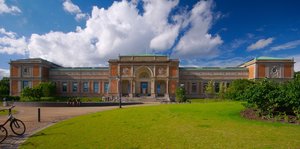 Statens Museum for Kunst |
Kopenhaga | 1 | En dansk lodsbåd i uroligt vejr. I baggrunden Kullen |
 The Museum of National History at Frederiksborg Castle |
Hillerød | 1 | The German steam corvette cannonboat "von der Tann" on fire, 25 July 1850 |
 National Maritime Museum |
Londyn | 1 | A frigate clawing off a rocky coast |
 Nationalmuseum |
Stockholm | 1 | Sea Piece |
 Muzeum Narodowe w Warszawie |
Warszawa | 1 | Sea landscape with sailing boats. |


En dansk lodsbåd i uroligt vejr. I baggrunden Kullen (1847), Statens Museum for Kunst, Kopenhaga. Następują po nim The German steam corvette cannonboat "von der Tann" on fire, 25 July 1850 (1855) oraz Cruising in the Baltic (1852).
Vilhelm Melbye, urodzony/a w 1824, miał/a 23 lat: En dansk lodsbåd i uroligt vejr. I baggrunden Kullen pochodzi z 1847.
W naszym katalogu znajduje się 9 dzieł artysty Vilhelm Melbye, datowanych od 1847 do 1868.
Większość znajduje się w Royal Collection (Londyn), Statens Museum for Kunst (Kopenhaga) i The Museum of National History at Frederiksborg Castle (Hillerød); powyższa lista wymienia każde muzeum oraz jego płótna.
W 1850s, który obejmuje 7 z 9 dzieł na tej stronie, wśród nich znajduje się The German steam corvette cannonboat "von der Tann" on fire, 25 July 1850.
Najwcześniejsze płótno pochodzi z En dansk lodsbåd i uroligt vejr. I baggrunden Kullen (1847), a najpóźniejsze z Sea landscape with sailing boats. (1868).
Muzeum Royal Collection, Londyn posiada 2 dzieł widocznych na tej stronie, w tym Cruising in the Baltic i Off the Shetlands.
Tak. Każdy obraz na tej stronie można zamówić z jego własnej podstrony jako ręcznie malowaną reprodukcję olejną lub jako wysokiej jakości wydruk artystyczny w wybranym przez Ciebie rozmiarze.
In the golden age of maritime romanticism, few artists captured the tempestuous spirit and serene majesty of the sea as profoundly as Vilhelm Melbye. Born in Elsinore, Denmark, in 1824, Melbye was destined for a life entwined with the rhythms of the ocean. While he initially trained for a career in commerce, the call of the canvas proved irresistible. He emerged from a family of profound artistic talent, being the middle brother to the renowned painters Anton and Fritz Melbye. This lineage provided him with a foundational connection to the marine tradition, yet his individual vision would soon transcend mere imitation, carving out a legacy defined by both technical precision and dramatic emotional depth.
Melbye’s artistic journey was one of constant movement, much like the tides he so lovingly depicted. His early education at the Royal Danish Academy of Fine Arts in Copenhagen, under the guidance of his brother Anton and the master of perspective Carl Dahl, provided him with a rigorous technical scaffolding. However, it was his travels that truly expanded his palette. From the icy, rugged coastlines of Iceland—reached aboard the corvette Valkyrien—to the sun-drenched harbors of the Mediterranean, Melbye’s work became a visual travelogue of nineteenth-century Europe. His time in Paris, studying under Théodore Gudin, and his immersion in the Düsseldorf School, particularly the works of Andreas Achenbach, infused his realism with a sense of romantic drama that could make the viewer feel the spray of salt water and the tension of a gathering storm.
The essence of Melbye’s oeuvre lies in his ability to balance the meticulous detail of a marine specialist with the sweeping grandeur of a romanticist. His paintings are not merely depictions of vessels; they are narratives of human endeavor against the infinite backdrop of nature. Whether he was rendering the bustling, congested shipping lanes of the Straits of Gibraltar or the quiet, atmospheric fishing villages of Skagen, his brushwork possessed an uncanny ability to capture light and motion. He often employed a realistic style that allowed for the depiction of complex maritime subjects—sailing vessels, coastal topography, and harbor scenes—with such clarity that they served as historical documents of a bygone era.
There is a certain theatricality in his most celebrated works, where the elements collide. Melbye had a particular talent for painting shipwrecks and the raw power of the North and Black Seas. In these compositions, the sky often becomes a character itself, heavy with the weight of impending weather, while the churning surf provides a sense of kinetic energy. Interestingly, during his years in London, he anglicized his signature to Wilhelm Melby, reflecting his integration into the British art scene and his fascination with British maritime subjects. This period saw him refining his ability to depict the interplay of light on water, a feat that required both immense patience and an acute understanding of atmospheric perspective.
As his career matured, Melbye’s influence extended far beyond the easel. His profound understanding of marine composition and the nuances of maritime life led him to prestigious academic appointments. In 1880, he reached the pinnacle of professional recognition when he was appointed a professor at the Royal Danish Academy in Copenhagen, eventually becoming the head of the institution. This role allowed him to shape the next generation of Scandinavian artists, passing on the traditions of the marine genre that had been so central to his own development.
Though he passed away in Roskilde in 1882, Melbye’s impact remains etched in the annals of maritime art history. His works continue to be celebrated for their ability to evoke the sublime—that specific mixture of awe and terror inspired by the ocean's vastness. Today, his paintings serve as vital windows into the nineteenth-century maritime world, preserved in esteemed collections such as Kunsthallen Brandts and various museums across Denmark and Europe. His life remains a testament to the power of artistic wandering, proving that by traversing the globe, an artist can find a universal language in the movement of the waves.