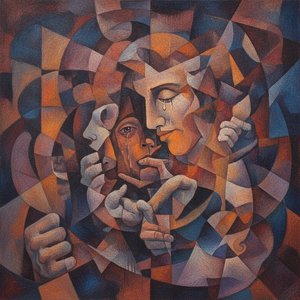
Amadeo de Souza-Cardoso: A Pioneer of Portuguese Modernism
Amadeo de Souza-Cardoso, a name resonating with the vibrant energy of early 20th-century modernism, remains a somewhat enigmatic figure despite his pivotal role in bridging Portuguese art to the international avant-garde. Born on November 14, 1887, in Manhufe, Portugal, his brief but intensely creative life was marked by a restless spirit and an unwavering dedication to artistic innovation. From humble beginnings rooted in the rural landscapes of his homeland, Souza-Cardoso embarked on a journey that would lead him to the heart of Parisian modernism, where he forged connections with some of the most influential artists of his time – Modigliani, Brancusi, Delaunay, and Gris among them. His early education began with architectural studies in Lisbon, but it was the allure of painting, particularly the expressive power of caricature, that truly captivated his imagination and set him on a path toward artistic exploration. This initial foray into art wasn’t merely technical training; it was an awakening to the potential of visual language as a means of commentary and self-expression.
- Early Life & Education: Born in Manhufe, Portugal, Amadeo’s upbringing instilled in him a deep appreciation for rural landscapes and a fascination with observation—skills that would prove invaluable throughout his artistic career. His architectural studies provided foundational knowledge but it was caricature that ignited his passion for visual storytelling.
- Parisian Encounters & Artistic Development: In 1906, Souza-Cardoso relocated to Paris, immersing himself in the city’s burgeoning artistic milieu and immediately absorbing the radical ideas reshaping art history. Influenced by Cubism and Futurism, he synthesized these movements with his own distinctive sensibility, creating a style characterized by bold forms, vibrant colors, and dynamic compositions.
- Key Achievements & Exhibitions: Souza-Cardoso’s participation in pivotal exhibitions like the Salon des Indépendants and the groundbreaking 1913 Armory Show cemented his place as a champion of Portuguese modernism and brought his innovative work to an international audience. His paintings, notably *Saut du Lapin* (1911) and *Cabeça* (1913), exemplify this period’s experimentation with perspective and chromatic intensity.
- Cultural Synthesis & Legacy: Souza-Cardoso skillfully blended Portuguese cultural motifs—religious processions, rural landscapes—with modernist techniques, demonstrating a remarkable ability to reconcile seemingly disparate influences. His work continues to inspire contemporary artists and serves as a reminder of the transformative power of artistic innovation.
Style & Technique: A Dialogue Between Tradition and Avant-Garde
Souza-Cardoso’s distinctive style wasn't simply imitation; it was transformation—a deliberate reimagining of established movements to forge something entirely new. He embraced Cubism and Futurism, but he didn’t merely replicate their visual vocabulary. Instead, he analyzed them critically, extracting essential elements while rejecting conventions that felt restrictive. His canvases pulsed with vibrant color palettes—aggressive reds, yellows, blues—and employed dynamic compositions featuring fragmented perspectives and seemingly chaotic arrangements that were meticulously balanced beneath the surface. This approach reflected a profound understanding of perceptual experience and aimed to convey emotion through formal innovation.
Notable Works
Among Souza-Cardoso’s most celebrated paintings are *Saut du Lapin* (1911), which showcases his masterful manipulation of perspective and color, and *Cabeça* (1913), a striking portrait that embodies the artist's exploration of form and psychological depth. These pieces stand as testaments to his artistic vision—bold statements against conventional representation. His contribution to Portuguese art history is undeniable, securing his place among the foremost figures of modernism.
Recognition & Remembrance
Despite initial obscurity following his untimely death in 1918, Souza-Cardoso’s legacy has experienced a resurgence in recent decades thanks to major retrospectives—one in 1958 and another at the Grand Palais in Paris in 2016—which reintroduced his work to a wider audience. Today, his paintings reside in museums worldwide, including the Plymouth City Museum and Art Gallery, alongside masterpieces by other influential artists. His enduring influence underscores the importance of artistic experimentation and cultural exchange.



 Visualizar em escala
 Ver impressão do pedido
 Enviar
 Compartilhar
 Ver detalhes

 Baixar
 Semelhantes
 Raio X
 Apresentação de slides


 Ver mais






































 A opção de vidro está disponível apenas para tamanhos inferiores a 110 cm