Ateliê — Envio gratuito para todo o mundo — Entrega em 2–6 semanas
      Jan Weenix, 1642 – 1719

      As 100 pinturas mais famosas de Jan Weenix

      Game Still-Life with Statue of Diana (1703) é a pintura pela qual Jan Weenix é mais lembrado; pertence ao Alte Pinakothek, Munique. Peacock and Hunting Trophies (1708) e Portrait of Abraham van Bronckhorst (1656-?) (1688) completam o trio das telas mais amadas. O nosso catálogo conta com 124 obras de Jan Weenix. Aqui estão as 100 mais famosas, com o ano, o museu e a história de cada tela.

      Classificado de acordo com o nosso índice de popularidade, que combina buscas, visitas e pedidos de cada obra. Atualizado em Novembro 2026. Cada pintura nesta página pode ser encomendada como uma reprodução a óleo pintada à mão sobre tela de linho, ou como uma impressão fine art, feita no tamanho que escolher.

      Retrato de Jan Weenix
      Jan Weenix · 1642 – 1719
      Nascimento · falecimento
      1642 – 1719, Amesterdão
      Movimento
      Baroque
      Obras em nosso catálogo
      124
      As mais famosas
      Game Still-Life with Statue of Diana (1703)
      Mais obras em
      Bavarian State Painting Collections

      As dez pinturas mais amadas de Jan Weenix

      Game Still-Life with Statue of Diana (1703) de Jan Weenix
      1

      Game Still-Life with Statue of Diana

      1703 · Oil On Canvas · Alte Pinakothek, Munique

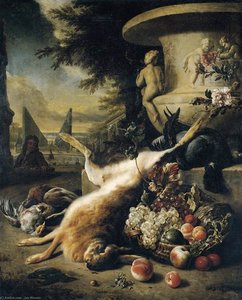
      Jan Weenix's "Game Still-Life with Statue of Diana," painted in 1703, isn’t merely a depiction of hunting trophies; it’s a meticulously crafted tableau brimming with symbolism and reflecting the sophisticated tastes of the Dutch Golden Age. The painting immediately draws the eye to its central subject: a magnificent statue of Diana, goddess of the hunt, presiding over a carefully arranged display of slain game – a stag, a deer, and…

      Reprodução em óleo pintada à mão de $178 24 × 42 cm
      Peacock and Hunting Trophies (1708) de Jan Weenix
      2

      Peacock and Hunting Trophies

      1708 · Acrylic On Canvas · Fundação Calouste Gulbenkian, Lisboa

      Jan Weenix’s “Peacock and Hunting Trophies,” painted in 1708, is more than just a still life; it’s a meticulously crafted window into the opulent world of the Dutch Golden Age. This large composition, measuring a substantial 200 x 195 cm, transports us to a scene of carefully curated abundance – a testament to the wealth and leisure enjoyed by the Palatine Elector Johann Wilhelm and his court at Bensberg Castle.…

      Reprodução em óleo pintada à mão de $178 32 × 32 cm Mesmo tamanho da original $1317 195 × 200 cm Encomendar no tamanho original →
      Portrait of Abraham van Bronckhorst (1656-?) (1688) de Jan Weenix
      3

      Portrait of Abraham van Bronckhorst (1656-?)

      1688 · Oil On Canvas · Amsterdam Museum, Amsterdão

      The oil on canvas known as Portrait of Abraham van Bronckhorst (1656-?) brings a moment from 1688 into sharp focus. Jan Weenix captures the likeness of Abraham van Bronckhorst (1656-?) with a precision that feels immediate, as if the subject has only just paused his movements to face the viewer. This portrait functions as a window into a specific life, rendered through the skilled hand of Jan Weenix during the…

      Reprodução em óleo pintada à mão de $203 29 × 35 cm Mesmo tamanho da original $367 74 × 87 cm Encomendar no tamanho original →
      Dead Peacock and Game (1707) de Jan Weenix
      4

      Dead Peacock and Game

      1707 · Oil On Canvas · Wallace Collection, Londres

      The oil on canvas work titled Dead Peacock and Game was executed by the artist Jan Weenix in 1707. This painting captures a stillness held within the pigments of the Dutch Golden Age. The medium of oil allows for a precise rendering of the subjects, fixing them in a permanent, silent state.

      Reprodução em óleo pintada à mão de $203 29 × 35 cm Mesmo tamanho da original $510 97 × 115 cm Encomendar no tamanho original →
      Dead Hare and Dog (1717) de Jan Weenix
      5

      Dead Hare and Dog

      1717 · Oil On Canvas · Wallace Collection, Londres

      Step closer and observe the quiet drama unfolding within this composition. Jan Weenix has captured a moment of stillness that follows the intensity of the chase. A dead hare hangs prominently, its form creating a strong diagonal movement that pulls the eye from the center toward the upper right of the canvas. This central figure is surrounded by the spoils of the hunt—a turkey, various birds, and a magpie—all set…

      Reprodução em óleo pintada à mão de $203 29 × 34 cm Mesmo tamanho da original $573 107 × 124 cm Encomendar no tamanho original →
      The Dead Swan (1716) de Jan Weenix
      6

      The Dead Swan

      1716 · Oil On Canvas · Museum Boijmans Van Beuningen, Roterdã

      A large white swan hangs vertically from a stone pedestal on the right side of the canvas. Its neck curves downward toward the bottom edge of the frame. Below the swan, a peacock with blue and green plumage lies alongside a smaller duck. To the left, a collection of peaches and grapes rests near the base of the arrangement. The scene is set against a landscape of dark trees and…

      Reprodução em óleo pintada à mão de $178 30 × 34 cm Mesmo tamanho da original $949 154 × 173 cm Encomendar no tamanho original →
      Stilleben med död svan, en påfågel och en hund vid en trädgårdsfontän (1684) de Jan Weenix
      7

      Stilleben med död svan, en påfågel och en hund vid en trädgårdsfontän

      1684 · Oil On Canvas · Nationalmuseum, Estocolmo

      A dead swan lies in the foreground, its white feathers a stark, pale weight against the dark earth. Beside it, a peacock spreads its plumage, a sudden burst of color amidst the muted tones of the garden. A black-and-white hunting dog rests near the scene, its fur coarse and textured under the light. In the distance, a stone fountain and classical statuary rise from a hazy, atmospheric landscape. The air…

      Reprodução em óleo pintada à mão de $178 28 × 35 cm Mesmo tamanho da original $888 138 × 178 cm Encomendar no tamanho original →
      Dead Swan (1709) de Jan Weenix
      8

      Dead Swan

      1709 · Oil On Canvas · Mauritshuis, Haia

      The scene unfolds through Dead Swan, a hunting still-life painted by Jan Weenix in 1716. This work presents a quiet, heavy moment of nature morte, where the stillness of the subjects invites a contemplation of vanitas. A large swan lies at the center of the drama, its presence anchored by a stone pedestal that grounds the composition within a sprawling landscape.

      Reprodução em óleo pintada à mão de $253 35 × 29 cm
      Portrait of a Dutch Merchant (1686) de Jan Weenix
      9

      Portrait of a Dutch Merchant

      1686 · Oil On Canvas · Städel Museum, Frankfurt

      A man stands in a three-quarter length pose, positioned slightly off-center against a stone ledge. He wears a blue-grey outer robe over a white lace cravat and sleeves. The fabric of the robe possesses a heavy sheen, while the lace displays intricate, fine detail. A patterned textile is draped to the right, showing a coarse weave. His dark hair is arranged in curls, and his skin is rendered with realistic…

      Reprodução em óleo pintada à mão de $178 30 × 34 cm Mesmo tamanho da original $242 52 × 60 cm Encomendar no tamanho original →
      Flowers on a Fountain with a Peacock (1710) de Jan Weenix
      10

      Flowers on a Fountain with a Peacock

      1710 · Oil On Canvas · Wallace Collection, Londres

      The canvas presents a dense arrangement of flora, fauna, and classical stone elements set against a receding landscape. In the immediate foreground, a collection of fruit is positioned with tactile precision, including grapes, peaches, plums, and gourds. To the right, a peacock occupies a prominent position, its neck rendered in iridescent blue and its plumage displaying patterned light. On the left, an overflowing bouquet contains red poppies, white anemones, and…

      Reprodução em óleo pintada à mão de $228 30 × 33 cm Mesmo tamanho da original $1075 165 × 177 cm Encomendar no tamanho original →

      Jan Weenix: telas de 11 a 100 do ranking

      Corpse of a Youth (1679) de Jan Weenix
      #16

      Corpse of a Youth

      1679 · Bavarian State Painting Collections

      In this large-scale Baroque painting, Jan Weenix presents a scene of profound solemnity. The central focus rests upon the corpse of a youth, whose body lies horizontally across…

      Encomende esta tela a partir de $278 →
      Bagged Game (1679) de Jan Weenix
      #17

      Bagged Game

      1679 · Bavarian State Painting Collections

      Jan Weenix presents a dense, pyramidal arrangement of hunted game in Bagged Game. This monochrome reproduction of a 17th-century Dutch still-life centers on a collection of animal carcasses.…

      Leve esta luz para casa a partir de $178 →
      Two Riders (1679) de Jan Weenix
      #19

      Two Riders

      1679 · Bavarian State Painting Collections

      In this vertical landscape, we find Two Riders, a work executed by Jan Weenix in 1679. The painting captures a quiet moment within a dense woodland, focusing on…

      Encomende esta tela a partir de $178 →
      Boar Hunt (1703) de Jan Weenix
      #79

      Boar Hunt

      1703 · Alte Pinakothek

      Jan Weenix's "Boar Hunt," painted around 1703, isn’t merely a depiction of a hunt; it’s a meticulously crafted tableau of primal instinct, stoic heroism, and the fleeting beauty…

      Encomende esta tela a partir de $178 →

      As telas de Jan Weenix, período por período

      O que Jan Weenix mais pintou

      Os quatro temas que mais aparecem nestas telas, cada um com o seu exemplo mais amado.

      Onde as telas de Jan Weenix estão expostas

      Os 8 museus que detêm a maioria das pinturas desta página.

      Museus Cidade Obras de Jan Weenix Pinturas desta lista
      Bavarian State Painting Collections, MuniqueBavarian State Painting Collections Munique 21 Sleeping girl, Corpse of a Youth, Bagged Game
      Wallace Collection, LondresWallace Collection Londres 14 Dead Peacock and Game, Dead Hare and Dog, Flowers on a Fountain with a Peacock
      Rijksmuseum, AmsterdãRijksmuseum Amsterdã 9 Portrait of Maria Cornelisz, wife of Silvester van Tongeren, A Seated Monkey, Jan Weenix, before 1685, Park with country home
      Alte Pinakothek, MuniqueAlte Pinakothek Munique 3 Game Still-Life with Statue of Diana, After the Hunt, Boar Hunt
      Städel Museum, FrankfurtStädel Museum Frankfurt 3 Portrait of a Dutch Merchant, Still Life with Dead Rabbit and Birds, Peacock and peahen
      Museu Nacional de Varsóvia, VarsóviaMuseu Nacional de Varsóvia Varsóvia 3 Still life, A dog over a dead boar.
      Amsterdam Museum, AmsterdãoAmsterdam Museum Amsterdão 2 Portrait of Abraham van Bronckhorst (1656-?), Agneta Block (Emmerich 29-10-1629 – Amsterdam 20-4-1704), and her family at their summer home Vijverhof (later called Flora Batavia), with her cultivated pineapple
      Petit Palais, ParisPetit Palais Paris 2 The Prodigal Son feasting with the courtesans in the midst of classical ruins, in the distance a Mediterranean harbor, Flowers and Dead Game Before a Landscape

      A tela mais famosa de Jan Weenix, década após década

      1. 1650s
        Fantasy Figures in a Boat with a Cittern Player (1656) de Jan Weenix
        Tela 11 de 100

        Fantasy Figures in a Boat with a Cittern Player

        Idade 8 – 17

        The oil painting titled Fantasy Figures in a Boat with a Cittern Player emerged from the brush of Jan Weenix. Created in 1656, the work captures a specific…

      2. 1660s
        Sleeping girl (1665) de Jan Weenix
        Tela 12 de 100

        Sleeping girl

        Idade 18 – 27 · Bavarian State Painting Collections

        A young woman reclines in a state of deep repose, her form nestled against the heavy, textured folds of her dress. Beside her, a white dog rests in…

      3. 1670s
        Corpse of a Youth (1679) de Jan Weenix
        16 de 100

        Corpse of a Youth

        Idade 28 – 37 · Bavarian State Painting Collections

        In this large-scale Baroque painting, Jan Weenix presents a scene of profound solemnity. The central focus rests upon the corpse of a youth, whose body lies horizontally across…

      4. 1680s
        Portrait of Abraham van Bronckhorst (1656-?) (1688) de Jan Weenix
        Classificado em 3 de 100

        Portrait of Abraham van Bronckhorst (1656-?)

        Idade 38 – 47 · Amsterdam Museum

        The oil on canvas known as Portrait of Abraham van Bronckhorst (1656-?) brings a moment from 1688 into sharp focus. Jan Weenix captures the likeness of Abraham van…

      5. 1690s
      6. 1700s
        Game Still-Life with Statue of Diana (1703) de Jan Weenix
        1 de 100

        Game Still-Life with Statue of Diana

        Idade 58 – 67 · Alte Pinakothek

        Jan Weenix's "Game Still-Life with Statue of Diana," painted in 1703, isn’t merely a depiction of hunting trophies; it’s a meticulously crafted tableau brimming with symbolism and reflecting…

      7. 1710s
        Dead Hare and Dog (1717) de Jan Weenix
        Classificado em 5 de 100

        Dead Hare and Dog

        Idade 68 – 77 · Wallace Collection

        Step closer and observe the quiet drama unfolding within this composition. Jan Weenix has captured a moment of stillness that follows the intensity of the chase. A dead…

      As telas de Jan Weenix, pergunta por pergunta

      Por qual tela Jan Weenix é mais lembrado(a)?Leia a resposta

      Game Still-Life with Statue of Diana (1703), Alte Pinakothek, Munique. Seguidos por Peacock and Hunting Trophies (1708) e Portrait of Abraham van Bronckhorst (1656-?) (1688).

      Game Still-Life with Statue of Diana: que idade tinha Jan Weenix quando foi pintada?Leia a resposta

      Jan Weenix, nascido(a) em 1642, tinha 61 anos: Game Still-Life with Statue of Diana data de 1703.

      Quais são as dez telas mais famosas de Jan Weenix?Leia a resposta

      Game Still-Life with Statue of Diana, Peacock and Hunting Trophies, Portrait of Abraham van Bronckhorst (1656-?), Dead Peacock and Game, Dead Hare and Dog, The Dead Swan, Stilleben med död svan, en påfågel och en hund vid en trädgårdsfontän, Dead Swan, Portrait of a Dutch Merchant e Flowers on a Fountain with a Peacock. Cada tela no ranking acima inclui o seu ano e o seu museu.

      Quantas pinturas Jan Weenix criou?Leia a resposta

      124 obras de Jan Weenix estão em nosso catálogo, datadas de 1656 a 1719.

      Onde estão expostas hoje as telas mais famosas de Jan Weenix?Leia a resposta

      Principalmente em Bavarian State Painting Collections (Munique), Wallace Collection (Londres) e Rijksmuseum (Amsterdã); a lista acima indica cada museu e as suas telas.

      Quando é que Jan Weenix pintou as suas telas mais famosas?Leia a resposta

      Em 1700s, que compreende 31 das 100 obras desta página, Game Still-Life with Statue of Diana entre elas.

      Qual tela famosa de Jan Weenix veio primeiro e qual veio por último?Leia a resposta

      A tela mais antiga aqui é de Fantasy Figures in a Boat with a Cittern Player (1656); a mais recente é de boy with dog, dead hare and birds in landscape (1719).

      Quais temas Jan Weenix mais pintou?Leia a resposta

      Landscape (49), Dog (24) e Hare (24), entre as 100 obras nesta página.

      Qual técnica é mais presente nas pinturas de Jan Weenix?Leia a resposta

      Oil On Canvas, utilizado em 81 das 100 obras nesta página.

      Com qual movimento Jan Weenix está associado(a)?Leia a resposta

      Baroque, como mostram as telas nesta página.

      Quais pinturas de Jan Weenix estão no Bavarian State Painting Collections?Leia a resposta

      O Bavarian State Painting Collections, Munique detém 21 das obras desta página, entre elas Sleeping girl, Corpse of a Youth e Bagged Game.

      Onde posso comprar uma reprodução de uma pintura de Jan Weenix?Leia a resposta

      Sim. Todas as pinturas desta página podem ser encomendadas a partir de sua própria página como uma reprodução a óleo pintada à mão, ou como uma impressão fine art, no tamanho de sua escolha.

      Conheça o pintor: Jan Weenix

      Um Legado do Realismo Holandês: A Vida e a Arte de Jan Weenix

      Jan Weenix, nascido em Amsterdã em 1641, emergiu de uma linhagem profundamente imersa na tradição artística, herdando a paixão pela pintura de seu pai, o estimado Jan Baptist Weenix. Embora os detalhes precisos sobre seus primeiros anos permaneçam um tanto elusivos, é evidente que o jovem Jan recebeu treinamento fundamental no atelier de seu pai, absorvendo técnicas cruciais para a representação tanto de naturezas-mortas quanto de temas animais — uma marca registrada da arte da Era de Ouro holandesa. Esta influência familiar não foi meramente técnica; ela instilou um profundo apreço pela observação meticulosa da natureza e um compromisso em retratar sua beleza com um realismo impressionante. A própria jornada artística do pai, incluindo estadias na Itália que infundiram seu trabalho com uma sensibilidade italianizante, sem dúvida moldou também a estética em desenvolvimento de Jan. Embora inicialmente ofuscado pela reputação de seu pai, Jan rapidamente se distinguiu, forjando um caminho único dentro da vibrante paisagem da pintura holandesa do século XVII.

      O Florescimento de um Estilo Barroco

      O estilo artístico de Weenix floresceu durante o auge do período Barroco, refletindo a inclinação da época pelo drama, pelo detalhe rico e pela composição dinâmica. Ele não trabalhava isoladamente; influências de contemporâneos como Hendrick Cornelisz Vroom, renomado por suas pinturas marinhas, e possivelmente outros especialistas em temas animais, como Melchior de Hondecoeter e Gillis Claesz d'Hondecoeter, informaram sutilmente sua abordagem. No entanto, Weenix sintetizou essas inspirações em um estilo distintamente seu. Suas telas são caracterizadas por uma precisão quase fotográfica na representação de texturas — o brilho das penas, a suavidade da pelagem, a delicada translucidez das frutas — tudo alcançado através de pinceladas magistrais e uma compreensão aguçada de luz e sombra. O Chiaroscuro, o jogo dramático entre claro e escuro, é empregado para criar profundidade e interesse visual, atraindo o espectador para a cena com um realismo envolvente. Uma paleta de cores vibrante anima ainda mais seus temas, imbuindo-os de uma sensação de imediatismo e vitalidade. Ele possuía uma habilidade excepcional em organizar elementos dentro do quadro, criando composições equilibradas e harmoniosas que são, ao mesmo tempo, visualmente atraentes e narrativamente cativantes.
      Obras-Primas e Patronato

      Ao longo de sua carreira, Jan Weenix produziu um corpo substancial de obras celebradas por seu brilho técnico e temática cativante. Pinturas como Natureza-morta com Caça e Frutas junto a um Vaso de Jardim (1714) exemplificam sua capacidade de integrar perfeitamente diversos elementos — aves de caça, frutas suculentas, detalhes arquitetônicos — em um arranjo complexo e visualmente deslumbrante. Natureza-morta com uma Lebre e outras Caças (1697) demonstra seu domínio da anatomia animal e da textura, capturando a qualidade realista de seus temas com uma precisão notável. Mesmo obras menores, como Um Macaco Sentado (antes de 1685), revelam seu talento para imbuir animais com personalidade e caráter expressivo. Essa habilidade não passou despercebida por patronos proeminentes. Em 1702, Weenix recebeu um convite para a corte de Johann Wilhelm, Eleitor Palatino, onde trabalhou ao lado de outros artistas renomados, criando cenas de caça em grande escala para o Schloss Bensberg — um testemunho de sua crescente reputação e destreza artística. Esses encargos proporcionaram-lhe tanto segurança financeira quanto oportunidades para refinar ainda mais suas habilidades.

      Uma Influência Duradoura na Arte Holandesa

      Jan Weenix desempenhou um papel fundamental na popularização das naturezas-mortas de caça e das pinturas de caça durante o período Barroco, elevando esses gêneros para além da mera decoração. Suas obras eram altamente procuradas por colecionadores, contribuindo significativamente para o desenvolvimento das tradições artísticas holandesas. Ele não apenas replicava a natureza; ele a interpretava através de sua lente única, imbuindo suas pinturas com um senso de realismo, drama e beleza estética que ressoou profundamente com o público contemporâneo. Seu legado estende-se para além de suas próprias criações; sua filha, Maria Weenix, continuou a tradição familiar como uma habilidosa pintora de flores, garantindo que o nome Weenix permanecesse sinônimo de excelência artística por gerações. Hoje, as pinturas de Jan Weenix são tesouros em museus e coleções particulares ao redor do mundo, continuando a inspirar artistas e a cativar o público com suas representações magistrais do mundo natural — um testemunho de sua contribuição duradoura para a rica tapeçaria da história da arte holandesa.
