Ateliê — Envio gratuito para todo o mundo — Entrega em 2–6 semanas
      Anna Ancher, 1859 – 1935

      As 100 pinturas mais famosas de Anna Ancher, classificadas

      A pintura mais amada de Anna Ancher é Dansk Dagens arbejde bedømmes English Appraising the Day's Work (1883), que está exposta no Statens Museum For Kunst, Copenhague. A Mãe do Artista, Anna Hedvig Brøndum (1913) e Mrs Ane Hedvig Brøndum. Anna Ancher vêm a seguir entre as telas que os leitores mais conhecem. O nosso catálogo contém 193 obras de Anna Ancher: aqui estão as 100 mais famosas, cada uma com o seu ano, o seu museu e o que a torna memorável.

      Classificado de acordo com o nosso índice de popularidade, que combina buscas, visitas e pedidos de cada obra. Atualizado em Outubro 2026. Cada pintura nesta página pode ser encomendada como uma reprodução a óleo pintada à mão sobre tela de linho, ou como uma impressão fine art, feita no tamanho que escolher.

      Retrato de Anna Ancher
      Anna Ancher · 1859 – 1935
      Nascimento · falecimento
      1859 – 1935, Skagen
      Movimento
      Impressionistic portrait
      Obras em nosso catálogo
      193
      Mais famosas
      Dansk Dagens arbejde bedømmes English Appraising the Day's Work (1883)
      Mais obras em
      Skagens Museum

      As 10 principais pinturas de Anna Ancher: as telas que todos conhecem

      Dansk Dagens arbejde bedømmes English Appraising the Day's Work (1883) de Anna Ancher
      1

      Dansk Dagens arbejde bedømmes English Appraising the Day's Work

      1883 · Oil On Canvas · Statens Museum For Kunst, Copenhague

      Anna Kirstine Brøndum Ancher, universally recognized as Anna Ancher, stands apart in the annals of Danish art history – not merely as a painter but as an embodiment of Skagen itself. Born in 1859 amidst the windswept shores and ethereal lightscape of Skagen, Denmark’s northernmost village, her artistic journey was inextricably intertwined with the very essence of its identity.

      A Mãe do Artista, Anna Hedvig Brøndum (1913) de Anna Ancher
      2

      A Mãe do Artista, Anna Hedvig Brøndum

      1913 · Acrílico sobre tela · Skagens Museum, Skagen

      Anna Kirstine Ancher’s “The Artist’s Mother, Anna Hedvig Brøndum” is more than just a depiction of an elderly woman; it’s a distillation of Skagen’s spirit—a testament to resilience, quiet dignity, and the enduring beauty found in simplicity. Painted in 1913, this portrait captures a moment frozen in time, illuminated by the distinctive Nordic light that defines the coastal village where Ancher spent her formative years.

      Mrs Ane Hedvig Brøndum. Anna Ancher de Anna Ancher
      3

      Mrs Ane Hedvig Brøndum. Anna Ancher

      Oil On Canvas · Skagens Museum, Skagen

      Anna Kirstine Ancher's "Mrs. Ane Hedvig Brøndum," painted in 1882, is more than a simple portrait; it’s a profound meditation on age, resilience, and the quiet dignity of rural life in Skagen, Denmark. Born into a family deeply intertwined with the burgeoning artistic community of this remote fishing village at the very edge of Europe, Ancher possessed an unparalleled ability to capture not just likeness but also the essence of…

      Bonatzi with the rooster (1906) de Anna Ancher
      4

      Bonatzi with the rooster

      1906 · Oil On Canvas · Skagens Museum, Skagen

      is an oil on canvas painting from 1906 that presents a somber and intimate scene. The composition features an elderly, bearded man positioned slightly off-center, occupying much of the vertical space. He is dressed in dark, heavy clothing and is depicted holding a large white rooster by its legs. The bright white plumage of the bird serves as a central focal point, drawing the viewer's eye downward against the man's…

      Churchgoers (1909) de Anna Ancher
      5

      Churchgoers

      1909 · Oil

      A group of individuals gathers in a moment of shared reflection. Dressed in long robes and headscarves, the congregation faces forward, their bodies arranged in a composition that suggests a collective pause in time. Some figures tilt their heads upward, eyes directed toward the heavens or perhaps toward a speaker unseen. The scene captures the stillness of a ritual, focusing on the quietude of worship within a communal space.

      Anna Ancher Fru Ane Brøndum i den blå stue English Mrs Ane Brøndum in the blue room (1913) de Anna Ancher
      6

      Anna Ancher Fru Ane Brøndum i den blå stue English Mrs Ane Brøndum in the blue room

      1913 · Oil On Canvas

      The oil on canvas painting titled Anna Ancher Fru Ane Brøndum i den blå stue English Mrs Ane Brøndum in the blue room by Anna Ancher brings us into a quiet, private moment from 1913. Within this intimate setting, the artist turns her gaze toward the most personal of subjects: her own mother, Ane Hedvig Brøndum. There is a profound sense of stillness as the woman sits, captured in a…

      Midday Meal in the Garden (1915) de Anna Ancher
      7

      Midday Meal in the Garden

      1915 · Oil On Canvas

      In the quiet, dappled light of a Danish summer, Anna Kirstine Ancher captures a scene that transcends mere domesticity to become a profound meditation on nourishment and peace. Midday Meal in the Garden is a breathtaking masterwork of Danish Impressionism, inviting the viewer into a secluded sanctuary where time seems to slow. The painting depicts a woman, perhaps a figure of maternal strength and grace, preparing food for a group…

      An old wife of a fisherman (1887) de Anna Ancher
      8

      An old wife of a fisherman

      1887 · Oil On Canvas · Skagens Museum, Skagen

      In "An old wife of a fisherman" by Anna Ancher, the artist invites us into a quiet, interior scene that feels deeply personal. The composition focuses on an elderly woman engaged in the rhythmic, meticulous task of mending fishing nets. This intimate portraiture avoids grand gestures, choosing instead to find weight in the stillness of a domestic moment. The subject is positioned within a space that feels lived-in and purposeful,…

      Blind woman, Blue Ane (Ane Christense Nielsdatter) (1882) de Anna Ancher
      9

      Blind woman, Blue Ane (Ane Christense Nielsdatter)

      1882 · Oil On Canvas · Skagens Museum, Skagen

      In this intimate portrait, titled Blind woman, Blue Ane (Ane Christense Nielsdatter), the artist Anna Ancher turns her gaze toward a specific member of the Skagen community. Created in 1882, the work presents us with Ane Christense Nielsdatter, a woman whose life was defined by her blindness. It is a quiet encounter with a person who lived within the social fabric of the Danish coast, captured during a period when…

      Mais telas de Anna Ancher, de 11 a 100

      The pear tree, autumn (1888) de Anna Ancher
      #84

      The pear tree, autumn

      1888 · Anchers Hus

      In the quiet, sun-drenched corners of Denmark, there exists a specific kind of magic found only when the seasons begin to turn. Anna Kirstine Ancher, a true daughter…

      Leve esta luz para casa →
      Sheep Shearing (1900) de Anna Ancher
      #85

      Sheep Shearing

      1900 · Kunsten Museum of Modern Art Aalborg

      The painting by Anna Kirstine Ancher is a beautiful depiction of a traditional family activity. Created in 1900, this oil on canvas piece is now housed at the…

      Encomende uma pintura feita à mão →

      O que Anna Ancher mais pintou

      Os quatro temas que mais aparecem nestas telas, cada um com o seu exemplo mais amado.

      Onde as telas de Anna Ancher estão expostas

      Os 8 museus que detêm a maioria das pinturas desta página.

      Museu Cidade Obras de Anna Ancher Pinturas desta lista
      Skagens Museum, SkagenSkagens Museum Skagen 48 A Mãe do Artista, Anna Hedvig Brøndum, Mrs Ane Hedvig Brøndum. Anna Ancher, Bonatzi with the rooster
      Anchers Hus, SkagenAnchers Hus Skagen 17 Saying Grace (HAF3069), Young woman in a green dress, sitting in the dunes, Young woman in black with a white headscarff, sitting in the dunes
      Hirschsprung Collection, CopenhagueHirschsprung Collection Copenhague 8 A blind woman in her room, Two old people and their rabbits, Sunshine in the Blind Woman's Room
      Statens Museum For Kunst, CopenhagueStatens Museum For Kunst Copenhague 10 Dansk Dagens arbejde bedømmes English Appraising the Day's Work, Lektien gennemgåes, Mrs. Brøndum
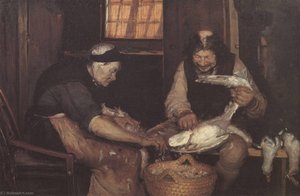
      Kunstmuseum Brandts, OdenseKunstmuseum Brandts Odense 2 Plucking the Christmas Goose. Study., Young Girl in a Garden with Orange Umbrella
      Kunsten Museum of Modern Art Aalborg, AalborgKunsten Museum of Modern Art Aalborg Aalborg 2 English A Young Girl Plucking a Swan Français Une jeune fille plumant un cygne Deutsch Junges Mädchen, einen Schwan rupfend, Sheep Shearing
      Sorø Art Museum, SorøSorø Art Museum Sorø 2 A blind woman
      Ribe Kunstmuseum, EsbjergRibe Kunstmuseum Esbjerg 2 A mother with her child in a sunlit room.

      A tela mais amada de cada década de Anna Ancher

      1. 1870s
      2. 1880s
      3. 1890s
      4. 1900s
        Bonatzi with the rooster (1906) de Anna Ancher
        4 de 100

        Bonatzi with the rooster

        Idade 41 – 50 · Skagens Museum

        is an oil on canvas painting from 1906 that presents a somber and intimate scene. The composition features an elderly, bearded man positioned slightly off-center, occupying much of…

      5. 1910s
        A Mãe do Artista, Anna Hedvig Brøndum (1913) de Anna Ancher
        Classificado em 2 de 100

        A Mãe do Artista, Anna Hedvig Brøndum

        Idade 51 – 60 · Skagens Museum

        Anna Kirstine Ancher’s “The Artist’s Mother, Anna Hedvig Brøndum” is more than just a depiction of an elderly woman; it’s a distillation of Skagen’s spirit—a testament to resilience,…

      6. 1920s
      7. 1930s

      Sobre as telas de Anna Ancher: suas perguntas respondidas

      Qual é a pintura mais conhecida de Anna Ancher?Leia a resposta

      Dansk Dagens arbejde bedømmes English Appraising the Day's Work (1883), Statens Museum For Kunst, Copenhague. Seguidos por A Mãe do Artista, Anna Hedvig Brøndum (1913) e Mrs Ane Hedvig Brøndum. Anna Ancher.

      Qual era a idade de Anna Ancher quando Dansk Dagens arbejde bedømmes English Appraising the Day's Work foi pintada?Leia a resposta

      Anna Ancher, nascido(a) em 1859, tinha 24 anos: Dansk Dagens arbejde bedømmes English Appraising the Day's Work data de 1883.

      Quais são as 10 pinturas mais famosas de Anna Ancher?Leia a resposta

      Dansk Dagens arbejde bedømmes English Appraising the Day's Work, A Mãe do Artista, Anna Hedvig Brøndum, Mrs Ane Hedvig Brøndum. Anna Ancher, Bonatzi with the rooster, Churchgoers, Anna Ancher Fru Ane Brøndum i den blå stue English Mrs Ane Brøndum in the blue room, Midday Meal in the Garden, An old wife of a fisherman, Blind woman, Blue Ane (Ane Christense Nielsdatter) e A blind woman. Cada tela no ranking acima inclui o seu ano e o seu museu.

      Quantas obras Anna Ancher pintou ao todo?Leia a resposta

      193 obras de Anna Ancher estão em nosso catálogo, datadas de 1877 a 1933.

      Onde posso ver as telas mais famosas de Anna Ancher?Leia a resposta

      Principalmente em Skagens Museum (Skagen), Anchers Hus (Skagen) e Hirschsprung Collection (Copenhague); a lista acima indica cada museu e as suas telas.

      Quando é que Anna Ancher pintou as suas telas mais amadas?Leia a resposta

      Em 1900s, que compreende 29 das 100 obras desta página, Bonatzi with the rooster entre elas.

      Quais são as primeiras e as últimas telas famosas de Anna Ancher?Leia a resposta

      A tela mais antiga aqui é de Self portrait (1877); a mais recente é de A young girl in the garden. (1933).

      O que Anna Ancher mais pintou?Leia a resposta

      Elderly woman (5), Domestic interior (4) e People (4), entre as 100 obras nesta página.

      Com qual técnica Anna Ancher pintou com mais frequência?Leia a resposta

      Oil On Canvas, utilizado em 9 das 100 obras nesta página.

      A que movimento pertence a pintura de Anna Ancher?Leia a resposta

      Impressionistic portrait, como mostram as telas nesta página.

      Quais telas de Anna Ancher estão expostas no Skagens Museum?Leia a resposta

      O Skagens Museum, Skagen detém 26 das obras desta página, entre elas A Mãe do Artista, Anna Hedvig Brøndum, Mrs Ane Hedvig Brøndum. Anna Ancher e Bonatzi with the rooster.

      Posso comprar uma reprodução de uma tela de Anna Ancher?Leia a resposta

      Sim. Todas as pinturas desta página podem ser encomendadas a partir de sua própria página como uma reprodução a óleo pintada à mão, ou como uma impressão fine art, no tamanho de sua escolha.

      Anna Ancher: uma vida em pintura

      A Life Bathed in the Light of Skagen

      Anna Kirstine Brøndum Ancher, forever known as Anna Ancher, occupies a unique and cherished position within Danish art history. Born in 1859 in the remote fishing village of Skagen, at the very tip of Denmark’s Jutland peninsula, she was intrinsically linked to the landscape and community that would become synonymous with her artistic vision. Unlike many of her fellow *Skagen Painters*, Anna wasn't a visitor drawn by the dramatic Nordic light; she *was* of Skagen, born and raised within its bracing winds and ever-changing skies. This deep connection imbued her work with an authenticity and intimacy rarely found in artists who merely observed from afar. Her father, Erik Andersen Brøndum, owned the renowned Brøndums Hotel, a haven for artists seeking to capture the raw beauty of the region – a constant exposure that undoubtedly nurtured her early artistic inclinations. From childhood, she was surrounded by creative energy and the stimulating exchange of ideas, laying the foundation for a life dedicated to painting.

      Early Years and Artistic Training

      Anna’s talent blossomed early, prompting her family to support her formal training. She spent three years at the Vilhelm Kyhn College of Painting in Copenhagen, honing her skills in drawing and developing a distinctive style characterized by sensitive observation and a nuanced understanding of color. This period provided her with a solid technical foundation, but it was her time studying in Paris, at the atelier of Pierre Puvis de Chavannes alongside Marie Triepcke (later Krøyer), that broadened her artistic horizons. This exposure to new techniques and perspectives proved invaluable, yet she always remained true to her Nordic roots. The influence of Puvis de Chavannes, with his focus on timeless subjects and evocative atmosphere, combined with the Parisian Impressionist movement, shaped Anna’s approach to composition and color. She learned to capture fleeting moments and convey emotions through subtle shifts in light and shadow – skills that would become central to her unique style. Crucially, she also developed a deep appreciation for the quiet dignity of everyday life, a theme that would dominate much of her work.

      The Skagen Circle and Artistic Partnership

      In 1880, a pivotal moment arrived when she married Michael Ancher, another prominent Skagen Painter. Their partnership was not only a personal union but also an artistic one, fostering mutual inspiration and support throughout their careers. They shared a studio, critiqued each other’s work, and often painted together – a rare and invaluable collaboration in the art world of the time. Michael's encouragement and Anna's independent spirit created a dynamic that fueled both their creativity. Their home became a gathering place for other artists associated with the Skagen Painters group, including Peder Severin Krøyer and Laurits Andersen Sørensen, contributing to a vibrant artistic community in the remote village. This close-knit circle provided a constant source of intellectual stimulation and artistic exchange.

      A Style Defined by Light and Intimacy

      Anna Ancher’s artistic focus centered on portraying the everyday lives of the people of Skagen – fishermen, their wives, and children – within intimate domestic settings. She wasn't interested in grand historical narratives or mythological scenes; instead, she found beauty and significance in the ordinary moments of existence. Her paintings are characterized by a remarkable sensitivity to light and color, skillfully capturing the fleeting effects of sunlight streaming through windows, illuminating interiors with a warm, inviting glow. Works like *Blue Ane* (1882) showcase her mastery of color interplay, while *The Girl in the Kitchen* (1883-1886) offers a poignant glimpse into domestic life. She possessed an exceptional ability to convey atmosphere and emotion through subtle nuances of tone and texture. Her later work, such as *Interior with Clematis* (1913), further demonstrates her evolving skill in exploring the interplay of light and shadow, creating scenes that are both visually captivating and emotionally resonant. She wasn’t merely depicting what she saw; she was conveying how it *felt* to be present in those moments. Her subjects were often rendered with a remarkable degree of realism, yet imbued with a sense of warmth and humanity.

      Legacy and Enduring Influence

      Anna Ancher's contributions to Danish art extend beyond her individual paintings. As a pioneering female artist, she challenged conventional norms and paved the way for future generations of women artists. Her work played a crucial role in the development of Danish Impressionism and the broader Nordic Modern Breakthrough movement, which sought a more truthful and authentic representation of reality. Today, her paintings are held in prestigious collections such as the Hirschsprung Collection in Copenhagen, Helga Anchers Fond, and Skagens Museum – testaments to her enduring artistic merit. The Anchers’ home in Skagen has been preserved as a museum, *Anchers Hus*, offering visitors a unique opportunity to step back in time and experience the world that inspired their art. It stands as a living tribute to their lives and work, ensuring that Anna Ancher's legacy continues to inspire and captivate audiences for years to come. Her ability to find profound beauty in the simplicity of everyday life, coupled with her masterful handling of light and color, solidifies her place as one of Denmark’s most beloved and significant artists.

      Todas as 193 obras de Anna Ancher →