Ateliê — Envio gratuito para todo o mundo — Entrega em 2–6 semanas
      Balthus, 1908 – 2001

      As 100 pinturas mais famosas de Balthus, classificadas

      A pintura mais amada de Balthus é A Rua (1933). Menina com gato (1937) e The Guitar Lesson (1934) vêm a seguir entre as telas que os leitores mais conhecem. O nosso catálogo contém 200 obras de Balthus: aqui estão as 100 mais famosas, cada uma com o seu ano, o seu museu e o que a torna memorável.

      Classificado de acordo com o nosso índice de popularidade, que combina buscas, visitas e pedidos de cada obra. Atualizado em Outubro 2026.

      Retrato de Balthus
      Balthus · 1908 – 2001
      Nascimento · falecimento
      1908 – 2001, Paris
      Movimento
      Symbolism
      Obras em nosso catálogo
      200
      Mais famosas
      A Rua (1933)
      Mais obras em
      Art Institute of Chicago

      As 10 principais pinturas de Balthus: as telas que todos conhecem

      A Rua (1933) de Balthus
      1

      A Rua

      1933 · Óleo sobre tela

      “A Rua” (1933), de Balthus, é um retrato cativante da vida urbana, fundindo o realismo com um surrealismo sutil para criar uma cena envolvente e instigante. Esta pintura de grandes proporções (195 x 240 cm) captura uma rua movimentada, repleta de diversos personagens entregues a diferentes atividades, oferecendo um vislumbre dos ritmos cotidianos da vida na cidade.

      Menina com gato (1937) de Balthus
      2

      Menina com gato

      1937 · Óleo sobre tela · Art Institute of Chicago, Chicago

      "Menina com gato" (1937) é uma obra-prima cativante de Balthus, renomado por suas composições oníricas e retratos psicologicamente carregados. Esta obra convida os espectadores a um momento íntimo entre uma jovem e seu companheiro felino, evocando uma sensação de tranquilidade e introspecção.

      The Guitar Lesson (1934) de Balthus
      3

      The Guitar Lesson

      1934 · Oil On Canvas

      The air in the room feels heavy, thick with a silence that is not peaceful. A young girl lies arched across the lap of a woman, her body a pale curve against the darker tones of the setting. The teacher’s hands are positioned with a clinical, almost musical intent, yet the gesture is fraught with a strange, unsettling weight. One hand reaches toward the girl's hair, pulling it downward, while…

      La Patience (Solitaire) de Balthus
      4

      La Patience (Solitaire)

      Oil On Canvas

      A young woman leans over a small wooden table, her body forming a heavy diagonal that pulls the eye toward the lower right corner of the canvas. She is caught in a moment of stillness, her posture suggesting a quiet, inward focus. The room is defined by the sharp, vertical rhythm of window blinds, their white and tan stripes cutting through the warmth of the scene. Deep reds, ochres, and…

      Guitar lesson (1934) de Balthus
      5

      Guitar lesson

      1934 · Oil On Canvas

      The painting depicts a provocative encounter between a music teacher, a woman in her early twenties, and a student, a girl thought to be about twelve years old. The teacher has thrown the girl across her lap, pulling her black dress up over her waist. The girl is naked from her navel to her knees, though her lower legs are covered by white socks. The teacher's hand yanks a chunk…

      Girl at the window (1955) de Balthus
      6

      Girl at the window

      1955 · Oil On Canvas

      In this 1957 portrait, we find ourselves in a room defined by a profound sense of stillness. A woman sits in a chair, her gaze directed toward the greenery visible through a window. The composition is anchored by the starkness of a white wall, which provides a sharp contrast to the lush, natural life outside. There is a certain weight to the atmosphere, a feeling of suspended time that invites…

      The white skirt (1937) de Balthus
      10

      The white skirt

      1937 · Oil On Canvas

      In the hushed atmosphere of Balthus’s 1937 masterpiece, The White Skirt, we are invited into a moment of profound stillness. The painting presents a solitary young woman seated within the embrace of an armchair, her presence commanding yet deeply introspective. There is an undeniable gravity to the composition; the figure does not merely sit, she exists in a state of quiet contemplation that seems to suspend time itself. As one…

      Mais telas de Balthus, de 11 a 100

      The Dream (1955) de Balthus
      #14

      The Dream

      1955

      To stand before Balthus’s The Dream is to step across the threshold into a meticulously constructed, yet deeply unsettling, private moment. This painting, dating from around 1955, captures…

      Nude at Rest (1977) de Balthus
      #17

      Nude at Rest

      1977

      To stand before Balthus’s Nude at Rest is to enter a space suspended between wakefulness and dream. The composition centers on a figure seated in an armchair, enveloped…

      Figure in Front of a Mantel (1955) de Balthus
      #19

      Figure in Front of a Mantel

      1955

      In the quietude of mid-century modernism, Balthus captures a moment that feels both profoundly ordinary and hauntingly eternal. Figure in Front of a Mantel invites the viewer into…

      The Cat in the Mirror (1988) de Balthus
      #22

      The Cat in the Mirror

      1988

      The Cat in the Mirror is an oil on canvas work by the artist Balthus. Executed in 1990, the piece is categorized within the Expressionism style. The composition…

      Still Life with Lamp (1958) de Balthus
      #43

      Still Life with Lamp

      1958

      To gaze upon this depiction, Still Life with Lamp, is to step into a moment suspended in amber—a quiet drama played out across the canvas. Balthus, ever the…

      Nude with Cat (1949) de Balthus
      #52

      Nude with Cat

      1949

      To stand before Balthus’s Nude with Cat is to step into a meticulously constructed dreamscape, one steeped in the quiet melancholy and profound stillness characteristic of his genius.…

      The Cat in the Mirror (1990) de Balthus
      #53

      The Cat in the Mirror

      1990

      To stand before Balthus’s The Cat in the Mirror is not merely to observe a painting; it is to step through a veil into a meticulously constructed, dreamlike…

      Drawing room (1942) de Balthus
      #54

      Drawing room

      1942

      The Expressionism movement has given birth to some of the most thought-provoking and visually stunning works of art in history. One such masterpiece is the "Drawing Room" by…

      O que Balthus mais pintou

      Os quatro temas que mais aparecem nestas telas, cada um com o seu exemplo mais amado.

      Onde as telas de Balthus estão expostas

      Os 2 museus que detêm a maioria das pinturas desta página.

      Museu Cidade Obras de Balthus Pinturas desta lista
      Art Institute of Chicago, ChicagoArt Institute of Chicago Chicago 1 Menina com gato
      Museu de Israel, JerusalémMuseu de Israel Jerusalém 1 La Place du Pantheon

      A tela mais amada de cada década de Balthus

      1. 1920s
      2. 1930s
        A Rua (1933) de Balthus
        Classificado em 1 de 100

        A Rua

        Idade 22 – 31

        “A Rua” (1933), de Balthus, é um retrato cativante da vida urbana, fundindo o realismo com um surrealismo sutil para criar uma cena envolvente e instigante. Esta pintura…

      3. 1940s
      4. 1950s
        Girl at the window (1955) de Balthus
        Classificado em 6 de 100

        Girl at the window

        Idade 42 – 51

        In this 1957 portrait, we find ourselves in a room defined by a profound sense of stillness. A woman sits in a chair, her gaze directed toward the…

      5. 1960s
      6. 1970s
        Nude at Rest (1977) de Balthus
        17 de 100

        Nude at Rest

        Idade 62 – 71

        To stand before Balthus’s Nude at Rest is to enter a space suspended between wakefulness and dream. The composition centers on a figure seated in an armchair, enveloped…

      7. 1980s
      8. 1990s
        Waiting (1995) de Balthus
        Tela 41 de 100

        Waiting

        Idade 82 – 91

      Sobre as telas de Balthus: suas perguntas respondidas

      Qual é a pintura mais conhecida de Balthus?Leia a resposta

      A Rua (1933), seguido por Menina com gato (1937) e The Guitar Lesson (1934).

      Qual era a idade de Balthus quando A Rua foi pintada?Leia a resposta

      Balthus, nascido(a) em 1908, tinha 25 anos: A Rua data de 1933.

      Quais são as 10 pinturas mais famosas de Balthus?Leia a resposta

      A Rua, Menina com gato, The Guitar Lesson, La Patience (Solitaire), Guitar lesson, Girl at the window, The King of the Cats, The Cat in the Mediterranean, Le passage du Commerce Saint-Andre Private e The white skirt. Cada tela no ranking acima inclui o seu ano e o seu museu.

      Quantas obras Balthus pintou ao todo?Leia a resposta

      200 obras de Balthus estão em nosso catálogo, datadas de 1926 a 1995.

      Onde posso ver as telas mais famosas de Balthus?Leia a resposta

      Principalmente em Art Institute of Chicago (Chicago) e Museu de Israel (Jerusalém); a lista acima indica cada museu e as suas telas.

      Quando é que Balthus pintou as suas telas mais amadas?Leia a resposta

      Em 1930s, que compreende 22 das 100 obras desta página, A Rua entre elas.

      Quais são as primeiras e as últimas telas famosas de Balthus?Leia a resposta

      A tela mais antiga aqui é de The First Communicants (1926); a mais recente é de Waiting (1995).

      O que Balthus mais pintou?Leia a resposta

      Nudes (11), Women (8) e Woman (7), entre as 100 obras nesta página.

      Com qual técnica Balthus pintou com mais frequência?Leia a resposta

      Oil On Canvas, utilizado em 11 das 100 obras nesta página.

      A que movimento pertence a pintura de Balthus?Leia a resposta

      Symbolism, como mostram as telas nesta página.

      Balthus: uma vida em pintura

      A World Apart: The Enigmatic Vision of Balthus

      Balthasar Klossowski de Rola, universally known as Balthus, remains one of the most compelling and controversial figures in 20th-century art. Born in Paris on February 29, 1908, into a family steeped in intellectual and artistic circles, his life was marked by an early immersion in culture and a deliberate rejection of prevailing artistic trends. His father, Erich Klossowski, was a respected art historian, while his mother, Baladine Klossowska, was a painter herself, fostering an environment where aesthetic contemplation was not merely encouraged but lived. This upbringing instilled in the young Balthus a deep reverence for the Old Masters and a skepticism towards the burgeoning avant-garde movements that dominated the Parisian scene. He wasn’t interested in breaking with tradition; rather, he sought to revitalize classical forms with a distinctly modern sensibility, creating a world uniquely his own—a world often unsettling, always captivating.

      Formative Years and Artistic Awakening

      Balthus's early life was nomadic, disrupted by the outbreak of World War I and his parents’ subsequent separation. These experiences instilled in him a sense of displacement and introspection that would profoundly influence his artistic vision. He began drawing at a remarkably young age, demonstrating an exceptional talent for capturing form and atmosphere. Mentored by Rainer Maria Rilke during his mother's relationship with the poet, Balthus received encouragement to pursue his artistic inclinations. This period was crucial in shaping his aesthetic sensibilities; Rilke’s poetic explorations of inner life resonated deeply with the young artist, fostering a fascination with psychological depth and symbolic resonance. He absorbed influences from diverse sources—pre-Renaissance Italian painters like Piero della Francesca and Simone Martini, as well as literary figures such as Emily Brontë and Lewis Carroll—creating a unique artistic language that defied easy categorization. His early works already hinted at the themes that would define his career: adolescence, solitude, and the complex interplay between innocence and desire. The influence of Rilke is particularly evident in Balthus’s early drawings, which are characterized by their haunting beauty and emotional intensity.

      Controversy and Recognition

      Balthus first exhibited publicly in 1934, presenting a body of work that immediately sparked controversy. Paintings like *The Guitar Lesson*, with its ambiguous depiction of a young girl receiving instruction from an older man, ignited debate about the artist’s intentions and the nature of his gaze. Critics were divided, some condemning the perceived eroticism while others praised the painting's psychological complexity and technical mastery. The subject matter itself – a seemingly innocent scene imbued with a subtle sense of unease – became a focal point of discussion. This controversy, however, only served to solidify Balthus’s reputation as a provocative and unconventional artist. He deliberately cultivated an air of mystery around himself, resisting attempts at biographical interpretation and insisting that his paintings should be experienced directly, without the filter of external commentary. Throughout the 1930s and 40s, he continued to develop his distinctive style, characterized by elongated figures, dramatic lighting, and a meticulous attention to detail. His compositions often featured young girls in states of reverie or contemplation, their poses both graceful and unsettling. The paintings were not merely portraits; they were explorations of the inner lives of his subjects, rendered with an almost obsessive precision.

      A Legacy of Introspection and Influence

      Despite remaining somewhat aloof from the mainstream art world, Balthus achieved significant recognition during his lifetime. He held major exhibitions at the Museum of Modern Art in New York (1956) and throughout Europe, solidifying his position as a leading figure in 20th-century painting. In 1977, he was appointed director of the Académie de France in Rome, a prestigious post that further cemented his status within the artistic establishment. His influence can be seen in the work of numerous contemporary artists, including Jan Saudek, Will Barnet, Duane Michals, and John Currin, who share his interest in figurative painting, psychological realism, and the exploration of complex emotional states. Balthus’s enduring appeal lies not only in his technical virtuosity but also in his ability to tap into universal human experiences—the longing for connection, the fear of isolation, and the search for meaning in a chaotic world. His work continues to be studied and debated by art historians and critics alike, revealing new layers of interpretation with each passing generation.

      Key Works and Enduring Themes

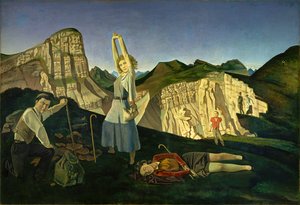
      Throughout his career, Balthus consistently returned to certain motifs and themes. *La Rue* (1933) exemplifies his early mastery of composition and atmosphere, depicting a street scene with an unsettling sense of isolation. *The Mountain* (1937), a monumental work featuring two adolescent girls in a stark landscape, embodies the artist’s fascination with youth and solitude. Later works, such as *Girl at a Window* (1957) – famously featured in François Truffaut's film Domicile Conjugal – showcase his ability to capture fleeting moments of introspection and vulnerability. His paintings are often characterized by a sense of stillness and silence, inviting viewers to contemplate the inner lives of his subjects. He was also deeply influenced by music, particularly the works of Wolfgang Amadeus Mozart, which he believed reflected the same balance between order and emotion that he sought to achieve in his art. Balthus’s enduring appeal lies not only in his technical skill but also in his ability to tap into universal human experiences—the longing for connection, the fear of isolation, and the search for meaning in a chaotic world. His paintings are not merely images; they are portals into a realm of dreams, anxieties, and unspoken desires—a testament to the enduring power of art to challenge our perceptions and illuminate the hidden corners of the human soul.

      Todas as 200 obras de Balthus →