Ateliê — Envio gratuito para todo o mundo — Entrega em 2–6 semanas
      Donatello, 1386 – 1466

      Donatello: As 100 pinturas mais conhecidas

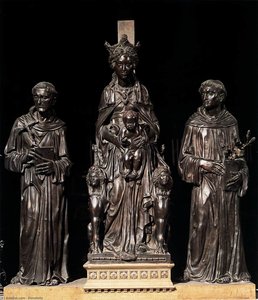
      De todas as pinturas de Donatello, Madonna and Child between St Francis and St Anthony (1448) é a mais famosa; está exposta no Basílica de Santo Antônio de Pádua, em Padua. Logo atrás vêm Cantoria (1439) e Entombment (1447). Entre as 148 obras de Donatello em nosso catálogo, estas 100 são as mais celebradas, cada uma apresentada com a sua data, o seu museu e a sua história.

      Classificado de acordo com o nosso índice de popularidade, que combina buscas, visitas e pedidos de cada obra. Atualizado em Outubro 2026. Cada pintura nesta página pode ser encomendada como uma reprodução a óleo pintada à mão sobre tela de linho, ou como uma impressão fine art, feita no tamanho que escolher.

      Retrato de Donatello
      Donatello · 1386 – 1466
      Nascimento · falecimento
      1386 – 1466, Florença
      Movimento
      Renascimento inicial
      Obras em nosso catálogo
      148
      Mais famosas
      Madonna and Child between St Francis and St Anthony (1448)
      Mais obras em
      Museo dell'Opera del Duomo

      As 10 pinturas mais celebradas de Donatello

      Madonna and Child between St Francis and St Anthony (1448) de Donatello
      1

      Madonna and Child between St Francis and St Anthony

      1448 · Bronze · Basílica de Santo Antônio de Pádua, Padua

      In the heart of the Italian Renaissance, where the shadows of antiquity met the burgeoning light of humanism, Donatello breathed life into metal with his masterpiece, Madonna and Child between St Francis and St Anthony. Created around 1448, this profound bronze sculpture serves as a window into a period of unparalleled spiritual and artistic transformation. The composition is a masterclass in symmetrical grace; at its center, the Virgin Mary cradles…

      Cantoria (1439) de Donatello
      2

      Cantoria

      1439 · Marble · Museo dell'Opera del Duomo, Florença

      To stand before Donatello’s Cantoria is to witness the very moment the Renaissance found its pulse. Completed around 1439 for the Cathedral of Santa Maria del Fiore in Florence, this monumental marble relief is far more than a functional singers' gallery; it is a breathtaking explosion of movement and spiritual ecstasy. While much of the era’s sculpture remained tethered to the static, formal traditions of the Byzantine style, Donatello broke…

      Entombment (1447) de Donatello
      3

      Entombment

      1447 · Oil On Canvas · Basílica de Santo Antônio de Pádua, Padua

      To stand before Donatello's depiction of the Entombment is to be enveloped in an atmosphere so thick with grief, it feels almost palpable. This scene transcends mere narrative illustration; it is a profound meditation on loss, sacrifice, and the solemn weight of human devotion. The composition draws the viewer into the immediate aftermath of unimaginable tragedy. Jesus Christ lies within the tomb, not merely as a subject, but as the…

      Miracle of the Repentant Son (1447) de Donatello
      4

      Miracle of the Repentant Son

      1447 · Acrylic · Basílica de Santo Antônio de Pádua, Padua

      Donatello’s bronze sculpture, "Miracle of the Repentant Son," transcends mere representation; it's a profound meditation on faith, remorse, and divine grace. Created in 1447 during the apex of his artistic maturity, this work embodies the burgeoning humanism and emotional depth that defined the Early Renaissance in Florence. More than just a depiction of a biblical miracle – the restoration of a severed limb by St. Anthony – it’s a study…

      Crucifix (1412) de Donatello
      5

      Crucifix

      1412 · Acrylic On Canvas · Basílica de Santa Croce, Florença

      Donatello's 1412 Crucifix, housed within the Basilica of Santa Croce in Florence, isn’t merely a depiction of Christ on the cross; it’s a visceral experience. This early Renaissance masterpiece transcends simple representation, plunging the viewer into the heart of Christian theology and embodying the profound tension between suffering and redemption. Crafted from richly-toned pearwood, the sculpture immediately commands attention with its remarkably realistic portrayal of the human form – a…

      Annunciation (1435) de Donatello
      6

      Annunciation

      1435 · Acrylic On Canvas · Basílica de Santa Croce, Florença

      Donatello’s 1435 Annunciation, housed within the Basilica di Santa Croce in Florence, isn’t merely a depiction of a biblical moment; it’s a profound meditation on grace, humility, and the transformative power of faith. Commissioned during a pivotal period of artistic innovation – bridging the Gothic and Renaissance eras – this sculpture embodies Donatello's revolutionary approach to humanism and his masterful command of classical forms. The scene unfolds with an arresting…

      St George (detail) (1416) de Donatello
      7

      St George (detail)

      1416 · Marble · Museo Nazionale del Bargello, Florença

      The marble figure of St. George, sculpted by Donatello around 1416, stands as more than just a depiction of a saint; it's a pivotal moment in the evolution of Renaissance sculpture – a testament to the artist’s innovative spirit and his profound understanding of human form and narrative. Originally gracing the north wall of Orsanmichele, Florence’s imposing guildhall, this statue immediately captivated viewers with its dynamic energy and strikingly realistic…

      Herod's Banquet (1427) de Donatello
      8

      Herod's Banquet

      1427 · Bronze · Batistério, Siena

      Donatello's Herod’s Banquet, crafted around 1427 for the baptismal font of Siena’s San Giovanni Baptistery, isn’t merely a depiction of a biblical episode; it’s a profound meditation on power, betrayal, and the chilling consequences of unchecked ambition. Commissioned amidst the competitive fervor of Renaissance Florence and Siena, this bronze relief stands as a testament to Donatello's burgeoning mastery – a pivotal work that showcases his innovative approach to sculpture and…

      Bearded Prophet (1418) de Donatello
      9

      Bearded Prophet

      1418 · Bronze · Museo dell'Opera del Duomo, Florença

      In the heart of the Florentine Renaissance, where the shadows of antiquity began to dance with the light of new humanism, Donatello breathed life into bronze with his Bearded Prophet. Created around 1418, this monumental figure is far more than a mere sculpture; it is a profound meditation on the weight of divine knowledge and the solemnity of faith. As one gazes upon the weathered surface of the bronze, there…

      St. John the Evangelist (1415) de Donatello
      10

      St. John the Evangelist

      1415 · Marble

      St. John the Evangelist is a marble sculpture created by the artist Donatello. Dated 1410, this work depicts one of the twelve apostles of Jesus. The subject is rendered as an elderly man, presented with a face etched with lines and a gaze that suggests a state of contemplation and wisdom. This choice of representation presents the figure as a philosopher-like individual.

      Pinturas de Donatello classificadas de 11 a 100

      St Mark (1411) de Donatello
      #11

      St Mark

      1411 · Orsanmichele

      Within the echoing halls of Orsanmichele in Florence, stands Donatello's sculpture of St. Mark – more than just a depiction of a biblical figure; it is a profound…

      Prophet with Scroll (detail) (1418) de Donatello
      #12

      Prophet with Scroll (detail)

      1418 · Museo dell'Opera del Duomo

      To stand before this detail of a prophet is to encounter a moment suspended in time—a profound echo from the heart of the Italian Renaissance. The marble itself,…

      St John on Patmos (1428) de Donatello
      #13

      St John on Patmos

      1428

      The St John on Patmos painting, created by the renowned artist Donatello in 1428, is a stunning example of Renaissance art. This masterpiece is a testament to Donatello's…

      David (detail) (1409) de Donatello
      #14

      David (detail)

      1409 · Museo Nazionale del Bargello

      To stand before this detail of Donatello's David is to encounter not merely a sculpture, but a profound meditation on nascent heroism. The marble seems to breathe with…

      Pietà (1447) de Donatello
      #15

      Pietà

      1447 · Basílica de Santo Antônio de Pádua

      In the quiet sanctity of the Basilica di Sant’Antonio in Padua, there exists a moment frozen in bronze, a profound intersection of divine tragedy and human vulnerability. Donatello’s…

      Pulpit (on the right) (1465) de Donatello
      #16

      Pulpit (on the right)

      1465 · Basílica de São Lourenço

      In the hallowed, sun-drenched silence of the Basilica of San Lorenzo in Florence, there exists a sculptural marvel that captures the very essence of a soul nearing its…

      Prophet Jeremiah (1423) de Donatello
      #17

      Prophet Jeremiah

      1423 · Museo dell'Opera del Duomo

      To stand before Donatello’s Prophet Jeremiah is to encounter not merely carved stone, but the very weight of human contemplation. This marble masterpiece transports us into a moment…

      Prophet Habakkuk (1427) de Donatello
      #18

      Prophet Habakkuk

      1427 · Museo dell'Opera del Duomo

      In the heart of Florence, within the hallowed halls of the Museo dell'Opera del Duomo, stands a figure that seems to breathe with the weight of centuries. Donatello’s…

      Pulpit (1438) de Donatello
      #19

      Pulpit

      1438 · Museum of the Cathedral

      The Pulpit by Donatello emerged from the stone and the shared vision of a workshop. In 1438, the artist completed this marble structure, working alongside collaborators Michelozzo and…

      Miracle of the New-born Child (detail) (1447) de Donatello
      #20

      Miracle of the New-born Child (detail)

      1447 · Basílica de Santo Antônio de Pádua

      This bronze detail captures an aged figure rendered with profound realism. The sculpture focuses on the upper torso and head, where deep wrinkles and facial contours convey experience…

      Miracle of the Ass (1447) de Donatello
      #21

      Miracle of the Ass

      1447 · Basílica de Santo Antônio de Pádua

      In the heart of the Italian Renaissance, amidst the burgeoning humanism of Florence, Donatello breathed life into metal with his 1447 masterpiece, The Miracle of the Ass. This…

      Cantoria (detail) (1439) de Donatello
      #22

      Cantoria (detail)

      1439 · Museo dell'Opera del Duomo

      The “Cantoria,” or Singing Gallery, crafted by the towering figure of Donatello between 1439 and 1440, isn't merely a decorative element within Florence’s Duomo; it’s an immersive experience,…

      Evangelist Luke (1428) de Donatello
      #23

      Evangelist Luke

      1428

      The "Evangelist Luke" is a remarkable painting created by the renowned artist Donatello in 1428. This stunning work of art, crafted from stucco and measuring 215 x 215…

      Encomende esta tela →
      Pulpit (detail) (1438) de Donatello
      #24

      Pulpit (detail)

      1438 · Museo dell'Opera del Duomo

      To look closely at this detail from the pulpit is to witness a quiet revolution in stone. The marble figures emerge from their setting with a sense of…

      Christ before Pilate and Caiaphas (1460) de Donatello
      #25

      Christ before Pilate and Caiaphas

      1460 · Basílica de São Lourenço

      Donatello's 1460 bronze sculpture, “Christ Before Pilate and Caiaphas,” stands as a monumental achievement within the burgeoning artistic landscape of the Italian Renaissance. Housed in the San Lorenzo…

      David (1409) de Donatello
      #26

      David

      1409 · Museo Nazionale del Bargello

      To stand before Donatello’s David is not merely to observe a sculpture; it is to witness a suspended moment of profound human potential. Carved from luminous marble, this…

      St George and the Dragon (1416) de Donatello
      #27

      St George and the Dragon

      1416 · Museo Nazionale del Bargello

      Gazing upon this marble bust is to confront a moment frozen in time—a powerful confluence of classical revivalism and raw human emotion. The subject, rendered with breathtaking verisimilitude,…

      Saint George (1417) de Donatello
      #28

      Saint George

      1417 · Museo Nazionale del Bargello

      In the heart of Florence, where the echoes of the Quattrocento still resonate through the cobblestone streets, stands a figure of unparalleled poise and quiet strength. Donatello’s Saint…

      St John the Evangelist (detail) (1410) de Donatello
      #29

      St John the Evangelist (detail)

      1410 · Museo dell'Opera del Duomo

      Donatello's “St John the Evangelist (detail),” a remarkably preserved marble sculpture created around 1410-1411, stands as a pivotal work in the transition from the late Gothic to the…

      St John the Evangelist (1410) de Donatello
      #30

      St John the Evangelist

      1410 · Museo dell'Opera del Duomo

      St John the Evangelist is a marble sculpture created by the artist Donatello. The work is dated 1410. It depicts one of the twelve apostles of Jesus, specifically…

      North pulpit (1460) de Donatello
      #33

      North pulpit

      1460 · Basílica de São Lourenço

      To stand before the North Pulpit is to witness a profound moment in the evolution of Western art, where the rigid structures of the Middle Ages began to…

      David (1430) de Donatello
      #35

      David

      1430 · Museo Nazionale del Bargello

      Michelangelo’s “David,” a colossal marble sculpture residing within the Galleria dell’Accademia in Florence, isn't merely a depiction of a biblical hero; it’s an embodiment of human potential, a…

      Leve esta luz para casa →
      Miracle of the Avaricious Man's Heart (1447) de Donatello
      #37

      Miracle of the Avaricious Man's Heart

      1447 · Basílica de Santo Antônio de Pádua

      Within the hallowed, sun-drenched walls of the Basilica di Sant’Antonio in Padua, there exists a moment frozen in time, a bronze whisper of the divine captured by the…

      Allegoric Figure of a Boy (Atys), rear view (1430) de Donatello
      #38

      Allegoric Figure of a Boy (Atys), rear view

      1430 · Museo Nazionale del Bargello

      To stand before an image evoking this bronze figure is to feel the very breath of the Renaissance wind against one's skin. This depiction, titled Allegoric Figure of…

      St George (detail) (1416) de Donatello
      #39

      St George (detail)

      1416 · Museo Nazionale del Bargello

      In the heart of Florence, within the hallowed halls of the Museo Nazionale del Bargello, resides a fragment of eternal courage. Donatello’s St. George, specifically captured in this…

      Cantoria (detail) (1439) de Donatello
      #40

      Cantoria (detail)

      1439 · Museo dell'Opera del Duomo

      In the heart of Florence, within the hallowed halls of the Museo dell’Opera del Duomo, lies a fragment of divine ecstasy known as the Cantoria. Created by the…

      Marzocco (1419) de Donatello
      #43

      Marzocco

      1419 · Museo Nazionale del Bargello

      In the heart of the Renaissance, amidst the political tremors and cultural rebirth of 15th-century Florence, Donatello breathed life into stone to create one of the city's most…

      Prophet Jeremiah (detail) (1423) de Donatello
      #44

      Prophet Jeremiah (detail)

      1423 · Museo dell'Opera del Duomo

      Donatello's “Prophet Jeremiah (detail),” a poignant study carved from pristine white marble around 1423-1427, transcends mere portraiture to become a profound meditation on faith, suffering, and the weight…

      Encomende esta tela →
      Cantoria (detail) (1439) de Donatello
      #45

      Cantoria (detail)

      1439 · Museo dell'Opera del Duomo

      Donatello's "Cantoria," a breathtaking detail from the larger marble relief adorning the south sacristy doors of the Duomo in Florence, isn’t merely a sculpture; it’s a vibrant snapshot…

      Encomende esta tela →
      Herod's Banquet (detail) (1427) de Donatello
      #46

      Herod's Banquet (detail)

      1427 · Batistério

      In the hallowed, quiet corridors of the Siena Baptistery, there exists a moment frozen in time, captured not in paint, but in the enduring strength of bronze. Donatello’s…

      Miracle of the Avaricious Man's Heart (detail) (1447) de Donatello
      #47

      Miracle of the Avaricious Man's Heart (detail)

      1447 · Basílica de Santo Antônio de Pádua

      The Miracle of the Avaricious Man's Heart is a remarkable bronze relief created by the renowned Italian artist Donatello in 1447. This stunning work of art is located…

      Bearded Prophet (detail) (1418) de Donatello
      #48

      Bearded Prophet (detail)

      1418 · Museo dell'Opera del Duomo

      Donatello's "Bearded Prophet" – often referred to as “Pensieroso,” meaning “the Thinker” – stands not merely as a sculpture, but as a profound meditation on humanity’s relationship with…

      Cantoria (detail) (1439) de Donatello
      #49

      Cantoria (detail)

      1439 · Museo dell'Opera del Duomo

      Donatello's Cantoria, a breathtaking marble relief sculpture from the Duomo di Firenze (Florence Cathedral), isn’t merely a decorative element; it’s a vibrant snapshot of Renaissance ambition and artistic…

      Encomende uma pintura feita à mão →
      Prophet Jeremiah (1423) de Donatello
      #50

      Prophet Jeremiah

      1423 · Museo dell'Opera del Duomo

      Prophet Jeremiah is a marble sculpture created by the artist Donatello. Dated 1423, the work represents a significant religious subject through the depiction of the biblical prophet. The…

      South pulpit (1460) de Donatello
      #51

      South pulpit

      1460 · Basílica de São Lourenço

      Donatello’s Passion Pulpit, a monumental bronze ensemble housed within the Basilica of San Lorenzo in Florence, isn’t merely a religious depiction; it’s a visceral embodiment of the artist’s…

      Encomende esta tela →
      Deposition (1465) de Donatello
      #52

      Deposition

      1465 · Basílica de São Lourenço

      Donatello's Deposition, completed in 1465, isn’t merely a sculpture; it’s a profound meditation on loss, faith, and the raw vulnerability of humanity. Carved from rich, burnished bronze –…

      St George (1416) de Donatello
      #53

      St George

      1416 · Museo Nazionale del Bargello

      Donatello’s “St. George,” sculpted in 1416 for the Museo Nazionale del Bargello in Florence, isn’t merely a depiction of a biblical hero; it’s a potent distillation of Renaissance…

      Cantoria (1439) de Donatello
      #54

      Cantoria

      1439 · Museo dell'Opera del Duomo

      Within the hallowed halls of the Museo dell'Opera del Duomo in Florence resides a sculpture that transcends mere stone and marble – it is an embodiment of Renaissance…

      Faith (1427) de Donatello
      #55

      Faith

      1427 · Batistério

      Donatello's "Faith," crafted in bronze around 1427-1429 for the baptismal font within Siena Cathedral, stands as a pivotal work bridging the late Gothic and burgeoning Early Renaissance styles.…

      Old Sacristy (1428) de Donatello
      #56

      Old Sacristy

      1428 · Basílica de São Lourenço

      To step into the Old Sacristy within the Basilica of San Lorenzo is to leave the chaotic bustle of Florence behind and enter a realm of profound mathematical…

      Annunciation (detail) (1435) de Donatello
      #57

      Annunciation (detail)

      1435 · Basílica de Santa Croce

      Donatello's "Annunciation," specifically this exquisite detail from the relief adorning the Cavalcanti Chapel in Santa Croce, Florence, stands as a pivotal moment in the burgeoning Renaissance. Crafted around…

      Encomende esta tela →
      Pulpit (on the left) (1465) de Donatello
      #58

      Pulpit (on the left)

      1465 · Basílica de São Lourenço

      Within the serene confines of San Lorenzo church in Florence resides a sculpture that transcends mere marble; it is a profound meditation on faith, humanity, and the very…

      Encomende esta tela →
      Prophet with Scroll (1418) de Donatello
      #59

      Prophet with Scroll

      1418 · Museo dell'Opera del Duomo

      Donatello’s “Prophet with Scroll,” crafted between 1415 and 1418, stands as a pivotal work in the burgeoning Early Renaissance of Florence. More than simply a depiction of biblical…

      St John the Evangelist (1410) de Donatello
      #60

      St John the Evangelist

      1410 · Museo dell'Opera del Duomo

      Donatello’s “St John the Evangelist,” completed between 1410 and 1411, isn't merely a sculpture; it’s an invitation into a realm of contemplative grace. Carved from pristine white marble,…

      Leve esta luz para casa →
      Prophet Habakkuk (1427) de Donatello
      #61

      Prophet Habakkuk

      1427 · Museo dell'Opera del Duomo

      In the hallowed, sun-drenched halls of the Museo dell'Opera del Duomo in Florence, there exists a figure that seems to breathe with the heavy weight of centuries. Donatello’s…

      Entombment (1465) de Donatello
      #62

      Entombment

      1465 · Basílica de São Lourenço

      Donatello's “Entombment,” completed around 1465 in Florence, stands as a monumental achievement within the Early Renaissance—a sculpture that transcends mere representation to embody profound human emotion and theological…

      Cantoria (9) (1439) de Donatello
      #63

      Cantoria (9)

      1439 · Museo dell'Opera del Duomo

      Donatello's "Cantoria," completed in 1439 for the Duomo of Florence, isn’t merely a decorative element; it’s a vibrant embodiment of Renaissance ideals – a testament to human ingenuity,…

      Leve esta luz para casa →
      Lamentation over the Dead Christ de Donatello
      #64

      Lamentation over the Dead Christ

      Victoria and Albert Museum

      Donatello, one of the most influential artists of the Italian Renaissance, created the Lamentation Over The Dead Christ around 1455-1460. This remarkable bronze relief is currently housed in…

      St George (1416) de Donatello
      #65

      St George

      1416 · Museo Nazionale del Bargello

      Donatello's *Saint George*, sculpted in 1416 during the nascent Renaissance, is more than just a marble statue; it’s a potent distillation of classical ideals interwoven with burgeoning humanist…

      St John the Baptist (1438) de Donatello
      #66

      St John the Baptist

      1438 · Basílica de Santa Maria Gloriosa dei Frari

      Donatello’s “St. John the Baptist,” sculpted around 1438 in Carrara marble and now residing within the serene Chapel of St. John the Baptist at Santa Maria Gloriosa dei…

      Encomende esta tela →
      Chellini Madonna, verso de Donatello
      #68

      Chellini Madonna, verso

      Victoria and Albert Museum

      Donatello's "Chellini Madonna," a bronze relief cast in the mid-15th century, stands as a remarkably intimate and profoundly moving work within the artist’s oeuvre. More than simply a…

      St Cosmas and St Damian (1428) de Donatello
      #69

      St Cosmas and St Damian

      1428

      Two figures emerge from an ornate stone backdrop, their presence defined by a quiet, shared intensity. These men, identified as the twin saints Cosmas and Damian, are positioned…

      St Mary Magdalen (1457) de Donatello
      #70

      St Mary Magdalen

      1457 · Museo dell'Opera del Duomo

      St Mary Magdalen is a sculptural work created by the Italian Renaissance sculptor Donatello. This figure is slightly larger than life size and was originally made for the…

      Bust of Niccolo da Uzzano (1430) de Donatello
      #71

      Bust of Niccolo da Uzzano

      1430 · Museo Nazionale del Bargello

      Donatello's 1430s marble bust of Niccolò da Uzzano is more than just a sculpted likeness; it’s a profound meditation on leadership, duty, and the quiet strength required to…

      Crucifixion (1465) de Donatello
      #72

      Crucifixion

      1465 · Museo Nazionale del Bargello

      A Moment Frozen in Time: Donatello’s Crucifixion The bronze sculpture “Crucifixion” by Donatello stands as an enduring testament to the artistic fervor of the Florentine Renaissance, capturing not…

      Prophet Habbakuk (1426) de Donatello
      #74

      Prophet Habbakuk

      1426

      To stand before this marble figure is to encounter a man caught in a moment of profound spiritual tension. Created between 1423 and 1426, this sculpture of the…

      The Feast of Herod (1427) de Donatello
      #75

      The Feast of Herod

      1427

      The air in the room feels heavy, thick with the tension of a moment that refuses to pass. Around a central banquet table, figures are caught in a…

      St Stephen and St Lawrence (1428) de Donatello
      #76

      St Stephen and St Lawrence

      1428

      The artwork presents two figures positioned within a recessed, arched niche. These figures are rendered in a relief sculpture technique, where the forms emerge from a flat plane…

      Evangelist Mark (1428) de Donatello
      #77

      Evangelist Mark

      1428

      This high-relief marble sculpture captures a moment of quiet scholarly devotion. Within an oval frame, the figure of the Evangelist is seated at a writing desk, his attention…

      Herod's Banquet (1435) de Donatello
      #78

      Herod's Banquet

      1435 · Palais des Beaux-Arts de Lille

      This high-relief marble sculpture depicts a crowded, dramatic biblical scene. The composition is densely packed with figures arranged across multiple planes to create a sense of depth and…

      Pulpit (1438) de Donatello
      #79

      Pulpit

      1438 · Cathedral

      A Masterpiece of Renaissance Sculpture: Donatello's Marble Pulpit Donatello’s marble pulpit, created in 1438 for the Church of San Lorenzo in Florence, stands as a pivotal work within…

      Encomende uma pintura feita à mão →
      Agony in the Garden (1465) de Donatello
      #80

      Agony in the Garden

      1465 · Basílica de São Lourenço

      Giovanni Bellini's "Agony in the Garden," housed within the venerable halls of the National Gallery, London, isn’t merely a depiction of a biblical scene; it’s a profound meditation…

      Encomende uma pintura feita à mão →
      Funeral Monument to John XXIII (detail) (1435) de Donatello
      #81

      Funeral Monument to John XXIII (detail)

      1435 · Batistério di San Giovanni

      The Funeral Monument to John XXIII (detail) is a work by the sculptor Donatello. This specific fragment captures a moment of stillness within a larger funerary structure. It…

      Chellini Madonna, recto de Donatello
      #82

      Chellini Madonna, recto

      Victoria and Albert Museum

      To gaze upon the Chellini Madonna is to step into the very heart of the Florentine Renaissance, where the divine and the human intersect through the masterful hands…

      Hope (1427) de Donatello
      #83

      Hope

      1427 · Batistério

      Within the quiet, hallowed space of the Baptistery of San Giovanni in the Siena Cathedral, a figure emerges from the shadows of a shallow marble niche. This is…

      St Mark (1411) de Donatello
      #84

      St Mark

      1411 · Orsanmichele

      In the Orsanmichele of Florence, a marble figure of St Mark emerges from its Gothic niche, marking a departure from the rigid traditions of the Middle Ages. Created…

      St Rossore (1425) de Donatello
      #86

      St Rossore

      1425 · Museo Nazionale di San Matteo

      In the quiet presence of Donatello’s St Rossore, one does not merely observe a sculpture; one encounters a profound dialogue between the earthly and the divine. Created around…

      Musician Angels (1447) de Donatello
      #90

      Musician Angels

      1447 · Basílica de Santo Antônio de Pádua

      In the hallowed stillness of the Basilica of Saint Anthony in Padua, there exists a moment where time seems to suspend itself, captured forever in the shimmering bronze…

      As telas de Donatello, período por período

      O que Donatello mais pintou

      Os quatro temas que mais aparecem nestas telas, cada um com o seu exemplo mais amado.

      Onde as telas de Donatello estão expostas

      Os 8 museus que detêm a maioria das pinturas desta página.

      Museu Cidade Obras de Donatello Pinturas desta lista
      Museo dell'Opera del Duomo, FlorençaMuseo dell'Opera del Duomo Florença 22 Cantoria, Bearded Prophet, Prophet with Scroll (detail)
      Museo Nazionale del Bargello, FlorençaMuseo Nazionale del Bargello Florença 13 St George (detail), David (detail), David
      Basílica de Santo Antônio de Pádua, PaduaBasílica de Santo Antônio de Pádua Padua 12 Madonna and Child between St Francis and St Anthony, Entombment, Miracle of the Repentant Son
      Basílica de São Lourenço, FlorençaBasílica de São Lourenço Florença 12 Pulpit (on the right), Christ before Pilate and Caiaphas, Deposition (detail)
      Piazza del Santo, PaduaPiazza del Santo Padua 6 Equestrian Statue of Gattamelata (8), Estátua Equestre de Gattamelata, Equestrian Statue of Gattamelata
      Batistério, SienaBatistério Siena 4 Herod's Banquet, Herod's Banquet (detail), Faith
      Batistério di San Giovanni, FlorençaBatistério di San Giovanni Florença 4 Funeral Monument to John XXIII (detail), Funeral Monument to John XXIII (detail), Funeral Monument to John XXIII (detail)
      Basílica de Santa Croce, FlorençaBasílica de Santa Croce Florença 3 Crucifix, Annunciation, Annunciation (detail)

      Década a década: a tela mais celebrada de Donatello

      1. 1400s
        David (detail) (1409) de Donatello
        14 de 100

        David (detail)

        Idade 14 – 23 · Museo Nazionale del Bargello

        To stand before this detail of Donatello's David is to encounter not merely a sculpture, but a profound meditation on nascent heroism. The marble seems to breathe with…

      2. 1410s
        Crucifix (1412) de Donatello
        Tela 5 de 100

        Crucifix

        Idade 24 – 33 · Basílica de Santa Croce

        Donatello's 1412 Crucifix, housed within the Basilica of Santa Croce in Florence, isn’t merely a depiction of Christ on the cross; it’s a visceral experience. This early Renaissance…

      3. 1420s
        Herod's Banquet (1427) de Donatello
        8 de 100

        Herod's Banquet

        Idade 34 – 43 · Batistério

        Donatello's Herod’s Banquet, crafted around 1427 for the baptismal font of Siena’s San Giovanni Baptistery, isn’t merely a depiction of a biblical episode; it’s a profound meditation on…

      4. 1430s
        Cantoria (1439) de Donatello
        Classificado em 2 de 100

        Cantoria

        Idade 44 – 53 · Museo dell'Opera del Duomo

        To stand before Donatello’s Cantoria is to witness the very moment the Renaissance found its pulse. Completed around 1439 for the Cathedral of Santa Maria del Fiore in…

      5. 1440s
        Madonna and Child between St Francis and St Anthony (1448) de Donatello
        1 de 100

        Madonna and Child between St Francis and St Anthony

        Idade 54 – 63 · Basílica de Santo Antônio de Pádua

        In the heart of the Italian Renaissance, where the shadows of antiquity met the burgeoning light of humanism, Donatello breathed life into metal with his masterpiece, Madonna and…

      6. 1450s
        St Mary Magdalen (1457) de Donatello
        70 de 100

        St Mary Magdalen

        Idade 64 – 73 · Museo dell'Opera del Duomo

        St Mary Magdalen is a sculptural work created by the Italian Renaissance sculptor Donatello. This figure is slightly larger than life size and was originally made for the…

      7. 1460s
        Pulpit (on the right) (1465) de Donatello
        Tela 16 de 100

        Pulpit (on the right)

        Idade 74 – 80 · Basílica de São Lourenço

        In the hallowed, sun-drenched silence of the Basilica of San Lorenzo in Florence, there exists a sculptural marvel that captures the very essence of a soul nearing its…

      As suas perguntas sobre as pinturas de Donatello, respondidas

      Qual é a pintura mais celebrada de Donatello?Leia a resposta

      Madonna and Child between St Francis and St Anthony (1448), Basílica de Santo Antônio de Pádua, Padua. Seguidos por Cantoria (1439) e Entombment (1447).

      Qual era a idade de Donatello na época de Madonna and Child between St Francis and St Anthony?Leia a resposta

      Donatello, nascido(a) em 1386, tinha 62 anos: Madonna and Child between St Francis and St Anthony data de 1448.

      Quais são as dez pinturas mais famosas de Donatello?Leia a resposta

      Madonna and Child between St Francis and St Anthony, Cantoria, Entombment, Miracle of the Repentant Son, Crucifix, Annunciation, St George (detail), Herod's Banquet, Bearded Prophet e St. John the Evangelist. Cada tela no ranking acima inclui o seu ano e o seu museu.

      Quantas pinturas de Donatello são conhecidas?Leia a resposta

      148 obras de Donatello estão em nosso catálogo, datadas de 1406 a 1465.

      Em quais museus se encontram as telas mais conhecidas de Donatello?Leia a resposta

      Principalmente em Museo dell'Opera del Duomo (Florença), Museo Nazionale del Bargello (Florença) e Basílica de Santo Antônio de Pádua (Padua); a lista acima indica cada museu e as suas telas.

      Em que anos Donatello pintou as suas telas mais célebres?Leia a resposta

      Em 1430s, que compreende 22 das 100 obras desta página, Cantoria entre elas.

      Quais são a primeira e a última das telas famosas de Donatello?Leia a resposta

      A tela mais antiga aqui é de Prophet (left of the Porta della Mandorla) (1406); a mais recente é de Pulpit (on the right) (1465).

      Quais temas aparecem com mais frequência nas pinturas de Donatello?Leia a resposta

      Renaissance (46), Sculpture (35) e Marble (19), entre as 100 obras nesta página.

      Com o que Donatello costumava pintar?Leia a resposta

      Marble, utilizado em 31 das 100 obras nesta página.

      A qual movimento artístico pertence Donatello?Leia a resposta

      Renascimento inicial, como mostram as telas nesta página.

      O que posso ver de Donatello no Museo dell'Opera del Duomo?Leia a resposta

      O Museo dell'Opera del Duomo, Florença detém 21 das obras desta página, entre elas Cantoria, Bearded Prophet e Prophet with Scroll (detail).

      Posso encomendar uma cópia pintada à mão de uma obra de Donatello?Leia a resposta

      Sim. Todas as pinturas desta página podem ser encomendadas a partir de sua própria página como uma reprodução a óleo pintada à mão, ou como uma impressão fine art, no tamanho de sua escolha.

      Donatello: a história do pintor

      A Vida e a Identidade de Donatello

      Nascido como Donato di Niccolò di Betto Bardi, o homem conhecido pela história como Donatello passou a sua vida entre as muralhas de Florença, na Itália. Ele chegou ao mundo por volta de 1386, uma época em que a cidade começava a remodelar a sua própria imagem através da pedra e do bronze. A sua presença na paisagem florentina era constante, marcada por uma mão firme e um foco na realidade física dos seus temas. Ele foi um escultor do Renascimento italiano que compreendia o peso dos materiais que manipulava, desde a dureza do mármore até à fluidez da cera.

      A sua obra não foi uma busca solitária pela perfeição, mas sim uma série de respostas às necessidades do seu tempo. Ele percorreu as ruas de Florença, trabalhando em diversos meios e deixando um rastro de figuras que capturavam uma presença humana específica. Embora fosse conhecido por ser amável e querido por aqueles que o rodeavam, ele enfrentava dificuldades com as questões práticas de gerir um negócio. Frequentemente, assumia mais trabalho do que as suas mãos podiam concluir em tempo útil, deixando por vezes os toques finais a outros ou entregando peças mais tarde do que o esperado. Esta tendência para o excesso de compromisso sugere um homem mais preocupado com o ato da criação do que com a gestão de uma oficina.

      Donatello morreu em Florença a 13 de dezembro de 1466. Deixou para trás um conjunto de obras que mudou a forma como os escultores abordavam a forma humana, afastando-se das tradições rígidas do passado em direção a algo mais terreno e expressivo. A sua vida estava ligada à cidade, e a sua identidade permanece inseparável do solo florentino onde viveu e trabalhou.

      Juventude e Formação Artística

      Nascido em Florença, na Itália, Donatello cresceu em uma cidade que atuava como o epicentro primordial para o florescente Renascimento. Este ambiente proporcionou a energia cultural essencial para o seu desenvolvimento. Ele passou seus primeiros anos imerso na atmosfera local, onde o afastamento das rígidas tradições medievais já começava a ganhar força. Sua conexão com a paisagem florentina era profunda, uma vez que os valores em evolução da cidade moldaram sua abordagem inicial em relação à forma e à figura.

      Sua formação envolveu um estudo minucioso da escultura clássica. Esse foco na antiguidade ajudou-o a caminhar em direção a um novo estilo que priorizava o realismo e o humanismo. Antes de encontrar sua própria voz, ele aprendeu o estilo Gótico Internacional com Lorenzo Ghiberti. Este período de aprendizado permitiu-lhe dominar as habilidades técnicas de seu ofício antes de começar a desviar-se daquelas tradições estabelecidas. Ele trabalhou com diversos materiais, incluindo pedra, bronze, madeira, argila, estuque e cera, utilizando frequentemente o vidro de maneiras inventivas para alcançar efeitos específicos.

      Patronos, Oficina e Comissões

      As mãos de Donatello estavam frequentemente ocupadas. Ele tinha o hábito de aceitar mais trabalhos do que sua agenda podia comportar, uma tendência que, por vezes, significava que projetos eram concluídos com atraso ou entregues a outros para serem finalizados. Essa carga de trabalho exaustiva exigia uma presença constante em sua oficina, onde ele trabalhava ao lado de diversos assistentes. Um grupo de quatro colaboradores era o número típico de seu estúdio, auxiliando-o a gerenciar as exigências físicas do manuseio da pedra, do bronze e da argila.

      A família Medici ofereceu um apoio constante, proporcionando o tipo de patronato que o permitiu atravessar as diferentes fases de sua vida. Seu alcance estendia-se muito além das ruas de Florença; ele viajou para trabalhar em comissões em Roma, Pádua e Siena. Esse movimento entre cidades significava que sua prática nunca esteve confinada a um único lugar, pois ele levava seus métodos e seus assistentes para diversos centros de atividade.

      Técnicas Inovadoras e Estilo Artístico

      A abordagem de Donatello em relação à escultura distanciou-se das tradições rígidas do estilo Gótico Internacional, pavimentando o caminho para uma nova era. Ele desenvolveu um estilo do início do Renascimento que favorecia uma forma inédita de realismo, alcançada através de uma compreensão profunda da anatomia humana e da maneira como a luz incide sobre as superfícies. Longe de se limitar a um único meio, o artista explorou com maestria a pedra, o bronze, a madeira, a argila, o estuque e a cera, encontrando inclusive formas inventivas de utilizar o vidro para conferir detalhes minuciosos às suas figuras.

      Uma de suas contribuições técnicas mais singulares foi o desenvolvimento do rilievo stiacciato. Trata-se de um tipo de baixo-relevo extremamente sutil, onde a escultura é tão rasa que cria uma ilusão de profundidade através de variações quase imperceptíveis na espessura. Ao dominar este método, Donatello conseguia sugerir perspectiva e distância em superfícies praticamente planas. Sua obra é frequentemente marcada por uma tensão palpável entre o peso físico do material e o movimento expressivo do sujeito; ele possuía o talento de fazer o mármore parecer tão suave quanto a pele ou de conferir ao bronze uma sensação de energia muscular densa e vigorosa.

      • David (bronze)
      • Monumento Equestre de Gattamelata
      • São Jorge (mármore)

      Obras-Primas Escultóricas

      No ano de 1416, ele concluiu São Jorge, uma figura em mármore que captura uma sensação de coragem resoluta. A escultura retrata o cavaleiro em armadura, equilibrando-se sobre a parte frontal dos pés em vez de adotar um contrapposto tradicional. Há uma sensação palpável do corpo muscular trabalhando sob a superfície da pedra. Esta obra foi uma das muitas encomendadas pelas guildas de Florença para decorar os nichos externos da Igreja de Orsanmichele.

      Seu David em bronze permanece como um ponto crucial na história da escultura, sendo a primeira escultura masculina nua e independente produzida desde a Antiguidade. A figura é retratada com um sorriso enigmático, com um pé pousado sobre a cabeça decepada de Golias. Enquanto a versão em mármore deste tema foi uma encomenda precoce, a versão em bronze destaca-se pelo seu físico delicado e andrógino, e pela forma como utiliza a nudez do jovem para contrastar com a pesada espada em sua mão.

      Mais tarde em sua carreira, ele moveu-se em direção a diferentes materiais e escalas. O Monumento Equestre de Gattamelata, criado em 1453, é uma obra massiva em bronze localizada em Pádua. Por volta de 1440, ele produziu a Madalena Penitente, uma escultura de madeira esculpida em álamo branco. Esta figura é magra e emaciada, distanciando-se das representações típicas de uma bela jovem. A talha é austera e altamente detalhada, revelando uma faceta distinta de sua maestria técnica.

      • São Jorge, 1416
      • David (bronze), c. 1440
      • Madalena Penitente, c. 1440
      • Monumento Equestre de Gattamelata, 1453

      Legado e Influência Artística

      A abordagem de Donatello em relação à forma não encontrou aceitação imediata em sua comunidade. Sua obra evoluiu através de fases distintas, iniciando com um foco na monumentalidade clássica e um crescente senso de expressividade. À medida que sua carreira progredia, esse estilo ganhava força, tornando-se, eventualmente, a forma de trabalhar mais popular na região. Sua influência estendeu-se muito além das fronteiras de Florença, espalhando-se por outras cortes italianas e afetando artistas por toda a Europa.

      A maneira como ele manipulava os materiais permitia uma vasta gama de profundidades emocionais. Ele transitou da presença pesada e sólida de suas primeiras figuras em mármore para obras mais austeras, e até brutais, em seus anos finais. Essa transição revelou uma disposição para explorar a condição humana através de texturas variadas, desde as superfícies polidas da pedra até a madeira texturizada e esguia de suas últimas esculturas religiosas. Sua habilidade em capturar uma sensação de movimento e peso psicológico transformou permanentemente a maneira como os escultores abordavam a figura humana.

      • David (bronze)
      • Estátua Equestre de Gattamelata
      • São Jorge
      • Madalena Penitente

      Todas as 148 obras de Donatello →