Ateliê — Envio gratuito para todo o mundo — Entrega em 2–6 semanas
      Fernand Léger, 1881 – 1955

      Fernand Léger: The 100 Best-Known Paintings

      Of all Fernand Léger's paintings, A Cidade (1919) is the most famous. Close behind come O Mecânico (1920) and Três Mulheres (1921). Among the 834 works by Fernand Léger in our catalogue, these 100 are the most celebrated, each shown with its date, its museum and its story.

      Ranked by our popularity score, which combines the searches, visits and orders for each work. Updated Outubro 2026. Each painting on this page can be ordered as an oil reproduction painted by hand on linen canvas, or as a fine art print, made to the size you choose.

      Portrait of Fernand Léger
      Fernand Léger · 1881 – 1955
      Born · died
      1881 – 1955, Argentan
      Movement
      Cubismo
      Works in our catalogue
      834
      Most famous
      A Cidade (1919)
      Most works at
      MoMA - Museu de Arte Moderna

      Fernand Léger's 10 most celebrated paintings

      A Cidade (1919) by Fernand Léger
      1

      A Cidade

      1919 · Óleo sobre tela

      “A Cidade” (1919) de Fernand Léger não é simplesmente uma representação de um cenário urbano; é uma declaração visceral sobre a alma da modernidade, um convite para desconstruir e reinterpretar o ritmo frenético do século XX. Longe de buscar a fidelidade à realidade, Léger nos entrega uma visão fragmentada, quase onírica, de uma metrópole em constante transformação – um testemunho da era industrial que se anunciava com força. A tela…

      O Mecânico (1920) by Fernand Léger
      2

      O Mecânico

      1920 · Óleo sobre tela · Galeria Nacional do Canadá, Ottawa

      “The Mechanic” (1920) de Fernand Léger não é apenas uma pintura; é um portal visual para a alma da modernidade, um momento crucial na história da arte que captura a essência da industrialização e a busca por novas formas de expressão. A obra, com sua paleta vibrante e geometria ousada, convida o espectador a uma reflexão sobre a relação entre o homem, a máquina e o espírito do século XX.

      Três Mulheres (1921) by Fernand Léger
      3

      Três Mulheres

      1921 · Óleo sobre tela · MoMA - Museu de Arte Moderna, Nova York

      Introdução "Três Mulheres" (1921), de Fernand Léger, é uma obra-prima da arte moderna que funde, de maneira impecável, as influências do Cubismo e do Art Déco. Esta composição vibrante e dinâmica captura a essência da modernidade do início do século XX, tornando-se uma adição cativante para qualquer coleção de arte contemporânea ou espaço interior sofisticado. Tema e Composição A obra apresenta três figuras femininas envolvidas em atividades de lazer, organizadas…

      Nudes na Floresta (1910) by Fernand Léger
      4

      Nudes na Floresta

      1910 · Óleo sobre tela · Kröller-Müller Museum, Otterlo

      A obra Nudes na Floresta (1909-1910), de Fernand Léger, ergue-se como um marco fundamental, assinalando uma etapa crucial no desenvolvimento do Cubismo. Mais do que uma simples representação de figuras entre árvores, trata-se de uma audaciosa desconstrução da forma e da perspectiva que continua a cativar espectadores mais de um século depois. Esta pintura não trata do *que* é representado, mas de *como* — uma abordagem radical que redefiniu a…

      A Grande Parade (1954) by Fernand Léger
      5

      A Grande Parade

      1954 · Óleo sobre tela

      O Grande Desfile: Uma Celebração Vibrante da Vida Moderna Tema e Composição "O Grande Desfile", de Fernand Léger, é uma celebração dinâmica e caótica da vida moderna, capturando a energia e o entusiasmo de um circo movimentado ou de uma performance teatral. A obra pulsa com figuras humanas envolvidas em diversas atividades, intercaladas com elementos mecânicos, como engrenagens e rodas. Esta fusão de formas orgânicas e motivos industriais cria uma…

      O casamento by Fernand Léger
      6

      O casamento

      Óleo sobre tela

      Assunto e Composição Esta obra cativante apresenta uma representação fragmentada e abstrata de uma figura humana, provavelmente uma mulher, imersa em uma complexa interação de formas geométricas e elementos abstratos. A composição convida o espectator a explorar múltiplas perspectivas simultaneamente, uma marca registrada da influência cubista. A figura parece estar envolvida em um momento íntimo ou contemplativo, cercada por um conjunto caótico, porém harmonioso, de formas angulares que evocam um…

      O Café da Manhã (1921) by Fernand Léger
      7

      O Café da Manhã

      1921 · Óleo sobre tela · MoMA - Museu de Arte Moderna, Nova York

      Na vibrante paisagem do modernismo do início do século XX, poucas obras capturam o pulso rítmico de uma era em transformação de forma tão marcante quanto O Café da Manhã, de Fernand Léger. Pintada em 1921, esta obra-prima serve como uma janela para um mundo onde o doméstico e o industrial começaram a fundir-se numa visão singular e dinâmica. A cena apresenta um grupo de três mulheres reunidas em torno…

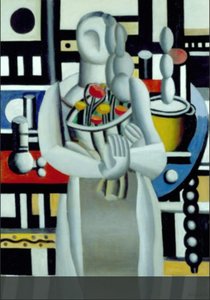
      Mulher com um Buquê de Flores (1920) by Fernand Léger
      8

      Mulher com um Buquê de Flores

      1920 · Óleo sobre tela · Staatsgalerie Stuttgart, Stuttgart

      Uma mulher emerge de uma grade de linhas pretas e pesadas, sua forma construída a partir de cilindros e esferas. Ela segura um buquê, mas as flores não são pétalas suaves, e sim fragmentos de vermelho, amarelo e azul. Cada forma parece ter peso, como se fosse esculpida em aço ou fundida em ferro. Os contornos espessos definem um corpo que se move com a precisão rítmica de uma máquina.…

      Composição em Azul by Fernand Léger
      9

      Composição em Azul

      Óleo sobre tela · Art Institute of Chicago, Chicago

      A "Composição em Azul" de Fernand Léger é um exemplo fundamental da arte modernista, demonstrando sua combinação única de Cubismo e Futurismo. A pintura apresenta uma composição marcante, dominada por tons de azul, com uma figura central – aparentemente uma mulher ou forma humanoide – representada em várias tonalidades dessa cor. Essa figura está parcialmente obscurecida por uma grande peça azul na cabeça, criando uma aparência enigmática e um tanto…

      A Ponte (1923) by Fernand Léger
      10

      A Ponte

      1923 · Óleo sobre tela · Museu Thyssen-Bornemisza, Madrid

      Aproxime-se para observar como o espaço é particionado. Em A Ponte, criada em 1923, não existe uma perspectiva única onde o olhar possa descansar. Em vez disso, encontramos uma composição dividida em zonas distintas, horizontais e verticais, que sugerem uma realidade arquitetônica fraturada. Duas colunas espessas de um verde esmeralda ancoram o plano médio superior, atuando como pilares estruturais dentro do arranjo. Atrás delas, o plano de fundo se revela…

      Fernand Léger paintings ranked 11 to 100

      smokers - - ) (1912) by Fernand Léger
      #11

      smokers - - )

      1912

      Fernand Léger's "Smokers," painted in 1912, isn’t merely a depiction of men enjoying a cigarette; it’s a vibrant manifesto of early Cubism and a bold assertion of modernity.…

      Bring this light home →
      Mural (1951) by Fernand Léger
      #12

      Mural

      1951

      Fernand Léger’s "Mural," completed in 1951, stands as an arresting embodiment of Cubist principles interwoven with a palpable fascination for the burgeoning machine age. This masterpiece does not…

      Have it painted by hand →
      Reading (1924) by Fernand Léger
      #15

      Reading

      1924

      In the quietude of an ambiguous interior, two figures sit side-by-side, lost in the profound intimacy of shared silence and individual discovery. Fernand Léger’s 1924 masterpiece, Reading, is…

      Order this canvas →
      Dança (1942) by Fernand Léger
      #16

      Dança

      1942

      Uma Celebração Rítmica de Forma e Cor A obra Dança, de Fernand Léger, é muito mais do que uma mera representação do movimento; é uma sinfonia vibrante e…

      Order this canvas →
      Os Discos (1910) by Fernand Léger
      #17

      Os Discos

      1910 · Museu de Arte do Condado de Los Angeles

      Uma série de círculos sobrepostos flutua pela tela como sinais pesados e pintados. Estes discos, renderizados em camadas espessas de óleo, intersectam-se com retângulos nítidos e faixas diagonais…

      Order this canvas →
      The Bather (1932) by Fernand Léger
      #18

      The Bather

      1932

      In the quiet intersection of Surrealist dreamscapes and the rigid precision of Cubism lies Fernand Léger’s 1932 masterpiece, The Bather. This is not merely a painting of a…

      Order this canvas →
      Three musicians (1930) by Fernand Léger
      #19

      Three musicians

      1930

      In the pantheon of twentieth-century modernism, few works capture the pulse of the machine age with as much vibrant vitality as Fernand Léger’s "Three Musicians." Completed in 1930,…

      Order this canvas →
      The Man with the Pipe (1920) by Fernand Léger
      #20

      The Man with the Pipe

      1920 · Musée d’Art Moderne de la Ville de Paris

      The man sits within a grid of sharp edges and heavy lines. His body is not composed of soft skin, but of cylinders and metallic volumes that suggest…

      Have it painted by hand →
      Contrast of Forms (1918) by Fernand Léger
      #21

      Contrast of Forms

      1918

      The canvas breathes with an energy that transcends mere pigment; it pulsates with the rhythm of industrial progress, captured in the bold strokes and vibrant hues of Fernand…

      Have it painted by hand →
      Dance (1929) by Fernand Léger
      #22

      Dance

      1929

      Two nude female figures move through a landscape of interlocking shapes, their bodies caught in a moment of dynamic instability. The scene unfolds with a flattened perspective, where…

      Order this canvas →
      Mulher com vaso (1924) by Fernand Léger
      #23

      Mulher com vaso

      1924 · Statens Museum For Kunst

      Nesta obra a óleo sobre tela de 1924, encontramos uma figura que se sente extraordinariamente sólida, quase escultural em sua construção. A mulher está posicionada frontalmente, sua forma…

      Bring this light home →
      The Builders (1920) by Fernand Léger
      #24

      The Builders

      1920 · Metropolitan Museum of Art

      Fernand Léger’s “The Builders,” completed in 1920, stands as a cornerstone of Cubist aesthetics and embodies the fervent optimism surrounding technological advancement during the tumultuous years of World…

      Order this canvas →
      Flor que Caminha (La fleur qui marche) (1952) by Fernand Léger
      #25

      Flor que Caminha (La fleur qui marche)

      1952 · Kimbell Art Museum

      “Flor que Caminha” de Fernand Léger: Uma Sinfonia de Cor e Forma contra um Cenário Industrial A escultura em cerâmica "Flor que Caminha (La fleur qui marche)", concluída…

      Plungers II (1942) by Fernand Léger
      #26

      Plungers II

      1942

      Uma Sinfonia de Forma e Identidade Fragmentada No coração de 1942, em meio às sombras profundas projetadas pela Segunda Guerra Mundial, Fernand Léger revelou Plungers II, uma obra…

      Bring this light home →
      Woman with Mirror (1920) by Fernand Léger
      #27

      Woman with Mirror

      1920 · Musée d’Art Moderne de la Ville de Paris

      The painting Woman with Mirror, created in 1920, presents a configuration of geometric shapes that deconstruct the human figure and its surroundings. The composition relies on an arrangement…

      Have it painted by hand →
      The man with the pipe (1918) by Fernand Léger
      #29

      The man with the pipe

      1918

      In the transformative landscape of early twentieth-century modernism, few works capture the rhythmic pulse of a changing world as vibrantly as Fernand Léger’s “The Man with the Pipe.”…

      Have it painted by hand →
      Project for a mural (1952) by Fernand Léger
      #30

      Project for a mural

      1952 · Cincinnati Art Museum

      In the vast landscape of twentieth-century modernism, few works capture the rhythmic pulse of the machine age as vibrantly as Fernand Léger’s "Project for a mural." Completed in…

      Order this canvas →
      Mechanical Elements by Fernand Léger
      #31

      Mechanical Elements

      Metropolitan Museum of Art

      Fernand Léger’s “Mechanical Elements,” painted in 1924, stands as a striking testament to the burgeoning fascination with technology during the interwar period. More than just a depiction of…

      Bring this light home →
      The City (1919) by Fernand Léger
      #32

      The City

      1919 · MoMA - Museu de Arte Moderna

      Step closer and observe how the canvas seems to move even when you remain still. In 1919, Fernand Léger captured something far more visceral than a mere urban…

      Bring this light home →
      Le Petit Djeuner (1919) by Fernand Léger
      #33

      Le Petit Djeuner

      1919 · Minneapolis Institute of Art

      In the 1919 painting Le Petit Djeuner, Fernand Léger presents a breakfast scene through a fragmented, Cubist lens. Two stylized human figures occupy a space that merges with…

      Have it painted by hand →
      The Dance - 1st Stage (1929) by Fernand Léger
      #34

      The Dance - 1st Stage

      1929 · Hiroshima Museum of Art

      The oil painting titled The Dance - 1st Stage presents two stylized female figures positioned in an intertwined pose. These figures are rendered with thick, continuous lines that…

      Bring this light home →
      Contrast of Forms (1910) by Fernand Léger
      #35

      Contrast of Forms

      1910 · Philadelphia Museum of Art

      Step closer to observe how the canvas begins to pulse with a rhythmic, mechanical energy. In Contrast of Forms, we find ourselves looking at a fragmented landscape where…

      Have it painted by hand →
      Komposition (1920) by Fernand Léger
      #36

      Komposition

      1920

      A heavy red rectangle anchors the center, pressed against thick black lines that slice through white and yellow planes. Circles overlap like the interlocking teeth of a gear,…

      Have it painted by hand →
      Sunflowers (1953) by Fernand Léger
      #37

      Sunflowers

      1953

      This striking black and white drawing of sunflowers by Fernand Léger, created in 1953, offers a compelling glimpse into the artist's unique vision – a synthesis of observed…

      Order this canvas →
      Reclining Woman by Fernand Léger
      #39

      Reclining Woman

      Art Institute of Chicago

      The painting is a Cubist artwork by Fernand Léger featuring a woman lying on her side with a yellow snake wrapped around her body. The snake appears to…

      Have it painted by hand →
      The man in the blue hat (1937) by Fernand Léger
      #40

      The man in the blue hat

      1937

      A Portrait of Quiet Contemplation Amidst Mechanical Forms Fernand Léger’s “The Man in the Blue Hat,” painted in 1937, stands as a striking embodiment of Purism – an…

      Order this canvas →
      Reading (1948) by Fernand Léger
      #41

      Reading

      1948

      Created in 1948, Reading is a portrait that captures a moment within an interior space. The painting features a woman sitting on the floor with her legs crossed,…

      Have it painted by hand →
      Os Mergulhadores (1943) by Fernand Léger
      #42

      Os Mergulhadores

      1943 · Harvard Art Museums

      Aproxime-se para observar como as figuras emergem do espaço branco. Em Os Mergulhadores, encontramos um grupo de indivíduos capturados no ar, realizando manobras acrobáticas que sugerem um ambiente…

      Bring this light home →
      Two Profiles (1928) by Fernand Léger
      #43

      Two Profiles

      1928 · Albertina

      Two profiles occupy the center of this 1928 composition. These two faces are rendered in stark black and white shapes, positioned so they face one another across the…

      Have it painted by hand →
      Mechanical Element (1920) by Fernand Léger
      #44

      Mechanical Element

      1920 · Kröller-Müller Museum

      Step closer and observe how the canvas seems to hum with a quiet, industrial energy. In Mechanical Element, created in 1920, there is no attempt to depict a…

      Have it painted by hand →
      Dancer Blue (1930) by Fernand Léger
      #45

      Dancer Blue

      1930

      To encounter Fernand Léger's "Dancer Blue" is to step directly into the rhythmic, metallic heartbeat of the twentieth century. Created in 1930, this masterpiece serves as a crystallized…

      Bring this light home →
      Adam and Eve (1937) by Fernand Léger
      #46

      Adam and Eve

      1937 · Kunstsammlung Nordrhein-Westfalen

      To stand before this work is to witness a moment of profound, unformed energy. Completed in 1939, Adam and Eve presents a landscape that feels less like a…

      Have it painted by hand →
      Mulher com gato (1921) by Fernand Léger
      #48

      Mulher com gato

      1921 · Hamburger Kunsthalle

      Uma mulher está sentada, sua forma construída a partir de esferas e tubos. Ela segura um gato preto no colo, um peso escuro contra os planos amarelo brilhante…

      Order this canvas →
      O Andaime (Primeiro Estado) (1919) by Fernand Léger
      #49

      O Andaime (Primeiro Estado)

      1919 · Philadelphia Museum of Art

      Um cilindro metálico corta um plano plano de cor. Em 1919, Paris era uma cidade de reconstrução, e a Place de Clichy estava envolta nas estruturas esqueléticas da…

      Order this canvas →
      Umbrella and Bowler (1926) by Fernand Léger
      #50

      Umbrella and Bowler

      1926 · MoMA - Museu de Arte Moderna

      A deconstructed arrangement of everyday objects defines this 1926 composition. An open umbrella and parts of a chair are integrated into a complex grid of shapes, utilizing strong…

      Have it painted by hand →
      Two Women and still life 1st state (1920) by Fernand Léger
      #51

      Two Women and still life 1st state

      1920 · Building of the Winterthur Museum of Art

      Fernand Léger's “Two Women & Still Life” stands as a cornerstone of Cubist aesthetics and a testament to the artist’s unwavering commitment to capturing the dynamism of the…

      Bring this light home →
      Composition (Definitive State) (1925) by Fernand Léger
      #52

      Composition (Definitive State)

      1925

      A large, dark reddish-brown oval anchors the center of the canvas, acting as a heavy weight amidst a sea of shifting planes. Around this central anchor, thick black…

      A bicicleta (1930) by Fernand Léger
      #53

      A bicicleta

      1930 · Art Gallery of New South Wales

      Um polígono branco central abriga uma forma fluida de um azul profundo, assemelhando-se a uma poça de óleo. Dentro deste espaço azul, linhas brancas e finas traçam estruturas…

      Order this canvas →
      Natureza Morta (1928) by Fernand Léger
      #54

      Natureza Morta

      1928 · Art Institute of Chicago

      Aproxime-se e observe como os elementos familiares de uma natureza-morta são transformados através de uma lente de precisão estrutural. Nesta obra de 1928, o artista afasta-se da representação…

      Order this canvas →
      The three musicians by Fernand Léger
      #56

      The three musicians

      In the vibrant tapestry of early twentieth-century modernism, few works resonate with as much structural vitality as Fernand Léger’s "The Three Musicians." This masterpiece is far more than…

      Have it painted by hand →
      Ballet mécanique (1924) by Fernand Léger
      #58

      Ballet mécanique

      1924

      Fernand Léger's "Ballet Mécanique," painted in 1924, isn’t merely a depiction of a scene; it’s a vibrant, pulsating embodiment of the machine age and its impact on human…

      Have it painted by hand →
      Still Life (1927) by Fernand Léger
      #59

      Still Life

      1927 · National Museum of Art, Architecture and Design

      Step closer to observe how the familiar objects on this table have been transformed. In this 1927 composition, we find a quiet arrangement that rejects the soft edges…

      Have it painted by hand →
      The Mechanic (1918) by Fernand Léger
      #60

      The Mechanic

      1918 · Munson-Williams-Proctor Arts Institute

      A rhythmic energy surges through the canvas as geometric shapes collide and overlap in a dense, industrial dance. Cylinders, cones, and flat planes interlock, creating a landscape where…

      Order this canvas →
      Nude Model in the Studio by Fernand Léger
      #61

      Nude Model in the Studio

      Fernand Léger's "Nude Model in the Studio," painted in 1912-13, stands as a cornerstone of Cubist art and embodies the movement’s radical departure from traditional artistic conventions. More…

      Have it painted by hand →
      Head constructor (1950) by Fernand Léger
      #62

      Head constructor

      1950

      Fernand Léger’s “Head Constructor,” painted in 1950, isn't merely a portrait; it’s a distilled essence of the burgeoning modernity that gripped Europe after World War I. This striking…

      Bring this light home →
      Machine elements (1920) by Fernand Léger
      #63

      Machine elements

      1920

      A Symphony of Steel and Geometry The year 1920 marked a profound shift in the visual language of modernity, and few works capture this seismic transition as vibrantly…

      Order this canvas →
      Three Characters (1924) by Fernand Léger
      #64

      Three Characters

      1924

      A Symphony of Form and Feeling: Exploring Fernand Léger’s “Three Characters” Fernand Léger's 1924 painting, *“Three Characters,”* is a pivotal work exemplifying his distinctive contribution to Cubism –…

      Order this canvas →
      Characters in the City (1919) by Fernand Léger
      #66

      Characters in the City

      1919 · Solomon R. Guggenheim Museum

      The Rhythms of an Urban Symphony Fernand Léger’s 1919 masterpiece, Characters in the City, is far more than a mere depiction of metropolitan life; it is a vibrant…

      Have it painted by hand →
      Contrast of Forms (1913) by Fernand Léger
      #67

      Contrast of Forms

      1913

      A fragmented landscape emerges through a complex vocabulary of cones, cylinders, cubes, and planes. The composition deconstructs reality into overlapping geometric shapes that intersect across a shallow, flattened…

      Have it painted by hand →
      Natureza-morta (1922) by Fernand Léger
      #68

      Natureza-morta

      1922

      Uma Sinfonia de Forma e Graça Industrial O ano de 1922 marcou uma era transformadora na vanguarda parisiense, e a obra Natureza-morta com Candelabro de Fernand Léger ergue-se…

      Have it painted by hand →
      Mural Painting (1920) by Fernand Léger
      #69

      Mural Painting

      1920 · Solomon R. Guggenheim Museum

      To stand before this 1924 canvas is to encounter the very pulse of a changing era. There is a certain structural honesty in how the composition unfolds, utilizing…

      Bring this light home →
      Smoke (1912) by Fernand Léger
      #70

      Smoke

      1912

      Created in 1912 by Fernand Léger, Smoke is an oil on canvas painting that belongs to the Cubism style. This cityscape features various buildings and structures characterized by…

      Bring this light home →
      The rider acrobat juggler (1921) by Fernand Léger
      #71

      The rider acrobat juggler

      1921

      A Dynamic Synthesis: Fernand Léger’s “The Rider Acrobat Juggler” (1921) Subject & Composition: This captivating work presents a stylized figure – a synthesis of rider, acrobat, and juggler…

      Order this canvas →
      Smoke on the Roofs (1911) by Fernand Léger
      #73

      Smoke on the Roofs

      1911

      The composition deconstructs an urban landscape into a rhythmic arrangement of overlapping planes and intersecting lines. Through a Cubist lens, the city is stripped of its traditional perspective,…

      Bring this light home →
      Contrast of form (1914) by Fernand Léger
      #74

      Contrast of form

      1914

      In the heart of the early twentieth century, as the gears of industry began to turn with an unstoppable rhythm, Fernand Léger captured the very pulse of modernity…

      Order this canvas →
      Untitled by Fernand Léger
      #75

      Untitled

      A Life Forged in Form: The World of Fernand Léger Fernand Léger, born Joseph Fernand Henri Léger in 1881 amidst the rural landscapes of Argentan, Normandy, stands as…

      Have it painted by hand →
      Woman with a Book (1923) by Fernand Léger
      #77

      Woman with a Book

      1923 · MoMA - Museu de Arte Moderna

      Fernand Léger: A Pioneer of Mechanistic Cubism Fernand Léger stands as one of the most distinctive figures in twentieth-century art, a painter who relentlessly pursued his own vision…

      Order this canvas →
      Sacred Heart of Audincourt (1951) by Fernand Léger
      #78

      Sacred Heart of Audincourt

      1951

      In the quiet, hallowed atmosphere of the Saint-Joseph Chapel in Audincourt, France, lies a masterpiece that defies the traditional boundaries between the sacred and the industrial. Fernand Léger’s…

      Transport forces (1937) by Fernand Léger
      #79

      Transport forces

      1937

      Fernand Léger's "Transport Forces," completed in 1937, stands as a cornerstone of Purism – an artistic movement that vehemently rejected Impressionism’s fleeting effects and embraced instead the bold…

      Bring this light home →
      The King of Cards (1927) by Fernand Léger
      #80

      The King of Cards

      1927

      A Glimpse into Modernity’s Rhythm: Deconstructing Léger's “The King of Cards” Fernand Léger’s 1927 painting, “The King of Cards,” is not merely a depiction of an interior scene;…

      Bring this light home →
      'The album ''Circus''' (17) (1950) by Fernand Léger
      #81

      'The album ''Circus''' (17)

      1950

      In the landscape of twentieth-century modernism, few works capture the rhythmic pulse of life with as much structural integrity and vibrant energy as Fernand Léger's 1950 masterpiece, 'The…

      Order this canvas →
      Still Life with Arm by Fernand Léger
      #82

      Still Life with Arm

      Geometric Fragments and Industrial Logic A vase brimming with apples occupies the center of this 1916 composition, though the fruit has been stripped of its organic softness. In…

      Have it painted by hand →
      Study for the (1954) by Fernand Léger
      #83

      Study for the

      1954 · Museu do Caramulo

      A Symphony of Form and Feeling: Exploring Fernand Léger’s “Study for Breakfast” Fernand Léger's "Study for Breakfast," completed in 1954, transcends mere representation; it embodies the very spirit…

      Have it painted by hand →
      Two Women Holding Flowers by Fernand Léger
      #84

      Two Women Holding Flowers

      Fernand Léger: Capturing the Rhythm of Industry Through Geometric Abstraction Fernand Léger’s artistic legacy rests upon a singular achievement – transforming the anxieties and exhilarations of the burgeoning…

      Bring this light home →
      The three companions (1920) by Fernand Léger
      #85

      The three companions

      1920

      A Geometric Echo of Modernity: Delving into Léger’s “The Three Companions” Fernand Léger's 1920 painting, *The Three Companions*, isn’t merely a depiction of figures; it is a bold…

      Bring this light home →
      The Sacred Heart of audincourt (1950) by Fernand Léger
      #86

      The Sacred Heart of audincourt

      1950

      In the quiet, hallowed spaces of Audincourt, France, there exists a window that does not merely permit light to pass through, but rather transforms it into a rhythmic…

      The Sacred Heart of audincourt (1950) by Fernand Léger
      #87

      The Sacred Heart of audincourt

      1950

      In the quiet, hallowed atmosphere of Audincourt, France, light does not merely illuminate; it transforms. Fernand Léger’s The Sacred Heart of Audincourt, completed around 1950-1951, stands as a…

      Sacred Heart of Audincourt (1951) by Fernand Léger
      #88

      Sacred Heart of Audincourt

      1951

      In the quiet, hallowed atmosphere of post-war Europe, Fernand Léger’s "Sacred Heart of Audincourt" emerged not merely as a religious ornament, but as a profound philosophical manifesto. Completed…

      Opera by Fernand Léger
      #89

      Opera

      The painting is a colorful depiction of people in various positions. There are three main figures in the scene, with one person standing on top of another figure…

      Bring this light home →
      Factories (1918) by Fernand Léger
      #90

      Factories

      1918

      In the wake of the First World War, as Europe grappled with the profound tremors of a changing era, Fernand Léger captured something far more enduring than mere…

      Bring this light home →
      Abstract Composition (1952) by Fernand Léger
      #91

      Abstract Composition

      1952

      In the vast landscape of twentieth-century modernism, few artists captured the rhythmic heartbeat of the industrial age as vibrantly as Fernand Léger. His 1952 masterpiece, Composition, serves as…

      Have it painted by hand →
      untitled (8601) by Fernand Léger
      #92

      untitled (8601)

      The Geometry of Sustenance A monochrome human face occupies the center of this composition, captured in the act of consuming an apple, a banana, and grapes. These organic…

      Have it painted by hand →
      Contrast of Forms (1918) by Fernand Léger
      #94

      Contrast of Forms

      1918

      The canvas breathes with an energy that defies stillness—a palpable pulse emanating from Fernand Léger’s 1918 masterpiece, "Contrast of Forms." More than just a depiction of a man…

      Bring this light home →
      The Sacred Heart of audincourt (1950) by Fernand Léger
      #95

      The Sacred Heart of audincourt

      1950

      In the quiet aftermath of a world reshaped by conflict, Fernand Léger’s "The Sacred Heart of Audincourt" emerges as a luminous testament to resilience and renewal. Completed around…

      Three Musicians (1930) by Fernand Léger
      #96

      Three Musicians

      1930

      In the pantheon of modernist masterpieces, few works capture the rhythmic pulse of the machine age as vibrantly as Fernand Léger’s “Three Musicians.” Created in 1930, this iconic…

      Have it painted by hand →
      The wedding (1910) by Fernand Léger
      #97

      The wedding

      1910

      Fernand Léger's "The Wedding," painted in 1911, isn’t merely a depiction of a social event; it’s a vibrant manifesto of the burgeoning modern age. Born amidst the rural…

      Have it painted by hand →
      The staircase (1913) by Fernand Léger
      #98

      The staircase

      1913

      In the vibrant landscape of early twentieth-century modernism, few works capture the pulse of a changing world as electrifyingly as Fernand Léger’s “The Staircase.” Painted in 1913, this…

      Order this canvas →
      Red Pot (1926) by Fernand Léger
      #99

      Red Pot

      1926

      In the vibrant landscape of early twentieth-century modernism, few works capture the rhythmic pulse of the machine age as elegantly as Fernand Léger’s Red Pot. Created in 1926,…

      Have it painted by hand →

      Fernand Léger's canvases, period by period

      What Fernand Léger painted most

      The four subjects that return most often on these canvases, each with its best-loved example.

      Where Fernand Léger's canvases hang

      The 8 museums that hold the most of the paintings on this page.

      Museum City Works by Fernand Léger Paintings from this list
      MoMA - Museu de Arte Moderna, Nova YorkMoMA - Museu de Arte Moderna Nova York 14 Três Mulheres, O Café da Manhã, The City
      Philadelphia Museum of Art, FiladélfiaPhiladelphia Museum of Art Filadélfia 8 A Cidade (Fragmento, Terceiro Estado), Contrast of Forms, O Andaime (Primeiro Estado)
      Art Institute of Chicago, ChicagoArt Institute of Chicago Chicago 6 Composição em Azul, Reclining Woman, Natureza Morta
      Metropolitan Museum of Art, Nova YorkMetropolitan Museum of Art Nova York 6 The Builders, Mechanical Elements
      Musée d’Art Moderne de la Ville de Paris, ParisMusée d’Art Moderne de la Ville de Paris Paris 5 The Man with the Pipe, Woman with Mirror
      Kröller-Müller Museum, OtterloKröller-Müller Museum Otterlo 4 Nudes na Floresta, Mechanical Element
      Solomon R. Guggenheim Museum, Nova YorkSolomon R. Guggenheim Museum Nova York 4 Characters in the City, Mural Painting
      Museu Thyssen-Bornemisza, MadridMuseu Thyssen-Bornemisza Madrid 3 A Ponte

      Decade by decade: Fernand Léger's most celebrated canvas

      1. 1910s
        A Cidade (1919) by Fernand Léger
        Canvas 1 of 100

        A Cidade

        Age 29 – 38

        “A Cidade” (1919) de Fernand Léger não é simplesmente uma representação de um cenário urbano; é uma declaração visceral sobre a alma da modernidade, um convite para desconstruir…

      2. 1920s
        O Mecânico (1920) by Fernand Léger
        Ranked 2 of 100

        O Mecânico

        Age 39 – 48 · Galeria Nacional do Canadá

        “The Mechanic” (1920) de Fernand Léger não é apenas uma pintura; é um portal visual para a alma da modernidade, um momento crucial na história da arte que…

      3. 1930s
        The Bather (1932) by Fernand Léger
        18 of 100

        The Bather

        Age 49 – 58

        In the quiet intersection of Surrealist dreamscapes and the rigid precision of Cubism lies Fernand Léger’s 1932 masterpiece, The Bather. This is not merely a painting of a…

      4. 1940s
        Dança (1942) by Fernand Léger
        16 of 100

        Dança

        Age 59 – 68

        Uma Celebração Rítmica de Forma e Cor A obra Dança, de Fernand Léger, é muito mais do que uma mera representação do movimento; é uma sinfonia vibrante e…

      5. 1950s
        A Grande Parade (1954) by Fernand Léger
        5 of 100

        A Grande Parade

        Age 69 – 74

        O Grande Desfile: Uma Celebração Vibrante da Vida Moderna Tema e Composição "O Grande Desfile", de Fernand Léger, é uma celebração dinâmica e caótica da vida moderna, capturando…

      Your questions on Fernand Léger's paintings, answered

      Which is the most celebrated painting by Fernand Léger?Read the answer

      A Cidade (1919), followed by O Mecânico (1920) and Três Mulheres (1921).

      How old was Fernand Léger at the time of A Cidade?Read the answer

      Fernand Léger, born in 1881, was 38 years old: A Cidade dates from 1919.

      Which ten paintings is Fernand Léger most famous for?Read the answer

      A Cidade, O Mecânico, Três Mulheres, Nudes na Floresta, A Grande Parade, O casamento, O Café da Manhã, Mulher com um Buquê de Flores, Composição em Azul and A Ponte. Each canvas in the ranking above comes with its year and its museum.

      How many paintings by Fernand Léger are known?Read the answer

      834 works by Fernand Léger are in our catalogue, dated 1910 to 1954.

      Which museums hold Fernand Léger's best-known canvases?Read the answer

      Mostly in MoMA - Museu de Arte Moderna (Nova York), Philadelphia Museum of Art (Filadélfia) and Art Institute of Chicago (Chicago); the list above names each museum and its canvases.

      In which years did Fernand Léger paint the most celebrated canvases?Read the answer

      In 1920s, which gave 36 of the 100 works on this page, O Mecânico among them.

      What are the first and the last of Fernand Léger's famous canvases?Read the answer

      The earliest canvas here is Nudes na Floresta (1910); the latest is A Grande Parade (1954).

      Which subjects return most often in Fernand Léger's paintings?Read the answer

      Geometric shapes (29), Geometric forms (16) and Modernity (11), across the 100 works on this page.

      What did Fernand Léger usually paint with?Read the answer

      Oil On Canvas, used in 45 of the 100 works on this page.

      To which art movement does Fernand Léger belong?Read the answer

      Cubismo, as the canvases on this page show.

      What can I see by Fernand Léger at the MoMA - Museu de Arte Moderna?Read the answer

      The MoMA - Museu de Arte Moderna, Nova York holds 5 of the works on this page, among them Três Mulheres, O Café da Manhã and The City.

      Can I order a hand-painted copy of a painting by Fernand Léger?Read the answer

      Yes. Every painting on this page can be ordered from its own page as an oil reproduction painted by hand, or as a fine art print, in the size you choose.

      Fernand Léger: the painter's story

      A Vida de Fernand Léger

      A história de Fernand Léger começa na aldeia de Argentan, situada na região de Orne, na Baixa Normandia. Ele chegou a este mundo em 4 de fevereiro de 1881, como filho único. Seus primeiros anos foram moldados pela quietude do campo francês e pela presença de sua mãe, Marie-Adèle Daunou. Seu pai, um homem que ganhava a vida como criador de gado, faleceu quando Fernand ainda era apenas um menino, deixando a criança para ser criada pela mãe em um lar marcado pela piedade e por uma certa natureza humilde.

      Essa criação nas paisagens rurais da Normandia proporcionou um contraste fundamental para a vida que ele viria a levar nos efervescentes centros da cultura francesa. Enquanto suas raízes estavam ligadas à terra e à fisicalidade da vida agrícola, seu espírito era atraído pelas complexidades da era moderna. Ele acabaria por expandir seu alcance muito além das fronteiras de Argentan, tornando-se um homem de múltiplas disciplinas. Ele não se limitou à tela, mas buscou expressar sua visão através da escultura e das imagens em movimento do cinema.

      Sua vida foi um movimento constante entre as texturas orgânicas de sua juventude e os ritmos estruturados e mecânicos das cidades. Essa dualidade definiu sua própria existência, enquanto ele navegava pelas transformações de um século em mudança. Seu caminho nunca foi simples, marcado pela tensão entre o mundo tradicional de sua infância e o pulso industrial e acelerado do futuro que ele, eventualmente, ajudaria a definir através de sua arte.

      Juventude, Família e Formação

      As raízes de sua visão foram plantadas nas paisagens rurais de Argentan, na região de Orne, na Baixa Normandia, França. Nascido em um mundo de pecuária, seus primeiros anos foram moldados pela fisicalidade da terra e pelos ritmos constantes da vida agrícola. Esse alicerce no mundo tangível e trabalhador permaneceria como uma presença silenciosa sob a superfície de suas explorações posteriores, mais complexas. Filho único, foi criado por uma mãe que era, ao mesmo tempo, piedosa e modesta, e seu caminho foi inicialmente direcionado para a disciplina estruturada da arquitetura. De 1897 a 1899, ele se dedicou a este ofício técnico, aprendendo a lógica do espaço e a necessidade do desenho preciso.

      Por volta de 1900, o apelo de a cidade tornou-se forte demais para ser ignorado, e ele mudou-se para Paris. Sustentou-se trabalhando como desenhista arquitetônico, uma função que exigia um olhar aguçado para a linha e a proporção. Embora sua formação formal em arquitetura tenha fornecido uma base de compreensão estrutural, seu coração começou a derivar para a tela. Ele buscou ingressar na prestigiada École des Beaux-Arts, mas a instituição não lhe concedeu o status oficial de aluno matriculado. Imperturbável, ele frequentou a escola como um aluno não matriculado, absorvendo as lições dos mestres enquanto navegava pelas margens do establishment acadêmico. Este período de estudos, embora por vezes descrito como um tempo de busca, foi essencial para refinar a habilidade técnica que ele eventualmente usaria para desmantelar e reconstruir o mundo à sua própria imagem.

      A Influência de Cézanne e o Cubismo

      Uma mudança profunda ocorreu em 1907, quando o artista se deparou com a retrospectiva de Cézanne no Salon d'Automne. Este encontro atuou como um catalisador, afastando-o das impressões suaves de sua juventude e conduzindo-o em direção a uma forma de ver mais estrutural. Ele começou a olhar para além da superfície das coisas, buscando, em vez disso, a geometria subjacente que define o mundo. Por volta de 1909, sua presença nos círculos criativos de Paris cresceu à medida que conhecia figuras como Alexander Archipenko, Jacques Lipchitz, Marc Chagall e Robert Delaunay. Esses encontros não foram meramente sociais; foram colisões de novas ideias que ajudaram a moldar a direção de sua visão em desenvolvimento.

      Com o passar dos anos, ele viu-se movendo-se dentro da órbita do Grupo Puteaux, um círculo de artistas também conhecido como Section d'Or. Ao lado de Jean Metzinger e Henri Le Fauconnier, ele explorou as possibilidades matemáticas e estruturais desta nova linguagem. Ele não se contentava em simplesmente seguir os caminhos traçados por outros, mas buscava encontrar seu próprio caminho através dos planos fraturados e das formas sobrepostas que definiam a era. Este período de intensa experimentação levou à sua primeira grande exposição no Salon des indépendants em 1911, onde apresentou Nudes in the Forest.

      • Nudes in the Forest (1911)

      A Guerra e o Período Mecânico

      O caos da Grande Guerra arrancou o artista dos estúdios de Paris e lançou-o nas realidades brutais da frente de batalha. De 1914 a 1917, Fernand Léger serviu no Exército Francês, passando dois anos extenuantes na região de Argonne. O conflito não foi apenas um pano de fundo para sua vida, mas uma força transformadora que alterou sua própria percepção da forma. Em 1916, um ataque com gás mostarda quase lhe tirou a vida, deixando-o em recuperação enquanto o mundo ao seu redor era remodelado pelo poder avassalador da destruição industrial. Mesmo durante um breve período de licença naquele mesmo ano, ele sentiu-se compelido a pintar, produzindo Soldier with a Pipe. Esta obra capturou a essência de uma nova realidade, onde a figura humana começava a assumir as qualidades das máquinas que dominavam o campo de batalha.

      Por volta de 1917, uma mudança distinta havia se instalado em seu espírito criativo, marcando o início do que viria a ser chamado de seu período mecânico. Ele encontrou uma beleza estranha e rítmica nas ferramentas e na tecnologia da guerra moderna e da indústria. As formas tubulares e elegantes e a precisão das peças mecânicas tornaram-se sua nova linguagem visual. Ele não via esses objetos como algo frio ou impessoal; pelo contrário, abraçou sua força e sua capacidade de organizar o caos da existência moderna. A guerra havia removido as bordas suaves de seu trabalho anterior, substituindo-as por uma clareza estrutural de contornos rígidos, que espelhava o aço e os pistões de uma era em constante transformação.

      Técnica e Estilo

      O seu pincel movia-se com uma precisão rítmica, quase industrial, buscando capturar o pulso de uma era em constante transformação. Ele afastou-se das sombras suaves e esfumadas do passado, optando, em vez disso, por construir as suas composições através de uma linguagem de força geométrica e robusta. Esta busca levou ao desenvolvimento de uma forma pessoal de Cubismo que a crítica identificou como "Tubismo". Neste estilo, o mundo era reimaginado através de formas tubulares, cônicas e cúbicas, criando uma sensação de volume que parecia simultaneamente sólida e dinâmica. Fernand Léger não se limitava a pintar objetos; ele procurava encontrar a sua lógica estrutural essencial.

      As cores que escolhia eram tão assertivas quanto as formas que preenchiam. Ele favorecia uma paleta dominada por cores primárias, frequentemente pontuada pelo preto e branco marcantes, o que ajudava a definir os contornos nítidos dos seus temas. Em vez de confiar no ilusionismo tradicional, aplicava a tinta em planos de cor ousados e achatados. Utilizava frequentemente um impasto espesso, uma técnica que enfatizava a presença física do meio sobre a tela. Esta abordagem textural garantia que a sua obra parecesse tangível e material, espelhando as próprias máquinas e estruturas urbanas que tanto admirava. As suas figuras assumiam frequentemente formas elegantes e de aspeto mecânico, desvanecendo a linha entre a forma humana orgânica e a precisão de engenharia da era moderna.

      • Nudes in the Forest (1910)
      • The Woman in Blue (1912)
      • Soldier with a Pipe (1916)
      • The Mechanic (1920)

      Anos Tardios e Morte

      As marés mutáveis dos conflitos globais acabaram por afastar o artista de seus círculos parisienses, lançando-o através do Atlântico. Entre 1940 e 1945, ele viveu nos Estados Unidos, um período que lhe ofereceu uma perspectiva distinta sobre o mundo moderno que ele tanto buscou traduzir para a tela. Este tempo no estrangeiro proporcionou uma pausa em sua longa evolução, um momento de transição antes de seu eventual retorno ao solo de sua França natal.

      Ao retornar à sua pátria, sua vida pessoal testemunhou uma mudança significativa. Em fevereiro de 1952, ele se casou com Nadia Khodasevich. Esta união marcou um capítulo final em sua existência, vivido em meio à produção contínua de suas obras diversas, que iam de murais de grande escala a delicados vitrais. Mesmo com o passar dos anos, seu reconhecimento permaneceu constante no cenário internacional. Em 1955, ele foi laureado com o Grande Prêmio na Bienal de São Paulo, uma honraria de alto nível que chegou no mesmo ano de seu falecimento. Fernand Léger faleceu em 17 de agosto de 1955, em Gif-sur-Yvette, França.

      Legado e Influência

      Fernand Léger deixou uma marca que se estendeu muito além dos círculos de vanguarda de sua própria época. Ao construir uma ponte entre a arte abstrata e a representação figurativa, ele ofereceu aos artistas uma maneira de dialogar com o mundo moderno sem abandonar completamente o tema humano. Sua abordagem permitiu um diálogo entre a lógica estrutural da geometria e a presença reconhecível de pessoas e objetos. Essa habilidade de encontrar um ponto de equilíbrio entre o puramente conceitual e o tangível ajudou a moldar o rumo de grande parte da arte que se seguiu.

      Sua simplificação audaciosa da forma e sua fascinação pela estética da produção em massa atuaram como um precursor do movimento Pop Art. Ele enxergou uma certa beleza na natureza repetitiva e funcional da era da máquina, uma perspectiva que mais tarde ressoaria em uma nova geração de criadores. Artistas como Roy Lichtenstein e Andy Warhol traçaram uma linha clara de seus experimentos com contornos marcantes e imagens mecânicas até suas próprias explorações da cultura popular. Ele ajudou a preparar a linguagem visual para uma era que, eventualmente, celebraria os próprios elementos industriais e comerciais que ele, outrora, buscou traduzir para a tela.

      Onde Ver as Obras Hoje

      Para encontrar a presença física de sua visão, pode-se viajar até o sul da França, especificamente para Biot, nos Alpes-Maritimes. É aqui que reside o Musée national Fernand Léger, um espaço inteiramente dedicado ao estudo e à preservação de sua produção criativa. O museu ocupa o Mas Saint-André, uma villa que outrora pertenceu ao próprio artista. Entre estas paredes e nos jardins circundantes, suas esculturas de cerâmica policromática encontram o cenário ideal, permitindo ao espectador perceber como suas formas interagem com a luz e o espaço da paisagem mediterrânea.

      Além deste santuário especializado, suas telas e esculturas estão guardadas em diversas instituições de grande relevância. O Musée d'Art et d'Histoire, na França, mantém uma coleção de suas obras, garantindo sua presença na narrativa mais ampla da arte francesa. Este acervo permite o estudo contínuo de como ele traduziu a energia da era da máquina em formas visuais estáticas, porém pulsantes. Viajantes que buscam sua estética específica podem encontrar seus traços em várias coleções importantes, incluindo:

      Sua influência também perdura nas obras de outros artistas, mas a principal maneira de testemunhar sua mão direta é através destes repositórios estabelecidos. Seja observando as formas cilíndricas audaciosas em um ambiente de museu ou contemplando suas esculturas na quietude de um jardim, o espectador é confrontado com a mesma clareza estrutural que definiu a obra de sua vida. Seu legado permanece ancorado nestes locais específicos, onde os ritmos pesados e mecânicos de suas pinturas são preservados para aqueles que buscam a verdade de sua geometria.

      All 834 works by Fernand Léger →