Ateliê — Envio gratuito para todo o mundo — Entrega em 2–6 semanas
      Georges Rouault, 1871 – 1958

      Georges Rouault: As 100 pinturas mais conhecidas

      De todas as pinturas de Georges Rouault, Head of Christ é a mais famosa. Logo atrás vêm Head of Christ 1 e The Breton Wedding (1937). Entre as 268 obras de Georges Rouault em nosso catálogo, estas 100 são as mais celebradas, cada uma apresentada com a sua data, o seu museu e a sua história.

      Classificado de acordo com o nosso índice de popularidade, que combina buscas, visitas e pedidos de cada obra. Atualizado em Outubro 2026.

      Retrato de Georges Rouault
      Georges Rouault · 1871 – 1958
      Nascimento · falecimento
      1871 – 1958, 19.º arrondissement de Paris
      Movimento
      Fauvism
      Obras em nosso catálogo
      268
      Mais famosas
      Head of Christ
      Mais obras em
      Art Institute of Chicago

      As 10 pinturas mais celebradas de Georges Rouault

      Head of Christ de Georges Rouault
      1

      Head of Christ

      Oil On Panel

      The face emerges from a deep, saturated blue background. It is a man's countenance, fixed with an intense and focused gaze that meets the viewer directly. His eyes are wide, open, and heavy with a quiet, introspective weight. A beard provides a rough texture to his features, grounding the ethereal color of the backdrop in something physical and tactile. On the left side of the face, a small bird rests,…

      Head of Christ 1 de Georges Rouault
      2

      Head of Christ 1

      Oil On Panel

      In this portrait, the face of Christ emerges from a profound, saturated blue, a space that offers no horizon and no sense of physical depth. The subject's countenance is fixed with an intense, focused gaze that meets the viewer directly, creating an immediate sense of intimacy and confrontation. There is a heavy, introspective weight in the eyes, which appear wide and open, as if carrying the gravity of existence itself.…

      The Breton Wedding (1937) de Georges Rouault
      3

      The Breton Wedding

      1937 · Oil On Canvas

      Georges Rouault’s “The Breton Wedding” is not merely a depiction of a rural ceremony; it's a profound meditation on faith, community, and the quiet dignity of everyday life. Painted in 1937, this canvas pulsates with an intensely personal vision, born from Rouault’s own devout Catholic beliefs and his deep empathy for the marginalized. The scene unfolds within a church or cathedral – a space traditionally imbued with solemnity – yet…

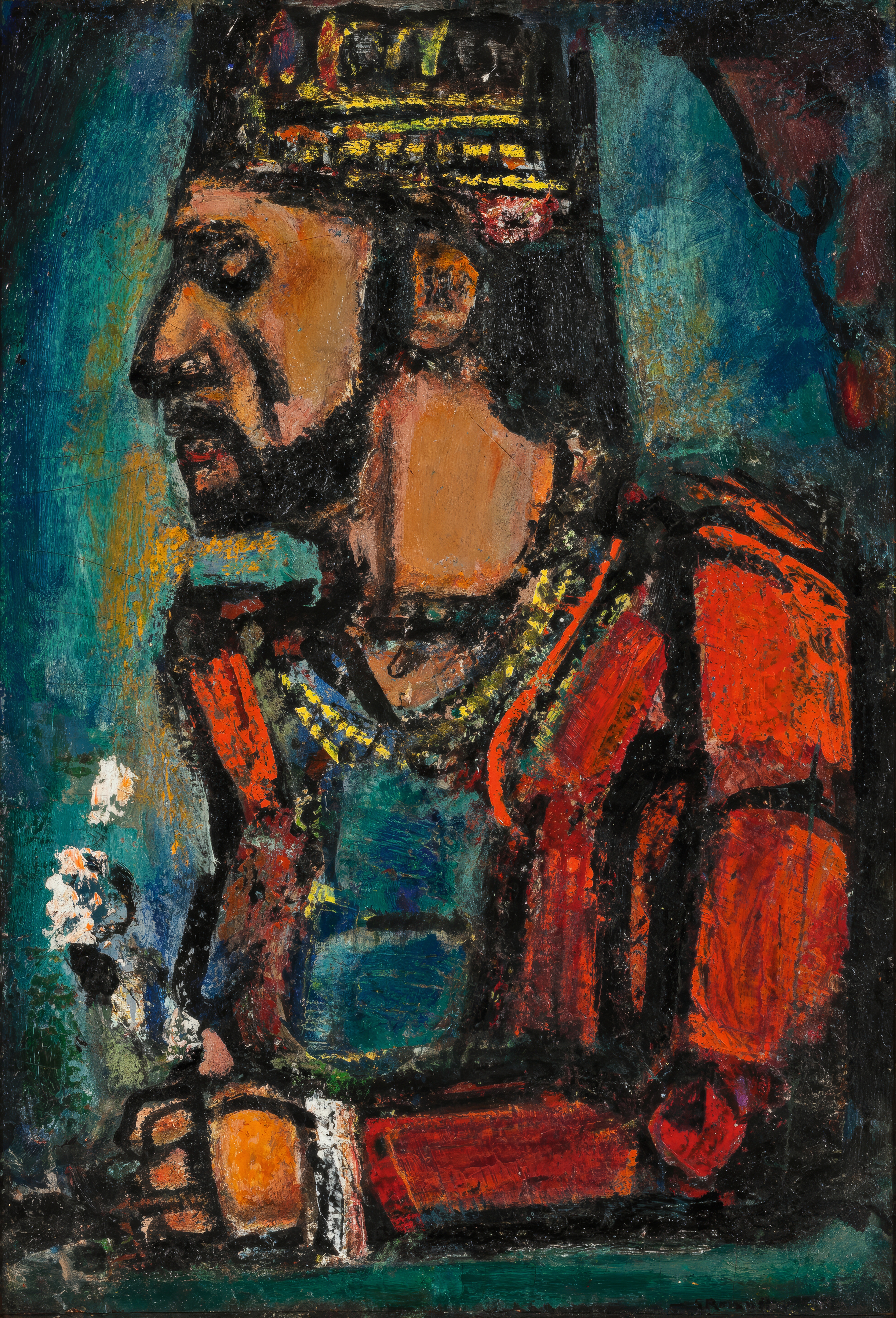
      The old king (1937) de Georges Rouault
      4

      The old king

      1937 · Oil On Canvas

      In the quiet, heavy atmosphere of Georges Rouault’s 1937 masterpiece, The Old King, one encounters a profound meditation on the human condition. The painting presents a solitary monarch, captured in profile, whose very presence seems to vibrate with an introspective melancholy. Draped in rich, crimson robes that catch the light with a somber intensity, the figure gazes inward, his expression etched with a deep, palpable sadness. This is not merely…

      Jesus on the cross as forgotten there de Georges Rouault
      5

      Jesus on the cross as forgotten there

      Acrylic On Canvas

      Georges Rouault’s “Jesus on the Cross as Forgotten There”: A Descent Into Spiritual Darkness The artwork presents a haunting meditation on faith and suffering, embodied in Georges Rouault's monumental print, "Jesus on the Cross as Forgotten There." Created in 1946 during the Second World War, amidst the pervasive anxieties of occupation and loss, this piece transcends mere depiction; it plunges into the abyss of existential despair, mirroring the artist’s own…

      Femme Affranchie, A Quatorze Heures, Chante Midi de Georges Rouault
      6

      Femme Affranchie, A Quatorze Heures, Chante Midi

      Acrylic

      Georges Rouault’s Femme Affranchie: A Portrait of Resilience Amidst Darkness The Denver Art Museum houses Georges Rouault's “Femme Affranchie, à Quatorze Heures, Chante Midi” (Woman Freed at Noon), a hauntingly beautiful engraving from his seminal Miserere et Guerre series completed in 1923. This artwork transcends mere visual representation; it embodies Rouault’s deeply felt empathy for the vulnerable and his unwavering commitment to exploring profound spiritual themes—a legacy born from witnessing…

      The Judges (1908) de Georges Rouault
      7

      The Judges

      1908 · Oil · Statens Museum For Kunst, Copenhague

      In this 1908 oil painting, three seated figures occupy a shallow, darkened space. The composition is arranged horizontally, with the figures positioned in a way that fills the frame, creating a sense of enclosure. The lighting is low-key, emerging from an indistinct source to illuminate only specific portions of the subjects, such as the pale, ghostly whites of facial features and the edges of clothing. The rest of the scene…

      Hollow dream de Georges Rouault
      8

      Hollow dream

      Oil On Canvas

      The artwork Hollow dream is an oil painting on canvas that presents a portrait of a person, likely male, rendered in an expressionistic style. The composition is a vertical frame that is tightly focused on the head and shoulders, with the subject facing forward and slightly turned toward the viewer's left. The figure fills most of the frame against a dark, undefined background.

      Pinturas de Georges Rouault classificadas de 11 a 100

      Bouquet II (1938) de Georges Rouault
      #13

      Bouquet II

      1938

      Georges Rouault: Bouquet II – A Meditation on Suffering and Beauty Georges Rouault’s “Bouquet II,” painted in 1929, stands as a poignant testament to the artist's unwavering commitment…

      Christ de Georges Rouault
      #14

      Christ

      The painting is a portrait of Jesus with his head bowed down. The background features a sky that appears to be blue in color.

      Away the smile of Reims de Georges Rouault
      #15

      Away the smile of Reims

      A single figure occupies the center of the frame, a presence carved from darkness and light. The face is elongated, pulled by invisible forces into a mask of…

      The Three Judges (1928) de Georges Rouault
      #18

      The Three Judges

      1928 · Art Institute of Chicago

      The Three Judges is an oil and gouache work on paper, mounted on cardboard and backed with canvas, created by the French artist Georges Rouault. The piece was…

      Dolls, puppets fire hall and the ''Bride'' de Georges Rouault
      #19

      Dolls, puppets fire hall and the ''Bride''

      The air feels heavy, thick with the scent of old dust and greasepaint. In this claustrophobic corner of a theatrical world, three figures huddle together, their presence casting…

      Legendary Landscape (1935) de Georges Rouault
      #20

      Legendary Landscape

      1935

      The artwork is a vertically oriented oil painting on canvas that presents a stylized, dreamlike landscape. The composition features a simplified architectural structure, possibly a church or monastery,…

      'Man of myrrh' de Georges Rouault
      #22

      'Man of myrrh'

      The artwork presents a somber and emotionally charged scene depicting what appears to be a biblical or allegorical narrative. The composition is centered around a reclining figure, presumably…

      Pierrot (1910) de Georges Rouault
      #24

      Pierrot

      1910

      is a work by the French artist Georges Rouault, executed in 1910. Born in Paris, France, in 1871, Rouault remained connected to his home city until his death…

      Grotesque (1917) de Georges Rouault
      #25

      Grotesque

      1917

      Completed in 1917, Georges Rouault’s Grotesque is a profound exploration of human vulnerability and spiritual resilience. Created against the backdrop of the escalating anxieties of World War I,…

      Crucifixion de Georges Rouault
      #26

      Crucifixion

      The painting depicts a crucifixion scene where the central figure of Jesus Christ is shown on the cross. He is rendered with an elongated torso and contorted limbs,…

      Two Women's Heads (1902) de Georges Rouault
      #27

      Two Women's Heads

      1902

      The painting depicts two women's heads positioned within the frame. On the left side, a woman with long hair is shown looking toward something in front of her,…

      The holy face de Georges Rouault
      #28

      The holy face

      The artwork presents a stylized and emotionally charged depiction of a human face, likely intended to represent Christ or a holy figure. The composition is centered around the…

      Project for the reincarnation of Father Ubu 3 de Georges Rouault
      #29

      Project for the reincarnation of Father Ubu 3

      Georges Rouault's “Project for the Reincarnation of Father Ubu 3” presents not merely a depiction, but an immersion into a world sculpted by anxiety and unsettling satire. This…

      Christ and the Fisherman de Georges Rouault
      #30

      Christ and the Fisherman

      Fine Arts Museums of San Francisco

      Christ and the Fisherman is an oil painting by Georges Rouault. Created in France, the work emerged around 1937. The artist applied oil to paper, which was then…

      Eternally scourged de Georges Rouault
      #31

      Eternally scourged

      In this somber composition, we find ourselves face to face with a figure caught in a moment of profound exhaustion. The subject is positioned slightly off-center, its body…

      King Ubu 1 de Georges Rouault
      #34

      King Ubu 1

      The artwork presents a stylized and somewhat grotesque depiction of a seated figure, identified by the title as King Ubu. The composition is dominated by this central figure,…

      The Superman (1916) de Georges Rouault
      #35

      The Superman

      1916

      In the heavy, somber atmosphere of 1916, as the Great War tore through the heart of Europe, Georges Rouault captured something far more profound than a mere portrait;…

      The Dwarf (1937) de Georges Rouault
      #36

      The Dwarf

      1937 · Art Institute of Chicago

      In this 1937 work, The Dwarf, Georges Rouault presents a figure that occupies the periphery of social visibility. The artist, a Frenchman, turned his attention toward those living…

      Dancer for the Ballets Russes de Georges Rouault
      #37

      Dancer for the Ballets Russes

      Georges Rouault's "Dancer for the Ballets Russes" is a striking portrait that encapsulates the spirit of early 20th-century artistic innovation. Created likely around 1929, this artwork offers a…

      Pierrot 2 de Georges Rouault
      #38

      Pierrot 2

      Georges Rouault's 'Pierrot 2' isn’t merely a depiction of the iconic commedia dell’arte figure; it’s an immersion into a world steeped in sorrow, isolation, and a profound spiritual…

      Twilight or Ile de France de Georges Rouault
      #39

      Twilight or Ile de France

      Georges Rouault’s “Twilight or Ile de France” is a captivating exploration of light, color, and human emotion, firmly rooted in the heart of the Fauvist movement. Painted in…

      Night Fall de Georges Rouault
      #40

      Night Fall

      The artwork presents a stylized and emotionally charged scene depicting figures in what appears to be a coastal or rural setting at night. It carries a somber and…

      '... when the night came. The moon rose' de Georges Rouault
      #41

      '... when the night came. The moon rose'

      In the hauntingly beautiful tableau titled '... when the night came. The moon rose,' Georges Rouault invites us into a world where the boundaries between the physical landscape…

      The blind man sometimes consoles the light de Georges Rouault
      #42

      The blind man sometimes consoles the light

      Georges Rouault's “The Blind Man Sometimes Consoles the Light” is not merely a depiction of two figures; it’s an immersion into a world steeped in sorrow, faith, and…

      Nude with arms raised (combed) de Georges Rouault
      #43

      Nude with arms raised (combed)

      In the quiet, heavy atmosphere of Georges Rouault’s 1937 masterpiece, Nude with Arms Raised (combed), one does not merely observe a figure; one encounters a soul in the…

      Dura Lex Sed Lex de Georges Rouault
      #44

      Dura Lex Sed Lex

      “Dura lex sed lex” – "The law is hard, but it is the law" – this stark and profoundly moving portrait by Georges Rouault transcends a simple depiction…

      As telas de Georges Rouault, período por período

      Early 20th Century

      1907 – 1910 · 3 obras nesta lista

      O que Georges Rouault mais pintou

      Os quatro temas que mais aparecem nestas telas, cada um com o seu exemplo mais amado.

      Onde as telas de Georges Rouault estão expostas

      Os 7 museus que detêm a maioria das pinturas desta página.

      Museu Cidade Obras de Georges Rouault Pinturas desta lista
      Art Institute of Chicago, ChicagoArt Institute of Chicago Chicago 2 The Three Judges, The Dwarf
      The Phillips Collection, Washington, D.C.The Phillips Collection Washington, D.C. 3 Verlaine
      Statens Museum For Kunst, CopenhagueStatens Museum For Kunst Copenhague 1 The Judges
      Fine Arts Museums of San Francisco, São FranciscoFine Arts Museums of San Francisco São Francisco 1 Christ and the Fisherman
      Royal Museum of Fine Arts Antwerp, AntuérpiaRoyal Museum of Fine Arts Antwerp Antuérpia 1 Newspaper Seller
      Galeria Nacional do Canadá, OttawaGaleria Nacional do Canadá Ottawa 1 Christ on the Cross
      Chimei Museum, TainanChimei Museum Tainan 1 Profile of a Woman

      Década a década: a tela mais celebrada de Georges Rouault

      1. 1900s
        The Judges (1908) de Georges Rouault
        7 de 100

        The Judges

        Idade 29 – 38 · Statens Museum For Kunst

        In this 1908 oil painting, three seated figures occupy a shallow, darkened space. The composition is arranged horizontally, with the figures positioned in a way that fills the…

      2. 1910s
      3. 1920s
        The Three Judges (1928) de Georges Rouault
        18 de 100

        The Three Judges

        Idade 49 – 58 · Art Institute of Chicago

        The Three Judges is an oil and gouache work on paper, mounted on cardboard and backed with canvas, created by the French artist Georges Rouault. The piece was…

      4. 1930s
        The Breton Wedding (1937) de Georges Rouault
        Classificado em 3 de 100

        The Breton Wedding

        Idade 59 – 68

        Georges Rouault’s “The Breton Wedding” is not merely a depiction of a rural ceremony; it's a profound meditation on faith, community, and the quiet dignity of everyday life.…

      As suas perguntas sobre as pinturas de Georges Rouault, respondidas

      Qual é a pintura mais celebrada de Georges Rouault?Leia a resposta

      Head of Christ, seguido por Head of Christ 1 e The Breton Wedding (1937).

      Quais são as dez pinturas mais famosas de Georges Rouault?Leia a resposta

      Head of Christ, Head of Christ 1, The Breton Wedding, The old king, Jesus on the cross as forgotten there, Femme Affranchie, A Quatorze Heures, Chante Midi, The Judges, Hollow dream, The Poulot or partner, Red Zone e Landscape from the Bible, Christ and the fishermen. Cada tela no ranking acima inclui o seu ano e o seu museu.

      Quantas pinturas de Georges Rouault são conhecidas?Leia a resposta

      268 obras de Georges Rouault estão em nosso catálogo, datadas de 1902 a 1938.

      Em quais museus se encontram as telas mais conhecidas de Georges Rouault?Leia a resposta

      Principalmente em Art Institute of Chicago (Chicago), The Phillips Collection (Washington, D.C.) e Statens Museum For Kunst (Copenhague); a lista acima indica cada museu e as suas telas.

      Em que anos Georges Rouault pintou as suas telas mais célebres?Leia a resposta

      Em 1900s, que compreende 5 das 100 obras desta página, The Judges entre elas.

      Quais são a primeira e a última das telas famosas de Georges Rouault?Leia a resposta

      A tela mais antiga aqui é de Two Women's Heads (1902); a mais recente é de Bouquet II (1938).

      Quais temas aparecem com mais frequência nas pinturas de Georges Rouault?Leia a resposta

      Suffering (13), Darkness (11) e Portrait (7), entre as 100 obras nesta página.

      Com o que Georges Rouault costumava pintar?Leia a resposta

      Oil On Canvas, utilizado em 11 das 100 obras nesta página.

      A qual movimento artístico pertence Georges Rouault?Leia a resposta

      Fauvism e Expressionism, como mostram as telas nesta página.

      O que posso ver de Georges Rouault no Art Institute of Chicago?Leia a resposta

      O Art Institute of Chicago, Chicago detém 2 das obras desta página, entre elas The Three Judges e The Dwarf.

      Georges Rouault: a história do pintor

      A Vida Forjada nas Sombras de Paris

      Georges Rouault, nascido em Paris em 1871, no coração da turbulência da Comuna, viveu uma vida profundamente marcada por dificuldades e busca espiritual. Seus primeiros anos foram literalmente sombrios – sua família buscou refúgio em um porão durante o bombardeio da cidade, um evento que ressoaria ao longo de sua visão artística. Esse humilde começo, combinado com uma educação católica fervorosa promovida por sua mãe, instilou nele uma profunda empatia pelos marginalizados e sofridos, temas que se tornariam centrais em seu trabalho. Ele não estava destinado a privilégios acadêmicos formais; em vez disso, embarcou em um aprendizado como vidreiro de quatorze anos, uma arte que moldou profundamente suas sensibilidades estéticas. As cores vibrantes e as linhas ousadas inerentes ao vitral tornaram-se fundamentais para seu estilo maduro – um uso característico de contornos escuros que enquadram campos de cor luminosa, reminiscentes da arte medieval. Essa imersão precoce não era meramente técnica; era espiritual, infundindo-o com uma apreciação pelo poder narrativo da luz e da imagem. Ao mesmo tempo, ele buscou treinamento formal na École des Beaux-Arts, onde se tornou um aluno dedicado de Gustave Moreau, cujos inclinações simbolistas nutrimentam ainda mais a inclinação de Rouault para temas emocionalmente carregados.

      Da Abrace da Fauvismo às Profundezas Expressionistas

      A jornada artística de Rouault não foi uma de reconhecimento imediato ou categorização fácil. Embora inicialmente influenciado pelos Simbolistas, ele se viu atraído pelo movimento fauvista em ascensão no início do século XX. Ele fez amizade com artistas como Henri Matisse e Albert Marquet, participando de exposições ao lado deles, mas sua natureza sempre o direcionou a um caminho mais sombrio e introspectivo do que as explorações estéticas puras de seus contemporâneos. As cores vibrantes do fauvismo serviram como uma plataforma, mas Rouault transcendeu rapidamente suas limitações, infundindo suas telas com uma intensidade emocional que prenunciava o expressionismo. Ele começou a se concentrar em assuntos frequentemente negligenciados ou considerados indignos de atenção artística: prostitutas, palhaços, juízes e prisioneiros. Esses não eram meras representações de figuras sociais marginalizadas; eles eram alegorias pungentes da condição humana – explorações do pecado, redenção e da dignidade inerente ao sofrimento. Suas caracterizações, frequentemente grotescas, mas profundamente empáticas, ressoaram com um crescente senso de inquietação e alienação na sociedade moderna, influenciando uma geração de pintores expressionistas que buscavam transmitir a angústia interior por meio de formas distorcidas e cores chocantes.

      Um Bom Compassa Moral em Tela e Gravura

      A Primeira Guerra Mundial provou ser um momento decisivo para Rouault, consolidando seu compromisso com a fé religiosa e aprofundando o peso moral de sua arte. Ele se retirou em grande parte das exposições públicas durante este período, dedicando-se a projetos pessoais intensos como a série *Miserere* – um ciclo monumental de gravuras inspirado nos Salmos. Essas obras, criadas ao longo de mais de uma década, são, sem dúvida, sua maior e mais duradoura conquista. As próprias placas foram reworkeadas repetidamente, refletindo a busca implacável de Rouault pela verdade emocional e compreensão espiritual. Ele não estava interessado em mera representação; ele buscava capturar a essência crua da experiência humana – o sofrimento, o desespero, mas também o brilho tênue de esperança que persiste mesmo nos cantos mais escuros da existência. Além de *Miserere*, suas pinturas continuaram a explorar temas semelhantes, frequentemente apresentando figuras isoladas e sobrecarregadas por suas circunstâncias, mas imbuidas de uma dignidade silenciosa. Suas representações de palhaços, por exemplo, não eram simplesmente cenas cômicas; eles eram figuras trágicas que personificavam a absurdidade e a solidão da vida.

      Influências e Estilo

      Rouault foi influenciado por uma variedade de artistas e movimentos. Além de Gustave Moreau, ele admirava os trabalhos de Vincent van Gogh, cujas pinceladas expressivas e uso dramático da cor o inspiraram profundamente. A influência do fauvismo também é evidente em suas obras iniciais, com suas cores vibrantes e formas simplificadas. No entanto, Rouault rapidamente transcendeu as limitações do fauvismo, desenvolvendo um estilo próprio que era caracterizado por sua paleta de cores escuras e sombrias, seus contornos definidos e seu foco na expressão emocional. Sua obra é frequentemente descrita como expressionista, embora ele nunca tenha se identificado totalmente com o movimento. Rouault também foi influenciado pela arte medieval, especialmente pelo vitral, que moldou seu estilo. Ele era um mestre em criar imagens que eram ao mesmo tempo belas e poderosas, e suas obras são cheias de simbolismo e significado.

      Conquistas Notáveis e Legado

      Ao longo de sua carreira, Rouault produziu mais de 1.300 pinturas, gravuras e desenhos. Ele também foi um curador talentoso do Museu Moreau em Paris, onde cuidou da coleção de seu mentor Gustave Moreau. Sua obra é exibida em importantes museus em todo o mundo, incluindo o Centre Pompidou em Paris, o Hermitage Museum em São Petersburgo e o Musée d’Art Moderne em Paris. Rouault morreu em Paris em 1958, deixando para trás um corpo de trabalho que continua a ressoar com os públicos de hoje – um testemunho do poder duradouro da arte nascida da compaixão, fé e uma visão inabalável da complexidade do coração humano. Sua obra é um convite à reflexão sobre a condição humana, um lembrete de que mesmo nos momentos mais sombrios, a beleza e a esperança podem ser encontradas.

      Informações Adicionais

      • Nascido: 27 de maio de 1871, Paris, França
      • Faleceu: 13 de fevereiro de 1958, Paris, França
      • Estilo artístico: Expressionismo, Fauvismo
      • Influências: Gustave Moreau, Vincent van Gogh
      • Obras notáveis: *Miserere* (série de gravuras), *The Way to Calvary*, *End of Autumn 1*, *The Minx*

      Todas as 268 obras de Georges Rouault →