
Ateliê — Envio gratuito para todo o mundo — Entrega em 2–6 semanas
      Marija Oksentiivna Pryjmačenko, 1908 – 1997

      Marija Oksentiivna Pryjmačenko: The 97 Best-Known Paintings

      Of all Marija Oksentiivna Pryjmačenko's paintings, Three Parrots on a Soldier's Grave (1982) is the most famous. Close behind come I Give My Little Stars to Children (1983) and The Little Elephant Who Wanted to Be a Sailor (1973). Among the 97 works by Marija Oksentiivna Pryjmačenko in our catalogue, these 97 are the most celebrated, each shown with its date, its museum and its story.

      Ranked by our popularity score, which combines the searches, visits and orders for each work. Updated Outubro 2026.

      Portrait of Marija Oksentiivna Pryjmačenko
      Marija Oksentiivna Pryjmačenko · 1908 – 1997
      Born · died
      1908 – 1997, Oblast de Kyiv
      Movement
      Naive art / primitivism
      Works in our catalogue
      97
      Most famous
      Three Parrots on a Soldier's Grave (1982)

      Marija Oksentiivna Pryjmačenko's 10 most celebrated paintings

      Let Us Go to the Betrothal Party (1968) by Marija Oksentiivna Pryjmačenko
      7

      Let Us Go to the Betrothal Party

      1968 · Gouache

      In the vibrant tapestry of twentieth-century Naive Art, few works radiate as much warmth and cultural vitality as Maria Primachenko’s 1968 masterpiece, "Let Us Go to the Betrothal Party." This gouache painting is far more than a mere depiction of a festive occasion; it is an immersive window into the heart of Ukrainian folklore. At its center, a man and a woman stand in a tender embrace, their figures rendered…

      Flax Blooms and a Cossack Goes to a Girl (1982) by Marija Oksentiivna Pryjmačenko
      8

      Flax Blooms and a Cossack Goes to a Girl

      1982 · Acrylic On Canvas

      In the enchanting realm of Maria Primachenko’s artistry, the boundaries between reality and folklore dissolve into a vibrant tapestry of color and cultural memory. Her masterpiece, Flax Blooms and a Cossack Goes to a Girl, serves as a breathtaking window into the soul of Ukraine. At first glance, the viewer is swept up in a whirlwind of saturated hues and whimsical forms that evoke the joyous spirit of a traditional…

      Marija Oksentiivna Pryjmačenko paintings ranked 11 to 97

      My Flowers To Those Who Love Peace (1983) by Marija Oksentiivna Pryjmačenko
      #11

      My Flowers To Those Who Love Peace

      1983

      In this 1983 work, Maria Primachenko offers a quiet, colorful meditation on the concept of tranquility. The composition centers on a stylized, ornamental structure, reminiscent of a central…

      Wild Bull and Raven Are Friends (1983) by Marija Oksentiivna Pryjmačenko
      #14

      Wild Bull and Raven Are Friends

      1983

      In the enchanting realm of Maria Primachenko’s 1983 masterpiece, "Wild Bull and Raven Are Friends," the boundaries between reality and folklore dissolve into a vibrant tapestry of color…

      Crane Makes Friends with a Fox (1979) by Marija Oksentiivna Pryjmačenko
      #15

      Crane Makes Friends with a Fox

      1979

      The Maria Primachenko painting, "Crane Makes Friends with a Fox", is a captivating example of Naive Art/Primitivism, a style characterized by its simplicity, flat rendering, and lack of…

      Lovely Spring, What Did You Bring. (1977) by Marija Oksentiivna Pryjmačenko
      #16

      Lovely Spring, What Did You Bring.

      1977

      In the vibrant masterpiece "Lovely Spring, What Did You Bring," the legendary Ukrainian artist Maria Primachenko invites us into a world where nature and myth intertwine with breathtaking…

      Two-Headed Chicken (1977) by Marija Oksentiivna Pryjmačenko
      #17

      Two-Headed Chicken

      1977

      In this 1977 composition, two large yellow birds occupy the central space of a 62 x 85 cm canvas. These avian figures possess elongated necks and are positioned…

      Ukrainian Wedding (1966) by Marija Oksentiivna Pryjmačenko
      #18

      Ukrainian Wedding

      1966

      In the vibrant tapestry of twentieth-century Naive Art, few threads are as luminous and emotionally resonant as those woven by Maria Primachenlyko. Her 1966 masterpiece, Ukrainian Wedding, serves…

      Ukraine Blooming (1979) by Marija Oksentiivna Pryjmačenko
      #19

      Ukraine Blooming

      1979

      In the enchanting realm of Naive Art, few works capture the pure, unadulterated joy of nature quite like Maria Primachenko’s Ukraine Blooming. Created in 1979, this masterpiece serves…

      Flax Blooms, a Bride Goes to Her Groom (1983) by Marija Oksentiivna Pryjmačenko
      #20

      Flax Blooms, a Bride Goes to Her Groom

      1983

      In the enchanting realm of Maria Primachenko’s imagination, reality dissolves into a tapestry of myth and memory. Flax Blooms, a Bride Goes to Her Groom serves as a…

      Do I Love Orchards, Do I Love Forests (1968) by Marija Oksentiivna Pryjmačenko
      #21

      Do I Love Orchards, Do I Love Forests

      1968

      In the vibrant masterpiece Do I Love Orchards, Do I Love Forests, created in 1968, the legendary Ukrainian artist Maria Primachenko invites us into a world where the…

      Wild and Big-Eared (1977) by Marija Oksentiivna Pryjmačenko
      #22

      Wild and Big-Eared

      1977

      The Naive Art/Primitivism style has always been a fascinating genre, and one artist who embodies its spirit is Maria Primachenko. Her painting, Wild and Big-Eared, created in 1977,…
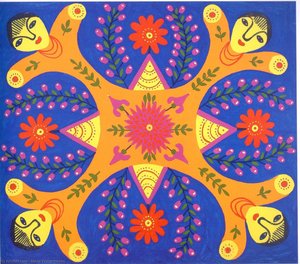
      Tablecloth (1976) by Marija Oksentiivna Pryjmačenko
      #23

      Tablecloth

      1976

      Created in 1976, this gouache work by Maria Primachenko utilizes a flattened perspective to organize a complex visual field. The composition centers on a large circle, which is…

      Ukrainian Dancers (1983) by Marija Oksentiivna Pryjmačenko
      #24

      Ukrainian Dancers

      1983

      In the vibrant tapestry of twentieth-century Ukrainian art, few works capture the pure, unadulterated joy of nature quite like Maria Primachenko’s Ukrainian Dancers. Created in 1983, this masterpiece…

      Monkey Riding a Four-Headed Beast (1982) by Marija Oksentiivna Pryjmačenko
      #25

      Monkey Riding a Four-Headed Beast

      1982

      The painting Monkey Riding a Four-Headed Beast by Maria Primachenko is a vibrant and captivating example of Naive Art/Primitivism, a style characterized by its simplicity, flat rendering, and…

      Dumplings on the Shelf (1979) by Marija Oksentiivna Pryjmačenko
      #26

      Dumplings on the Shelf

      1979

      In the tender, vibrant strokes of "Dumplings on the Shelf," we encounter the enchanting world of Maria Primachenko, a master of Naive Art who transformed the mundane into…
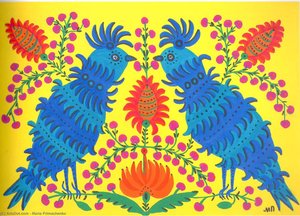
      Two Kites (1982) by Marija Oksentiivna Pryjmačenko
      #27

      Two Kites

      1982

      In the vibrant realm of Naive Art, few works capture the whimsical essence of nature as tenderly as Maria Primachenko’s 1982 masterpiece, Two Kites. This enchanting gouache painting…

      Red Poppies (1982) by Marija Oksentiivna Pryjmačenko
      #29

      Red Poppies

      1982

      Red Poppies is a work by Maria Prymachenko, executed in 1982. Measuring 85 x 61 cm, the piece belongs to the Naive Art and Primitivism movements. It reflects…

      Poppy (1983) by Marija Oksentiivna Pryjmačenko
      #52

      Poppy

      1983

      In the enchanting realm of Naive Art, few works capture the rhythmic pulse of life as tenderly as Maria Primachenko’s Poppy. Created in 1983, this masterpiece serves as…

      This Bear Wants to Have Some Flour Milled (1972) by Marija Oksentiivna Pryjmačenko
      #54

      This Bear Wants to Have Some Flour Milled

      1972

      In the enchanting realm of Maria Primachenko’s imagination, the boundaries between the mundane and the magical dissolve into a vibrant tapestry of color and folklore. Her captivating gouache…

      Tiger Laughs (1982) by Marija Oksentiivna Pryjmačenko
      #66

      Tiger Laughs

      1982

      Here are the cantos, eighteen of them, each one different in form, mood, color, beat, scale, and key. There are no cadenzas. Each is separate. Each can stand…

      Pigeons (1968) by Marija Oksentiivna Pryjmačenko
      #75

      Pigeons

      1968

      In the vast landscape of twentieth-century art, few voices resonate with as much pure, unadulterated joy as that of Maria Primachenko. Her 1968 masterpiece, "Pigeons," serves as a…

      A Cow Like That Gives 5,000 Liters a Day (1978) by Marija Oksentiivna Pryjmačenko
      #76

      A Cow Like That Gives 5,000 Liters a Day

      1978

      The painting "A Cow Like That Gives 5,000 Liters a Day" by Maria Primachenko is a stunning example of Naive Art/Primitivism, a style characterized by its simplicity, flat…

      Ukrainian Dough Looks Into Every House (1977) by Marija Oksentiivna Pryjmačenko
      #77

      Ukrainian Dough Looks Into Every House

      1977

      In the enchanting realm of Maria Primachenko’s 1977 masterpiece, "Ukrainian Dough Looks Into Every House," the boundaries between reality and myth dissolve into a vibrant, dreamlike landscape. This…

      My Bouquet to Grain Growers (1983) by Marija Oksentiivna Pryjmačenko
      #78

      My Bouquet to Grain Growers

      1983

      In the vibrant tapestry of twentieth-century Ukrainian art, few works capture the whimsical essence of life quite like Maria Primachenko’s My Bouquet to Grain Growers. Created in 1983,…

      Our Army, Our Protectors (1978) by Marija Oksentiivna Pryjmačenko
      #79

      Our Army, Our Protectors

      1978

      The painting "Our Army, Our Protectors" by Maria Primachenko is a stunning example of Naive Art/Primitivism, a style characterized by its simplicity, flat rendering, and lack of formal…

      Savage Hump-Shaker (1977) by Marija Oksentiivna Pryjmačenko
      #80

      Savage Hump-Shaker

      1977

      The Naive Art/Primitivism style has always been a fascinating genre, and one artist who embodies its spirit is Maria Primachenko. Her painting, Savage Hump-Shaker, created in 1977, is…

      Maiden and Cossack Enjoying a Ride on Horseback (1982) by Marija Oksentiivna Pryjmačenko
      #81

      Maiden and Cossack Enjoying a Ride on Horseback

      1982

      The painting Maiden and Cossack Enjoying a Ride on Horseback by Maria Primachenko is a stunning example of Naive Art, a style characterized by its simplicity, flat rendering,…

      A Hare's Birthday Party (1977) by Marija Oksentiivna Pryjmačenko
      #82

      A Hare's Birthday Party

      1977

      The Naive Art/Primitivism style has always been a fascinating genre, and one artist who embodies its spirit is Maria Primachenko. Her painting, "A Hare's Birthday Party", created in…

      A Coward Went A-Hunting (1983) by Marija Oksentiivna Pryjmačenko
      #83

      A Coward Went A-Hunting

      1983

      The Naive Art/Primitivism movement has long been a source of fascination for art enthusiasts, and Maria Primachenko's work is a stunning example of this style. Her painting, A…

      A Bunch of Red Flowers on Read Army Day (1970) by Marija Oksentiivna Pryjmačenko
      #84

      A Bunch of Red Flowers on Read Army Day

      1970

      The painting A Bunch of Red Flowers on Read Army Day is a stunning example of Naive Art/Primitivism, a style characterized by its simplicity, flat rendering, and lack…

      October Flowers (1968) by Marija Oksentiivna Pryjmačenko
      #85

      October Flowers

      1968

      The painting October Flowers is a stunning example of Naive Art/Primitivism, a style characterized by its simplicity, flat rendering, and lack of formal training. Created in 1968 by…

      This Beast is Making Magic (1983) by Marija Oksentiivna Pryjmačenko
      #86

      This Beast is Making Magic

      1983

      The painting "This Beast is Making Magic" by Maria Primachenko is a captivating example of Naive Art/Primitivism, a style characterized by its simplicity, flat rendering, and lack of…

      Menagerie (1977) by Marija Oksentiivna Pryjmačenko
      #87

      Menagerie

      1977

      The Menagerie by Maria Primachenko is a captivating example of Naive Art/Primitivism, a style characterized by its simplicity, flat rendering, and lack of formal training. Created in 1977,…

      An Outer Space Memory (1977) by Marija Oksentiivna Pryjmačenko
      #88

      An Outer Space Memory

      1977

      The Maria Primachenko painting, An Outer Space Memory, is a fascinating example of Naive Art/Primitivism. Created in 1977, this piece showcases the artist's unique style and perspective. The…
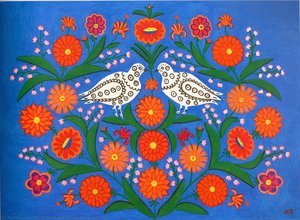
      Pigeon and Dove (1982) by Marija Oksentiivna Pryjmačenko
      #89

      Pigeon and Dove

      1982

      The painting "Pigeon and Dove" by Maria Primachenko is a stunning example of Naive Art/Primitivism, a style characterized by its simplicity, flat rendering, and lack of formal training.…

      Blue Birds in Flowers (1983) by Marija Oksentiivna Pryjmačenko
      #90

      Blue Birds in Flowers

      1983

      The painting Blue Birds in Flowers by Maria Primachenko is a stunning example of Naive Art, a style characterized by its simplicity, flat rendering, and lack of formal…

      Dear Cosmonauts, I Give You These Red Poppies (1983) by Marija Oksentiivna Pryjmačenko
      #91

      Dear Cosmonauts, I Give You These Red Poppies

      1983

      The painting Dear Cosmonauts, I Give You These Red Poppies is a stunning example of Naive Art/Primitivism, a style characterized by its simplicity, flat rendering, and lack of…

      Wild Cat (1977) by Marija Oksentiivna Pryjmačenko
      #92

      Wild Cat

      1977

      The Wild Cat painting by Maria Primachenko is a stunning example of Naive Art/Primitivism, a style characterized by its simplicity, flat rendering, and lack of formal training. Created…

      Red Snowball Tree Blooms Over a Well (1982) by Marija Oksentiivna Pryjmačenko
      #93

      Red Snowball Tree Blooms Over a Well

      1982

      The painting "Red Snowball Tree Blooms Over a Well" by Maria Primachenko is a stunning example of Naive Art/Primitivism, a style characterized by its simplicity, flat rendering, and…

      A Dove Has Spread Her Wings and Asks for Peace (1982) by Marija Oksentiivna Pryjmačenko
      #94

      A Dove Has Spread Her Wings and Asks for Peace

      1982

      The painting A Dove Has Spread Her Wings and Asks for Peace by Maria Primachenko is a stunning example of Naive Art/Primitivism, a style characterized by its simplicity,…

      Ukrainian Milkmaids Work Hard Like Miners (1970) by Marija Oksentiivna Pryjmačenko
      #95

      Ukrainian Milkmaids Work Hard Like Miners

      1970

      The Ukrainian Milkmaids Work Hard Like Miners painting by Maria Primachenko is a stunning example of Naive Art/Primitivism, a style characterized by its simplicity, flat rendering, and lack…

      Ola Man and Old Woman Carry a Turnip (1983) by Marija Oksentiivna Pryjmačenko
      #96

      Ola Man and Old Woman Carry a Turnip

      1983

      The painting "Ola Man and Old Woman Carry a Turnip" by Maria Primachenko is a stunning example of Naive Art/Primitivism, a style characterized by its simplicity, flat rendering,…

      The Lark (1976) by Marija Oksentiivna Pryjmačenko
      #97

      The Lark

      1976

      The Maria Primachenko painting, The Lark, is a stunning example of Naive Art/Primitivism, a style characterized by its simplicity, flat rendering, and lack of formal training. Created in…

      Marija Oksentiivna Pryjmačenko's canvases, period by period

      What Marija Oksentiivna Pryjmačenko painted most

      The four subjects that return most often on these canvases, each with its best-loved example.

      Decade by decade: Marija Oksentiivna Pryjmačenko's most celebrated canvas

      1. 1930s
      2. 1960s
        Let Us Go to the Betrothal Party (1968) by Marija Oksentiivna Pryjmačenko
        7 of 97

        Let Us Go to the Betrothal Party

        Age 52 – 61

        In the vibrant tapestry of twentieth-century Naive Art, few works radiate as much warmth and cultural vitality as Maria Primachenko’s 1968 masterpiece, "Let Us Go to the Betrothal…

      3. 1970s
      4. 1980s

      Your questions on Marija Oksentiivna Pryjmačenko's paintings, answered

      Which is the most celebrated painting by Marija Oksentiivna Pryjmačenko?Read the answer

      Three Parrots on a Soldier's Grave (1982), followed by I Give My Little Stars to Children (1983) and The Little Elephant Who Wanted to Be a Sailor (1973).

      How old was Marija Oksentiivna Pryjmačenko at the time of Three Parrots on a Soldier's Grave?Read the answer

      Marija Oksentiivna Pryjmačenko, born in 1908, was 74 years old: Three Parrots on a Soldier's Grave dates from 1982.

      Which ten paintings is Marija Oksentiivna Pryjmačenko most famous for?Read the answer

      Three Parrots on a Soldier's Grave, I Give My Little Stars to Children, The Little Elephant Who Wanted to Be a Sailor, Corncob Horse in Outer Space, Lamd Has Harnesed a Wolf, Magpie in Roses, Let Us Go to the Betrothal Party, Flax Blooms and a Cossack Goes to a Girl, Black Beast and Taras Hryhorovych Shevchenko Arrives From His Exile to Flowering Ukraine. Each canvas in the ranking above comes with its year and its museum.

      How many paintings by Marija Oksentiivna Pryjmačenko are known?Read the answer

      97 works by Marija Oksentiivna Pryjmačenko are in our catalogue, dated 1936 to 1983.

      In which years did Marija Oksentiivna Pryjmačenko paint the most celebrated canvases?Read the answer

      In 1980s, which gave 46 of the 97 works on this page, Three Parrots on a Soldier's Grave among them.

      What are the first and the last of Marija Oksentiivna Pryjmačenko's famous canvases?Read the answer

      The earliest canvas here is Black Beast (1936); the latest is I Give My Little Stars to Children (1983).

      Which subjects return most often in Marija Oksentiivna Pryjmačenko's paintings?Read the answer

      Animals (30), Flowers (23) and Birds (14), across the 97 works on this page.

      What did Marija Oksentiivna Pryjmačenko usually paint with?Read the answer

      Gouache, used in 24 of the 97 works on this page.

      To which art movement does Marija Oksentiivna Pryjmačenko belong?Read the answer

      Naive art / primitivism, as the canvases on this page show.

      Marija Oksentiivna Pryjmačenko: the painter's story

      Uma Vida Enraizada no Solo Ucraniano

      Maria Aksentievna Primachenko, nascida na pequena aldeia de Bolotnya, perto de Kyiv, em 1908, emergiu como uma das artistas mais celebradas e distintas da Ucrânia — uma verdadeira visionária cuja obra transcende qualquer categorização. Sua vida estava profundamente entrelaçada com os ritmos da existência rural, um mundo imerso no folclore antigo, em tradições vibrantes e em uma conexão íntima com a natureza. Desde cedo, o caminho de Maria divergiio das expectativas convencionais; contrair poliomielite na infância confinou-a ao ambiente doméstico por longos períodos, mas esse isolamento provou ser um solo inesperadamente fértil para o florescimento artístico. Sua mãe e sua avó, habilidosas bordadeiras, transmitiram-lhe as técnicas intrincadas e a linguagem simbólica da arte popular ucraniana — uma herança que se tornaria o alicerce de seu estilo único. Essas lições precoces não eram meramente técnicas; eram uma transmissão de memória cultural, uma forma de ver o mundo imbuída de significado e magia. Foi nesses anos formativos, cercada por fios coloridos e padrões ancestrais, que Maria começou a desenvolver um extraordinário vocabulário visual.

      A Revelação Naif: Um Estilo Sem Amarras

      A arte de Primachenko é frequentemente descrita como “naif”, um termo que pode ser enganosamente limitante. Embora não tenha recebido treinamento artístico formal, sua obra possui uma sofisticação profunda — uma energia bruta e indomada aliada a uma compreensão profunda de composição e cor. Na década de 1930, após ser descoberta pela artista Tetiana Floru, Maria juntou-se à Associação Cooperativa de Bordado de Kyiv, onde seu talento rapidamente se tornou evidente. Isso levou a um convite para participar de workshops experimentais no Museu de Arte Ucraniana de Kyiv, marcando um momento crucial em sua jornada artística. Foi ali que ela começou a traduzlin os motivos e as técnicas do bordado para a pintura — telas de grande escala repletas de criaturas fantásticas, flores vibrantes e cenas da vida cotidiana reimaginadas através de uma lente profundamente pessoal. Seus temas não surgiam apenas da observação; eles brotavam de sonhos, memórias e de uma fonte profunda de imaginação. Leões com rostos humanos, pássaros envolvidos em rituais lúdicos de acasalamento, cavalos adornados com padrões intrincados — estas não eram meras representações, mas personificações de esperanças, medos e do espírito resiliente da Ucrânia.

      Simbolismo Tecido em Cada Pincelada

      O poder da arte de Primachenko reside não apenas em sua exuberância visual, mas também em seu rico simbolismo. Suas pinturas são repletas de motivos extraídos do folclore ucraniano — rodas solares ancestrais que representam a vida e a renovação, pássaros que simbolizam a liberdade e a paz, e cavalos que atuam como protetores contra espíritos malignos. Esses símbolos não eram usados conscientemente como uma forma de mensagem codificada; em vez disso, emergiam organicamente de seu contexto cultural e de sua compreensão intuitiva do mundo natural. Os animais em suas pinturas frequentemente assumem características humanas — participando de casamentos, aniversários e outros eventos sociais — borrando as fronteiras entre o reino animal e o domínio humano. Esse antropomorfismo não é apenas fantasioso, mas reflete um profundo respeito por todas as criaturas vivas e uma crença em sua dignidade inerente. Seu uso da cor é igualmente significativo — tons ousados e saturados que evocam alegria, vitalidade e uma sensação de beleza de outro mundo. A sobreposição de padrões e texturas cria uma superfície visual dinâmica que atrai o espectador para dentro de seu universo fantástico.

      Reconhecimento e um Legado Duradouro

      O talento de Maria Primachenko não passou despercebido. Em 1937, sua obra foi exibida na Exposição Mundial de Paris, onde cativou o público — e até conquistou a admiração de Pablo Picasso, que declarou famosamente que ela poderia ter se tornado mais famosa do que ele se tivesse vivido na França. Ela recebeu uma medalha de ouro na exposição e ganhou reconhecimento internacional por seu estilo único. Apesar de enfrentar períodos de dificuldades e agitações políticas, Primachen$\\chenko$ continuou a pintar ao longo de toda a sua vida, criando mais de 800 obras que celebram a beleza e a resiliência da Ucrânia. Sua arte tornou-se um símbolo de identidade nacional — um testemunho do poder duradouro das tradições populares e do espírito humano. Hoje, Maria Primachenko é reverenciada como uma das artistas mais importantes da Ucrânia, com sua imagem aparecendo em selos e moedas. Os recentes ataques ao Museu Histórico e Local de Ivankiv, que abrigava muitas de suas pinturas, serviram apenas para ressaltar a importância de preservar seu legado — um tesouro cultural que encarna o coração e a alma de uma nação.

      Um Chamado pela Paz: Primachenko no Mundo Moderno

      Após a invasão russa da Ucrânia em 2022, a arte de Maria Primachenko assumiu uma nova ressonância. Suas pinturas vibrantes, que frequentemente retratam cenas de harmonia entre humanos e animais, tornaram-se poderosos símbolos de paz e resistência. A destruição de algumas de suas obras durante os ataques a Ivankiv serviu como um lembrete contundente da fragilidade do patrimônio cultural em tempos de conflito. No entanto, isso também despertou uma apreciação renovada por sua arte — um testemunho de seu poder duradouro e mensagem universal. As pinturas de Primachenko não são meros objetos estéticos; são expressões de esperança, resiliência e um profundo amor pela Ucrânia. Seu legado continua a inspirar artistas e públicos ao redor do mundo, lembrando-nos da importância de preservar as tradições culturais e celebrar a beleza da criatividade humana diante da adversidade. Sua obra permanece como um testemunho vibrante do poder duradouro da arte — um farol de esperança em um mundo frequentemente obscurecido pelas trevas.

      All 97 works by Marija Oksentiivna Pryjmačenko →