

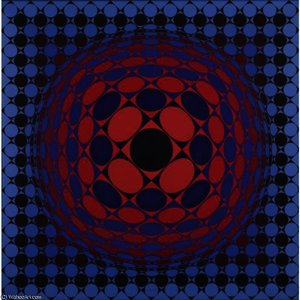
Bivega é a pintura pela qual Victor Vasarely é mais lembrado(a). Quadrature e ORION-MC completam o trio das telas mais amadas. O nosso catálogo conta com 776 obras de Victor Vasarely. Aqui estão as 100 mais famosas, com o ano, o museu e a história de cada tela.
Classificado de acordo com o nosso índice de popularidade, que combina buscas, visitas e pedidos de cada obra. Atualizado em Outubro 2026.


Victor Vasarely's *Quadrature* isn't merely a painting; it’s an invitation – an invitation to question the very nature of visual reality. Created by a visionary who anticipated the digital age, this work embodies the core tenets of Op Art, a movement that sought to manipulate perception through carefully constructed geometric forms and vibrant color fields. Painted in 1960s, *Quadrature* showcases Vasarely’s mastery of optical illusion, transforming two dynamic spheres into…

Victor Vasarely's ORION-MC is not merely a painting; it’s an invitation to experience the world through a radically altered lens. This captivating work, rendered in a vibrant palette of red, yellow, green, blue, purple, orange, and black, exemplifies the core tenets of Op Art – Optical Art – pioneered by Vasarely himself. Born Károly Vaszary in 1906 in Pécs, Croatia, his artistic trajectory began with an unexpected detour into medicine…

The artwork titled Zebras (white on black) was created by the artist Victor Vasarely. This piece features two zebras positioned against a black background. The composition includes smaller figures of animals in the background, such as two birds and three additional zebras, which contribute to the depth of the image. The visual structure utilizes geometric shapes and patterns to form the figures.

Uma Sinfonia Geométrica: Vega-Wa-3 de Victor Vasarely Este vibrante painel, intitulado “Vega-Wa-3”, é uma obra emblemática do artista húngaro Victor Vasarely (1906 – 1997), considerado um dos pais da Op Art e um pioneiro na exploração das percepções visuais. Pintado em 1968, este trabalho representa uma composição meticulosamente planejada que captura a essência da estética geométrica abstrata e convida o espectador a uma jornada sensorial única. A Essência da Op…

To stand before Victor Vasarely’s Kaglo II is to enter a realm where the boundaries between the static and the kinetic dissolve into a rhythmic dance of light and color. Created in 1986, this masterful print serves as a profound testament to the enduring power of geometric abstraction. At first glance, the eye is drawn to a central, commanding red sphere, which acts as the sun within a private cosmos.…

Victor Vasarely’s *Vega 1* isn't merely a painting; it’s an invitation. An invitation to step outside the confines of traditional representation and into a world governed by perception itself. Born in 1906 in Pécs, Croatia – then part of Austria-Hungary – Vasarely’s artistic trajectory was initially rooted in medicine before he decisively embraced the burgeoning field of visual abstraction. This pivotal shift, fueled by his studies at the Podolini-Volkmann Academy…

Victor Vasarely’s “NB 22 Caope” is more than just an abstract painting; it's a meticulously crafted portal into the heart of Op Art, a movement that sought to redefine our perception of reality. This striking work, dominated by a precisely arranged grid of black and white circles, exemplifies Vasarely’s pioneering approach to visual illusion – a technique he developed with mathematical rigor and an almost obsessive attention to detail. The…

To stand before a work by Victor Vasarely is not merely to observe paint on canvas; it is to engage in a sophisticated dialogue with perception itself. This piece, characterized by its vibrant, almost pulsating geometric network, draws the viewer into a mesmerizing optical labyrinth. It speaks directly to the intellectual curiosity of the modern collector and the design sensibility of those who appreciate art as an architectural element. The…

To stand before Harmas is to step directly into the mind of its creator, Victor Vasarely. This piece is not merely an arrangement of color and pattern; it is a vibrant intellectual puzzle, a visual meditation on structure itself. The eye is immediately drawn into the intricate dance between the bold red checks and the myriad small circles that populate the background. It possesses the undeniable energy characteristic of Op…

Victor Vasarely's Pal-Ket, painted in 1974, isn’t merely a visual experience; it’s an invitation to reconsider the very nature of perception. This vibrant acrylic on canvas piece, measuring…

Victor Vasarely's "Vonal-2" is more than just a colorful pattern; it’s a meticulously crafted portal into the heart of Op Art and a testament to the revolutionary ideas…

In this 1957 work, titled Vega II, Victor Vasarely explores the fundamental mechanics of sight. The piece is a purely abstract composition, eschewing any recognizable subject matter in…

To stand before Victor Vasarely's Axo 99 is not merely to observe a painting; it is to engage in a visual dialogue with the very mechanics of sight…

Victor Vasarely's “Abstract Composition 9” is more than just a painting; it’s an invitation to experience the world through the lens of perception itself. Created by one of…

The artwork titled Zebras was created by the artist Victor Vasarely. This piece, dated 1938, emerged from a period of intense graphic experimentation. It is considered one of…

To encounter Victor Vasarely’s Kezdi-Ga is to step away from the stillness of traditional viewing and enter a realm where the canvas breathes, pulses, and vibrates with an…

Victor Vasarely’s ‘SIR-RIS,’ a captivating sculpture rendered in meticulous black and white, stands as a cornerstone of Op Art – a movement that fundamentally challenged our understanding of…

To stand before Victor Vasarely’s "Torony-Nagy" is not merely to observe paint on canvas; it is to engage in a sophisticated dialogue with perception itself. This vibrant 1969…

Victor Vasarely's 'Quasar' is not merely a painting; it’s an invitation into the very fabric of perception, a testament to the revolutionary impact of Op Art and the…

To stand before Victor Vasarely's Zett-Ka is not merely to observe a painting; it is to step into a meticulously constructed optical puzzle. This masterful piece, a quintessential…

Victor Vasarely's "Vega-Kontosh-Va" is not merely a painting; it’s an invitation to experience the world through a radically altered lens. This vibrant composition, dominated by a pulsating red…

We are looking at Vèga 3, a significant work by the artist Victor Vasarely. Created about 1968, this piece belongs to the Op Art movement, a style that…

Zoeld V, 1967 – A Geometric Dance of Color Victor Vasarely’s “Zoeld V” stands as a cornerstone of Op Art—a movement that revolutionized visual perception in the mid-20th…

Victor Vasarely (1906-1997) revolucionou o mundo da arte moderna com sua abordagem singular à abstração geométrica, estabelecendo-se como um dos principais representantes do movimento Op Art – Arte…

Victor Vasarely’s “SIR-RIS” is more than just a painting; it's an invitation into the mesmerizing realm of Op Art – Optical Art – a movement that fundamentally questioned…

In the realm of Op Art, few works capture the hypnotic essence of visual disruption as masterfully as Victor Vasarely’s Zebras (full body white on blue-black). This striking…

Victor Vasarely's "Kezdi-All," a captivating exploration of optical illusion and geometric abstraction, stands as a cornerstone of Op Art – a movement that fundamentally challenged our understanding of…

To stand before Harmas is to step directly into the mind of its creator, Victor Vasarely. This piece is not merely an arrangement of color and pattern; it…

To encounter Victor Vasarely’s 1951 masterpiece, “Terek,” is to step away from the static world of traditional representation and enter a realm where the canvas itself seems to…

To stand before this piece is to step through a portal built entirely of color and calculated form. It is an immediate confrontation with perception itself. The composition,…

To encounter Victor Vasarely's 'Folklore' is to step away from the stillness of traditional viewing and enter a realm where the canvas begins to breathe, pulse, and vibrate…

Victor Vasarely’s “O N D - I I - V A” is more than just a painting; it's an invitation to experience the world through a radically altered…

The artwork is a grid-based abstract composition dominated by concentric circles of varying sizes and shades of red and green. It presents a highly geometric and symmetrical design,…

Victor Vasarely's "F-VERT-BLEU" is not merely a puzzle; it’s a meticulously crafted portal into the heart of Op Art, a movement that fundamentally altered our perception of space…

Victor Vasarely’s “Vonal-Lap,” created in 1969, represents more than just a visual composition; it embodies the very essence of Op Art – Optical Art – a movement that…

The painting Dia-Tuz-Neg is a blue and white composition characterized by a circular pattern. At the center of the work, a large circle is prominently featured, surrounded by…

Victor Vasarely’s “Caopeo” isn’t merely a painting; it’s an invitation, a carefully constructed illusion designed to challenge and delight the viewer. Created in 1962, this seminal work exemplifies…

Sorata-T is a painted glass triptych executed in 1953. The work is composed of three panels:

The artwork Triond features three colorful balls presented in various shades of blue, purple, pink, and green. These spheres are arranged in a triangular formation, with one ball…

Step closer to observe how the eye begins to move across the surface of Domb-B. At first glance, your attention is drawn to that central blue and yellow…

VP-115 by Victor Vasarely exists as a precise study in the mechanics of sight. The work operates through a calculated arrangement of geometric shapes, specifically a sphere and…

Victor Vasarely's 'Jong,' completed in 1968, is more than just an image; it’s an invitation to question the very nature of reality. This arresting work, a cornerstone of…

“Lain,” obra assinada pelo renomado artista Victor Vasarely (1906-1997), representa uma composição fascinante que transcende a mera estética visual para explorar conceitos fundamentais da percepção humana. Esta pintura,…

To encounter Victor Vasarely’s “Obor” is to step away from the stillness of traditional viewing and enter a realm where the canvas itself seems to breathe, pulse, and…

Ion-DR: A Geometric Symphony of Color and Illusion Victor Vasarely’s *Ion-DR*, painted in 1967, stands as a cornerstone of Op Art—Optical Art—a movement that revolutionized visual perception during…

A Dance of Circles on Crimson: Exploring Victor Vasarely's "Untitled 16" Victor Vasarely, a name synonymous with Op Art and kinetic abstraction, gifted the world a visual language…

Tridem K – A Geometric Revelation by Victor Vasarely Victor Vasarely (1906-1997) stands as an undisputed titan of Op Art, a movement that revolutionized visual perception in the…

The artwork Louisiana features a symmetrical, circular design composed of numerous small, overlapping circles in varying shades of red, orange, and brown. A blue grid subtly underlies the…

A Symphony of Geometry: Exploring Victor Vasarely's "Sikra-Z" Victor Vasarely, a name synonymous with Op Art and kinetic art, dedicated his life to unraveling the mysteries of perception…

Victor Vasarely permanece uma figura fundamental nas áreas da Arte Óptica e arte cinética. Sua jornada artística transcendeu a pintura tradicional explorando ousadamente ilusões óticas e criando experiências…

Victor Vasarely (1906-1997), a Hungarian-French artist, stands as an undisputed titan of Op Art – Kinetic Art – reshaping our perception of space and color. His groundbreaking approach…

Quadrature ''X'' – Uma Sinfonia Geométrica de Victor Vasarely A obra "Quadrature ''X''", assinada pelo renomado artista húngaro Viktor Vasarely (1906-1997), representa um marco significativo na história da…

A Dance of Light and Geometry: Unveiling Victor Vasarely’s “Untitled 18” Victor Vasarely's "Untitled 18" isn’t merely a painting; it’s an invitation to step into a world where…

Victor Vasarely (1906-1997) stands as an undisputed titan of Op art, a movement that irrevocably altered the landscape of 20th-century visual culture. Born Károly Vásárhelyi in Pécs, Hungary…

KALOTA T is an artwork created by the artist Victor Vasarely. Born in 1906 and passing away in 1997, the French/Hungarian artist developed a visual language centered on…

Victor Vasarely's "Sikra," painted in 1966, is more than just a colorful composition; it’s a meticulously crafted portal into the heart of Op Art and a testament to…

Victor Vasarely's "Dia-Or" is not merely a painting; it’s an invitation into the very fabric of perception. This captivating work, rendered in oil with meticulous attention to detail,…

To encounter Victor Vasarely's “Mahn” is to step into a realm where the canvas ceases to be a static surface and begins to breathe, pulse, and vibrate with…

Uma Jornada Geométrica em Cores Vibrantes: Explorando a Obra de Victor Vasarely A arte abstrata do século XX frequentemente desafia nossa percepção convencional da realidade, buscando comunicar ideias…

To encounter Victor Vasarely’s Caribe Negatif is to step away from the stillness of traditional viewing and enter a realm where the canvas breathes, vibrates, and dances before…

To encounter Victor Vasarely's “Tomor” is to step away from the static world of traditional imagery and enter a realm where the canvas itself seems to breathe, pulse,…

Victor Vasarely's Rhombus-B is more than just a painting; it’s an invitation to question the very nature of visual perception. Created by one of the foremost figures in…

Victor Vasarely's "Sreeh" is more than just a painting; it’s an invitation into the heart of Op Art, a visual exploration of perception itself. This striking work, dominated…

Victor Vasarely's "Hetta," a deceptively simple composition of four vibrant circles – red, orange, green, and blue – is far more than just an abstract arrangement. It’s a…

Victor Vasarely's *Opus 2604* is not merely a painting; it’s an invitation to question the very nature of visual reality. This mesmerizing work, dominated by a vibrant blue…

This vibrant artwork, designated VY-47-C, is a captivating embodiment of Victor Vasarely's groundbreaking contributions to Op Art and his pioneering exploration of geometric abstraction. Executed with a masterful…

Uma Sinfonia Geométrica em Azul e Vermelho: Uma Análise da Obra Vega-EG de Victor Vasarely A obra "Vega-EG" de Victor Vasarely, uma peça emblemática do movimento Op Art…

“Guimen,” obra de Victor Vasarely, transcende uma mera pintura; é um convite à contemplação sensorial e intelectual. Criada em torno de uma tela azul suavemente iluminada por pontos…

Victor Vasarely's "Molnar" is more than just a painting; it’s an invitation into the mesmerizing world of Op Art, a realm where perception itself becomes the subject. This…

Victor Vasarely's Folkokta is more than just a colorful arrangement of squares; it’s a meticulously crafted portal into the heart of Op Art and a testament to the…

Victor Vasarely: Pioneering Op Art & Democratizing Visual Experience Victor Vasarely (1906–1997) stands as an undisputed titan of Op Art, a movement that irrevocably altered the landscape of…


Victor Vasarely's "Andromeda" isn't merely a painting; it’s an invitation into a realm where perception itself becomes the subject. This striking composition, dominated by a meticulously rendered geometric…

Uma Sinfonia Geométrica: Explorando o Universo de Victor Vasarely A obra "Planetary Folklore Participations No. 1" de Victor Vasarely é uma janela para um mundo fascinante onde geometria…
Victor Vasarely's "Versakk" is not merely a painting; it’s an invitation, a carefully constructed illusion that challenges our very perception of space and form. Created by the Hungarian…

Victor Vasarely's DVA-DVA is more than just a colorful square; it’s a meticulously crafted portal into the heart of Op Art and a testament to the revolutionary approach…

Uma Jornada Geométrica para Além da Superfície: Uma Análise Sobre “Sphere” de Victor Vasarely “Sphere”, obra emblemática do artista húngaro Victor Vasarely (1906-1997), transcende a mera representação visual,…

Victor Vasarely: Uma Jornada ao Universo Geométrico Victor Vasarely (1906-1997) revolucionou o mundo da arte moderna com suas obras que desafiam percepção e exploram princípios matemáticos fundamentais. Sua…

Louisiana 3: A Symphony of Geometric Illusion Louisiana 3, a captivating circular composition by Victor Vasarely, transcends mere visual representation; it embodies the very essence of Op Art…

Victor Vasarely e Koentoesh: Uma Sinfonia Geométrica da Percepção Koentoosh, pintado em 1974 pelo escultor húngaro Victor Vasarely, é uma obra emblemática do movimento Op Art – Arte…

To encounter Victor Vasarely’s Tridim is to step into a realm where the boundaries of the two-dimensional canvas dissolve, replaced by a pulsating, architectural depth that defies the…

Victor Vasarely (1906-1997), born Károly Vaszary in Pécs, Croatia, stands as a monumental figure in the realm of modern art, specifically within the influential movement known as Op…


Uma Sinfonia Geométrica: Explorando o Universo de Victor Vasarely Victor Vasarely (1906-1997), um artista húngaro-francês cuja obra revolucionária permanece influente até hoje, é considerado por muitos como o…

Victor Vasarely (1906-1997) stands as an undisputed titan of 20th-century art, recognized globally as the “grandfather” and foremost architect of Op Art – Optical Art. His artistic journey…

“MEH2,” a captivating work by Hungarian artist Victor Vasarely, is more than just a painting; it's an invitation to explore the very nature of visual perception. Executed in…

Victor Vasarely's Vega-Fel is not merely a painting; it’s an invitation to experience the world through a radically altered lens. This captivating work, dominated by a monumental blue…

Victor Vasarely's "Attam" is more than just a painting; it’s an invitation into the very heart of perception, a testament to the revolutionary impact of Op Art and…

To encounter Victor Vasarely’s “Sikra” is to step away from the stillness of traditional viewing and enter a realm where the canvas breathes, pulses, and vibrates with an…

Victor Vasarely's "Atelier Arcay" isn’t merely a painting; it’s an invitation to a perceptual adventure. Created in the heart of the Op Art movement, this vibrant geometric abstraction…

Uma Sinfonia Geométrica: Explorando a Essência da Obra "Abstract Composition 5" de Victor Vasarely A obra “Abstract Composition 5” de Victor Vasarely transcende uma simples pintura; ela é…

Victor Vasarely's Composition 7 is more than just a colorful painting; it’s a portal into the heart of Op Art and a testament to the revolutionary ideas of…

Victor Vasarely’s "Variációk" (Variations), created in 1989, is more than just an arrangement of circles; it's a vibrant exploration of perception and the underlying mathematical order that governs…

A Dance of Geometry and Color: Exploring Victor Vasarely's "Abstract Composition 13" Victor Vasarely, a name synonymous with Op Art and kinetic art, gifted the world a visual…

Victor Vasarely's Firaxo II is more than just a colorful textile; it’s a meticulously constructed portal into the heart of Op Art and a testament to the revolutionary…

A Symphony in Black: Exploring Victor Vasarely's Serigraph Victor Vasarely’s serigraphy in black is more than just an image; it’s an experience, a visual puzzle that invites the…

“Vonal-Fegn,” created by Victor Vasarely, is more than just an abstract painting; it's a meticulously crafted exploration of perception itself. Painted in hues of orange, yellow, blue, gray,…

Victor Vasarely's "Ouivar," a captivating exploration of geometric abstraction, invites the viewer into a world where perception itself becomes the subject. This artwork, characterized by its precisely arranged…

Victor Vasarely's "Abstract Composition 17" is more than just an image; it’s an invitation to experience the world anew. Born in 1906 in Pécs, Croatia – then part…
Os quatro temas que mais aparecem nestas telas, cada um com o seu exemplo mais amado.
Os 3 museus que detêm a maioria das pinturas desta página.
| Museu | Cidade | Obras de Victor Vasarely | Pinturas desta lista |
|---|---|---|---|
 Bechtler Museum of Modern Art |
Charlotte | 4 | NB 22 Caope, SIR-RIS, Tridem K |
 Inter-American Development Bank |
Washington, D.C. | 2 | Kaglo II |
 Museu de Belas Artes de Bilbao |
Bilbau | 1 | Pal-Ket |
The artwork titled Zebras was created by the artist Victor Vasarely. This piece, dated 1938, emerged from a period of intense graphic experimentation. It is considered one of…
In this 1957 work, titled Vega II, Victor Vasarely explores the fundamental mechanics of sight. The piece is a purely abstract composition, eschewing any recognizable subject matter in…

Uma Sinfonia Geométrica: Vega-Wa-3 de Victor Vasarely Este vibrante painel, intitulado “Vega-Wa-3”, é uma obra emblemática do artista húngaro Victor Vasarely (1906 – 1997), considerado um dos pais…
Victor Vasarely's Pal-Ket, painted in 1974, isn’t merely a visual experience; it’s an invitation to reconsider the very nature of perception. This vibrant acrylic on canvas piece, measuring…

To stand before Victor Vasarely’s Kaglo II is to enter a realm where the boundaries between the static and the kinetic dissolve into a rhythmic dance of light…
Bivega, seguido por Quadrature e ORION-MC.
Bivega, Quadrature, ORION-MC, Zebras (white on black), Vega-Wa-3, Kaglo II, Vega 1, NB 22 Caope, Yon e Harmas. Cada tela no ranking acima inclui o seu ano e o seu museu.
776 obras de Victor Vasarely estão em nosso catálogo, datadas de 1938 a 1986.
Principalmente em Bechtler Museum of Modern Art (Charlotte), Inter-American Development Bank (Washington, D.C.) e Museu de Belas Artes de Bilbao (Bilbau); a lista acima indica cada museu e as suas telas.
Em 1960s, que compreende 10 das 100 obras desta página, Vega-Wa-3 entre elas.
A tela mais antiga aqui é de Zebras (1938); a mais recente é de Kaglo II (1986).
Visual perception (36), Geometric abstraction (33) e Color field (27), entre as 100 obras nesta página.
Acrylic On Canvas, utilizado em 41 das 100 obras nesta página.
Optical art, como mostram as telas nesta página.
O Bechtler Museum of Modern Art, Charlotte detém 3 das obras desta página, entre elas NB 22 Caope, SIR-RIS e Tridem K.
Nascido como Károly Vaszary em 9 de abril de 1906, em Pécs, Hungria, o homem que viria a ser conhecido como Victor Vasarely iniciou sua trajetória em um campo inteiramente distinto. Em 1925, ele ingressou nos corredores da Universidade Eötvös Loránd, em Budapeste, para estudar medicina. A lógica do corpo humano e da ciência ocupou seu tempo por dois anos, mas o fascínio pela expressão visual acabou por prevalecer. Em 1927, ele deixou para trás os estudos médicos para buscar o aprendizado da pintura acadêmica tradicional na Academia Podolini-Volkmann.
Sua formação continuou quando ele ingressou no műhely de Sándor Bortnyik. Este workshop era um lugar onde os princípios do movimento Bauhaus criavam raízes, focando na intersecção entre o design funcional e a abstração geométrica. Ali, o foco deslocou-se em direção ao estrutural e ao sistemático. As lições aprendidas nesses estúdios forneceram a base para suas investigações posteriores sobre como as formas e as cores interagem com o olhar humano.
Entre 1929 e 1944, Victor Vasarely concentrou-se intensamente no trabalho gráfico. Ele dedicou esses anos a experimentar a dança entre a luz e a sombra sobre formas simples, explorando as fronteiras da percepção. Seu período gráfico inicial deu origem a obras como Chess Board (1935) e Girl-power (1934). Em 1937, ele também trabalhou em Zebras, peças que revelam um interesse crescente em como o espectador percebe uma superfície plana. Foi nesse processo que ele se afastou da pintura tradicional, abraçando uma abordagem mais estruturada e gráfica.
Entre 1944 e 1947, sua trajetória artística sofreu uma transformação profunda. Ele transitou por diversos estilos, mergulhando em abordagens cubistas, futuristas, expressionistas, simbolistas e surrealistas. Com o tempo, ele transcendeu esses experimentos em busca de uma maneira mais precisa de organizar o espaço. Essa busca por uma nova lógica o conduziu à publicação de seu Manifesto Amarelo. Sua obra deixou de ser uma questão de expressão individual para se tornar uma investigação sobre a própria mecânica da visão. Esse método sistemático foi o que, finalmente, o estabeleceu como um dos grandes líderes do movimento Op Art.
A abordagem de Victor Vasarely baseia-se num uso sistemático da geometria para desencadear uma resposta física no espectador. Ele não dependia de fontes de luz tradicionais ou do chiaroscuro clássico para criar forma; em vez disso, utilizava um jogo sofisticado de pigmentos de alto contraste para simular profundidade e movimento. Ao manipular a densidade das cores, ele era capaz de enganar o olho, fazendo-o perceber recessão e protuberância num plano bidimensional. Este método transforma uma superfície estática num espaço que parece pulsar, expandir-se ou recuar diante dos nossos olhos.
O seu método, que ele denominava como cinética visual ou plastique cinétique, envolve uma disposição precisa de formas. Ele utilizava efeitos de textura, perspetiva, sombra e luz para construir estas ilusões. A obra baseia-se, frequentemente, na forma como o olho interpreta uma radiância interna e rítmica, em vez de uma iluminação externa. Através do uso de grelhas e princípios matemáticos, ele criou sensações de vibração visual e efeitos de redemoinho. O resultado é uma sensação de movimento que existe inteiramente dentro da percepção de quem observa.
A precisão da sua técnica é evidente na forma como manipula a cor e a linha para criar uma profundidade arquitetónica. Em obras como Torony-Nagy, a intersecção de linhas brancas nítidas com azuis profundos e verdes esmeralda cria uma vibração ótica rítmica. Estes elementos trabalham em conjunto para produzir uma sensação de luz pulsante. Ele utilizou estas ferramentas para transcender a simples representação, focando-se, em vez disso, na própria mecânica de como vemos.
Em 1937, a criação de Zebra marcou uma transição fundamental em direção ao que muitos consideram os primeiros exemplos da Op Art. Esta obra distanciou-se da representação tradicional, focando-se, em vez disso, na maneira como o olho interpreta formas simples. Já na década de 1960, os seus experimentos com ritmo e luz atingiram o seu apogeu na obra de 1969, Torony-Nagy. Esta peça utiliza quatro torres estilizadas e uma paleta de alto contraste em tons de azul, verde e laranja para criar uma sensação de radiância interna. A composição baseia-se na intersecção de linhas brancas e na densidade das cores para fazer com que a superfície plana pareça pulsar e recuar diante do espectador.
O seu interesse pelo movimento estendeu-se ao espaço tridimensional e aos objetos do quotidiano. Victor Vasarely desenhou Georges Pompidou, um grande objeto cinético que integrou as suas teorias visuais numa forma física e em movimento. Este interesse pela aplicação prática da sua geometria levou também a uma colaboração com o Rosenthal Studio Linie. Esta parceria resultou na série de louça Suomi, uma edição de 500 peças que levou os seus padrões geométricos para o seio do ambiente doméstico.
Em 1966, Victor Vasarely deu início ao processo de criação da Fondation Vasarely, um projeto profundamente enraizado em suas convicções sobre o conceito de "arte para todos" e em sua visão visionária de uma "cidade do amanhã". Seu desejo era transcender a experiência convencional de uma galeria tradicional, criando um espaço que refletisse verdadeiramente esses princípios humanistas e estruturais. A construção física deste monumento ao seu pensamento teve início em 1973, materializando uma ideia que unia estética e propósito social.
A fundação foi oficialmente inaugurada em 14 de fevereiro de 1976, em Aix-en-Provence, na França. O local foi meticulosamente projetado para abrigar suas obras e servir como um epicentro para a promoção de suas teorias sobre a interatividade entre a arte e o design urbano. A própria arquitetura do espaço foi concebida como parte integrante dessa visão artística, com um layout planejado para potencializar a forma como suas composições geométricas deveriam ser vivenciadas e sentidas pelo público.
O alcance de sua linguagem visual estendeu-se muito além das paredes de uma galeria. Seus padrões e estruturas geométricas encontraram o caminho para as texturas da vida cotidiana, influenciando as linhas da moda, os layouts do design de interiores e a lógica do design gráfico. Até mesmo o desenvolvimento inicial da computação gráfica carrega a impressão de sua abordagem sistemática da forma e da percepção. Suas ideias não ficaram confinadas à tela; elas transitaram para o mundo funcional dos objetos e para as estruturas digitais que se seguiram.
Em 1982, sua obra viajou para o espaço quando serigrafias foram incluídas a bordo da nave espacial franco-soviética Salyut 7. Este momento destacou uma conexão entre sua precisão matemática e o esforço humano mais amplo de exploração. Ele permaneceu como uma figura central na história da arte moderna até sua morte em Paris, França, em 15 de março de 1997.
Rastrear a presença física de sua obra exige uma jornada por diversos locais na França e na Hungria. Em Aix-en-Provence, na França, a Fondation Vasarely abriga uma parte significativa de sua produção. Este museu foi estabelecido pelo próprio artista para promover suas ideias sobre a "arte para todos". O espaço é organizado em sete células hexagonais, cada uma medindo 14 metros de largura por 11 metros de altura, projetadas para acolher quarenta e duas obras de grande escala com dimensões de 6 por 8 metros.
Sua presença na Hungria também é sentida através de espaços dedicados. O Museu Vasarely está localizado em Pécs, a cidade de seu nascimento. Há também um Museu Vasarely situado no Palácio Zichy, em Óbuda, Budapeste. Esses locais permitem um encontro direto com as formas geométricas e os efeitos óticos que definiram sua prática. Na França, outro ponto de encontro para sua obra é o Museu Vasarely no Palácio Saint-Firmin, em Gordes.
Para além destes museus específicos, sua influência é encontrada em diversas coleções institucionais. Algumas de suas peças estão sob a guarda do Bilbao Fine Arts Museum, enquanto outras fazem parte das coleções do Inter-American Development Bank em Washington, D.C., e do Bechtler Museum of Modern Art em Charlotte. Estas localizações dispersas garantem que seus experimentos visuais permaneçam acessíveis a diferentes públicos.


