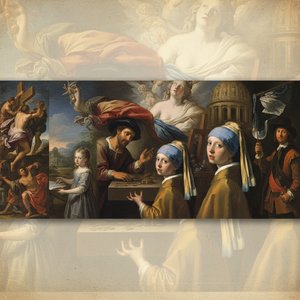
A Moment Suspended: Unveiling Caravaggio’s *The Sacrifice of Isaac*
Caravaggio's 1601 masterpiece, *The Sacrifice of Isaac*, is a visceral and profoundly moving depiction of one of the most dramatic narratives in the Old Testament. Housed within the esteemed Galleria degli Uffizi in Florence, this oil on canvas (104 x 135 cm) continues to captivate viewers with its raw emotionality and revolutionary artistic approach. It’s a painting that transcends mere representation; it strives to capture the very essence of faith, doubt, and agonizing decision—themes that resonate powerfully across centuries.
Biblical Narrative & Historical Context
The painting illustrates the biblical story of God’s test of Abraham's faith – a command to sacrifice his beloved son, Isaac. Just as Abraham raises his knife, poised to obey, an angel intervenes, halting the act and providing a ram for sacrifice in its place. Created during the Counter-Reformation, Caravaggio’s interpretation resonated with the era’s emphasis on religious fervor and personal piety. However, unlike earlier depictions that often glorified the divine intervention, Caravaggio focuses intensely on the *human* drama of the moment – Abraham's internal struggle and Isaac’s vulnerability. This deliberate choice to portray not triumphant piety but agonizing conflict distinguishes Caravaggio from his contemporaries and elevates *The Sacrifice of Isaac* to a pinnacle of Baroque psychological realism. The painting speaks directly to the viewer, inviting contemplation on moral dilemmas and the complexities of religious belief.
A Masterclass in Baroque Realism
Caravaggio’s style is immediately recognizable for its dramatic realism and groundbreaking use of light and shadow—a technique known as *tenebrism*. He eschewed idealized forms, instead portraying his figures with unflinching honesty, revealing their age, imperfections, and emotional turmoil. This departure from Mannerist conventions was revolutionary. The composition isn't grand or sweeping; it’s intimate and claustrophobic, drawing the viewer directly into the heart of the scene. Consider the deliberate positioning of Abraham and Isaac—their bodies crammed into a small space, mirroring the compressed emotional landscape of the narrative. Caravaggio’s masterful manipulation of light creates an unsettling theatrical effect, highlighting key details while plunging much of the canvas into darkness – a technique designed to heighten tension and evoke profound feelings of sorrow and apprehension.
Decoding the Artistic Technique
- Chiaroscuro & Tenebrism: The stark contrast between intensely lit areas and deep shadows isn’t merely aesthetic; it amplifies the emotional tension, focusing our attention on Abraham's hand with the knife and Isaac’s resigned expression. It creates a theatrical spotlight effect that draws the eye to the central action.
- Naturalistic Detail: Note the meticulous rendering of textures – the rough fabric of Abraham’s clothing, the smooth skin of Isaac, and even the subtle details of their hands. This commitment to realism grounds the scene in tangible reality, mirroring Caravaggio's fascination with observing human anatomy and portraying it with unprecedented accuracy.
- Compositional Focus: The figures are tightly grouped, almost filling the canvas, which amplifies the sense of immediacy and psychological pressure. The angel’s arm, reaching down from the darkness, acts as a powerful diagonal line that disrupts the impending act—a compositional element designed to convey both divine intervention and human vulnerability.
- Direct Observation: Caravaggio famously worked directly from life models, eschewing preparatory sketches. This approach lends an unparalleled authenticity to his figures, capturing their physicality and emotional expressions with remarkable sensitivity.
Symbolism & Emotional Resonance
Beyond the literal depiction of the biblical story, *The Sacrifice of Isaac* is rich in symbolism. Abraham’s aged face and hesitant posture suggest not triumphant faith, but agonizing internal conflict—a reflection of humanity's struggle to reconcile divine command with personal compassion. Isaac’s youthful vulnerability underscores the tragedy of the potential loss—a poignant reminder of innocence threatened by forces beyond human control. The angel isn’t portrayed as a radiant being, but as a human figure emerging from shadow – a subtle yet powerful representation of divine intervention that feels both immediate and relatable.
The painting evokes feelings of fear, sorrow, faith, and ultimately, relief—a testament to Caravaggio's ability to convey profound emotional depth through masterful artistic technique.
A Lasting Legacy & Collecting Considerations
*The Sacrifice of Isaac* is a cornerstone of Baroque art, profoundly influencing generations of artists. Its dramatic intensity, psychological depth, and innovative technique continue to inspire awe and admiration. For collectors and interior designers seeking a statement piece that embodies both artistic mastery and emotional power, a high-quality reproduction of this work offers an opportunity to bring a fragment of art history into any space. The painting’s somber palette and powerful imagery lend themselves well to a variety of interiors, adding depth and sophistication to both traditional and contemporary settings—a timeless masterpiece deserving of careful consideration and thoughtful display.
Photo Description: --Overall Impression-- The artwork is a dramatic oil painting depicting the biblical scene of Isaac's sacrifice by his father Abraham. It’s characterized by intense emotionality and a stark realism typical of Caravaggio’s style. The composition is dynamic, with figures clustered closely together in the foreground, creating a sense of immediacy and urgency. Light plays a crucial role, dramatically illuminating the central action while casting deep shadows that heighten the scene's tension. Lines are used to define strong contours and create a sense of volume, particularly in the figures’ musculature and drapery. Shapes are predominantly organic – human forms, animal shapes (the ram), and natural elements like trees and mountains. Textures appear smooth due to the oil paint technique, but there is also a visible layering that contributes to the depth. The lighting is chiaroscuro, with strong contrasts between light and dark areas, emphasizing key details and creating a theatrical effect. Perspective is somewhat flattened, focusing on the immediate action rather than strict spatial realism. Depth is suggested through atmospheric perspective – distant elements are rendered in paler tones. The subject matter is religious and symbolic, representing faith, obedience, and divine will. Symbolic elements include the ram offered as a substitute for Isaac, highlighting Abraham’s willingness to sacrifice his son. Emotionally, the painting evokes feelings of fear, sorrow, faith, and acceptance. The style is Baroque, emphasizing drama and emotional intensity. The technique involves meticulous brushwork and layering of oil paint to achieve rich colors and textures. Materials used are primarily oil paints on canvas.
Size: 104 x 135 cm
Date: 1601
ARTIST INFORMATION:
==================
Artist: Caravaggio
Birth Year: 1571
Death Year: 1610
Birth City: Milan
Birth Country: Spain
Biography: Michelangelo Merisi da Caravaggio (also Michele Angelo Merigi or Amerighi da Caravaggio; September 29, 1571 – July 18, 1610) was an Italian painter active in Rome for most of his artistic life. During the final four years of his life, he moved between Naples, Malta, and Sicily. His paintings have been characterized by art critics as combining a realistic observation of the human state, both physical and emotional, with a dramatic use of lighting, which had a formative influence on Baroque painting. Caravaggio employed close physical observation with a dramatic use of chiaroscuro that came to be known as tenebrism. He made the technique a dominant stylistic element, transfixing subjects in bright shafts of light and darkening shadows. Caravaggio vividly expressed crucial moments and scenes, often featuring violent struggles, torture, and death. He worked rapidly with live models, preferring to forgo drawings and work directly onto the canvas. His inspiring effect on the new Baroque style that emerged from Mannerism was profound. His influence can be seen directly or indirectly in the work of Peter Paul Rubens, Jusepe de Ribera, Gian Lorenzo Bernini, and Rembrandt. Artists heavily under his influence were called the “Caravaggisti” (or “Caravagesques”), as well as tenebrists or tenebrosi (“shadowists”). Caravaggio trained as a painter in Milan before moving to Rome when he was in his twenties. He developed a considerable name as an artist and as a violent, touchy and provocative man. He killed Ranuccio Tommasoni in a brawl, which led to a death sentence for murder and forced him to flee to Naples. There he again established himself as one of the most prominent Italian painters of his generation. He travelled to Malta and on to Sicily in 1607 and pursued a papal pardon for his sentence. In 1609, he returned to Naples, where he was involved in a violent clash; his face was disfigured, and rumours of his death circulated. He died in 1610 under uncertain circumstances while on his way from Naples to Rome. Reports stated that he died of a fever, but suggestions have been made that he was murdered or that he died of lead poisoning. Caravaggio's innovations inspired Baroque painting, but the latter incorporated the drama of his chiaroscuro without the psychological realism. The style evolved and fashions changed, and Caravaggio fell out of favour. In the 20th century, interest in his work revived, and his importance to the development of Western art was reevaluated. The 20th-century art historian André Berne-Joffroy stated: “What begins in the work of Caravaggio is, quite simply, modern painting.”



 Previzualizare
 Comandă versiunea tipărită
 Trimite
 Distribuie
 Detalii despre lucrare

 Descarcă
 Produse similare
 Radiografie
 Diapozitive automate


 Vezi mai mult






































 Opțiunea cu sticlă este disponibilă doar pentru dimensiuni de sub 110 cm