Atelier — Livrare gratuită în întreaga lume — Livrare în 2–6 săptămâni

      Edouard Cortès

      1882 - 1969

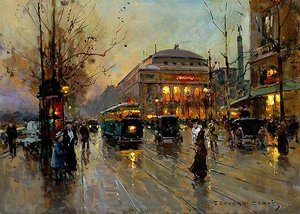
      Edouard Cortès (1882–1969) a pictat Piața Bastille, Paris, cea mai cunoscută pânză dintr-un catalog de 212 lucrări.

      Pe scurt

      • Room fit: living room
      • Creative periods: mature period
      • Color intensity:
        • echilibrat
        • monocromatic
      • Nationality: Franța
      • Also known as:
        • Edouard Leon Cortes
        • Edouard Leon Cortés
        • Edouard Cortes
        • Leon Edouard Cortes
        • Edouard Cortès
      • Vibe: nostalgic
      • Top 3 works:
        • Piața Bastille, Paris
        • Theatre du Chatelet
        • Flower Market At La Madeleine
      • Art period: Era modernă

      Care este cea mai celebră pictură a lui Edouard Cortès?

      Piața Bastille, Paris este pictura cea mai asociată cu Edouard Cortès; de asemenea, sunt cunoscute și: Bouquinistes.

      The Parisian Poet: A Life in Light and Shadow

      Édouard Léon Cortès, affectionately known as “Le Poète Parisien de la Peinture” – the Parisian Poet of Painting – wasn’t born into the glittering world he would so vividly capture on canvas. His origins lay in Lagny-sur-Marne, a quiet town east of Paris, where he arrived on August 6th, 1882. Though France was his birthplace, artistic lineage flowed through his veins from his Spanish father, Antonio Cortés, a painter who had once served the Spanish Royal Court. This heritage instilled within young Édouard an early appreciation for artistry and a dedication to honing his skills. He began formal studies at the École des Beaux-Arts in Paris at just seventeen, immersing himself in the techniques of the masters while simultaneously forging his own distinct path. Even then, Cortès possessed a fiercely independent spirit, playfully rebuffing suggestions that he was merely a student of any particular master, declaring himself “a student of myself only.” This self-reliance would become a hallmark of his career and artistic vision.

      Capturing the Soul of Paris

      Cortès’s name became synonymous with Parisian cityscapes. He didn't simply paint buildings; he painted atmospheres – the soft glow of gas lamps on rain-slicked cobblestones, the bustling energy of boulevards teeming with life, the quiet intimacy of a café scene unfolding under a hazy sky. His work wasn’t about grand monuments or historical events, but rather the everyday poetry of Parisian existence. He possessed an uncanny ability to capture fleeting moments – a shaft of sunlight illuminating Notre Dame, the vibrant colors reflected in puddles after a shower, the hushed anticipation before a performance at the Opera. These weren't idealized visions; they were honest portrayals of a city brimming with life, beauty, and a touch of melancholy. His palette favored muted tones, skillfully blended to evoke mood and atmosphere, often employing shades of gray, blue, and ochre that perfectly mirrored the Parisian climate. He wasn’t interested in radical experimentation or abstract forms; his focus remained steadfastly on representing the world as he saw it – beautiful, transient, and deeply evocative. His paintings are not mere depictions of places but windows into a specific feeling, a particular moment in time.

      A Soldier's Brush: War and Resilience

      The idyllic world Cortès painted was shattered by the outbreak of World War I. Despite being a committed pacifist, duty called, and at the age of thirty-two, he enlisted in the French Infantry Regiment. The horrors of war profoundly impacted him, yet even amidst the chaos and destruction, his artistic spirit endured. Wounded early in the conflict, he was reassigned to utilize his talent for sketching, tasked with mapping enemy positions. This experience, though harrowing, likely sharpened his observational skills and deepened his appreciation for the fragility of life – themes that would subtly permeate his later work. He refused the Légion d'Honneur offered by the French Government, a testament to his unwavering pacifist beliefs. Personal tragedy also struck during this period; his first wife, Fernande Joyeuse, passed away in 1918, leaving him with their daughter, Jacqueline Simone. He later married Fernande’s sister, Lucienne Joyeuse, finding solace and companionship amidst the lingering shadows of war.

      Influences and Artistic Kinship

      While Cortès developed a uniquely personal style, echoes of other masters can be discerned within his work. The atmospheric effects and subtle play of light recall the Impressionists, particularly Camille Pissarro and Alfred Sisley. However, he lacked their focus on pure optical sensation, instead prioritizing narrative and emotional resonance. Post-Impressionist artists like Eugène Boudin also influenced his approach to capturing fleeting moments and atmospheric conditions. *His dedication to depicting everyday life aligns him with Realist painters*, yet his romanticized vision of Paris elevates his work beyond mere documentation. He wasn’t attempting to replicate reality precisely; he was striving to capture its essence, its mood, its poetry. Artists like Frederick Soulacroix and Paul Gauguin, though distinct in their styles, shared Cortès's fascination with capturing the spirit of a place and its people, imbuing their canvases with a sense of atmosphere and emotion. His legacy lies not in revolutionizing painting but in perfecting a particular vision – a deeply personal and profoundly moving portrayal of Paris that continues to resonate with audiences today.

      Major Achievements and Recognition

      Cortès’s career spanned several decades, during which he gained considerable recognition both in France and abroad. His early Salon successes established him as a promising young artist, and his work was exhibited extensively throughout Europe. Following the war, he achieved international acclaim, with exhibitions held in North America in 1945. His distinctive style – characterized by its atmospheric perspective, subtle color palettes, and evocative depictions of Parisian life – quickly gained admirers. In 1969, in his final year of life, he received the prestigious Prix Antoine-Quinson from the Salon de Vincennes – a fitting tribute to a lifetime dedicated to artistic expression. His paintings continue to be highly sought after by collectors and art enthusiasts worldwide, serving as enduring reminders of Paris’s beauty and charm.

      A Lasting Legacy

      Edouard Léon Cortès died on November 26th, 1969, in Lagny-sur-Marne, leaving behind a vast body of work that continues to captivate art lovers. A street in his hometown bears his name, ensuring that his artistic legacy will endure for generations to come. His paintings are not simply decorative objects; they are windows into a bygone era – glimpses of a Paris that exists now primarily through his evocative and enduring art. He remains a testament to the power of observation, the beauty of simplicity, and the ability of art to capture the soul of a city.

      Un scurt chestionar

      Fiecare întrebare are un singur răspuns corect.

      Întrebare 1:
      Care este numele artistic cel mai cunoscut al lui Edouard Cortès?
      Întrebare 2:
      În ce oraș s-a născut Edouard Cortès?
      Întrebare 3:
      În timpul cărui război a servit Edouard Cortès în armata franceză, deși era pacifist?
      Întrebare 4:
      Ce premiu prestigios a primit Edouard Cortès în ultimul său an de viață?
      Întrebare 5:
      La ce se dedică Edouard Cortès prin picturile sale?

      Întrebări și răspunsuri

      Există un tur virtual 3D al operelor lui Edouard Cortès?

      Unde și când s-a născut Edouard Cortès?

      Edouard Cortès s-a născut în Lagny-sur-Marne, în anul 1882.

      Opera lui Edouard Cortès face parte din domeniul public?

      Nu. Lucrările lui Edouard Cortès sunt încă protejate de drepturile de autor.

      Ce tehnici de lucru a folosit Edouard Cortès?

      Lucrările lui Edouard Cortès prezentate pe acest site sunt realizate în principal în ulei pe pânză.

      Unde pot găsi informații despre opera Piața Bastille, Paris a lui Edouard Cortès?

      Fapte despre Piața Bastille, Paris sunt prezentate într-un ghid de studiu care poate fi tipărit.

      Din ce epocă face parte Edouard Cortès?

      Edouard Cortès a activat în perioada Era modernă. Această perioadă situează activitatea artistului în context istoric.

      Cât de mult a trăit Edouard Cortès?

      Edouard Cortès a trăit aproximativ 87 ani, de la 1882 până la 1969.

      În ce stil a pictat Edouard Cortès?

      Edouard Cortès a pictat în stilul Post-impressionism, la fel ca ceilalți artiști celebri ai Post-impressionism.

      Pentru care picturi este cunoscut(ă) Edouard Cortès?

      Edouard Cortès este cunoscut pentru operele incluse în cele mai celebre picturi ale lui Edouard Cortès.